Author: l0cknsec

  • NavigateAI Returns After 4 Years — Eric Wu Takes Direct Aim at the Construction Labor Crunch

    NavigateAI Returns After 4 Years — Eric Wu Takes Direct Aim at the Construction Labor Crunch

    Key Takeaways

    • Eric Wu ran Opendoor for eight years before stepping away in 2022 amid a sharp interest rate hike.
    • After a year-long break, he judged AI to be the most decisive technology platform of his life and re-entered the startup world, saying, “I would have regretted it if I weren’t working on something AI-related in 10 years.”
    • His new company, unveiled in May 2026 after coming out of stealth mode, is NavigateAI, which is developing an AI copilot for construction laborers and field workers.

    Analysis — The strategic significance of a successful first-generation PropTech founder (Opendoor) choosing a traditional industry (construction) as his four-year comeback stage, and an assessment from the funding, market, and policy angles of whether AI can solve the structural problem of skilled labor shortages.

    Table of Contents

    Start with the number: “349,000.” That is how many additional workers the U.S. construction industry estimates it needs to secure this year — a figure from the Associated Builders and Contractors. NavigateAI is the company that stepped into the spotlight in May 2026 to target this gap.

    The Market NavigateAI Is Targeting — 349,000 Empty Seats

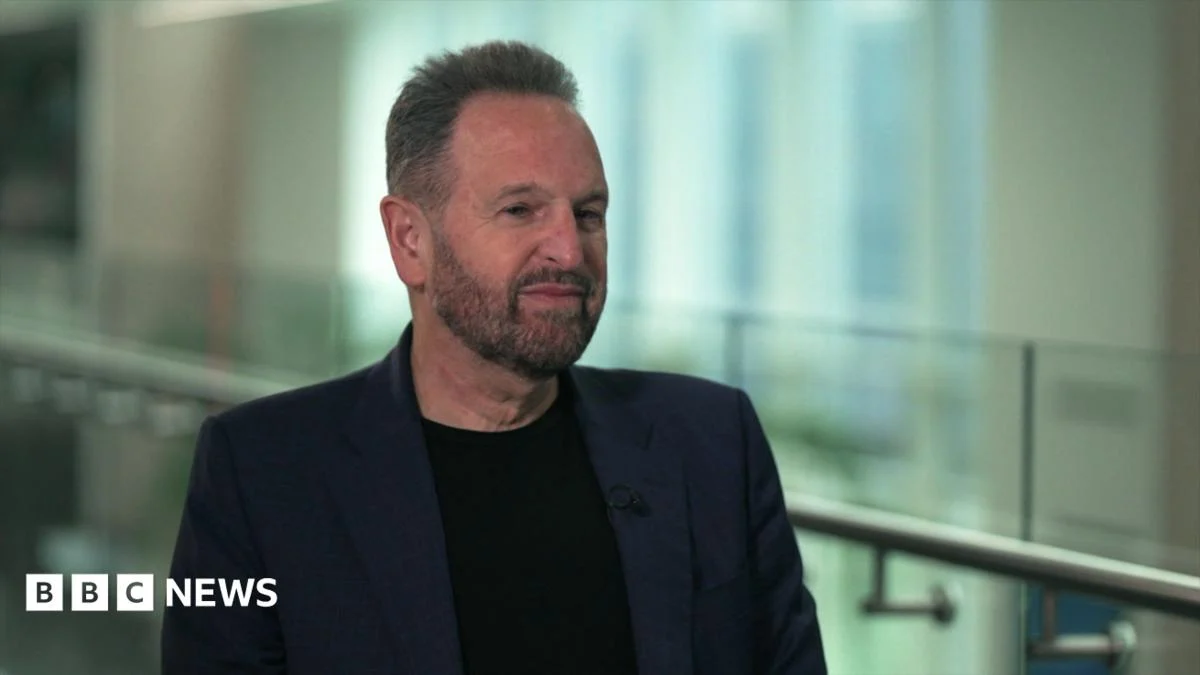
    After running Opendoor for eight years and leaving in 2022 amid the rate shock, Eric Wu took a year off and then returned to the startup arena. The statement, “I would have regretted it if I weren’t working on something AI-related in 10 years,” was the driving force behind his move. The NavigateAI he built delivers real-time, hands-free step-by-step guidance to construction field workers via smartphones and Meta AI Glasses. Wu himself defined it as “a hands-free expert coach for people who make things with their bodies.”

    The causes of the labor shortage are not simple. The aging of skilled workers and tightened immigration enforcement have reduced the supply of foreign labor. On top of this, the AI industry’s expansion has driven new data center construction, creating job sites that require 4,000–5,000 workers per single project. The irony is deepening every year: the people who build the spaces where AI lives are themselves in short supply.

    NavigateAI’s Solution — How the Hands-Free AI Copilot Works

    The core of NavigateAI is “see it, answer it instantly.” When a worker points their glasses or smartphone camera at the current task, the AI guides the next step through voice and visuals. The difference from a generic AI assistant is that it is designed under the assumption of a job-site environment with noise, dust, and vibration.

    In my view, the key question is how the model absorbs the field constraints that generic AI misses. Even within the same trade, state building codes, OSHA safety standards, and worker skill levels all differ. If NavigateAI cannot absorb these variables to deliver step-by-step guidance, the tool ends up being no different from a YouTube video.

    NavigateAI’s $25M Funding — What Lennar Is Betting On

    The first funding round, totaling $25 million, was raised from Elad Gil, Khosla Ventures, Lennar, and others. The participation of Lennar, a major U.S. homebuilder, signals that NavigateAI is viewed not as a generic AI tool, but as a solution directly linked to the job site within the housing, real estate, and construction value chain.

    The reason I find this point most meaningful is that the homebuilder isn’t just putting up capital — it is committing to bringing the “jobsite” along. Lennar’s new developments are likely to effectively serve as NavigateAI’s testbed, creating a structure where sales, validation, and data labeling all run in parallel.

    Investor Type Implication
    Elad Gil Individual VC Signal of a proven AI startup lineup
    Khosla Ventures VC Expanding PropTech and construction tech portfolio
    Lennar Strategic investor (homebuilder) Potential for direct on-site validation and value chain integration

    Key Issues Summary

    • NavigateAI is a B2B tool designed on top of an explicit demand: a 349,000-worker shortfall.
    • The 4,000–5,000-worker demand per single project driven by the data center boom acts as a market-expansion variable.
    • Homebuilder Lennar’s funding participation suggests an attempt at simultaneous on-site adoption, not just capital provision.
    • Remaining challenges include the accuracy of AI guidance, liability for industrial accidents, and the barriers to adopting wearable devices in the field.

    What to Do Right Now

    • If you’re a site manager, test a smartphone-based AI guide on a single pilot trade (e.g., rebar placement) for 30 days to measure accuracy and adoption.
    • If you’re in construction R&D, pre-check PPE compatibility and safety certification issues for wearable devices like Meta AI Glasses.
    • If you’re an investor, group and compare NavigateAI with workforce pool or marketplace companies capable of supplying 4,000–5,000 workers to a single site.
    • If you run a startup, position your offering as a distinct category targeting “people who make things with their bodies” — not a generic AI assistant.

    Wu said his goal is not to replace people, but to help the same people finish more work safely. The moment that statement translates into actual on-site KPIs (output, rework rate, accident rate) will be the true validation point for NavigateAI.

    Frequently Asked Questions

    What is NavigateAI?

    NavigateAI is the company unveiled in May 2026 by Opendoor founder Eric Wu after coming out of stealth. It develops an AI copilot for construction field workers, delivering step-by-step hands-free guidance through smartphones and Meta AI Glasses.

    Why is the U.S. construction industry short on labor?

    The aging of skilled workers, reduced foreign labor supply due to tightened immigration enforcement, and the increase in large-scale projects like data centers are all converging. An estimated 349,000 additional workers are needed this year alone.

    What is the size of NavigateAI’s funding and who are the investors?

    NavigateAI raised $25 million from Elad Gil, Khosla Ventures, Lennar, and others. Lennar, a major U.S. homebuilder, participated, suggesting direct integration with the construction value chain.

    Can the AI copilot solve the skilled labor shortage?

    There is significant room to boost productivity by enabling less-skilled workers to follow step-by-step guidance. However, the company must simultaneously address challenges around the accuracy of AI guidance, liability for industrial accidents, and barriers to adopting wearable devices.

    Reference: Original TechCrunch interview with Eric Wu

    Reference

    This article was written after reviewing the following original: TechCrunch — Eric Wu’s newest company, out of stealth since May, is going after construction’s labor crunch
  • MiniCPM5-2B: OpenBMB’s 2.5B Model Hits 53.9 Average Across 34 Benchmarks, Redefining On-Device LLM Standards

    MiniCPM5-2B: OpenBMB’s 2.5B Model Hits 53.9 Average Across 34 Benchmarks, Redefining On-Device LLM Standards

    Key Summary

    • MiniCPM5-2B is a dense causal language model with 2,516,756,480 parameters (1,981,982,720 excluding embeddings), adopting 42 layers and grouped-query attention (16 query heads, 2 key/value heads).
    • The native context window is 131,072 tokens, and because the architecture is standard LlamaForCausalLM, it runs on vLLM, SGLang, Transformers, llama.cpp, Ollama, LM Studio, MLX, and FlagOS without custom kernels or model code forks.
    • Licensed under Apache 2.0, it is benchmarked against same-class peers such as LFM2.5-2.6B, Qwen3.5-2B, and Gemma-4-E2B-it, with references including Qwen3.5-4B (51.1), granite-4.2-3B (42.7), and LFM2.5-2.6B (33.2).

    Analysis

    Table of Contents

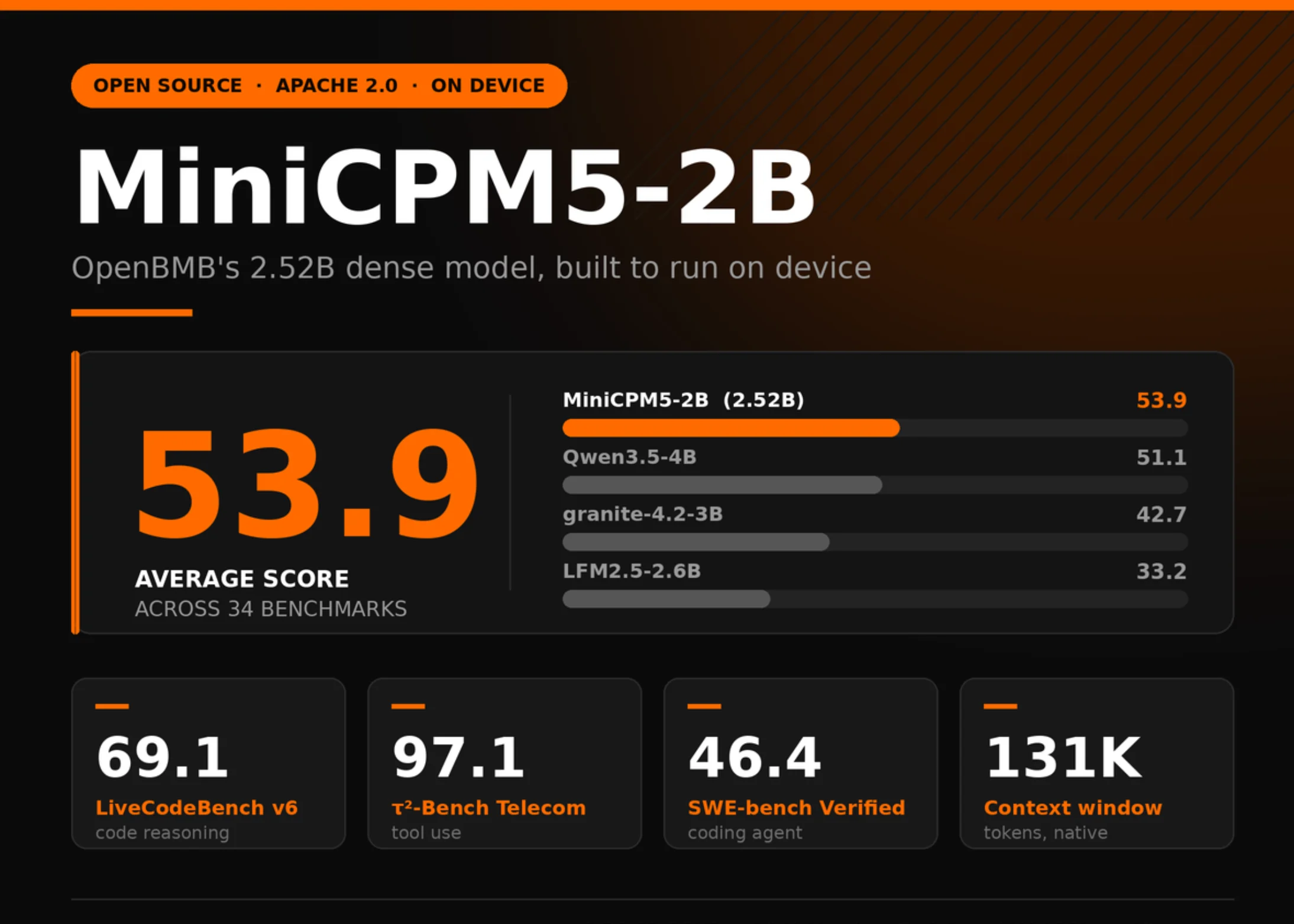
    MiniCPM5-2B debuted on September 7 with a spec sheet of 2,516,756,480 parameters and a native context window of 131,072 tokens. Its 53.9 average across 34 benchmarks is 2.8 points ahead of the best same-lineup baseline, Qwen3.5-4B at 51.1. With less than half the parameters, it posts a higher overall score. For the author, the real significance of this model lies in numerically proving that “small doesn’t mean incapable.”

    MiniCPM5-2B Architecture: Standard Llama Fork for Instant Compatibility with 8 Inference Engines

    MiniCPM5-2B is a dense causal language model with 42 layers and grouped-query attention (16 query heads, 2 key/value heads). Excluding embeddings, it has 1,981,982,720 parameters. The key point is that the architecture is standard LlamaForCausalLM. Eight inference engines—vLLM, SGLang, Transformers, llama.cpp, Ollama, LM Studio, MLX, and FlagOS—run it as-is, without custom kernels or model code forks. Combined with the Apache 2.0 license, this makes it one of the lowest-friction options for teams looking to deploy a 2–3B-class model in real services.

    What the 53.9 Average Across 34 Benchmarks Means for MiniCPM5-2B

    The single score of 53.9 alone doesn’t tell the full story. Broken down by domain, MiniCPM5-2B’s character becomes clearer. The same-class comparison set includes LFM2.5-2.6B, Qwen3.5-2B, and Gemma-4-E2B-it, while reference points include Qwen3.5-4B (51.1), granite-4.2-3B (42.7), and LFM2.5-2.6B (33.2). The overall 53.9 is the highest figure in this reference pool.

    Benchmark MiniCPM5-2B Best Baseline Gap
    34-benchmark overall average 53.9 Qwen3.5-4B 51.1 +2.8
    LiveCodeBench v6 69.1 56.4 +12.7
    SWE-bench Verified 46.4 33.6 +12.8
    τ²-Bench Telecom 97.1 — —
    BFCL v4 66.6 — —
    τ³-Bench Banking 20.8 6.8 +14.0
    NoLiMa 68.1 43.5 +24.6
    AA-LCR 59.0 61.0 −2.0
    LongBench v2 43.7 47.3 −3.6
    MMLU-Pro 70.8 78.0 −7.2
    Humanity’s Last Exam 8.9 9.9 −1.0

    Strengths: Dominating the Baseline in Code Reasoning and Tool Use

    The largest gap is in code. MiniCPM5-2B scored 69.1 on LiveCodeBench v6 and 46.4 on SWE-bench Verified, beating the baseline of 33.6 by 12.8 points. A 2.5B model hitting 46.4 on SWE-bench means it achieves nearly a 50% success rate on tasks that go beyond simple code completion to include multi-turn debugging.

    Tool use is even steeper. The τ²-Bench Telecom score of 97.1 is essentially near-perfect, and BFCL v4 at 66.6 and τ³-Bench Banking at 20.8 (baseline 6.8) also far exceed what you’d expect from a 2.5B-class model in function calling and routing. These numbers most directly demonstrate that MiniCPM5-2B is a credible candidate for real agent workloads.

    Trade-offs: Long-Context Variability by Benchmark and General-Knowledge Limits

    It doesn’t lead on every metric. Long-context results vary by benchmark. On NoLiMa (68.1 vs. baseline 43.5) it leads by 24.6 points, but on AA-LCR (59.0 vs. 61.0) and LongBench v2 (43.7 vs. 47.3) it actually trails. Even with a 131K-token window, there are areas where measured accuracy falls short of the baseline.

    General knowledge shows a similar pattern. MMLU-Pro (70.8 vs. 78.0) and Humanity’s Last Exam (8.9 vs. 9.9) are both slightly behind. It’s natural that a model with roughly half the parameters can’t beat a 4B-class model on broad factual recall, so it’s more accurate to view MiniCPM5-2B not as an “all-rounder” but as a “coding- and agent-specialized compact model.”

    Training Pipeline: UltraData → 400B SFT → JustRL II → 16-Expert Distillation

    Behind these scores lies a staged training design. Base training ran in stable and decay phases using UltraData’s hierarchical data management, followed by 400B-token deep-thinking SFT after mid-training. The RL stage covered four separate domains—math, code, agentic, and writing—with a critic-based teacher called JustRL II guiding the training. The pipeline finishes with on-policy distillation that merges 16 expert models into a single checkpoint.

    The model card separately labels rows from Artificial Analysis and internal reproductions, proactively flagging evaluation-consistency issues—a sign that reproducibility was a deliberate priority.

    What to Try Right Now

    • Download MiniCPM5-2B via Ollama or llama.cpp and measure inference latency directly on a Mac or a single RTX 3090 GPU.
    • Pick 30 coding problems from your own domain, run multi-turn debugging, and compare response quality against Qwen3.5-2B and Gemma-4-E2B-it.
    • Build 10 BFCL-style function-calling scenarios and re-evaluate tool-use accuracy against your in-house data.
    • Stuff 50K tokens of internal documents into the 131K context and check retrieval and summarization accuracy yourself, just like NoLiMa, AA-LCR, and LongBench.
    • Confirm Apache 2.0 applicability with your legal team and verify there are no licensing risks around your in-house fine-tuning data.

    Practical Application Notes

    • When evaluating 2–3B-class models, don’t rely on a single overall average—weight domain benchmarks like LiveCodeBench, SWE-bench, and BFCL into your scoring.
    • If you’re considering MiniCPM5-2B for agent workloads, validate function-calling routing separately. Don’t assume the τ²-Bench 97.1 score generalizes to your case.
    • If long context is critical, judge models on measured benchmarks like AA-LCR and LongBench rather than the 131K window size alone.
    • For on-device deployment, note that the grouped-query attention’s 2 key/value head configuration keeps attention cache memory small but can lower batch throughput, so measure per scenario.
    • Once licensing is cleared, the practical sequence is to stand up a first baseline with vLLM or SGLang, then bolster weak areas with JustRL II-style RL fine-tuning.

    Frequently Asked Questions

    Can MiniCPM5-2B be used directly in commercial projects?

    The Apache 2.0 license permits both commercial use and redistribution. However, responsibility for the model’s outputs rests with the user, so it’s safer to decide on adoption after domain-specific evaluation.

    A 2.5B model scores higher than Qwen3.5-4B—is it really usable?

    The 53.9 average across 34 benchmarks is real. But the lead is concentrated in code and tool use, while it trails by more than 7 points on general-knowledge benchmarks like MMLU-Pro. You’ll need to re-weight the evaluation by domain.

    Does MiniCPM5-2B actually run on-device?

    Yes—because it’s standard LlamaForCausalLM, it runs out of the box on llama.cpp, Ollama, LM Studio, and MLX. In practice, though, it’s more realistic to use 8K–32K slices than the full 131K context on mobile.

    Is there a reason to migrate from previous MiniCPM models?

    Context window and code/agent scores have both been lifted compared to the previous generation. For new projects, start with MiniCPM5-2B; for existing systems, compare token usage and response latency before migrating gradually.

    The original source material was verified via MarkTechPost’s MiniCPM5-2B coverage. Comparison-group information referenced the same outlet’s IFM K2 Horizon launch article.

    Reference Sources

    This article was written after checking the following original sources: MarkTechPost — OpenBMB Releases MiniCPM5-2B: A 2.52B Dense Model Averaging 53.9 Across 34 Benchmarks and Built to Run On Device

  • AI Cancer Treatment Could Become Reality Within 5 Years — Arm CEO Diagnoses the Chip Shortage Wall

    AI Cancer Treatment Could Become Reality Within 5 Years — Arm CEO Diagnoses the Chip Shortage Wall

    Key Takeaways

    • Arm Holdings CEO Rene Haas argued in a BBC interview that AI could discover cancer treatments humans would never find in a lifetime
    • Haas explained that modeling how DNA markers affect cancer remains “too complex a problem” for both humans and AI computers today
    • Haas diagnosed that the current rapid growth of AI is being held back by a shortage of chips needed to build data centers

    The CEO of the world’s leading semiconductor design firm simultaneously diagnosed both AI’s potential for medical and industrial innovation and the structural bottleneck of chip shortages, offering an analysis of where the UK tech industry stands and its policy implications

    Table of Contents

    AI cancer treatment could uncover molecules that human researchers would never reach in an entire career. That statement, made by Arm Holdings CEO Rene Haas in a BBC interview, is neither optimism nor pessimism—it is a diagnosis built on two hard constraints: data scarcity and chip bottlenecks.

    This past summer, when the AI boom pushed Arm’s stock to an all-time high, the company became the most valuable UK-headquartered firm on a cash basis in history. Arm is a design house that does not manufacture. That fact lends the cool-headed precision of an engineer to Haas’s remarks. When a company that designs CPUs for tens of billions of devices worldwide—phones, cars, smartwatches, gadgets—diagnoses the limits of AI infrastructure, that is not an abstract concern but a reality measured down to the part number.

    The Potential and Limits of AI Cancer Treatment, According to Haas

    On BBC’s “Big Boss Interview” podcast, Haas acknowledged that modeling how DNA markers influence cancer expression is “too complex a problem” for today’s human researchers—and for AI computers as well. But his vision is that the moment one end of that complexity unravels, AI-generated cancer treatment candidates that humans would never have found in a lifetime could appear on screen.

    Prof Chris Bakal of the Institute of Cancer Research (CEO of Sentinal4D) gave the same answer to the BBC. Cancer is a system in which the genome, microenvironment, and time axis are intertwined, and from that perspective, AI’s pattern recognition has room to accelerate research. This is where I find the most significance. In an industry where drug pipelines move on a ten-year timescale, automating molecular-level simulation is a narrative that flips the cost structure itself.

    How Far Can the AI Cancer Treatment Timeline Be Compressed?

    The compression of timelines that AI cancer treatment could bring is most visible at the candidate discovery stage. Conventional drug development takes an average of 10 to 15 years from candidate identification through Phase III clinical trials, but a conservative estimate is that if AI narrows the search space, the preclinical stage could be shortened to a matter of months. Patient recruitment, regulatory approval, and side-effect verification during the clinical stage, however, still consume the same amount of time and cost. In other words, what AI accelerates is “research,” not “approval.”

    The Data Center Bottleneck Created by Chip Shortages

    Haas was unequivocal: AI’s growth is being hobbled by a shortage of semiconductors needed to expand data centers. The supply chains for GPUs and high-bandwidth memory (HBM) cannot keep up with demand, pushing back timelines for new data center construction. From a practitioner’s perspective, what stands out is that Arm cannot solve this bottleneck directly. Arm is a CPU design house, while the GPU and HBM markets are dominated by NVIDIA, AMD, and SK Hynix. There is weight in the fact that the person who understands “no one knows how to make the chips” best is the one making that statement.

    Arm’s Market Position and the SoftBank-OpenAI Structure

    Arm’s parent company, Japan’s SoftBank, bundles together a variety of technology investments, including OpenAI. Haas’s perspective reflects the globally diversified strategy of Japanese capital. The infrastructure investment chain running from OpenAI through Brainwave to London and Stargate is a direct beneficiary path for Arm’s design demand. This past summer, Arm overtook the shale companies within the FTSE 100 to claim the top spot as the most valuable UK-headquartered firm (on a cash basis) in history. It is a signal flare that the design industry is being revalued.

    Humanoid Robots in 5 Years: Optimistic Timeline, Pessimistic on UK Manufacturing

    Haas predicted that humanoid robots would become commonplace within the next five years. His calculation is that once bipedal platforms are commercialized in mobility, logistics, and household applications, the low-power CPU demand inside them becomes Arm’s next growth engine. On the other hand, he is pessimistic about the possibility of chip manufacturing within the UK. Looking at TSMC Arizona, Intel Ohio, and Samsung’s new Texas plant alone, building an advanced-node fab requires tens of billions of dollars in capital. The UK government’s semiconductor strategy is centered on R&D subsidies, and there are clear limits to securing a large-scale manufacturing base. This past April, Haas also stepped down from the board of UK pharmaceutical giant AstraZeneca. The move appears to be due to differences in decision-making speed between AI healthcare startups and other large pharmaceutical companies.

    Global Advanced-Node Investment Comparison

    Region Key Project Investment Phase Notes
    Arizona, USA TSMC Fabs 1–3 Fab 1 operational, Fabs 2–3 under construction 3nm node
    Ohio, USA Intel New Fab Early construction Up to 1.4nm
    Texas, USA Samsung Taylor Partial operation 4nm node
    Cambridge, UK Arm R&D Headquarters Design hub No manufacturing
    Kumamoto, Japan TSMC JASM Fab 1 operational, Fab 2 under construction 12–6nm

    As the table shows, the UK is strong in design capabilities, but there is still a gap to achieving self-sufficient manufacturing infrastructure. This numerically supports Haas’s diagnosis.

    Key Issues

    • The essence of AI cancer treatment is accelerating drug candidate discovery, not short-term innovation at the point of diagnosis or treatment
    • The chip shortage is a training infrastructure bottleneck centered on GPUs and HBM, and Arm is a design house that cannot resolve it directly
    • For UK semiconductor self-sufficiency, fab construction capital and supply chain security are bigger variables than policy will
    • The commercialization timeline for humanoid robots requires simultaneous maturity across three axes: batteries, actuators, and software
    • Arm’s UK-headquartered valuation is read as a signal that the stock market is revaluing the design industry

    What to Do Right Now

    • Convert Arm’s quarterly stock price into relative return against the FTSE 100 to capture the six-month trend
    • Listen to the original BBC “Big Boss Interview” podcast to gauge Haas’s tone directly
    • Track weekly data center capex announcements from AI labs such as OpenAI, Anthropic, and xAI
    • Set up alerts for AI cancer treatment industry news and monitor on a quarterly basis
    • Compile new fab construction timelines from TSMC, Intel, and Samsung into a single table and compare with UK investment

    Frequently Asked Questions

    When did Haas give this interview?

    The content was published in autumn 2025 on BBC’s “Big Boss Interview” podcast and accompanying article. The timing coincides with the period following Arm’s all-time stock price high.

    Does Arm conduct AI cancer treatment research directly?

    No. Arm is a chip design house that supplies CPUs for AI infrastructure, and drug R&D is a separate field. Haas’s remarks are closer to a macro-level diagnosis.

    Can the UK manufacture advanced chips?

    Haas himself stated he is pessimistic. The industry consensus is that capital, talent, and supply chains are all lacking compared to TSMC, Intel, and Samsung.

    What does “humanoid robots in 5 years” actually mean?

    It refers to the point at which bipedal robots are deployed in limited forms in households, logistics, and manufacturing sites—not fully autonomous household robots.

    Source: BBC News – Arm CEO Rene Haas Interview

    Source Reference

    This article was prepared after reviewing the following original source: BBC News — AI cancer cures slowed by chip shortage, says UK’s biggest tech boss

  • 3 Major Shifts in Financial Internal Controls — From Post-Audit to Continuous Monitoring

    3 Major Shifts in Financial Internal Controls — From Post-Audit to Continuous Monitoring

    Key Takeaways

    • Cases of financial firm employees unauthorized viewing and private misuse of customer transaction data have surfaced in succession, exposing the structural limits of existing internal control systems.
    • Unauthorized data download incidents caused by negligent management of outsourced development and operations staff have brought the control vacuum over partners and contractors to the forefront.
    • It is increasingly recognized that periodic post-audits based on sampling alone cannot detect sophisticated insider threats in a timely manner.

    A balanced explanatory article analyzing the background of the paradigm shift in financial internal controls, the authorities’ moves toward tighter regulation, and the practical implications of a continuous monitoring framework

    Table of Contents

    An incident that exposed the blind spots of financial internal controls occurred at a commercial bank in 2024. An internal review belatedly revealed that a responsible employee had repeatedly accessed transaction information of roughly 10,000 customers outside of business hours. The information had already leaked externally, and the damage was discovered only by chance before it could grow further. This case starkly demonstrated the reality that periodic sample-based post-audits cannot catch insider threats in a timely manner.

    Since then, financial internal controls have reached a fundamental inflection point. The shift from periodic post-audits to access-log-based continuous monitoring, and from ambiguous executive responsibility to concrete accountability under the accountability map (chaegimgujo-do), is accelerating. According to a Boan News report, a significant share of recently uncovered internal data leak cases occurred through after-hours access and outsourced personnel pathways.

    Structural Limits of Legacy Post-Audits and Sophisticated Insider Threats

    Most financial firms have operated internal controls in the form of monthly or bimonthly sample audits. The approach extracts roughly 0.5–1% of all transactions at random and verifies them after the fact. These structural limits have long been pointed out in financial internal control practice, but they have been difficult to change due to cost and staffing constraints.

    The problem lies in the 99% that falls outside the sample. If an insider deliberately targets blind spots, a sample audit becomes ineffective. Access during off-hours, holidays, or through partner accounts is largely missed by the sample. What concerns me most at this point is that the more sophisticated the insider, the more precisely they understand the common weakness of sample-based audits.

    The shape of insider threats has also changed. Beyond simple curiosity-driven access, cases have emerged involving organized exfiltration, indirect access through outsourced development and operations staff, and even abuse of systems while keeping the perpetrator’s own profile clean. A 2023 incident in which a card company contractor downloaded customer information is a representative example, with the absence of permission management cited as the direct cause.

    Regulatory Tightening: The Accountability Map and Two Major Legislative Amendments

    Financial authorities are reshaping the regulatory framework in line with this reality. The central keyword is the accountability map (chaegimgujo-do). Fully introduced in 2024, the accountability map requires that the specific duties and responsibilities each executive must manage be documented. It carries significant meaning in that it renders the excuse “I didn’t know” no longer valid.

    Amendments to the Credit Information Act and the Personal Information Protection Act are also moving in the direction of greater stringency. Notification obligations in the event of a personal data breach have been clarified, the cap on administrative fines has been expanded, and provisions for the direct liability of the CEO have been introduced. A former bank executive noted, “Wrongful instructions or negligence can now lead directly to personal criminal liability, so the awareness of the executive ranks itself has changed.” From a practitioner’s perspective, the most visible change is that compliance teams are beginning to shift their center of gravity from formalistic checks to substantive control functions.

    Four Core Elements of a Continuous Monitoring Framework

    So what should continuous monitoring look like in practice? The core is the comprehensive collection of access logs and real-time analysis.

    First, user access logs from all business systems must be unified into a single log repository. Branch terminals, call centers, outsourced partner VPNs, and administrator consoles all need to be recorded with consistent timestamps and user IDs for meaningful analysis. Second, anomaly detection rules must be designed with sophistication; the key is to move beyond simple thresholds toward behavioral pattern analysis.

    Third, detected anomalies must be designed to be automatically reported to the compliance team and the responsible executive. If detection and response are separated, effectiveness is halved. Fourth is partner and contractor management. Access rights for outsourced personnel must be minimized to the task level, and permissions should be set to be automatically revoked at the end of a work session.

    Where Are Financial Internal Controls Headed?

    The transition in financial internal controls is now less a question of system implementation and closer to one of organizational culture. Continuous monitoring inherently invites resistance as ongoing surveillance of employee behavior. The message that monitoring is a means of protecting employees and customer trust must be clearly conveyed at the corporate level before that resistance can be reduced.

    It is also not uncommon for organizations to collect data but fail to analyze it. Real effectiveness requires pairing the deployment of tools such as SIEM with the development of analytical talent. Ultimately, the essence of financial internal controls is shifting from “who is responsible after an incident occurs” to “how to catch it before an incident happens.” The center of gravity is moving from after-the-fact to always-on, from samples to full coverage, and from formalistic responsibility to substantive accountability. That process is underway right now.

    Issues at a Glance

    • Because continuous monitoring entails ongoing surveillance of employee behavior, alignment around a corporate-level purpose and rationale must come first.
    • Without growing analytical capacity alongside the increase in access-log volume, there is a risk of alert fatigue and purely formal operation.
    • Minimizing partner and contractor access rights at the task level, along with automatic revocation policies at the end of work, is the key mechanism for closing the control vacuum.

    What to Do Right Now

    • Identify the current sample extraction ratio and inspection cycle of the internal control system and report to management the need to introduce continuous monitoring.
    • Check whether access logs from all enterprise systems are unified into a single log repository, and draft an integration plan if gaps exist.
    • Derive core anomaly rules—such as bulk queries outside business hours and out-of-scope access—and register them in detection systems such as SIEM.
    • Review the access-rights policy to ensure outsourced partner permissions are minimized at the task level and automatically revoked at the end of a work session.
    • Design an escalation path so that detected anomalies are automatically reported to the compliance team and executives.

    Comparison: Legacy Post-Audit vs. Continuous Monitoring

    Category Legacy Post-Audit Continuous Monitoring
    Inspection Method Monthly/bimonthly sampling (0.5–1% of total) Real-time analysis of 100% of access logs
    Detection Timing After the incident, after the fact Immediately when an anomaly occurs
    Scope Primarily regular employees Regular employees plus outsourced partners
    Accountability Ambiguous responsibility at the team level Specific responsibility per executive under the accountability map
    Anomaly Response Manual investigation if found in the sample Automated alerts and escalation

    Frequently Asked Questions

    What is the key difference between the accountability map and previous financial internal controls?

    The accountability map requires that the specific duties and responsibilities each executive must manage be documented. Previously ambiguous areas that made it hard to assign blame have been eliminated, and when a problem occurs, the responsible party can be identified immediately.

    Does continuous monitoring lower employee morale?

    Such concerns are natural, but clearly explaining the purpose of monitoring as protecting customer information and employees—and limiting its scope to work-related activity—can substantially reduce resistance. It is most effective when paired with an internal communications strategy.

    What is the biggest technical challenge when introducing access-log-based continuous monitoring?

    Log integration and real-time analysis. Building the infrastructure to consolidate access logs scattered across multiple systems into a single repository and analyze them in real time with tools such as SIEM must come first for meaningful detection to be possible.

    Can small financial firms also adopt a continuous monitoring system?

    If building an entire SIEM in-house is difficult, cloud-based security analytics services can be used. What matters is not the size of the tool, but the completeness of log integration and anomaly rules.

  • $3.2 Billion Multi-Corporate AI Data Center Structure Exposes Accountability Gaps — Lessons from the Lake Mariner Fire

    $3.2 Billion Multi-Corporate AI Data Center Structure Exposes Accountability Gaps — Lessons from the Lake Mariner Fire

    Key Summary

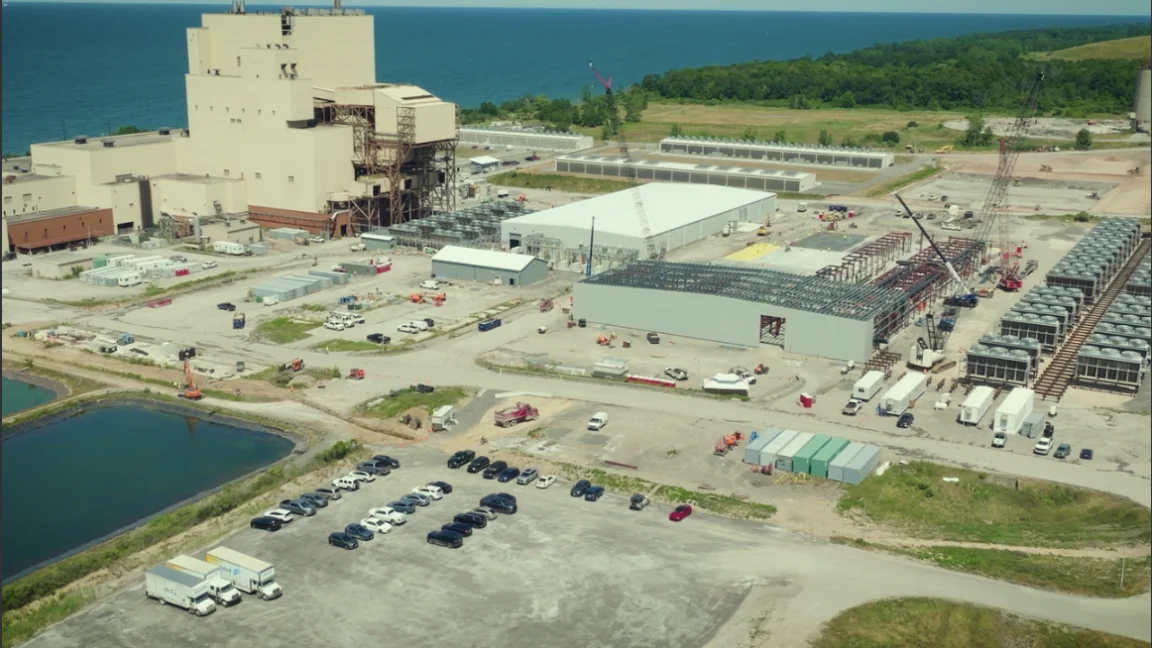
    • In early June 2026, a fire broke out at a new Lake Mariner data center building in Somerset, New York. The facility is part of a $3.2 billion AI data center campus.
    • Fire Chief Steve Matisz of the Barker Fire Department stated that there were no functioning fire alarms, extinguishing equipment, or operational hydrants at the time of suppression efforts, and that safety documents legally accessible to firefighters were reportedly destroyed in the fire.
    • The site is located on a former coal mining area along the shores of Lake Ontario and is one of the largest AI data center construction projects in New York State.

    Analysis

    Table of Contents

    In early June 2026, a fire broke out at a new Lake Mariner AI data center building in Somerset, New York. Fire Chief Steve Matisz of the Barker Fire Department, who was deployed to the scene, stated that not a single fire alarm, extinguishing system, or hydrant was operational. What began as an incident at a $3.2 billion campus is not merely a fire; it is a case that lays bare the accountability vacuum within multi-corporate AI data center structures.

    At least four companies are involved in this campus. TeraWulf owns and operates the land and buildings, the UK-based AI company Fluidstack handles operations, Google guarantees Fluidstack’s lease payments and holds warrants for a future 14% equity stake, and Anthropic is included as a compute customer. From a practitioner’s perspective, what stands out is the land lease structure. It is reported that a company owned by TeraWulf’s own CEO leased the land to TeraWulf — a mechanism that appears to blur who holds operational safety obligations.

    Company Role Stated Safety Obligations
    TeraWulf Owner/operator, campus operating company Acknowledged in official response
    Fluidstack Operating entity (UK AI company) No separate statement
    Google Lease guarantor + 14% warrant No separate statement
    Anthropic Compute customer No separate statement

    TeraWulf’s Chief Strategy Officer Kerri Langlais officially responded that TeraWulf assumes responsibility for operational safety, emergency response, essential safety equipment, and coordination with local fire authorities. It is a glamorous acknowledgment of responsibility. However, the report that firefighters were unable to access safety documents during the fire and that those documents were destroyed in the blaze plainly illustrates the gap between “having responsibility” and “actually fulfilling that responsibility.”

    The author considers this point to be the most significant. Accountability does not refer to a device that prevents a fire; it refers to the channel through which firefighters and the local community can receive information after a fire. In a state where it is not even specified who locks that channel within a multi-corporate AI data center structure, the statement that “TeraWulf takes responsibility” amounts to little more than a legal shield.

    The original story was covered in detail in an Ars Technica analysis, and reports that RAM price surges are simultaneously driving up AI infrastructure expansion costs are cross-verified in The Verge’s supply chain analysis.

    Where Does the Problem of Singly Attributing AI Data Center Safety Responsibility Originate?

    Lake Mariner encapsulates the contradictions of multi-corporate AI data center structures. TeraWulf states it is the responsible party, but what obligations does Google — with its funding guarantees and equity warrants — bear? What about Fluidstack, which holds operational authority, or Anthropic, which generates the demand? If no single company is explicitly legally obligated to contact frontline firefighters directly, then it becomes unclear who to call when a report comes in. This is not a problem unique to Lake Mariner. Nearly every large AI data center campus being built across the United States adopts a similar multi-corporate structure.

    Key Issues

    • The single entity contractually responsible for operational safety must be clearly designated within multi-corporate AI data center structures.
    • Where land leases are arranged with companies owned by the operating firm’s own CEO, conflict-of-interest disclosure obligations should follow.
    • Pre-construction fire department awareness and remote access systems for safety documentation should be mandated.
    • The scope of emergency response contributions from funding and demand-side players such as Google and Anthropic needs to be defined in advance.

    What You Can Do Right Now

    • Identify the list of participating companies at AI data center campuses under construction or set to operate near your residence.
    • Submit a written request to the operator asking which entity holds safety responsibility and what the emergency contact network looks like.
    • Map the locations of data centers within your local fire department’s jurisdiction and subscribe to fire service notification channels.
    • Where lease structures overlap with companies owned by the firm’s own executives, raise the disclosure status as an agenda item at shareholder meetings.
    • Check whether corporate ESG reports separate data center safety metrics into their own dedicated category.

    Frequently Asked Questions

    When and where did the Lake Mariner AI data center fire occur?

    In early June 2026, a fire broke out at a new Lake Mariner building in Somerset, New York. The facility is part of a $3.2 billion campus being constructed on a former coal mining site along the shores of Lake Ontario.

    Why is TeraWulf’s claim of safety responsibility insufficient?

    Statements emerged that the safety documents firefighters were legally required to access were destroyed during the fire, and that there were no operational alarms or hydrants. Identifying who the responsible party is and ensuring that responsibility is actually carried out are two separate matters.

    What is Google’s and Anthropic’s relationship to this fire?

    Google guarantees Fluidstack’s lease payments and holds warrants for a future 14% equity stake. Anthropic participates as a compute customer. Neither company has made any official statement regarding safety obligations.

    Why is a land lease structure with a company owned by the firm’s own CEO problematic?

    When the lessor is the same individual as the operating company’s CEO, a conflict of interest arises between lease terms and operational decision-making. It becomes difficult for external audits to determine who bears the cost of emergency response funding and who sets facility investment priorities.

    Source Article

    This article was prepared by verifying the following original source: Ars Technica — The complex corporate web behind a $3.2 billion AI data center

  • 4 Criteria for AI Job Risk — A Checklist to Ease White-Collar Anxiety

    4 Criteria for AI Job Risk — A Checklist to Ease White-Collar Anxiety

    Key Takeaways

    • Context of the original post: Repeated news that AI is cutting CS jobs has triggered community recommendations to switch to other white-collar fields (accounting, general engineering, law, etc.), and a user who questioned those recommendations ended up concluding that “no job is safe.”
    • The reasoning trap in the original post: A tendency to generalize threats at the job level (“if job A is at risk, so is job B”), with the author reaching a conclusion while openly doubting it—writing “Maybe I’m just dumb”—rather than holding a firm view.
    • Common solutions surfacing in the community: ① Breaking AI exposure down at the task level rather than the job level; ② Distinguishing licensed and accountability-bound fields (CPA, patent attorney, physician, etc.) from open-market fields; ③ Separating work that requires physical presence, clients, or on-site activity (audits, installations, court appearances, etc.) from work that can be split into document and coding stages.

    Analysis

    Table of Contents

    AI job risk has been a serious topic of conversation among white-collar workers for some time now. The pattern is familiar: a headline says “CS is shrinking,” and within days the anxiety spreads as “won’t every other white-collar job face the same fate?” The same worry keeps surfacing in community threads (a post asking whether any role is safe after leaving CS). I don’t think this question can be brushed off lightly.

    Why the Same Anxiety Keeps Repeating

    The conclusion that “no job is safe” usually comes from two leaps of generalization. The first is accepting the news that “job A is under threat.” The second is extending that to “jobs B, C, and D are probably in the same boat.” The problem is that the second leap happens at the job level.

    When you judge a profession as a single block, you mix tasks that are easy to automate with tasks that aren’t, even though they share the same job title. Under the label “accounting,” routine data entry sits next to auditing and advisory work. Under “engineering,” new design sits next to operations and incident response. In this process, the fact that AI job risk emerges from “task fragments,” not from “occupations,” gets buried.

    In my view, this is the most important point. Even within the same occupation, your exposure looks completely different depending on which fragment you sit in.

    4 Criteria That Determine AI Job Risk

    Synthesizing the analyses that keep appearing in the community, exposure can be broken down into four axes: rule-based and repetitive structure, accountability for outcomes, dependence on physical and relational context, and labor supply oversupply. Map your own tasks against these four and the answer comes from task composition, not job title.

    Criterion High Exposure Low Exposure
    Rule-based structure Standardized input, repetitive documents Exception handling, new design
    Accountability Just receiving and recording results Approval, audit, advisory
    Physical / relational Code and documents on screen On-site, client meetings, field dispatch
    Labor supply Plentiful replacement workforce Licenses and certifications required

    When you fill in the table, the more of your tasks that fall in the right column, the slower you’ll be swept up by the same wave of AI job risk. This scorecard is a tool that reframes AI job risk in terms of task composition rather than job title.

    Common Misconceptions

    The advice “since CS is risky, move to another white-collar field” is half right and half wrong. The right half: software development does face automation pressure on the coding fragment. The wrong half: treating accounting, law, and engineering as a safe harbor. Those professions also have their “standardized input” stages, and that’s where humans get pushed out.

    Another mistake is equating headlines with the actual rate of automation. On-the-ground reality and news headlines usually differ by 2 to 3 years. If you narrow your career choice to “which field is less risky,” you risk losing your interests and strengths. AI job risk is not a matter of closing the gap between fields—it’s a matter of closing the gap within a field.

    What to Do Right Now

    • Break your current job into 10 tasks and write a one-line note for each against the 4 criteria (rule-based structure, accountability, context, supply).
    • Check whether tasks marked “high exposure” on 3 or more of the 4 criteria make up more than half of your work.
    • If a majority of your tasks are high-exposure, propose to your manager within 6 months that you shift toward the safer column within the same organization.
    • Set a calendar reminder to recheck every 6 months whether the share of safer-column tasks is growing.
    • Track job posting data and actual changes in task composition separately, rather than relying on headlines.

    Practical Application Points

    The 4-criteria scorecard can be used as-is even when you change industries. Apply the same table to accounting, legal, and operations roles, and the very category of “a safe job” starts to look fuzzy. At that point, the answer to AI job risk comes from task composition, not from job titles.

    Even if your scores aren’t great, attempting to renegotiate the mix of tasks within your current organization is usually cheaper than an immediate job change.

    Frequently Asked Questions

    Which profession has the lowest AI job risk?

    Rather than the profession itself, roles whose tasks fall mostly in the “low exposure” column of the 4 criteria are safer. Roles that combine a license, accountability, and on-site presence generally fall into that column.

    Are there other safe fields if I cut back on coding?

    They exist but aren’t guaranteed. Every profession faces automation pressure at its standardized-input stage, so you need to check directly which fragment you’ll be assigned to.

    How much do headlines differ from the actual pace of automation?

    On-the-ground estimates put the gap at about 2 to 3 years. If you’re taking AI job risk seriously, you need the habit of tracking job posting numbers and real changes in work content separately.

    How do I run a 6-month recheck?

    Set a calendar reminder and re-score your 10 tasks against the same 4-criteria scorecard. If any item’s score has improved, negotiate to spend more time on that task.

    Six months from now, fill in the same scorecard again. Where the seat you’re sitting in falls on the table—and whether that column is the same as it was six months ago—will be your own personal answer to AI job risk.

    Reference

    This article was written after reviewing the following original post: r/cscareerquestions — If CS is cooked because of AI, why wouldn’t every other white collar job be either?

  • AI Research Automation: September Milestone — How OpenAI’s Internal Report Reveals Coding Agents Becoming Everyday Infrastructure

    AI Research Automation: September Milestone — How OpenAI’s Internal Report Reveals Coding Agents Becoming Everyday Infrastructure

    Key Summary

    • An investigation finds that coding agents have deeply penetrated the daily workflows of OpenAI researchers, running continuously throughout the day in the form of multiple concurrent sessions
    • Since the introduction of agents, both the amount of code written by researchers and the number of experiments performed have increased
    • The nature of tasks delegated to agents is observed to be shifting beyond simple assistance toward more complex research assignments

    Analysis – An in-depth review cross-verified with primary sources on how the AI R&D process itself is being accelerated by AI agents

    Table of Contents

    A report recently disclosed that AI research automation is already part of daily life inside OpenAI. The piece titled “Research acceleration: The view inside OpenAI” is a document that unpacks with primary data how OpenAI researchers use coding agents, as can be confirmed directly from the OpenAI official report. What the author found most significant was not a simple showcase of use cases, but the fact that the same piece explicitly published the automated intern and automated researcher roadmap.

    A Different Kind of Colleague Inside the Lab

    The first piece of information in this report is that OpenAI researchers keep coding agents running all day long. The pattern of opening multiple sessions simultaneously and working on other tasks while the model writes code has become routine. People often talk about it at the level of “trying out an agent,” but analysis suggests that inside OpenAI it has already settled into something closer to ‘infrastructure for delegating multiple tasks at once.’

    The results surface in two metrics. The number of experiments run increased even though the amount of code researchers wrote directly did not decrease, and the nature of tasks delegated to agents also changed. The explanation is that the work has moved beyond the level of ‘fix this one function’ to defined research assignments like ‘test this hypothesis.’ The center of gravity appears to have shifted from simple assistance to autonomous work closer to that of an assistant.

    AI Research Automation Roadmap: September, and March 2028

    Two dates are stamped in the report. One is the ‘automated research intern’ that the company aims to secure by September of this year, and the other is the ‘automated AI researcher’ that will advance deep learning and alignment research on its own under human supervision by March 2028. The former refers to a system capable of performing defined research assignments over several days under human direction, and the latter refers to a system that can steer research direction with little to no human hands-on involvement.

    What stands out from a practitioner’s perspective is that the bar for ‘automated intern’ is not ‘an AI that writes code’ but ‘an AI that receives research assignments.’ This means the unit of delegation—hypothesis definition, experimental design, and result interpretation bundled together—is already internally valid. The fact that this bar has been met suggests that the next stage of AI research automation is not simple coding assistance but the work bundle of a single researcher.

    The Cumulative Curve of AI Research Automation

    OpenAI Chief Scientist Jakub Pachocki’s “An alien mind” post takes this flow back into the past. The explanation starts from the point in mid-2023 when the RLSlow project first confirmed the scalability of training reasoning models, and then describes how reasoning models like the o-series came to sit on top of that foundation. Pachocki diagnoses that reasoning language models are spreading rapidly across the broader economy and into the cybersecurity domain.

    Reading it through, you get the sense that the September milestone did not appear out of nowhere. A feedback loop in which reasoning models write code and that code in turn trains reasoning models has been accelerating over the past two to three years, and the term ‘automated intern’ emerged at the end of that loop. The progress of AI research automation is more naturally interpreted not as a discrete event but as a point on a cumulative curve.

    Issues: Governance, Pacing, and Control

    The reason this roadmap touches governance issues rather than being a simple engineering milestone is that the more an automated researcher decides to accelerate, the more alignment research is also accelerated. Although the phrase ‘human supervision’ appears multiple times in the report, as the rate of acceleration rises, the meaning of a single unit of supervision can become lighter. Model development pacing, internal control structures, and the timing of external disclosure—these three are likely to be the key issues over the next one to two years.

    There is also a point of contact with discussions of democratic control over AGI. If an automated researcher actually starts proposing research directions, the question of who holds the authority to decide ‘why are we doing this research’ arises. Even though the flow originated inside OpenAI, if the response from outside academia and the policy community is slower than the technology, the control vacuum could lengthen. The heaviest part of this report is that AI research automation immediately translates into a speed problem of research governance.

    Summary of Issues

    • The ‘unit’ of an automated intern is a research assignment rather than code—the very definition of AI research automation is changing.
    • The March 2028 milestone reopens the question of what ‘supervision’ means, rather than the question of ‘speed.’
    • When alignment research and capability research accelerate at the same pace, the gap between external control and internal control is the core risk.

    What to Do Right Now

    • Measure and record the number of agent sessions you keep open simultaneously for a week—the difference between casual use and real use.
    • Classify your team’s delegated work into two categories, ‘simple assistance’ and ‘defined assignments,’ and look at the ratio—to gauge the next stage of AI research automation adoption.
    • Extend your alignment and safety review checklist to include ‘hypotheses proposed by agents’—to prepare for post-September scenarios.
    • Separately tag and track PRs and experiments produced by agents into a tracking pipeline—to establish a baseline for the automation ratio.
    • Share the ‘automated researcher’ scenario with your governance lead in advance and simulate one round of decision-making delay—to gauge the length of the control vacuum.

    Frequently Asked Questions

    How is an automated research intern different from a typical coding agent?

    The automated research intern defined by the OpenAI report is not at the level of ‘writing a function,’ but a unit that performs a research assignment directed by a human over several days and reports back the results. Hypothesis formulation and experimental design are delegated as one bundle.

    Why is the March 2028 milestone important?

    It is a declaration to build a system by that date that advances deep learning and alignment research on its own under human supervision. It is significant less for the speed itself than for the fact that ‘the actual weight of the word supervision’ may be shaken.

    How does the RLSlow project connect to the current flow?

    In mid-2023, the scalability of training reasoning models was first confirmed in RLSlow, and reasoning models like the o-series came to sit on top of that. The September milestone is a point on that cumulative curve, not a sudden turning point.

    If you are already using agents, what more should you do?

    Measuring usage, classifying delegated work, and establishing a baseline for the automation ratio are actions that can be taken immediately. Without this data, designing the next stage of AI research automation will open a governance vacuum first.

    Reference Originals

    This article was written after confirming the following original source: OpenAI Blog — Research acceleration: The view inside OpenAI

  • Tibet Mega-Flood: 1,387 Dead, 5,406 Missing — What’s Behind China’s ‘Limited Access’ for Foreign Media

    Tibet Mega-Flood: 1,387 Dead, 5,406 Missing — What’s Behind China’s ‘Limited Access’ for Foreign Media

    Key Summary

    • China reportedly allowed limited foreign media access to Tibet, a region devastated by a mega-flood, marking a temporary adjustment to its normally strict entry-control stance toward the area
    • The move is being interpreted as a response to allegations of information control, and assessed as an attempt at information disclosure aimed at both the international community and domestic public opinion
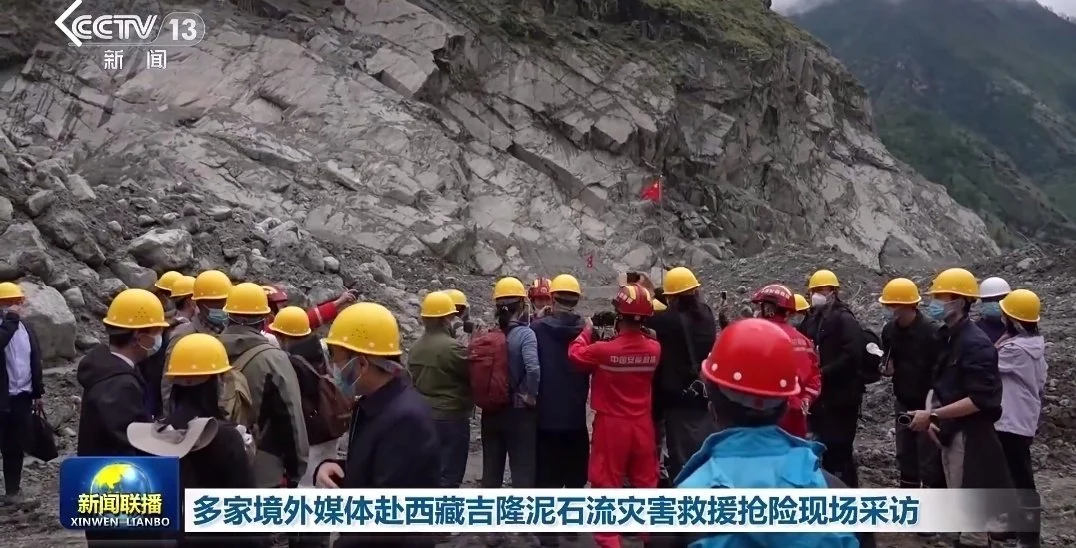
    • The devastating damage at the Gyirong site in Tibet was revealed publicly for the first time, with rescue operations reportedly struggling to make progress

    A current-affairs analysis piece that addresses both disaster reporting and information disclosure. It cross-references hard casualty figures with a policy and issue-oriented look at the shift in China’s information-control posture.

    Table of Contents

    As the human toll of the Tibet mega-flood grows to nearly incomprehensible scale, the Chinese government has partially allowed foreign journalists into Tibet, a region it has long kept in effective lockdown. According to reports from Dong-A Ilbo and YTN, the measure is being read as a stopgap response to allegations of information control, and assessed as a move designed to appeal to both international and domestic audiences. In this writer’s view, the scope of the access and the level of escort control carry far more meaning than the word “permission” itself.

    1. Tibet Mega-Flood Damage Status — What the Numbers Reveal

    According to figures cross-checked by Newsis and No Cut News, the total death toll from the Tibet mega-flood stands at 1,387, with 5,406 people reported missing. Within the Tibet Autonomous Region of China, 43 deaths and 519 missing persons have been tallied, while three people have been rescued on the Nepalese side. The numbers alone suggest that damage near Nepal is overwhelmingly greater than inside the Tibet Autonomous Region, but because external verification of conditions inside Tibet is typically difficult, the actual scale of damage within Tibet may be larger.

    Among the affected areas from the Tibet mega-flood, the Gyirong site was revealed to the public first in the most devastating state. Reports indicate that landslides swept away homes, roads, and bridges, and that joint search operations involving rescue teams, the military, and militia have been deployed — but progress has been slow due to difficult terrain and significant concerns about secondary damage. For those watching the situation on the ground, this is the most meaningful point. The fact that on-site images have been released from a region where even routine reporting is normally prohibited is itself evidence of the gravity of this disaster.

    2. ‘Limited’ Foreign Press Access — What Actually Changed

    China’s access controls on Tibet have long operated in a direction that effectively barred independent entry by foreign journalists. Allowing partial access during this Tibet mega-flood situation is, in name, an exceptional case. However, because the word “limited” is attached, the process reportedly comes with escort controls, designated shooting locations, and prior vetting of interview subjects. In other words, the door to reporting access has been opened only a crack.

    From the perspective of foreign media, the essential task is to gauge what lies behind this unusual move. A related Dong-A Ilbo report notes that the government framed the permission as a purely humanitarian measure, while observers have pointed out the possibility that access will revert to tight controls once disaster coverage wraps up.

    3. Issues Lurking Behind the ‘Permission’

    Behind the label of information disclosure, three substantive control mechanisms — escort, censorship, and selective editing — still have plenty of room to operate. First, when escort controls determine which sites reporters can access, the images transmitted may be limited to the scenes the government wants shown, rather than the full picture of the damage. Second, footage deemed disadvantageous may be blocked at the censorship stage just before broadcast. Third, when interview subjects are pre-vetted, only one side’s voice — from rescue teams, victims, or witnesses — may be reflected in reporting. In cases like the Tibet mega-flood, where early coverage shapes the figures, the influence of these three factors only grows.

    International scrutiny of the Tibet mega-flood is also not simple. Opening up disaster reporting is welcome on humanitarian grounds, but it simultaneously ties into human rights and information-access issues, and may end up setting a baseline for reporting environments in other conflict zones in the future. The same YTN report indicates that interpretations are divided over whether this permission is a one-off fix or a signal of a shift in China’s information-disclosure posture.

    4. Remaining Questions and Future Challenges

    The most essential question is this: is this “limited permission” merely a one-time measure specific to a disaster situation, or a substantive change in China’s information-disclosure posture toward Tibet? If the latter, journalist access may expand in other cases in the future; if the former, there is a high likelihood that control levels will revert to status quo once this Tibet mega-flood ends.

    At present, the methods available to outside observers to verify this are limited. However, recalling the patterns that typically govern Chinese disaster coverage, there have been few cases in which an initial signal of openness translated into a lasting shift in posture. The weight of this move, therefore, rests less on immediate reporting access and more on what follow-up measures China puts in place.

    Issue Summary

    • Asymmetric scale of damage: Damage near Nepal is overwhelmingly greater than the 43 deaths reported within the Tibet Autonomous Region, but external verification of conditions inside Tibet is difficult, leaving room for undercounting
    • Reality of the ‘permission’: Three procedural control mechanisms — escort control, designated shooting locations, and pre-vetting of interviews — effectively determine the substance of what is reported
    • One-off vs. policy shift: Interpretations diverge because there are few prior cases in China where an initial signal of openness led to a lasting change in information disclosure
    • International baseline: This permission may end up setting a standard for disaster reporting environments in other conflict zones in the future

    What You Can Do Right Now

    • Cross-check casualty figures across sources — monitor whether the numbers shift in reports from Dong-A Ilbo, YTN, Newsis, and No Cut News
    • Examine the scope of ‘permission’ directly in foreign press originals — look at how cues related to escort, censorship, and selective editing are framed in the body text
    • Track follow-up reporting in 7–14 day intervals — observe whether initial access reverts to status quo or expands to other regions
    • Periodically review the gap between official Chinese announcements and foreign press reports — record changes in death/missing figures and the timing of reporting
    • Check follow-up statements from international human rights and disaster-reporting NGOs — track how external evaluations evolve

    Frequently Asked Questions

    What is the exact human toll of the Tibet mega-flood?

    Within the Tibet Autonomous Region of China, 43 deaths and 519 missing persons have been tallied. Combined figures for Nepal and Tibet stand at 1,387 deaths and 5,406 missing, though external verification inside Tibet is limited, so the actual numbers may be higher.

    Why did China allow foreign press access this time?

    It is being interpreted as a stopgap measure responding to the international community’s and domestic public’s scrutiny of the massive human toll, as well as to allegations of information control. However, because the reporting environment differs from the norm, the possibility that it is a one-time measure is also being raised.

    How does ‘limited permission’ work in practice?

    It is generally accompanied by escort controls, designated shooting locations, and pre-vetting of interview subjects. The result is that the scenes the government wishes to show are more likely to be transmitted first.

    Could this permission signal a real shift in China’s information-disclosure posture?

    The possibility is open, but given the rarity of past cases in Chinese disaster reporting where an initial opening translated into a lasting change, it should be interpreted with caution.

  • Chrome Zero-Day Exploited in the Wild for the 6th Time This Year — Emergency Patch for CVE-2026-85046, V8 Type Confusion Analysis

    Chrome Zero-Day Exploited in the Wild for the 6th Time This Year — Emergency Patch for CVE-2026-85046, V8 Type Confusion Analysis

    Key Summary

    • Google has released a Chrome update addressing 12 security vulnerabilities, including the zero-day CVE-2026-85046 found in the V8 JavaScript and WebAssembly engine
    • CVE-2026-85046 is classified as a high-severity “Type Confusion” flaw that allows attackers to perform remote code execution (RCE)
    • The vulnerability has already been confirmed to be exploited in real-world attacks, which is why the emergency patch was issued

    Security incident analysis — an analytical article examining the technical characteristics of a Chrome zero-day actively being exploited, the year’s zero-day trends, and practical response points for practitioners

    Table of Contents

    Chrome zero-day CVE-2026-85046 has been confirmed as the 6th in-the-wild exploitation case this year. The Chrome security update released in early September includes a type confusion flaw in the V8 JavaScript engine, which can be leveraged by attackers to perform remote code execution (RCE). This Chrome zero-day incident is approaching a record-high figure on a quarterly basis.

    This single patch addressed 12 security flaws simultaneously, including CVE-2026-85046. The vulnerability was confirmed to have already been exploited in real-world attacks as of the patch date. This incident was introduced in Korea through Bleeping Computer reporting carried by Boannews; the specific affected versions and patch release dates were not confirmed in the original report.

    Type confusion flaws occur when the engine misjudges the internal type of an object. A path is created where valid data intrudes into another object’s memory region, and from there arbitrary code execution follows — a familiar pattern in practice. Because V8 compiles JavaScript and WebAssembly close to native, any misstep in type inference during JIT optimization stages directly translates into a security flaw.

    The author views this point as the fundamental contradiction of Chrome zero-days. The very structure of applying JIT for speed inherently reduces the precision of type verification. The fact that 6 in-the-wild exploitation cases have accumulated within 9 months is evidence of a vicious cycle in which V8’s design philosophy hands advantages to attackers, while defenders chase them with post-hoc patches every time.

    This Year’s Chrome Zero-Day Trend — What the Numbers Tell Us

    Looking at the raw count alone, the pace exceeds 1.5 cases per quarter. The more meaningful point than the numbers is the ‘rate of cases reaching real-world exploitation.’ The fact that Google’s Threat Analysis Group (TAG) directly confirmed use means the flaw has been incorporated into targeted spyware or commercial exploit kits. What sets this Chrome zero-day apart is the fact that it is bundled in a 12-vulnerability simultaneous patch.

    V8’s Impact Scope: Beyond the Browser

    Browsers run regardless of desktop or mobile, enterprise or personal use. V8 affects Microsoft Edge, Electron-based desktop apps, and the Node.js runtime. A single vulnerability spreads into a broad desktop attack surface. IT departments should check whether Electron-based apps exist within the organization and, if so, separately inspect their custom V8 build versions.

    Comparison of This Year’s Chrome Zero-Day Trends

    Period Case Notes
    Q1 RCE, DOM flaw, 1 each Suspected APT campaign link
    Q2 V8 memory corruption, Scheme flaw, 1 each Exploit kit distribution confirmed
    Q3 V8 type confusion (CVE-2026-85046), renderer flaw Includes this Chrome zero-day

    What to Do Right Now

    • Check immediately whether you are on the latest build via Chrome Menu → Help → About Chrome
    • In enterprise environments, set the forced update channel to Extended Stable or above via Group Policy
    • Verify whether your EDR solution’s V8 exploit detection rules have been updated since September
    • Retroactively trace endpoint logs for abnormal child process (powershell, cmd) creation since September
    • If your organization uses Electron-based desktop apps, separately inspect their custom V8 build versions

    Practical Application Points

    • Patch verification: Prioritize identifying endpoints with auto-update disabled via AD/MDM
    • Vulnerable endpoint isolation: Identify endpoints running Chrome versions below 152, then update or isolate immediately
    • Exploit artifact inspection: Check logs for abnormal child process generation from browser processes

    • Department notice: Send an IT administrative notice warning against clicking links from unknown sources
    • Incident response: Upon detecting exploit artifacts, perform credential rotation and endpoint isolation simultaneously

    Frequently Asked Questions

    Doesn’t Chrome update automatically?

    Auto-update is enabled by default, but it can be delayed by insufficient admin privileges, Group Policy locks, or pinning to a specific version. The most reliable approach is to manually click ‘Check for updates’ in the Help menu.

    How does CVE-2026-85046 gain entry?

    Entry occurs when a vulnerable Chrome opens a web page containing crafted JavaScript. Common vectors include email links, ad banners, and manipulated search results.

    Are Mac or Linux users also affected?

    The V8 engine behaves identically across all operating systems where Chrome is installed, so the impact is platform-agnostic. Regardless of OS, Chrome itself must be updated to the latest version.

    Are other browsers like Edge or Brave safe?

    All of them share the same V8 engine, so they are theoretically exposed to the same flaw. Each browser’s individual patch schedule should be checked separately.

    Browser Zero-Days: No Longer an Incident, but Routine

    What stands out from a practitioner’s perspective is that as patch speed accelerates, attackers also push out variants at speed. A single neglected Chrome zero-day can turn an endpoint into the starting point of lateral movement in no time. It is time to include browser version and EDR rule update checks in every quarterly inspection. Reviewing the primary source Boannews original article alongside the related internal report will help you trace the context of this Chrome zero-day patch announcement.

  • NVIDIA PAIR Launch Analysis: How This Local Inference Router Wakes Up 5 Idle GPUs at Once

    NVIDIA PAIR Launch Analysis: How This Local Inference Router Wakes Up 5 Idle GPUs at Once

    Key Summary

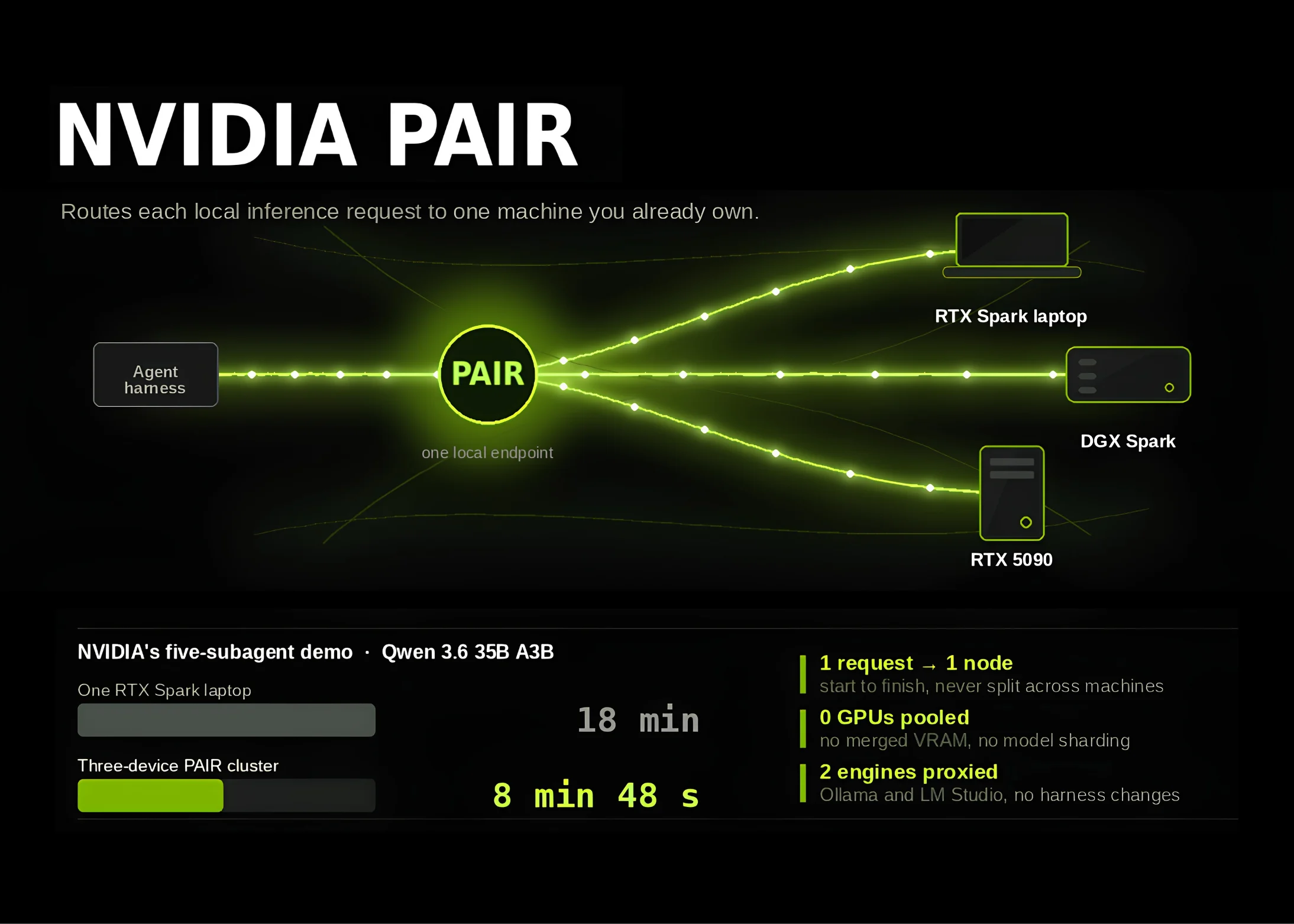
    • PAIR is not a new inference engine but a virtual inference router that distributes traffic across existing Ollama/LM Studio engines on a local network
    • Released as public beta v0.1.1, with signed installers available for Windows, macOS, and Linux; the full source code is published on GitHub under the Apache 2.0 license
    • PAIR does not introduce a new cluster-specific API; instead, it proxies Ollama-compatible, LM Studio-compatible, and OpenAI-compatible endpoints, minimizing changes to existing agent harnesses

    Analysis

    Table of Contents

    One RTX on your desk, a Mac mini in the study, a DGX Spark in the living room. NVIDIA PAIR ties these scattered GPUs together so you can use them as a single endpoint. The key point first: NVIDIA PAIR is not a new inference engine. It is a virtual layer that distributes traffic across existing engines like Ollama and LM Studio on a local network.

    You might first wonder, “Why build a separate router?” In my view, the answer lies in the growth of multi-agent workflows. When the number of sub-agents grows to 5-10, a single machine’s GPU quickly becomes a bottleneck, and agent harnesses have repeatedly been asked to switch endpoints. NVIDIA PAIR proxies all three endpoint types – Ollama, LM Studio, and OpenAI-compatible. This means you can distribute traffic while barely touching your existing code.

    NVIDIA PAIR Distribution – Signed Installers and Apache 2.0

    Public beta v0.1.1 has been distributed as signed installers for Windows, macOS, and Linux. The full source code is published on GitHub under Apache 2.0, putting even organizations that cannot use commercial builds directly on the evaluation table. The specifications and download links can be confirmed in the initial MarkTechPost report.

    Node Management – mDNS Discovery, 6-Digit PIN, and mTLS

    NVIDIA PAIR first detects devices on the same subnet via mDNS. If discovery fails, IP addresses can be added manually, and pairing is completed with a single 6-digit PIN. After that, traffic is encrypted with generated-certificate-based mTLS. The fact that plaintext exposure risk is reduced when running on an office LAN without a VPN is attractive to operators.

    From a practitioner’s perspective, the standout feature is setup automation. Remote engine installation and model downloads can be triggered on paired nodes. The manual work of downloading a 30GB embedding model to five machines one by one disappears. Once the operator handles the first boot on one machine, NVIDIA PAIR fills in the rest.

    NVIDIA PAIR Compatibility – The No-Harness-Change Strategy

    It is significant that NVIDIA PAIR does not bring a new cluster-specific API. If your agent harness already knows Ollama or OpenAI endpoints, you just point it at the router address and it works as-is. The same direction is read in our article on extending local agent workflows.

    Endpoint Underlying Engine Representative Use Case
    Ollama-compatible Ollama Legacy agents, custom tools
    LM Studio-compatible LM Studio Desktop GUI workflows
    OpenAI-compatible Multiple backends LangChain, LlamaIndex families

    Performance Implications – The 5-Sub-Agent Demo

    In the reported 5-sub-agent demo, a task that took an average of 18 minutes on a single RTX Spark node was reportedly reduced to around 8 minutes with multi-node distribution. The trailing comparison context for the reported figures has not been verified, but the evidence that “workflow-level time” decreased is meaningful. This means there is now room to maintain responsiveness while increasing the number of sub-agents.

    However, these figures are the result of a specific model and prompt combination. For practical adoption, it is safer to run microbenchmarks with your own workflow. The view that NVIDIA PAIR’s value lies not in buying new GPUs but in reviving machines already on your desk is realistic. From a data governance perspective, it is also meaningful in that more traffic stays local.

    Practical Application Points

    • Prioritize an adoption path that keeps existing Ollama and LM Studio instances in place and simply layers the router on top.
    • Align the flow where 6-digit PINs and mTLS certificates are auto-issued with your internal security guidelines in advance.
    • Pre-define the candidate node list for distribution based on the number of sub-agents and model sizes in your multi-agent workflow.
    • Before enabling the remote model download trigger, verify there are no conflicts with internal proxy and bandwidth policies.

    Try It Right Now

    • Download the v0.1.1 release notes from GitHub and verify the signed installer hash.
    • Launch Ollama or LM Studio on one desktop machine and confirm that requests are proxied through the NVIDIA PAIR router address.
    • Check whether the second node on your LAN is auto-discovered via mDNS, and if not, test manual IP addition as a fallback.
    • After 6-digit PIN pairing, verify via logs that mTLS certificates are properly issued on both nodes.
    • Point your frequently used agent harness at the OpenAI-compatible endpoint and measure the response round-trip.

    Frequently Asked Questions

    Is NVIDIA PAIR a new inference engine?

    No. NVIDIA PAIR itself does not run models. It is simply a router that finds existing Ollama and LM Studio engines and sends traffic to them. Therefore, the models and prompts you already use remain unchanged.

    Do I need to learn a new cluster-specific API?

    No, you don’t. Since it proxies Ollama, LM Studio, and OpenAI-compatible endpoints, your agent harness only needs a one-line change to point at the router address.

    Does it work in an office with external internet blocked?

    Yes. Since all node-to-node communication is handled by mDNS and mTLS, you can operate it in a closed environment within your LAN. However, the initial model download will need to go out to the internet at least once.

    What is the licensing burden?

    The source on GitHub is released under Apache 2.0. You can compile, modify, and redistribute it internally, with only the obligations to preserve copyright notices and document changes.