Key Summary
- Industry trends are pushing SSL certificate maximum validity toward shorter durations, and cases have been confirmed where certificates prepaid for 365 days are actually issued for only 200 days
- In manual installation environments, certificate expiration dates are scattered across sites, so if a CA’s renewal flow is not intuitive at the moment a large-scale reissuance and reinstallation is needed, operators face a high risk of incurring additional costs
- The core UX problem exposed in the Namecheap case is that the rekey (residual-period reissuance) path, which runs separately from the ‘buy a new certificate’ icon, is not clearly communicated to users — and as a result, users fail to reuse the already-paid residual period and end up paying extra
Analysis
Table of Contents
- Key Summary
- Why SSL Certificate Renewal Always Falls Into the Same Trap
- SSL Certificate Renewal Decision Criteria: How to Split by Environment
- 200-Day Issuance Policy Comparison by CA
- Proven Response: Automation + Monitoring
- Practical Application Points
- Practical Application Points
- Common Mistakes
- What to Do Right Now
- What to Do Right Now
- Frequently Asked Questions
- Frequently Asked Questions
- Closing
- Reference Source
SSL certificate renewal schedules for 10 WatchGuard firewalls were set on a yearly cycle. Three months later, four certificates were discovered in the Namecheap dashboard that had gone through as ‘new purchase’ rather than ‘reissue.’ The already-paid residual period was discarded entirely, and the extra cost approached roughly $500. This article, written from an operator’s perspective, outlines how SSL certificate renewal should be designed in environments where non-ACME appliances are mixed in.
Why SSL Certificate Renewal Always Falls Into the Same Trap
Industry trends are moving SSL certificate maximum validity in a shorter direction. Following CA/Browser Forum decisions, there is still room for it to drop to as little as 90 days in the future. The collision with prepaid structures is the problem. When you pay for 365 days but receive a 200-day certificate because of issuance-time policy, the remaining 165 days can only be reused within that same CA.
The UX defect exposed in the Namecheap case is that the rekey (residual-period reissuance) path — which exists separately from the ‘new purchase’ button — is not communicated to users. Operators typically read rekey, renew, and reissue as the same thing because the menu names differ. Each CA defines them differently. This one small difference causes already-paid periods to disappear, and in multi-site environments that cost multiplies.
WatchGuard’s lack of ACME-based auto-renewal support has been one of users’ long-standing requests. As of 2026, it still has not been reflected in the vendor’s roadmap. In field deployments where certificates must be manually distributed across multiple remote WatchGuard appliances, this limitation is the single biggest friction point. Operator reports on the 200-day certificate transition at one point drew more than 100 comments on r/sysadmin.
SSL Certificate Renewal Decision Criteria: How to Split by Environment
There are two variables to look at first when deciding on a process: ① whether ACME is supported, and ② the number of sites. In reality, SSL certificate renewal itself is not the goal — preventing service outages from certificate expiration is what matters.
If you have five or more appliances that do not support ACME (many WatchGuard models, legacy load balancers, industrial control devices), the process is effectively manual. In that case, paying upfront for multiple years and reissuing in installments is the cost-advantaged approach. Paying for a 3-year certificate up front and then reissuing one year at a time reduces the per-unit residual-period loss.
If your stack is dominated by ACME-capable servers such as nginx, Apache, Caddy, or Traefik, you can automate issuance and deployment with a client like certbot. Even when 90-day certificates are issued automatically, however, monitoring alerts need to start 60 days before expiration — not 30 — so you have time to respond to a failed reissuance.
200-Day Issuance Policy Comparison by CA
When you pay for 365 days, the actual issued certificate lifetime and the way residual periods are handled differ by CA. From an operator’s perspective, the most visible difference is the transparency of the guidance flow.
| CA | Actual Issued Lifetime | Residual Period Handling | Reissuance UX Guidance |
|---|---|---|---|
| Namecheap (Comodo) | 200 days | Residual carries over on rekey | Separated from new purchase; guidance is weak |
| Sectigo (direct purchase) | 200 days | Residual carries over on rekey | Rekey menu is clearly labeled |
| DigiCert | 200 days | Varies by renewal timing | Rekey vs. renew clearly distinguished |
| GoDaddy | 200 days | Partial carryover on reissuance | Korean-language guidance pages provided |
| Let’s Encrypt | 90 days | N/A (free) | Assumes ACME automation |
This table synthesizes CA official documentation with operator reports. Even at the same 200 days, Namecheap and DigiCert handle residual-period carryover differently and present it differently. The first thing to do when setting up an SSL certificate renewal process is to check directly how visible the rekey menu of your current CA is on the payment screen.
Proven Response: Automation + Monitoring
There are four workarounds frequently discussed in the community: ① operating an ACME-compatible internal CA (smallstep, step-ca); ② issuing with certbot and writing deployment scripts; ③ paying upfront for multiple years and reissuing in installments; ④ setting up pre-expiration alerts with zabbix or checkmk.
The combination I have found most effective in the field is ③ + ④. Paying for a 5-year certificate up front and reissuing it in yearly installments produces almost no extra cost. Add to that the checkmk ssl-cert-check rule with four-stage alerts at 60, 30, 7, and 1 day(s) before expiration, and the chance of an operator missing a fragmented expiration date drops significantly.
Operating an internal CA is only meaningful in environments where external CAs are not allowed by security policy. Because it brings browser trust-chain issues, it cannot be applied to general SaaS or external services. certbot-based automation is only effective for ACME-capable appliances. A workaround of placing an nginx reverse proxy in front of WatchGuard does exist, but it raises configuration complexity by a corresponding degree.
Practical Application Points
Practical Application Points
- First, determine the share of appliances that do not support ACME. If it is 30% or more, paying upfront for multiple years plus installment reissuance is the cost-advantaged approach.
- When paying upfront for multiple years, confirm the residual-period carryover conditions in writing through the CA’s sales channel. Menu structure and policy can change at any time depending on the CA’s circumstances.
- Separate certificate replacement work into a nighttime window and spread schedules across sites. WatchGuard reboots are long, so simultaneous work across multiple sites increases operator fatigue.
- Document the configuration differences between wildcard and SAN in a single place. The number-one cause of reissuance rejection is missing SAN entries.
- Clean up old certificates immediately after installing the new one. If the intermediate (chain) certificate has changed, a chain error will occur.
Common Mistakes
The most common case is starting the reissuance only right before expiration. Even though issuing a certificate takes just 10 minutes, reinstallation, reboot, and chain verification take 30 minutes to an hour. For appliances like WatchGuard that require a reboot, it takes even longer. Starting 7 days before expiration is effectively already too late.
The next most common mistake is reading rekey/renew/reissue as the same thing. In Namecheap, renew updates an existing certificate under the same conditions, while rekey reissues it by carrying over the residual period. The two menu options have different prices and different outcomes. When an operator confuses the two, an already-paid period disappears.
Cases are also frequent where SAN entries are missed when reissuing a wildcard certificate. If the original certificate had three SAN entries and the reissuance includes only two, one of the domains will immediately throw a certificate error. Always compare the SAN list before issuing a new certificate.
The fourth is the chain error that occurs when old certificates are not cleaned up after the new one is installed. If the intermediate (chain) certificate has changed but the old chain remains, browsers will display an ‘untrusted issuer’ error. This problem is particularly pronounced on non-ACME appliances.
What to Do Right Now
What to Do Right Now
- Build a table organizing the SSL certificate expiration dates currently in operation by domain. If even one certificate expires within 30 days, start the reissuance immediately.
- Capture the location of the rekey menu in your current CA and pin it to the team wiki. Add a note explaining how it differs from the ‘new purchase’ button.
- Reconfigure expiration alerts to four stages: 60/30/7/1 day(s). Check the zabbix tls.expires trigger or the checkmk ssl-cert-check rule.
- Rewrite the list of non-ACME appliances. If the share is 30% or more, contact your CA about paying upfront for 3 years plus installment reissuance.
- Pick the most recent reissuance rejection, and classify its cause: missing SAN, CSR error, or domain validation failure. Check whether the same cause keeps repeating.
Frequently Asked Questions
Frequently Asked Questions
When I receive a 200-day certificate, what happens to the remaining 165 days?
It depends on the CA, but if you reissue through the rekey menu, the residual period of the existing certificate is carried over to the new one. On the other hand, if you go through with a ‘new purchase,’ the residual period disappears and the 200 days restart from zero. It is also worth remembering that carryover is only possible within the same CA.
Is there any way to work around ACME auto-renewal on WatchGuard appliances?
The appliance itself has no ACME, but you can place nginx or Caddy as a reverse proxy in front of it, have certbot automatically issue and renew the certificate, and then deploy a private certificate to the WatchGuard. This does require a change to the network configuration, however, and a review of trust with external clients should come first.
If I run an internal (Private) CA, can I save the cost of an external CA?
There is a cost-saving effect. However, because it is not registered in the browser trust chain, it cannot be used for services exposed to external users. It is meaningful only in closed environments such as internal portals, API gateways, and IoT device authentication. It is often used in parallel with free external CAs such as Let’s Encrypt.
Isn’t a 30-day-before-expiration alert enough?
For a single-domain environment, it is sufficient. However, in multi-site setups where 10 or more certificates may expire at the same time, completing all reissuance and reinstallation within 30 days is difficult. For appliances like WatchGuard that require a reboot, alerts need to start coming in 60 days before expiration to be safe. Spreading out the SSL certificate renewal schedule also reduces the risk of multiple expirations clustering at the same time.
Closing
The shift to 200-day certificates demands a change in operations, not just a shorter cycle. If you treat SSL certificate renewal as a once-a-year task to be done all at once, costs will keep spiking and expiration incidents will keep recurring. If you use installment reissuance and a multi-stage alert system as your baseline, operational burden will barely grow even as certificate lifetimes get shorter. The higher the share of non-ACME appliances like WatchGuard, the greater the benefit of paying upfront for multiple years. The most realistic workarounds for certificate fragmentation ultimately boil down to two things: distributing issuance and making expirations visible.
Reference Source
This article was written after checking the following original source: r/sysadmin — What is your SSL certificate provider doing now that 200 day certs are starting to expire? My provider (Namecheap) is being sketchy.
Expert Commentary (AI)
Security Systems Operations Specialist
In the era of shortened certificate lifetimes, the ‘non-automatable zone’ becomes the new single point of failure
The CA/B Forum’s lifetime-shortening roadmap is best read as targeting 47 days around 2029, with 200 days as the midpoint, and this is effectively a declaration of the end of the once-a-year manual renewal model. ACME is already the industry standard for issuance automation, but firewall appliances, legacy load balancers, and industrial devices are left out of this trend, and in multi-site operations that zone is the bottleneck that creates most of the expiration incidents. Paying upfront for multiple years and then reissuing in installments is a reasonable choice for near-term cost control and distributing expiration dates, but once lifetimes drop to 90 days or below, the economics of the upfront-payment model itself and the management burden will inevitably be restructured. Multi-stage monitoring at 60/30/7/1 day(s) before expiration is a basic practice, but alerts alone are not enough; the next step is designing a pipeline that connects issuance to deployment, reboot, and chain verification. A workaround based on a reverse proxy in front is an improvisation that works in practice, but if the proxy becomes a new failure point and attack surface, it is dangerous to introduce it without availability and security review. The fundamental solution is not operator-side workarounds but ACME adoption by appliance vendors, and making ACME support a written requirement at the procurement stage is the most cost-effective pressure tool.
PKI Infrastructure Specialist
The absence of standards for the terms rekey, renew, and reissue, and residual-period handling in the upfront-payment model, are the real cracks in this transition
After the CA/B Forum banned multi-year certificate issuance, the ‘prepay + reissue’ structure became an industry compromise, and the fact that residual-period carryover policies differ for each CA is not a bug but the inevitable consequence of this model. The Baseline Requirements only enforce the upper limit on issuance lifetime; the proprietary terminology and carryover rules used by resellers are not subject to standardization, so user confusion remains an area for improvement but the institutional drive to enforce it is weak. The shorter lifetimes get — from 200 days to 100 days to 47 days — the weaker the value proposition of upfront-payment commercial CAs becomes, and there is a high probability that the certificate market will be restructured around ACME-based free issuance and CLM platforms. The security rationale for shorter lifetimes (reducing key-compromise exposure time and minimizing the impact of misissuance) is correct in direction, but it is only persuasive when premised on outdated key-storage practices, and in environments where hardware key protection and automated rotation are already widespread, its marginal utility drops sharply. The realistic corporate response is not CA-by-CA UX comparison but the introduction of CLM tools, issuance automation, and the bifurcation of closed segments into private CAs and trust management. That said, appliances and closed-network segments will be the last to benefit from this restructuring, so vendor adoption of ACME will remain the biggest challenge for the PKI ecosystem over the next five years.
Critical Analyst
The winners of shorter certificate lifetimes are decided in advance — those who control the automation infrastructure
The surface-level narrative says ‘shorter lifetimes are safer,’ but if you look behind the scenes, the biggest beneficiaries of this change are the large CAs and the cloud and automation ecosystems that already have ACME and CLM infrastructure, while the biggest cost bearers are the small and mid-sized operators who relied on manual renewals. The answer to ‘why now, specifically’ is closer to market than to technology: as lifetimes get shorter, the number of issuance and reissuance cycles multiplies, which structurally favors players with the economies of scale in automation in the per-unit pricing competition. If appliance vendors have not reflected ACME in their roadmaps despite years of user requests accumulated on public forums, that is better read not as a technical delay but as the result of an incentive structure in which renewal friction feeds into maintenance contracts and professional service revenue. The fact that the rekey path is hidden behind the new-purchase button in reseller consoles is also more likely the product of a structure in which the new-purchase conversion rate of renewal-inflow customers is tied to revenue metrics, creating an incentive against clear residual-period carryover guidance, rather than a pure UX defect. One cannot say the security logic itself is wrong, but the fact that cost and risk are asymmetrically passed on depending on automation capability is not officially addressed anywhere. The question we should really be paying attention to is not ‘why are lifetimes getting shorter’ but ‘through this transition, who is gaining market share and who is paying the cost.’
- There is a high probability that the lifetime-shortening schedule was passed through a CA/B Forum voting structure in which browser vendors and large CAs hold significant influence, and it may function as a restructuring device that accelerates the market exit of small CAs and resellers without automation infrastructure — the distribution of voting interests is circumstantial evidence of this.
- The fact that the rekey option in reseller consoles is separated from the new-purchase button and given weak guidance is more likely not a coincidental UI error but the result of a revenue structure that drives new-purchase conversions of renewal customers, which works against clear residual-period carryover guidance — a recurring pattern in which no company places residual-period carryover guidance on the front page supports this.
- The long-running lack of ACME support from firewall vendors is more likely tied to an interplay of interests in which certificate renewal friction drives up annual maintenance contract renewal rates and professional service demand than a technical delay — the fact that user requests have accumulated over years while roadmap gaps persist is circumstantial evidence.
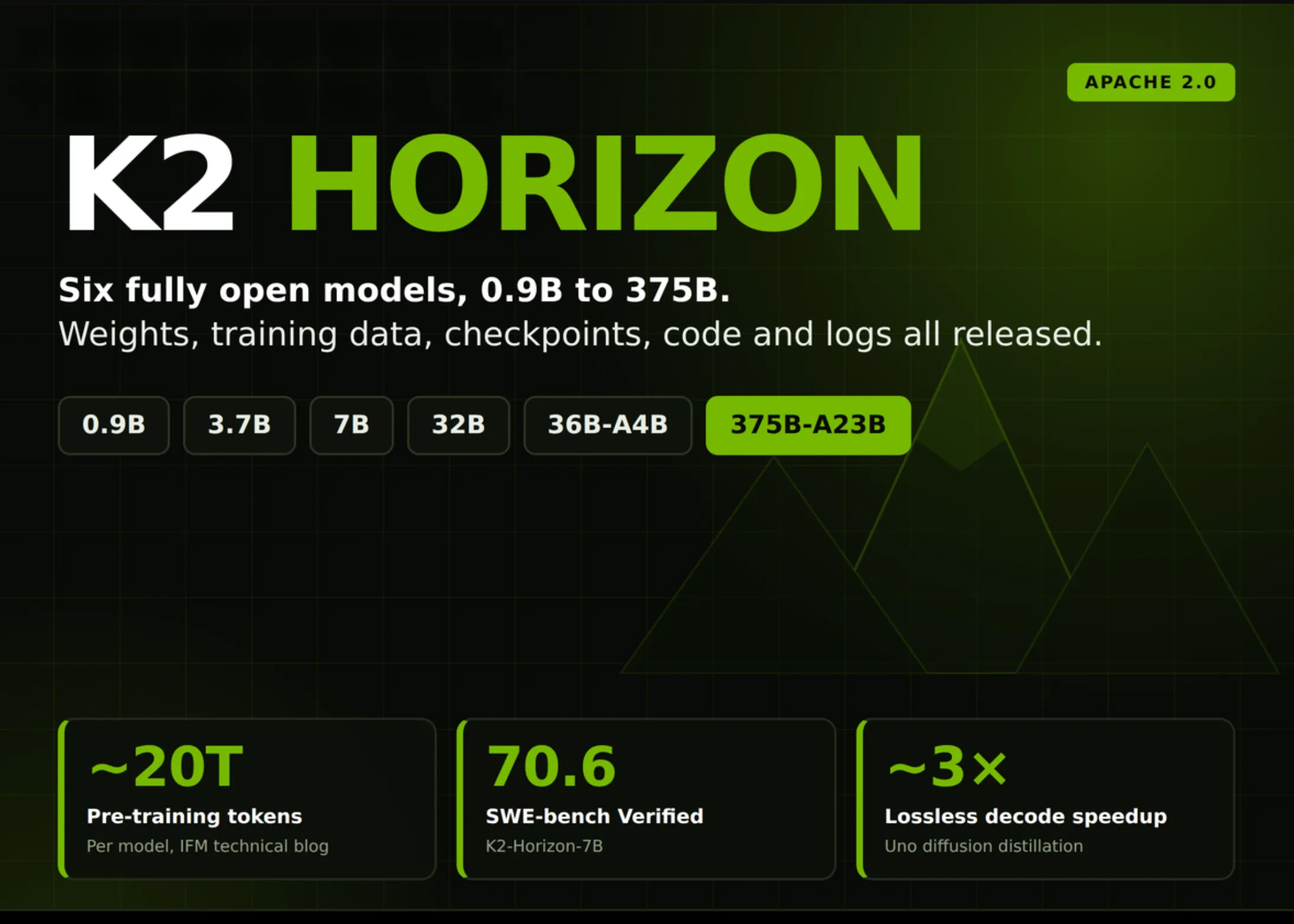
K2 Horizon Analysis: IFM’s Six-Model Fleet from 0.9B to 375B Released Simultaneously Under Apache 2.0
Key Summary
- Release scale: Six models—375B-A23B, 36B-A4B, 32B, 7B, 3.7B, and 0.9B—all simultaneously distributed under Apache 2.0 on Hugging Face (the 0.9B uses a smaller vocabulary)
- Open stack included: Beyond model weights, the release ships the pretraining corpus, intermediate checkpoints, training code, configuration files, and detailed logs—IFM describes this as “the largest fully open-source release in AI history”
- Training data: All six models were pretrained on approximately 20 trillion tokens, of which about 17% consists of explicit reasoning traces, and roughly 10 trillion tokens are synthetic data
An analytical article examining what it means—for technology, licensing, and commercialization—when a large language model is released as a full-stack open-source project, and what it implies in practice to run the same architecture consistently from 0.9B to 375B.
Table of Contents
- Key Summary
- K2 Horizon Lineup: From 0.9B to 375B-A23B
- The Scope of the Open Stack Brought by K2 Horizon
- Training Data Design: 20 Trillion Tokens, 100M+ Tasks
- MoVA: A Second MoE Scaling Axis Built on Attention
- Tool-Calling Format: Markdown’s 18.5% Token-Efficiency Edge
- Serving Ecosystem: Day-0 Support for vLLM, SGLang, and Ollama
- Practical Application Points
- What to Try Right Now
- Frequently Asked Questions
- Reference
The fact that K2 Horizon released six models ranging from 0.9B to 375B under Apache 2.0 on the same day forces us to revisit what it means for a large language model to be open-sourced as a full stack. The bundle published in September 2026 by the Foundation Model Institute (IFM) under MBZUAI is not a single model but a “fleet” that ships the pretraining corpus, intermediate checkpoints, training code, configuration files, and detailed logs together.
In the author’s view, the core of this announcement lies not in model size or benchmark scores but in the scope of openness. The fact that even the 0.9B model’s use of a smaller vocabulary is explicitly stated means that the same training pipeline can be repeated by varying only the scale. The ability to use an identical interface across sizes in practice becomes a prerequisite for unified operations.
K2 Horizon Lineup: From 0.9B to 375B-A23B
The lineup is divided into six models. The 0.9B uses a reduced vocabulary, while the 3.7B, 7B, and 32B are dense. The 36B-A4B and 375B-A23B are MoE configurations. Because all models share the same tokenizer and tool-calling interface, the same code can be run by switching only the model identifier.
| Model | Total Parameters | Active | Type |
|---|---|---|---|
| 0.9B | 0.9B | 0.9B | Reduced-vocab dense |
| 3.7B | 3.7B | 3.7B | Local-inference dense |
| 7B | 7B | 7B | General-purpose dense |
| 32B | 32B | 32B | High-quality generation dense |
| 36B-A4B | 36B | 4B | MoVA MoE |
| 375B-A23B | 375B | 23B | Flagship MoE |
Because all six K2 Horizon models pass through the same synthetic-task generator and are trained with the same reasoning-trace ratio (about 17%), data alignment is applied consistently across the entire lineup. There is a high probability that a prompt format validated on the 0.9B will not break significantly when ported to the 375B-A23B.
The Scope of the Open Stack Brought by K2 Horizon
IFM used the phrase “the largest fully open-source release in AI history.” The K2 Horizon distribution bundle includes the pretraining corpus, intermediate checkpoints, training code, configuration files, and detailed logs. Compared with other open-source projects that release only weights and inference code, the scope is on a different level.
The release of intermediate checkpoints is directly tied to reproducibility. While retraining the 375B-A23B from scratch is difficult, you can continue fine-tuning from an intermediate stage or run ablations. In effect, the surface needed to experiment by varying the synthetic-data ratio or the reasoning-trace ratio is now secured.
Training Data Design: 20 Trillion Tokens, 100M+ Tasks
All six models were pretrained on approximately 20 trillion tokens, of which about 17% consists of explicit reasoning traces, and roughly 10 trillion tokens are synthetic data. The research team generated more than 100 million unique synthetic tasks and progressively incorporated post-training data during the middle-training stage.
The point practitioners should pay attention to is the scale of the synthetic tasks—the most striking number in the author’s view. 100 million is far beyond what can be hand-designed by humans. The structure has shifted from defining domain tasks and feeding them into the model to letting the model itself generate tasks while humans curate them. When examining the performance gap between the 36B-A4B and the 7B, the distribution of these 100 million tasks becomes the decisive variable.
MoVA: A Second MoE Scaling Axis Built on Attention
Among the K2 Horizon lineup, the 36B-A4B applies MoVA (Mixture-of-Value Attention). If MoE created a scaling axis by routing experts in the feed-forward layer, MoVA integrates routing into multi-head attention itself, adding a second scaling axis along the attention dimension. It is compatible with FlashAttention, GQA, and sparse attention, so it can be used without significantly overhauling existing serving stacks.
What makes MoVA interesting is that it can push MoE’s parameter efficiency a step further. Whether the upper K2 Horizon lineup converges entirely on MoVA, or dense and MoVA coexist, is a point to watch.
Tool-Calling Format: Markdown’s 18.5% Token-Efficiency Edge
IFM trained tool definitions in three formats—JSON, XML, and Markdown—and set Markdown as the default for inference. Measurement results show that Markdown uses approximately 18.5% fewer tokens than JSON. Producing the same result with fewer tokens translates directly into lower latency and cost.
The Markdown advantage grows as tool definitions get longer. Agents that expose 30 to 50 tools simultaneously are common, and in those cases, 18.5% is not a simple optimization but a near architectural decision. When designing a tool-calling system with K2 Horizon, it is simpler to let the model read and call Markdown tool definitions directly rather than building a separate router.
Serving Ecosystem: Day-0 Support for vLLM, SGLang, and Ollama
On the day of release, vLLM, SGLang, and Ollama received day-0 support, with FP8 and GGUF builds also provided. The supported range extends beyond NVIDIA to include AMD and Cerebras. According to the official IFM announcement, hosting is split across Compass, Cerebras, and Nebius APIs, plus the platform.ifm.ai gateway, so the same weights can be tested immediately on various stacks. Deployment-infrastructure choice is worth evaluating from the perspective of data-movement costs by AI chip architecture.
Day-0 serving support is a “signal” from the announcement. New models typically stabilize only after community patches, but K2 Horizon works on three inference engines at the moment of release. This shows IFM’s strategic choice to ship open-source models as a “stack.”
Practical Application Points
Size selection depends on call frequency and acceptable response latency. The 0.9B and 3.7B are efficient for classification, routing, and simple transformations; the 7B fits general-purpose reasoning; and the 32B is best for high-quality generation and summarization, where resource-to-output ratio matters. The 36B-A4B is well suited to agent routers or multi-tool-call workloads, leveraging its 4B active parameters per token. The 375B-A23B carries a significant operational cost, so the safer approach is to validate prompts and tool shapes on the 0.9B first, then scale up gradually.
What to Try Right Now
- Download the K2 Horizon 0.9B or 3.7B weights from Hugging Face and spin up a local vLLM server.
- Write the same tool definition in both JSON and Markdown, and compare token counts and response times.
- Pull the 36B-A4B and run at least five multi-tool-calling scenarios with MoVA routing enabled.
- Inspect the synthetic-task distribution in the pretraining-corpus metadata, pick the cluster closest to your in-house domain tasks, and start fine-tuning.
Frequently Asked Questions
Why does the K2 Horizon 0.9B model use a different vocabulary?
It is targeted at edge devices, so the vocabulary was reduced to lower memory usage. It goes through the same training pipeline but adopts a reduced vocabulary tailored to the inference environment.
Can it be commercialized under the Apache 2.0 license?
Because the weights, code, and data are all released under Apache 2.0, it can be used as-is in commercial services. Note, however, that the same license-notice requirement must be followed when redistributing.
How is MoVA different from conventional MoE?
If MoE routes experts in the feed-forward layer, MoVA integrates routing into multi-head attention itself. Its defining feature is compatibility with FlashAttention, GQA, and sparse attention.
Why is Markdown tool calling 18.5% more efficient than JSON?
Markdown uses fewer metacharacters such as braces, quotes, and tags, so fewer tokens are needed to express the same meaning. The advantage grows as tool definitions get longer.
The question K2 Horizon’s release poses is not simply “Is this yet another open-source model launch?” The fact that a fleet running consistently on the same pipeline from 0.9B to 375B has been released under Apache 2.0 shows that the axis of open-source LLM competition is shifting from weights to the “stack”—including data, code, and intermediate states. What licensing standards this change produces, and how commercial vendors respond, will be the deciding factor over the coming quarters.
Reference
This article was written after reviewing the following source: MarkTechPost — IFM Releases K2 Horizon: Six Apache 2.0 Models From 0.9B to 375B
Expert Commentary (AI)
LLM Infrastructure Engineer
A fleet design unifying the tokenizer and tool interface simplifies operations, but MoVA’s serving-stack maturity is the gate to commercialization
A fleet design that shares one tokenizer and tool-calling interface from the 0.9B up to the 375B-A23B unifies size-specific integration, testing, and rollback procedures, materially lowering the operational cost of agent workloads. Day-0 support across vLLM, SGLang, and Ollama, along with the simultaneous release of FP8 and GGUF builds, eliminates adoption friction and is a strength: the models enter production-ready serving at the moment of release. That said, MoVA’s approach of inserting routing into attention heads adds new complexity to KV-cache layout and continuous batching—the claim of compatibility with FlashAttention and GQA must be validated at the kernel level before serving-stack options broaden. The 18.5% Markdown tool-calling token saving is a reasonable direction given the metacharacter composition, but it is a trade-off: the burden of schema validation and error handling shifts to the application layer. In addition, the 0.9B’s reduced vocabulary introduces a token-level crack in the “completely identical interface” claim, so cross-size prompt portability needs empirical verification.
Open-Source Strategy & Licensing Expert
Releasing not just weights but data, code, and checkpoints under Apache 2.0 is a declaration that shifts the competitive axis to the “stack,” but data-rights-chain verification remains an outstanding task
A case in which the pretraining corpus, intermediate checkpoints, training code, and logs are bundled under Apache 2.0 goes well beyond the prevailing open-weights practice of “weights plus inference code,” and is significant in that reproducibility research and data-mix audits become possible. The corpus, with a high proportion of synthetic data (about 10 trillion tokens), substantially avoids the copyright risks of web-crawled data, but Apache 2.0 notice alone does not settle the rights chain of original works, so the level of metadata disclosure on provenance and licensing becomes the gate to commercial adoption. The permissive-license choice is readable as a strategy of forcibly opening the market at the cost of allowing closed competitors to absorb the stack, and it exerts pressure on competing labs to follow the scope of openness. The release of intermediate checkpoints broadens the surface for ablations and fine-tuning experiments, which is highly beneficial to academia, but without a clear standard for distinguishing which checkpoints have passed safety evaluation from which have not, trust is halved. Overall, this is a preemptive move that raises the open-source baseline, but if data-rights verification and licensing best practices do not follow, the substantive value of “full openness” will be greatly undermined.
Critical Analyst
Behind the “fully open source” packaging lies the calculation of standard capture and commercial-gateway monetization
First, cui bono: if six sizes share one tokenizer, one format, and one serving recipe, developers building on this ecosystem effectively stand on IFM’s specification, and “openness” is likely to function as a tool of standard capture. The push to make Markdown the inference default for tool calling may not be a coincidence—even if the efficiency figures are real, the moment that format becomes a community standard, IFM effectively owns the agent-interoperability spec without a standards body. The structure of giving weights away for free while revenue comes from the platform.ifm.ai gateway and hosting partners is a textbook open-core play, and the phrase “the largest fully open-source release in AI history” reads simultaneously as a large-scale customer-acquisition campaign. Day-0 simultaneous support across three major inference engines is impossible without months of prior coordination, which raises the plausibility that the launch timing was a planned move aligned with competitors’ release schedules. One may also ask who bore the compute cost of training a 375B-class model on 20 trillion tokens, and how a research institute based in Abu Dhabi is leveraging this release within a sovereign-AI narrative. The release itself is substantive and the benefits to academia are clear, but anyone building an agent stack on their Markdown format today should start by asking who writes the price list for that format tomorrow.
Behind-the-Scenes Scenarios
- IFM may have designed Markdown tool-calling as a de facto standard by front-running the efficiency rationale, creating a structure in which the agent ecosystem becomes locked into the IFM specification—the fact that the official announcement puts the per-format token-efficiency figures front and center is circumstantial evidence.
- The timing of “the largest open-source release in history” may have been a market-preemption play aligned with a competitor’s major-release schedule—day-0 simultaneous support across three inference engines without prior coordination is the basis for this.
- Free weights may be an open-core customer-acquisition device driving traffic to the paid platform.ifm.ai gateway—the unusually detailed emphasis on the hosting-partner list in the announcement supports this.
Virtual Taekwondo Debuts at the 2026 Asian Games — The Debate Over Its First Official Medal Event
Key Summary
- Non-contact virtual taekwondo will appear as an official medal event for the first time at this year’s Asian Games.
- The event is a new variant of the Korean martial art taekwondo, with one key difference: there is no actual physical contact between competitors.
- Critics dismiss the discipline as nothing more than a “glorified video game.”
An issue-driven analysis of how a traditional martial art is being absorbed into a major multi-sport event in a non-contact format, and how that intersects with debates over sport’s identity, esports-ification, and media content-ification.
Table of Contents
Virtual taekwondo will appear as an official medal event for the first time at this year’s Asian Games. This new variant of the Korean martial art taekwondo has one decisive difference: competitors never actually kick or strike each other. The kicking motions and stances remain, but the moment bodies collide exists only on the screen.
No contact. That single line is the starting point of every debate that follows.
According to a New York Times report dated September 7, in non-contact virtual taekwondo, athletes equipped with sensors compete while a scoring system reads their movements and assigns points. No protective gear, no head referee’s whistle, no dull thud of impact. How much of the scoring authority remains in the human eye — and how much shifts to software — is what will determine this discipline’s identity debate.
Why the Asian Games Chose ‘Virtual Taekwondo’
International competitions always face two kinds of pressure when adopting new events: safety and accessibility on one side, and broadcast/digital-platform friendliness on the other. The non-contact format is especially strong on the second axis. Short sets, clear scores, flashy visual production — these three elements are perfectly optimized for esports and OTT content.
What this writer finds noteworthy is not the stated rationale but the venue of the debut. The fact that this discipline debuted on an Asian stage — one that includes Korea, the spiritual home of the martial art — reads as a signal that traditional martial arts no longer stay within the boundary of “fighting.”
The Criticism Piling On — ‘A Glorified Video Game’
The opposition is fierce. The critics quoted in the New York Times article are blunt: virtual taekwondo is not a martial art in the traditional sense, but merely a “glorified video game.” The argument that taekwondo stops being taekwondo once the strikes are removed is not simple conservatism. Underneath it lies a deeper concern: if scoring is effectively reduced to movement accuracy read by software, the physical intensity and risk disappear, and the very meaning of “competition” is shaken.
Moreover, the closer the discipline sits to esports, the more likely a different kind of athlete will come to the fore — young competitors with fast reflexes and visual literacy — distinct from the existing taekwondo player base. From an industry standpoint, the most worrying part is that an international competition has already kicked off before any consensus on the discipline’s identity has been reached.
After Virtual Taekwondo: The Digital Fragmentation of Traditional Martial Arts
How non-contact virtual taekwondo is scored at this Asian Games — and what viewer reaction it draws — is likely to heavily shape follow-up decisions by the International Olympic Committee (IOC) and national federations. This trajectory will not stop at taekwondo. Other martial arts such as kendo, judo, and kung fu can no longer avoid the question of a “non-contact digital version.” Wherever the three axes of safety controversies, young-audience capture, and OTT/metaverse broadcasting overlap, traditional martial arts will continue to split apart.
One thing, however, is clear: whether virtual taekwondo succeeds or fails will not automatically raise the standing of original taekwondo. They share the same name, but the evaluation criteria, athlete pool, and viewing experience differ. The phenomenon of one name splitting into two is solidifying into a defining feature of the sports industry in this era.
Issues at a Glance
- Identity Collision: The question of “is this a sport or content?” brought by the non-contact format has not been resolved before official adoption.
- Shift of Scoring Authority: As scoring moves from human referees to algorithms and sensors, friction with traditional officiating culture grows.
- Changing Athlete Profile: An athlete model that prizes movement accuracy and reaction speed over fighting ability is likely to emerge naturally.
- Proliferation Signal: If virtual taekwondo moves from the Asian Games into the Olympics and other martial arts, the shape of traditional disciplines could be fundamentally reshaped.
What to Do Right Now
- Check the official Asian Games broadcast page for the non-contact virtual taekwondo schedule and scoring criteria.
- Read position statements from World Taekwondo and the Korea Taekwondo Association to understand the background of the discipline’s adoption.
- Write a short memo comparing esports scoring systems with traditional sports officiating.
- Draft a paragraph on how the non-contact format debate might apply to other martial arts such as kendo and judo.
- After watching, pick one virtual taekwondo clip and write a one-line verdict in your own words: “Is this a sport or content?”
Frequently Asked Questions
Where did virtual taekwondo first become an official event?
It was first adopted as an official medal event at the 2026 Asian Games. A notable change is that it debuted on an Asian stage rather than an international Olympic stage.
How is non-contact virtual taekwondo scored?
A judging system reads the movements of athletes wearing sensors and assigns points. Because there is no physical contact, much of the scoring depends on algorithms and video data.
Why is it being criticized as a “glorified video game”?
Critics argue that, with actual combat removed and movement accuracy and visual production taking center stage, the discipline has drifted away from what a martial art traditionally means.
Can existing taekwondo athletes compete in virtual taekwondo?
The technical foundation is shared, but the required athlete profile is likely to change as sensor-friendly movement design, reaction speed, and visual literacy become more important.
Reference
This article was written after reviewing the following source: NY Times Tech — Virtual Taekwondo Takes the Contact Out of a Combat Sport
Expert Commentary (AI)
Sports Engineering Expert
Sensor-based non-contact scoring shows that the technology has matured, but securing scoring reliability and ‘sportness’ at the same time remains the task ahead.
Scoring movements with sensors and motion-judgment systems builds on the technical lineage accumulated since taekwondo’s electronic Protector and Scoring System (PSS), so the strengths of reproducibility and objectivity in score calculation are clear. The non-contact structure sharply reduces injury risk and lowers the entry barrier down to the level of schools and local dojangs, which is favorable for grassroots expansion. However, in cases of rapid joint-angle changes in high-difficulty kicks, errors in sensor placement, and occlusion during rotational movements, scoring errors can grow. If sensor specifications and algorithm versions differ between competitions, the same motion may receive different scores. Especially if the algorithm’s basis for calculating ‘completeness’ is kept proprietary, there is a risk of a ‘sensor gaming’ phenomenon, where athletes train movements that score well on recognition rather than movements that are complete in a martial-arts sense. Independent verification of the scoring algorithm, a standardized calibration process, and an established review process for disputed calls must be in place for this format to settle in as a sport. The technology itself is ready, but the institutional scaffolding that underpins trust is still at an early stage.
International Sports Policy Expert
Asian Games adoption is a rational experiment aimed at younger viewers and digital broadcasting, but launching before identity consensus is reached plants the seeds of conflict.
As an extension of the ‘capture young viewers and digital platforms’ strategy that has continued since esports were added to the Asian Games, the adoption of non-contact virtual taekwondo is directionally sound. Short sets, instant scores, and video-friendly production are optimized for OTT and social distribution, and are expected to raise the event’s media value. On the other hand, launching the competition before governance design has been completed — covering how it will coexist with existing taekwondo’s athlete registration, national-team selection, and coaching certification systems — is a structural risk. If two disciplines with different scoring criteria and required athlete profiles coexist under the same name, confusion will grow in federation resource allocation, the dojang ecosystem, and international-competition roadmaps. Considering the IOC’s push to expand Olympic esports, this attempt looks fairly promising as a stepping stone toward Olympic-program entry. However, if the discipline proliferates without identity consensus and clear separation principles, a side effect of ‘devaluing the traditional event’ will follow.
Critical Analyst
Behind the official justification of ‘youth and safety,’ the market expansion of the sensor-tech ecosystem and an Olympic-program survival strategy intersect.
Official explanations cite safety, accessibility, and capturing young viewers, but looking beneath the surface, the biggest beneficiaries are likely the companies that own the scoring platform and sensor technology, and the federations eager to elevate their own tech to ‘internationally certified’ status. Taekwondo has always been a discipline under pressure within the Olympic program as popularity and broadcast value compete, and the non-contact virtual format reads as a hedge that allows the brand to survive while sidestepping the safety and popularity controversies facing combat sports. The timing of using the Asian Games as a de facto ‘technology certification ceremony’ and then expanding into the Olympic esports line clearly overlaps with this roadmap. What we should really be watching is who owns the scoring algorithm and match data — once the authority to judge moves into a particular company’s software, even a dispute over a bad call becomes a ‘request for an algorithm patch’ to that company. And nowhere in any official response is it explained why the competition schedule was announced before the internal debate over the discipline was settled. Before asking whether this is a sport or content, we should first question who holds the data rights and the sovereignty of judgment over this event.
Behind-the-Scenes Scenarios
- The scoring-system developer may have held a technical partnership with the organizing committee and federation before the discipline was selected — the Asian Games is the ideal stage for granting a new scoring platform global certification, and a repeated pattern has been event adoption and technology selection being announced together without separate open review.
- The taekwondo camp may have laid down a ‘contact-free brand insurance’ policy in advance to prepare for Olympic-program cuts to combat sports — the timing of the IOC formalizing Olympic esports and the Asian Games scooping up a non-contact discipline fits neatly.
5 Risks of the PEEP Backdoor: How an Attack Disguised as a Browser Extension Works

Key Takeaways
- Security firm SocketRadar has named and publicly analyzed an attack tool that disguises itself as a Chrome or Edge extension, calling it “PEEP.”
- PEEP does not stop at stealing user credentials and session cookies; it also includes the ability to execute commands on the infected PC.
- The tool is not designed for initial compromise. It is classified as a post-exploitation tool used by attackers who have already obtained administrator or command-execution rights to consolidate their foothold on the system.
analysis
Table of Contents
- Key Takeaways
- 1. What is the PEEP Backdoor? The Tool Named by SocketRadar and What It Does
- 2. Forging Integrity Values: The Technique That Makes It Look Like a Normal Install
- 3. What the PEEP Backdoor Steals: From Accounts to PC Control
- 4. Why It Is Not an Initial-Access Tool: What Its Position in the Attack Chain Means
- 5. Key Issues: Web Store Policies and the Limits of Integrity Verification
- Issue Summary
- What to Do Right Now
- FAQ
- Reference
Details have emerged on how the PEEP backdoor disguises itself as a Chrome or Edge extension and takes over the browser without the user noticing. The PEEP backdoor, named and analyzed by security firm SocketRadar, is not ordinary info-stealing malware. Its threat level is different because it is a follow-on tool used by attackers who have already obtained system privileges to leverage the browser as a launchpad.
The part of this incident I find most significant is the installation stage. There is a high chance that an ordinary user would not even realize they have installed an extension.
1. What is the PEEP Backdoor? The Tool Named by SocketRadar and What It Does
SocketRadar classifies the PEEP backdoor as a tool for an attacker who already holds privileges to dig deeper roots into the system. Unlike initial-access malware, the PEEP backdoor runs on a PC where administrator rights have already been obtained and converts the browser into a surveillance and command-execution platform.
The key point is that it completely bypasses the Chrome Web Store and the Microsoft Add-in Marketplace. The attacker downloads the extension file directly to the user’s PC and registers it, and the browser never even displays its usual “Add this extension?” prompt.
2. Forging Integrity Values: The Technique That Makes It Look Like a Normal Install
Chromium-based browsers store hash-based integrity values to check whether the extension preferences file has been tampered with. The PEEP backdoor forges these values to match the legitimate ones, neutralizing the verification step itself. As a result, the browser treats the extension as if it had been installed through a normal channel and shows no warning at all.
This pattern is exactly as described in the Boannews article covering SocketRadar’s analysis. Attempts to abuse legitimate template mechanisms to plant a backdoor have recurred in the past. The StyleSmuggler zero-day in Magento environments is a case in point. Like the StyleSmuggler zero-day analysis, attacks that abuse legitimate bypass paths to plant backdoors keep evolving in the web and browser space.
3. What the PEEP Backdoor Steals: From Accounts to PC Control
The range of data it can collect is wide. By default, it targets the session cookies and account information of websites the user is logged into. On top of that, it includes the ability to run arbitrary commands on the infected PC, so it is no exaggeration to say the browser effectively becomes a remote-control console.
For practitioners, what stands out is the persistence feature. Once planted, the PEEP backdoor survives browser restarts, providing the attacker with a stable entry point.
4. Why It Is Not an Initial-Access Tool: What Its Position in the Attack Chain Means
The PEEP backdoor is not a first-stage tool used to initially breach a PC. It is a “next-step” tool used by an attacker who has already obtained administrator privileges through phishing or vulnerability exploitation. In other words, if the PEEP backdoor is discovered on its own, you should assume that PC already has a bigger problem behind it.
However, as these second-stage tools grow more sophisticated, routine review of installed extension lists becomes increasingly important for organizations. Even if initial access is not blocked, quickly spotting second-stage tools like the PEEP backdoor can limit the spread of damage.
5. Key Issues: Web Store Policies and the Limits of Integrity Verification
There are two structural problems this incident highlights. First, extensions that bypass official stores are effectively traded only on black markets and dark web channels, and ordinary users have no way to know about them in advance. Second, the integrity verification system itself cannot distinguish attacks that make a malicious file look like a legitimate one.
Since this cannot be solved by user awareness alone, a redesign of browser vendor policies appears necessary. Unless mechanisms such as mandatory verification of file hashes and installation sources go beyond a simple pop-up, attacks similar to the PEEP backdoor are likely to keep appearing.
Issue Summary
- Installs that bypass the official store occur outside the user’s awareness
- Integrity value forgery exposes a structural limit of the browser security model
- Because the PEEP backdoor is a persistence-stage tool rather than a standalone one, its discovery should be treated as evidence of a larger intrusion
- Extension list reviews often become a formality even at organizations with EDR in place
What to Do Right Now
- Open the extension lists in Chrome (chrome://extensions) and Edge (edge://extensions) right now and remove any items of unclear origin
- Apply Group Policy (GPO) or admin console policies to block the installation of unofficial extensions
- Review EDR rules so that child-process execution from browser processes (Chrome.exe, msedge.exe) is monitored
- Reduce day-to-day use of administrator accounts and switch routine work to standard-user privileges
- Apply browser updates regularly to pick up improvements to the integrity verification system itself
FAQ
Can ordinary users be infected by the PEEP backdoor?
Not on its own. The PEEP backdoor is planted by an attacker who already holds administrator privileges, so a separate first-stage intrusion (phishing, vulnerability exploit, etc.) has most likely already occurred.
Are extensions from the Chrome Web Store safe?
Extensions that go through the Web Store receive some review, but they are not 100% safe. It is best to install only extensions from clearly identified publishers and to check their permissions regularly after installation.
What symptoms should make me suspect the PEEP backdoor?
If a specific extension reappears after being removed, the browser becomes abnormally slow, or you see logs of unknown processes spawning child processes, you should suspect a second-stage intrusion that could include the PEEP backdoor.
Which policy is most effective for organizations?
A combination of Group Policy blocking unofficial extension installs and EDR rules that detect abnormal behavior in browser processes is the most effective. A single control is bypassed too quickly on its own.
Reference
This article was written with reference to the following original: Boannews — Browser turned into a surveillance tool… ‘PEEP’ backdoor disguised as a Chrome/Edge extension discovered
Expert Commentary (AI)
Incident Response Specialist
The essence of extension backdoors like PEEP is not a new attack technique, but the exposure of a control gap that defends the phase after administrator rights have been obtained
The technical core of this attack is that it automates the trust-boundary weakness in which Chromium-based browsers’ Secure Preferences integrity check can be recomputed and forged by a local administrator, and chains it into a real-world path through sideloaded extension installs. Session cookie theft is the most practical account-takeover route that bypasses multi-factor authentication, and once arbitrary command execution and persistence are combined, the browser effectively becomes a C2 channel and proxy. However, since administrator privilege escalation is a prerequisite, it is a threat that can be largely defended with already mature controls: least-privilege operation, blocking unofficial extensions via GPO and ExtensionSettings, and monitoring child-process execution from browser processes. From an incident-response standpoint, valid IOCs can be concretized as extensions loaded from local paths rather than store sources, abnormal writes to the preferences file, and extension entries that silently reappear after browser restarts. A point of regret is that this type of integrity forgery is not unprecedented, and many EDR environments do not treat browser configuration tampering as a default detection item, so real-world detection rates depend heavily on the deployment environment.
Browser Platform Security Engineer
Extension integrity verification is designed to block user-level tampering, so the moment an administrator-level attacker is in scope it hits a structural limit
Chromium’s extension integrity system was originally designed with a threat model of detecting user-level or remote tamperers, and because the verification seed lives on the local machine it was never intended to stop a local administrator from the start. The install-consent pop-up is not a boundary enforced by the OS, just a UI policy, so the real issue is not the sideloaded install itself but the fact that the source of an out-of-store install leaves no signature trail. Technically, mitigations such as installation-source signing and remote attestation, default-on blocking of non-store installs, and source reverification at load time exist, but compatibility and privacy trade-offs have slowed adoption. Enterprise extension control policies are already strong, so the real gap is not the absence of technology but the fact that it is not the default, which is a deployment-structure problem. As the shift to Manifest V3 and stricter store review reduces store-routed attacks, the relative weight of local sideloaded installs will grow, and this case is a typical signpost in that direction.
Critical Analyst
This disclosure reads as both a technical analysis and a demand-creation narrative in which ‘second-stage detection is the product value, even if you do not know the first stage’
Start with who benefits: giving a memorable name to a threat and layering a ‘dark web trade’ frame on it creates a narrative that is easy to cite in enterprise security budget reviews, and that carries a clear beneficiary structure beyond the technical facts themselves. The claim that ‘extensions bypassing official stores are traded only on the dark web’ has a great deal of room to read as circumstantial exaggeration. For an attacker who has already obtained administrator privileges, an anonymous marketplace is unnecessary and direct deployment is the default. The classification ‘not an initial-access tool’ is technically accurate, but it also conveniently pushes first-stage intrusion aside and locks neatly into the EDR vendor narrative in which second-stage detection is the product value. Browser vendors gain justification to tighten out-of-store install controls, security vendors gain demand for browser monitoring, and the public gains a fresh awareness message. A threat narrative in which all three sides win is hardly common. The point we should really focus on is how much verifiable data on victim scale, targets, and distribution channels has been disclosed, and if that is empty, we cannot rule out the possibility that this was a threat story optimized for marketing rather than a purely technical analysis.
Underlying Scenarios
- The timing of the threat naming and report release may have aligned with the security company’s threat trend and product marketing cycle. Assigning a proper noun to a threat to make it a searchable brand is a long-standing lead-generation technique in the industry.
- The ‘dark web trade’ framing may have functioned more as a fear-based demand-creation device than as evidence of an actual distribution channel, since it conflicts with the fact that anonymous markets are themselves meaningless in attacks that presuppose administrator privilege escalation.
NavigateAI Returns After 4 Years — Eric Wu Takes Direct Aim at the Construction Labor Crunch

Key Takeaways
- Eric Wu ran Opendoor for eight years before stepping away in 2022 amid a sharp interest rate hike.
- After a year-long break, he judged AI to be the most decisive technology platform of his life and re-entered the startup world, saying, “I would have regretted it if I weren’t working on something AI-related in 10 years.”
- His new company, unveiled in May 2026 after coming out of stealth mode, is NavigateAI, which is developing an AI copilot for construction laborers and field workers.
Analysis — The strategic significance of a successful first-generation PropTech founder (Opendoor) choosing a traditional industry (construction) as his four-year comeback stage, and an assessment from the funding, market, and policy angles of whether AI can solve the structural problem of skilled labor shortages.
Table of Contents
Start with the number: “349,000.” That is how many additional workers the U.S. construction industry estimates it needs to secure this year — a figure from the Associated Builders and Contractors. NavigateAI is the company that stepped into the spotlight in May 2026 to target this gap.
The Market NavigateAI Is Targeting — 349,000 Empty Seats
After running Opendoor for eight years and leaving in 2022 amid the rate shock, Eric Wu took a year off and then returned to the startup arena. The statement, “I would have regretted it if I weren’t working on something AI-related in 10 years,” was the driving force behind his move. The NavigateAI he built delivers real-time, hands-free step-by-step guidance to construction field workers via smartphones and Meta AI Glasses. Wu himself defined it as “a hands-free expert coach for people who make things with their bodies.”
The causes of the labor shortage are not simple. The aging of skilled workers and tightened immigration enforcement have reduced the supply of foreign labor. On top of this, the AI industry’s expansion has driven new data center construction, creating job sites that require 4,000–5,000 workers per single project. The irony is deepening every year: the people who build the spaces where AI lives are themselves in short supply.
NavigateAI’s Solution — How the Hands-Free AI Copilot Works
The core of NavigateAI is “see it, answer it instantly.” When a worker points their glasses or smartphone camera at the current task, the AI guides the next step through voice and visuals. The difference from a generic AI assistant is that it is designed under the assumption of a job-site environment with noise, dust, and vibration.
In my view, the key question is how the model absorbs the field constraints that generic AI misses. Even within the same trade, state building codes, OSHA safety standards, and worker skill levels all differ. If NavigateAI cannot absorb these variables to deliver step-by-step guidance, the tool ends up being no different from a YouTube video.
NavigateAI’s $25M Funding — What Lennar Is Betting On
The first funding round, totaling $25 million, was raised from Elad Gil, Khosla Ventures, Lennar, and others. The participation of Lennar, a major U.S. homebuilder, signals that NavigateAI is viewed not as a generic AI tool, but as a solution directly linked to the job site within the housing, real estate, and construction value chain.
The reason I find this point most meaningful is that the homebuilder isn’t just putting up capital — it is committing to bringing the “jobsite” along. Lennar’s new developments are likely to effectively serve as NavigateAI’s testbed, creating a structure where sales, validation, and data labeling all run in parallel.
| Investor | Type | Implication |
|---|---|---|
| Elad Gil | Individual VC | Signal of a proven AI startup lineup |
| Khosla Ventures | VC | Expanding PropTech and construction tech portfolio |
| Lennar | Strategic investor (homebuilder) | Potential for direct on-site validation and value chain integration |
Key Issues Summary
- NavigateAI is a B2B tool designed on top of an explicit demand: a 349,000-worker shortfall.
- The 4,000–5,000-worker demand per single project driven by the data center boom acts as a market-expansion variable.
- Homebuilder Lennar’s funding participation suggests an attempt at simultaneous on-site adoption, not just capital provision.
- Remaining challenges include the accuracy of AI guidance, liability for industrial accidents, and the barriers to adopting wearable devices in the field.
What to Do Right Now
- If you’re a site manager, test a smartphone-based AI guide on a single pilot trade (e.g., rebar placement) for 30 days to measure accuracy and adoption.
- If you’re in construction R&D, pre-check PPE compatibility and safety certification issues for wearable devices like Meta AI Glasses.
- If you’re an investor, group and compare NavigateAI with workforce pool or marketplace companies capable of supplying 4,000–5,000 workers to a single site.
- If you run a startup, position your offering as a distinct category targeting “people who make things with their bodies” — not a generic AI assistant.
Wu said his goal is not to replace people, but to help the same people finish more work safely. The moment that statement translates into actual on-site KPIs (output, rework rate, accident rate) will be the true validation point for NavigateAI.
Frequently Asked Questions
What is NavigateAI?
NavigateAI is the company unveiled in May 2026 by Opendoor founder Eric Wu after coming out of stealth. It develops an AI copilot for construction field workers, delivering step-by-step hands-free guidance through smartphones and Meta AI Glasses.
Why is the U.S. construction industry short on labor?
The aging of skilled workers, reduced foreign labor supply due to tightened immigration enforcement, and the increase in large-scale projects like data centers are all converging. An estimated 349,000 additional workers are needed this year alone.
What is the size of NavigateAI’s funding and who are the investors?
NavigateAI raised $25 million from Elad Gil, Khosla Ventures, Lennar, and others. Lennar, a major U.S. homebuilder, participated, suggesting direct integration with the construction value chain.
Can the AI copilot solve the skilled labor shortage?
There is significant room to boost productivity by enabling less-skilled workers to follow step-by-step guidance. However, the company must simultaneously address challenges around the accuracy of AI guidance, liability for industrial accidents, and barriers to adopting wearable devices.
Reference: Original TechCrunch interview with Eric Wu
Reference
This article was written after reviewing the following original: TechCrunch — Eric Wu’s newest company, out of stealth since May, is going after construction’s labor crunch
Expert Commentary (AI)
Construction ICT & Site Safety Expert
A solid approach built on clear demand, but liability, PPE constraints, and site culture will determine success or failure
In a context where the generational transfer of field experience is accelerating due to the aging of skilled workers, layering hands-free step-by-step guidance onto a work environment where both hands and eyes are already occupied is well-conceived in both problem definition and interaction design. The fact that a major homebuilder like Lennar is providing both capital and access to real job sites is a structure that sidesteps the recurring “lack of field validation” problem that has repeatedly tripped up construction tech — and is effectively this attempt’s biggest asset. However, success depends on policy and institutions more than technology. If it remains unclear whether liability for rework and accidents caused by faulty AI guidance falls on the contractor, the solution provider, or the worker, the rollout will be blocked at insurance underwriting and legal review; and since OSHA does not certify software, the company must build its own safety case. Whether wearing glasses conflicts with PPE requirements such as safety glasses and face shields, and whether connectivity and battery life hold up inside concrete and steel structures, will also be gates to on-site adoption. A realistic rollout would secure an initial foothold in low-risk, repetitive trades like drywall and masonry, accumulate rework rate and accident rate data, and only then expand into higher-risk work.
AI & Edge Systems Engineer
The design direction under field constraints is right, but hallucination and latency in safety-critical guidance remain the technical gate
The multimodal vision-language approach — “understand what’s in front of you and tell the worker the next step” — is the first realistic architecture capable of sidestepping the hard-coding problem that sank past attempts at AR work instructions. However, hallucinations in generative models are fatal in safety-critical domains, so without retrieval-grounded generation against state building codes, OSHA standards, and manufacturer manuals — and without confirmation gates at high-risk steps — field trust will be hard to earn. Considering unreliable connectivity in steel, underground, and remote sites, hybrid on-device/cloud inference is unavoidable; the challenges of delivering low-latency, low-power inference on glasses-class hardware, video streaming costs, and worker privacy concerns all remain. The real moat isn’t the model but the data: if process footage and outcomes (rework or not, output volume) are accumulated in pairs at Lennar sites, it creates a domain flywheel that money can’t buy. Voice input/output quality in noise, dust, and backlight is also an area where the gap between lab demos and outdoor sites is large. In short, the direction is right, but differentiation from generic assistants hinges on whether the company ships a measurement framework that proves accuracy alongside the product.
Critical Analyst
Behind the rhetoric of solving the labor shortage, the homebuilder’s strategy to regain labor leverage and the platform side’s play to secure a wearable ecosystem beachhead are overlapping
The official narrative is that “technology helps fill the job gap,” but look beneath the surface and the parties who benefit first are not the workers but the large homebuilders — whose bargaining power over labor had been weakening — and the platform players trying to root wearable AI in the field. The 349,000 figure is, after all, an industry association estimate, so the labor shortage framing can easily be recycled as a one-size-fits-all narrative that simultaneously justifies immigration policy pressure, wage suppression, and investment in technological displacement. Lennar’s dual role as both investor and de facto testbed raises the probability that this is less a simple fundraise and more a move to gain visibility into subcontractor process data and work methods. The fact that the “not replacing people, but helping them” line is repeated at exactly the moment friction with skilled labor’s standing is anticipated is hard to read as coincidence. What we should really be watching is whose servers the gaze, movement, and error records of thousands of workers end up on — and how that data becomes a card in the next round of labor-management and subcontractor negotiations.
Behind-the-Scenes Scenarios
- Lennar’s strategic investment is more likely to be a behind-the-scenes structure designed to secure integration rights over subcontractor process data by offering its own new developments as a conditional testbed, rather than seeking financial returns — the recent pattern of large homebuilders requiring supply chain and process data standardization as contract terms is the tell.
- The fact that construction sites are being chosen as the beachhead for wearable AI glasses is not only because hard hats and safety glasses are already part of the environment — it is also a sign that device procurement contracts were already in place before the public announcement; the fact that a specific pair of glasses is always mentioned alongside the solution is the hint.
- Behind the annual emphasis on labor shortage statistics, there is a reasonable possibility that the same number is being used twice over — as the basis for industry immigration policy lobbying and as the basis for justifying investment in technological displacement. The cross-check point is that whoever is saying “shortage” is often the same party selling the fix.
MiniCPM5-2B: OpenBMB’s 2.5B Model Hits 53.9 Average Across 34 Benchmarks, Redefining On-Device LLM Standards
Key Summary
- MiniCPM5-2B is a dense causal language model with 2,516,756,480 parameters (1,981,982,720 excluding embeddings), adopting 42 layers and grouped-query attention (16 query heads, 2 key/value heads).
- The native context window is 131,072 tokens, and because the architecture is standard LlamaForCausalLM, it runs on vLLM, SGLang, Transformers, llama.cpp, Ollama, LM Studio, MLX, and FlagOS without custom kernels or model code forks.
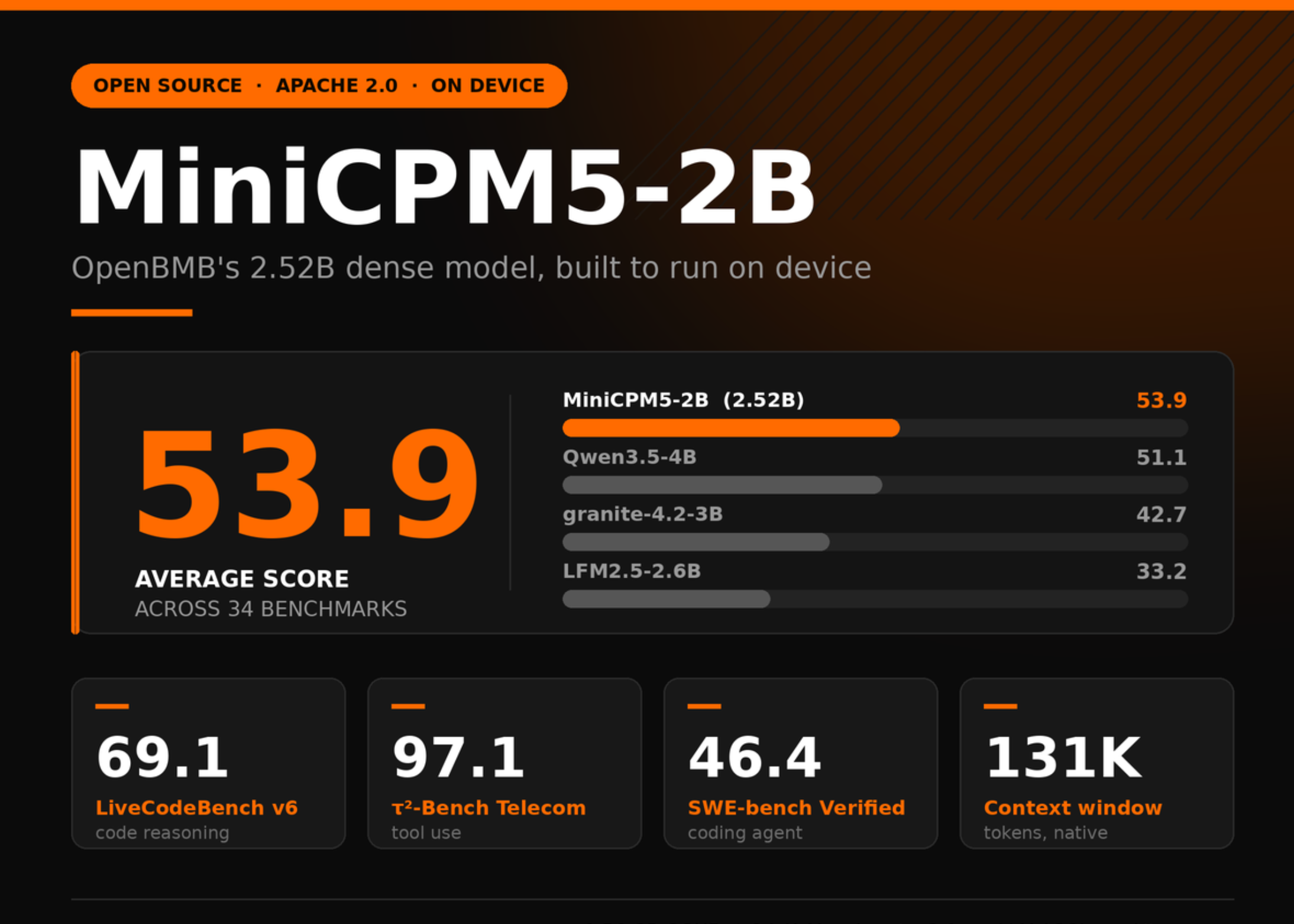
- Licensed under Apache 2.0, it is benchmarked against same-class peers such as LFM2.5-2.6B, Qwen3.5-2B, and Gemma-4-E2B-it, with references including Qwen3.5-4B (51.1), granite-4.2-3B (42.7), and LFM2.5-2.6B (33.2).
Analysis
Table of Contents
- Key Summary
- MiniCPM5-2B Architecture: Standard Llama Fork for Instant Compatibility with 8 Inference Engines
- What the 53.9 Average Across 34 Benchmarks Means for MiniCPM5-2B
- Strengths: Dominating the Baseline in Code Reasoning and Tool Use
- Trade-offs: Long-Context Variability by Benchmark and General-Knowledge Limits
- Training Pipeline: UltraData → 400B SFT → JustRL II → 16-Expert Distillation
- What to Try Right Now
- Practical Application Notes
- Frequently Asked Questions
- Reference Sources
MiniCPM5-2B debuted on September 7 with a spec sheet of 2,516,756,480 parameters and a native context window of 131,072 tokens. Its 53.9 average across 34 benchmarks is 2.8 points ahead of the best same-lineup baseline, Qwen3.5-4B at 51.1. With less than half the parameters, it posts a higher overall score. For the author, the real significance of this model lies in numerically proving that “small doesn’t mean incapable.”
MiniCPM5-2B Architecture: Standard Llama Fork for Instant Compatibility with 8 Inference Engines
MiniCPM5-2B is a dense causal language model with 42 layers and grouped-query attention (16 query heads, 2 key/value heads). Excluding embeddings, it has 1,981,982,720 parameters. The key point is that the architecture is standard LlamaForCausalLM. Eight inference engines—vLLM, SGLang, Transformers, llama.cpp, Ollama, LM Studio, MLX, and FlagOS—run it as-is, without custom kernels or model code forks. Combined with the Apache 2.0 license, this makes it one of the lowest-friction options for teams looking to deploy a 2–3B-class model in real services.
What the 53.9 Average Across 34 Benchmarks Means for MiniCPM5-2B
The single score of 53.9 alone doesn’t tell the full story. Broken down by domain, MiniCPM5-2B’s character becomes clearer. The same-class comparison set includes LFM2.5-2.6B, Qwen3.5-2B, and Gemma-4-E2B-it, while reference points include Qwen3.5-4B (51.1), granite-4.2-3B (42.7), and LFM2.5-2.6B (33.2). The overall 53.9 is the highest figure in this reference pool.
| Benchmark | MiniCPM5-2B | Best Baseline | Gap |
|---|---|---|---|
| 34-benchmark overall average | 53.9 | Qwen3.5-4B 51.1 | +2.8 |
| LiveCodeBench v6 | 69.1 | 56.4 | +12.7 |
| SWE-bench Verified | 46.4 | 33.6 | +12.8 |
| τ²-Bench Telecom | 97.1 | — | — |
| BFCL v4 | 66.6 | — | — |
| τ³-Bench Banking | 20.8 | 6.8 | +14.0 |
| NoLiMa | 68.1 | 43.5 | +24.6 |
| AA-LCR | 59.0 | 61.0 | −2.0 |
| LongBench v2 | 43.7 | 47.3 | −3.6 |
| MMLU-Pro | 70.8 | 78.0 | −7.2 |
| Humanity’s Last Exam | 8.9 | 9.9 | −1.0 |
Strengths: Dominating the Baseline in Code Reasoning and Tool Use
The largest gap is in code. MiniCPM5-2B scored 69.1 on LiveCodeBench v6 and 46.4 on SWE-bench Verified, beating the baseline of 33.6 by 12.8 points. A 2.5B model hitting 46.4 on SWE-bench means it achieves nearly a 50% success rate on tasks that go beyond simple code completion to include multi-turn debugging.
Tool use is even steeper. The τ²-Bench Telecom score of 97.1 is essentially near-perfect, and BFCL v4 at 66.6 and τ³-Bench Banking at 20.8 (baseline 6.8) also far exceed what you’d expect from a 2.5B-class model in function calling and routing. These numbers most directly demonstrate that MiniCPM5-2B is a credible candidate for real agent workloads.
Trade-offs: Long-Context Variability by Benchmark and General-Knowledge Limits
It doesn’t lead on every metric. Long-context results vary by benchmark. On NoLiMa (68.1 vs. baseline 43.5) it leads by 24.6 points, but on AA-LCR (59.0 vs. 61.0) and LongBench v2 (43.7 vs. 47.3) it actually trails. Even with a 131K-token window, there are areas where measured accuracy falls short of the baseline.
General knowledge shows a similar pattern. MMLU-Pro (70.8 vs. 78.0) and Humanity’s Last Exam (8.9 vs. 9.9) are both slightly behind. It’s natural that a model with roughly half the parameters can’t beat a 4B-class model on broad factual recall, so it’s more accurate to view MiniCPM5-2B not as an “all-rounder” but as a “coding- and agent-specialized compact model.”
Training Pipeline: UltraData → 400B SFT → JustRL II → 16-Expert Distillation
Behind these scores lies a staged training design. Base training ran in stable and decay phases using UltraData’s hierarchical data management, followed by 400B-token deep-thinking SFT after mid-training. The RL stage covered four separate domains—math, code, agentic, and writing—with a critic-based teacher called JustRL II guiding the training. The pipeline finishes with on-policy distillation that merges 16 expert models into a single checkpoint.
The model card separately labels rows from Artificial Analysis and internal reproductions, proactively flagging evaluation-consistency issues—a sign that reproducibility was a deliberate priority.
What to Try Right Now
- Download MiniCPM5-2B via Ollama or llama.cpp and measure inference latency directly on a Mac or a single RTX 3090 GPU.
- Pick 30 coding problems from your own domain, run multi-turn debugging, and compare response quality against Qwen3.5-2B and Gemma-4-E2B-it.
- Build 10 BFCL-style function-calling scenarios and re-evaluate tool-use accuracy against your in-house data.
- Stuff 50K tokens of internal documents into the 131K context and check retrieval and summarization accuracy yourself, just like NoLiMa, AA-LCR, and LongBench.
- Confirm Apache 2.0 applicability with your legal team and verify there are no licensing risks around your in-house fine-tuning data.
Practical Application Notes
- When evaluating 2–3B-class models, don’t rely on a single overall average—weight domain benchmarks like LiveCodeBench, SWE-bench, and BFCL into your scoring.
- If you’re considering MiniCPM5-2B for agent workloads, validate function-calling routing separately. Don’t assume the τ²-Bench 97.1 score generalizes to your case.
- If long context is critical, judge models on measured benchmarks like AA-LCR and LongBench rather than the 131K window size alone.
- For on-device deployment, note that the grouped-query attention’s 2 key/value head configuration keeps attention cache memory small but can lower batch throughput, so measure per scenario.
- Once licensing is cleared, the practical sequence is to stand up a first baseline with vLLM or SGLang, then bolster weak areas with JustRL II-style RL fine-tuning.
Frequently Asked Questions
Can MiniCPM5-2B be used directly in commercial projects?
The Apache 2.0 license permits both commercial use and redistribution. However, responsibility for the model’s outputs rests with the user, so it’s safer to decide on adoption after domain-specific evaluation.
A 2.5B model scores higher than Qwen3.5-4B—is it really usable?
The 53.9 average across 34 benchmarks is real. But the lead is concentrated in code and tool use, while it trails by more than 7 points on general-knowledge benchmarks like MMLU-Pro. You’ll need to re-weight the evaluation by domain.
Does MiniCPM5-2B actually run on-device?
Yes—because it’s standard LlamaForCausalLM, it runs out of the box on llama.cpp, Ollama, LM Studio, and MLX. In practice, though, it’s more realistic to use 8K–32K slices than the full 131K context on mobile.
Is there a reason to migrate from previous MiniCPM models?
Context window and code/agent scores have both been lifted compared to the previous generation. For new projects, start with MiniCPM5-2B; for existing systems, compare token usage and response latency before migrating gradually.
The original source material was verified via MarkTechPost’s MiniCPM5-2B coverage. Comparison-group information referenced the same outlet’s IFM K2 Horizon launch article.
Reference Sources
This article was written after checking the following original sources: MarkTechPost — OpenBMB Releases MiniCPM5-2B: A 2.52B Dense Model Averaging 53.9 Across 34 Benchmarks and Built to Run On Device
AI Cancer Treatment Could Become Reality Within 5 Years — Arm CEO Diagnoses the Chip Shortage Wall
Key Takeaways
- Arm Holdings CEO Rene Haas argued in a BBC interview that AI could discover cancer treatments humans would never find in a lifetime
- Haas explained that modeling how DNA markers affect cancer remains “too complex a problem” for both humans and AI computers today
- Haas diagnosed that the current rapid growth of AI is being held back by a shortage of chips needed to build data centers
The CEO of the world’s leading semiconductor design firm simultaneously diagnosed both AI’s potential for medical and industrial innovation and the structural bottleneck of chip shortages, offering an analysis of where the UK tech industry stands and its policy implications
Table of Contents
- Key Takeaways
- The Potential and Limits of AI Cancer Treatment, According to Haas
- The Data Center Bottleneck Created by Chip Shortages
- Arm’s Market Position and the SoftBank-OpenAI Structure
- Humanoid Robots in 5 Years: Optimistic Timeline, Pessimistic on UK Manufacturing
- Key Issues
- What to Do Right Now
- Frequently Asked Questions
- Source Reference
AI cancer treatment could uncover molecules that human researchers would never reach in an entire career. That statement, made by Arm Holdings CEO Rene Haas in a BBC interview, is neither optimism nor pessimism—it is a diagnosis built on two hard constraints: data scarcity and chip bottlenecks.
This past summer, when the AI boom pushed Arm’s stock to an all-time high, the company became the most valuable UK-headquartered firm on a cash basis in history. Arm is a design house that does not manufacture. That fact lends the cool-headed precision of an engineer to Haas’s remarks. When a company that designs CPUs for tens of billions of devices worldwide—phones, cars, smartwatches, gadgets—diagnoses the limits of AI infrastructure, that is not an abstract concern but a reality measured down to the part number.
The Potential and Limits of AI Cancer Treatment, According to Haas
On BBC’s “Big Boss Interview” podcast, Haas acknowledged that modeling how DNA markers influence cancer expression is “too complex a problem” for today’s human researchers—and for AI computers as well. But his vision is that the moment one end of that complexity unravels, AI-generated cancer treatment candidates that humans would never have found in a lifetime could appear on screen.
Prof Chris Bakal of the Institute of Cancer Research (CEO of Sentinal4D) gave the same answer to the BBC. Cancer is a system in which the genome, microenvironment, and time axis are intertwined, and from that perspective, AI’s pattern recognition has room to accelerate research. This is where I find the most significance. In an industry where drug pipelines move on a ten-year timescale, automating molecular-level simulation is a narrative that flips the cost structure itself.
How Far Can the AI Cancer Treatment Timeline Be Compressed?
The compression of timelines that AI cancer treatment could bring is most visible at the candidate discovery stage. Conventional drug development takes an average of 10 to 15 years from candidate identification through Phase III clinical trials, but a conservative estimate is that if AI narrows the search space, the preclinical stage could be shortened to a matter of months. Patient recruitment, regulatory approval, and side-effect verification during the clinical stage, however, still consume the same amount of time and cost. In other words, what AI accelerates is “research,” not “approval.”
The Data Center Bottleneck Created by Chip Shortages
Haas was unequivocal: AI’s growth is being hobbled by a shortage of semiconductors needed to expand data centers. The supply chains for GPUs and high-bandwidth memory (HBM) cannot keep up with demand, pushing back timelines for new data center construction. From a practitioner’s perspective, what stands out is that Arm cannot solve this bottleneck directly. Arm is a CPU design house, while the GPU and HBM markets are dominated by NVIDIA, AMD, and SK Hynix. There is weight in the fact that the person who understands “no one knows how to make the chips” best is the one making that statement.
Arm’s Market Position and the SoftBank-OpenAI Structure
Arm’s parent company, Japan’s SoftBank, bundles together a variety of technology investments, including OpenAI. Haas’s perspective reflects the globally diversified strategy of Japanese capital. The infrastructure investment chain running from OpenAI through Brainwave to London and Stargate is a direct beneficiary path for Arm’s design demand. This past summer, Arm overtook the shale companies within the FTSE 100 to claim the top spot as the most valuable UK-headquartered firm (on a cash basis) in history. It is a signal flare that the design industry is being revalued.
Humanoid Robots in 5 Years: Optimistic Timeline, Pessimistic on UK Manufacturing
Haas predicted that humanoid robots would become commonplace within the next five years. His calculation is that once bipedal platforms are commercialized in mobility, logistics, and household applications, the low-power CPU demand inside them becomes Arm’s next growth engine. On the other hand, he is pessimistic about the possibility of chip manufacturing within the UK. Looking at TSMC Arizona, Intel Ohio, and Samsung’s new Texas plant alone, building an advanced-node fab requires tens of billions of dollars in capital. The UK government’s semiconductor strategy is centered on R&D subsidies, and there are clear limits to securing a large-scale manufacturing base. This past April, Haas also stepped down from the board of UK pharmaceutical giant AstraZeneca. The move appears to be due to differences in decision-making speed between AI healthcare startups and other large pharmaceutical companies.
Global Advanced-Node Investment Comparison
| Region | Key Project | Investment Phase | Notes |
|---|---|---|---|
| Arizona, USA | TSMC Fabs 1–3 | Fab 1 operational, Fabs 2–3 under construction | 3nm node |
| Ohio, USA | Intel New Fab | Early construction | Up to 1.4nm |
| Texas, USA | Samsung Taylor | Partial operation | 4nm node |
| Cambridge, UK | Arm R&D Headquarters | Design hub | No manufacturing |
| Kumamoto, Japan | TSMC JASM | Fab 1 operational, Fab 2 under construction | 12–6nm |
As the table shows, the UK is strong in design capabilities, but there is still a gap to achieving self-sufficient manufacturing infrastructure. This numerically supports Haas’s diagnosis.
Key Issues
- The essence of AI cancer treatment is accelerating drug candidate discovery, not short-term innovation at the point of diagnosis or treatment
- The chip shortage is a training infrastructure bottleneck centered on GPUs and HBM, and Arm is a design house that cannot resolve it directly
- For UK semiconductor self-sufficiency, fab construction capital and supply chain security are bigger variables than policy will
- The commercialization timeline for humanoid robots requires simultaneous maturity across three axes: batteries, actuators, and software
- Arm’s UK-headquartered valuation is read as a signal that the stock market is revaluing the design industry
What to Do Right Now
- Convert Arm’s quarterly stock price into relative return against the FTSE 100 to capture the six-month trend
- Listen to the original BBC “Big Boss Interview” podcast to gauge Haas’s tone directly
- Track weekly data center capex announcements from AI labs such as OpenAI, Anthropic, and xAI
- Set up alerts for AI cancer treatment industry news and monitor on a quarterly basis
- Compile new fab construction timelines from TSMC, Intel, and Samsung into a single table and compare with UK investment
Frequently Asked Questions
When did Haas give this interview?
The content was published in autumn 2025 on BBC’s “Big Boss Interview” podcast and accompanying article. The timing coincides with the period following Arm’s all-time stock price high.
Does Arm conduct AI cancer treatment research directly?
No. Arm is a chip design house that supplies CPUs for AI infrastructure, and drug R&D is a separate field. Haas’s remarks are closer to a macro-level diagnosis.
Can the UK manufacture advanced chips?
Haas himself stated he is pessimistic. The industry consensus is that capital, talent, and supply chains are all lacking compared to TSMC, Intel, and Samsung.
What does “humanoid robots in 5 years” actually mean?
It refers to the point at which bipedal robots are deployed in limited forms in households, logistics, and manufacturing sites—not fully autonomous household robots.
Source: BBC News – Arm CEO Rene Haas Interview
Source Reference
This article was prepared after reviewing the following original source: BBC News — AI cancer cures slowed by chip shortage, says UK’s biggest tech boss
3 Major Shifts in Financial Internal Controls — From Post-Audit to Continuous Monitoring

Key Takeaways
- Cases of financial firm employees unauthorized viewing and private misuse of customer transaction data have surfaced in succession, exposing the structural limits of existing internal control systems.
- Unauthorized data download incidents caused by negligent management of outsourced development and operations staff have brought the control vacuum over partners and contractors to the forefront.
- It is increasingly recognized that periodic post-audits based on sampling alone cannot detect sophisticated insider threats in a timely manner.
A balanced explanatory article analyzing the background of the paradigm shift in financial internal controls, the authorities’ moves toward tighter regulation, and the practical implications of a continuous monitoring framework
Table of Contents
- Key Takeaways
- Structural Limits of Legacy Post-Audits and Sophisticated Insider Threats
- Regulatory Tightening: The Accountability Map and Two Major Legislative Amendments
- Four Core Elements of a Continuous Monitoring Framework
- Where Are Financial Internal Controls Headed?
- Issues at a Glance
- What to Do Right Now
- Comparison: Legacy Post-Audit vs. Continuous Monitoring
- Frequently Asked Questions
- Reference Source
An incident that exposed the blind spots of financial internal controls occurred at a commercial bank in 2024. An internal review belatedly revealed that a responsible employee had repeatedly accessed transaction information of roughly 10,000 customers outside of business hours. The information had already leaked externally, and the damage was discovered only by chance before it could grow further. This case starkly demonstrated the reality that periodic sample-based post-audits cannot catch insider threats in a timely manner.
Since then, financial internal controls have reached a fundamental inflection point. The shift from periodic post-audits to access-log-based continuous monitoring, and from ambiguous executive responsibility to concrete accountability under the accountability map (chaegimgujo-do), is accelerating. According to a Boan News report, a significant share of recently uncovered internal data leak cases occurred through after-hours access and outsourced personnel pathways.
Structural Limits of Legacy Post-Audits and Sophisticated Insider Threats
Most financial firms have operated internal controls in the form of monthly or bimonthly sample audits. The approach extracts roughly 0.5–1% of all transactions at random and verifies them after the fact. These structural limits have long been pointed out in financial internal control practice, but they have been difficult to change due to cost and staffing constraints.
The problem lies in the 99% that falls outside the sample. If an insider deliberately targets blind spots, a sample audit becomes ineffective. Access during off-hours, holidays, or through partner accounts is largely missed by the sample. What concerns me most at this point is that the more sophisticated the insider, the more precisely they understand the common weakness of sample-based audits.
The shape of insider threats has also changed. Beyond simple curiosity-driven access, cases have emerged involving organized exfiltration, indirect access through outsourced development and operations staff, and even abuse of systems while keeping the perpetrator’s own profile clean. A 2023 incident in which a card company contractor downloaded customer information is a representative example, with the absence of permission management cited as the direct cause.
Regulatory Tightening: The Accountability Map and Two Major Legislative Amendments
Financial authorities are reshaping the regulatory framework in line with this reality. The central keyword is the accountability map (chaegimgujo-do). Fully introduced in 2024, the accountability map requires that the specific duties and responsibilities each executive must manage be documented. It carries significant meaning in that it renders the excuse “I didn’t know” no longer valid.
Amendments to the Credit Information Act and the Personal Information Protection Act are also moving in the direction of greater stringency. Notification obligations in the event of a personal data breach have been clarified, the cap on administrative fines has been expanded, and provisions for the direct liability of the CEO have been introduced. A former bank executive noted, “Wrongful instructions or negligence can now lead directly to personal criminal liability, so the awareness of the executive ranks itself has changed.” From a practitioner’s perspective, the most visible change is that compliance teams are beginning to shift their center of gravity from formalistic checks to substantive control functions.
Four Core Elements of a Continuous Monitoring Framework
So what should continuous monitoring look like in practice? The core is the comprehensive collection of access logs and real-time analysis.
First, user access logs from all business systems must be unified into a single log repository. Branch terminals, call centers, outsourced partner VPNs, and administrator consoles all need to be recorded with consistent timestamps and user IDs for meaningful analysis. Second, anomaly detection rules must be designed with sophistication; the key is to move beyond simple thresholds toward behavioral pattern analysis.
Third, detected anomalies must be designed to be automatically reported to the compliance team and the responsible executive. If detection and response are separated, effectiveness is halved. Fourth is partner and contractor management. Access rights for outsourced personnel must be minimized to the task level, and permissions should be set to be automatically revoked at the end of a work session.
Where Are Financial Internal Controls Headed?
The transition in financial internal controls is now less a question of system implementation and closer to one of organizational culture. Continuous monitoring inherently invites resistance as ongoing surveillance of employee behavior. The message that monitoring is a means of protecting employees and customer trust must be clearly conveyed at the corporate level before that resistance can be reduced.
It is also not uncommon for organizations to collect data but fail to analyze it. Real effectiveness requires pairing the deployment of tools such as SIEM with the development of analytical talent. Ultimately, the essence of financial internal controls is shifting from “who is responsible after an incident occurs” to “how to catch it before an incident happens.” The center of gravity is moving from after-the-fact to always-on, from samples to full coverage, and from formalistic responsibility to substantive accountability. That process is underway right now.
Issues at a Glance
- Because continuous monitoring entails ongoing surveillance of employee behavior, alignment around a corporate-level purpose and rationale must come first.
- Without growing analytical capacity alongside the increase in access-log volume, there is a risk of alert fatigue and purely formal operation.
- Minimizing partner and contractor access rights at the task level, along with automatic revocation policies at the end of work, is the key mechanism for closing the control vacuum.
What to Do Right Now
- Identify the current sample extraction ratio and inspection cycle of the internal control system and report to management the need to introduce continuous monitoring.
- Check whether access logs from all enterprise systems are unified into a single log repository, and draft an integration plan if gaps exist.
- Derive core anomaly rules—such as bulk queries outside business hours and out-of-scope access—and register them in detection systems such as SIEM.
- Review the access-rights policy to ensure outsourced partner permissions are minimized at the task level and automatically revoked at the end of a work session.
- Design an escalation path so that detected anomalies are automatically reported to the compliance team and executives.
Comparison: Legacy Post-Audit vs. Continuous Monitoring
| Category | Legacy Post-Audit | Continuous Monitoring |
|---|---|---|
| Inspection Method | Monthly/bimonthly sampling (0.5–1% of total) | Real-time analysis of 100% of access logs |
| Detection Timing | After the incident, after the fact | Immediately when an anomaly occurs |
| Scope | Primarily regular employees | Regular employees plus outsourced partners |
| Accountability | Ambiguous responsibility at the team level | Specific responsibility per executive under the accountability map |
| Anomaly Response | Manual investigation if found in the sample | Automated alerts and escalation |
Frequently Asked Questions
What is the key difference between the accountability map and previous financial internal controls?
The accountability map requires that the specific duties and responsibilities each executive must manage be documented. Previously ambiguous areas that made it hard to assign blame have been eliminated, and when a problem occurs, the responsible party can be identified immediately.
Does continuous monitoring lower employee morale?
Such concerns are natural, but clearly explaining the purpose of monitoring as protecting customer information and employees—and limiting its scope to work-related activity—can substantially reduce resistance. It is most effective when paired with an internal communications strategy.
What is the biggest technical challenge when introducing access-log-based continuous monitoring?
Log integration and real-time analysis. Building the infrastructure to consolidate access logs scattered across multiple systems into a single repository and analyze them in real time with tools such as SIEM must come first for meaningful detection to be possible.
Can small financial firms also adopt a continuous monitoring system?
If building an entire SIEM in-house is difficult, cloud-based security analytics services can be used. What matters is not the size of the tool, but the completeness of log integration and anomaly rules.
Reference Source
This article was prepared by reviewing the following original source: Boan News — Strengthening the Effectiveness of Financial Sector Internal Controls: From ‘Periodic Post-Audits’ to ‘Access-Log-Based Continuous Monitoring’
$3.2 Billion Multi-Corporate AI Data Center Structure Exposes Accountability Gaps — Lessons from the Lake Mariner Fire
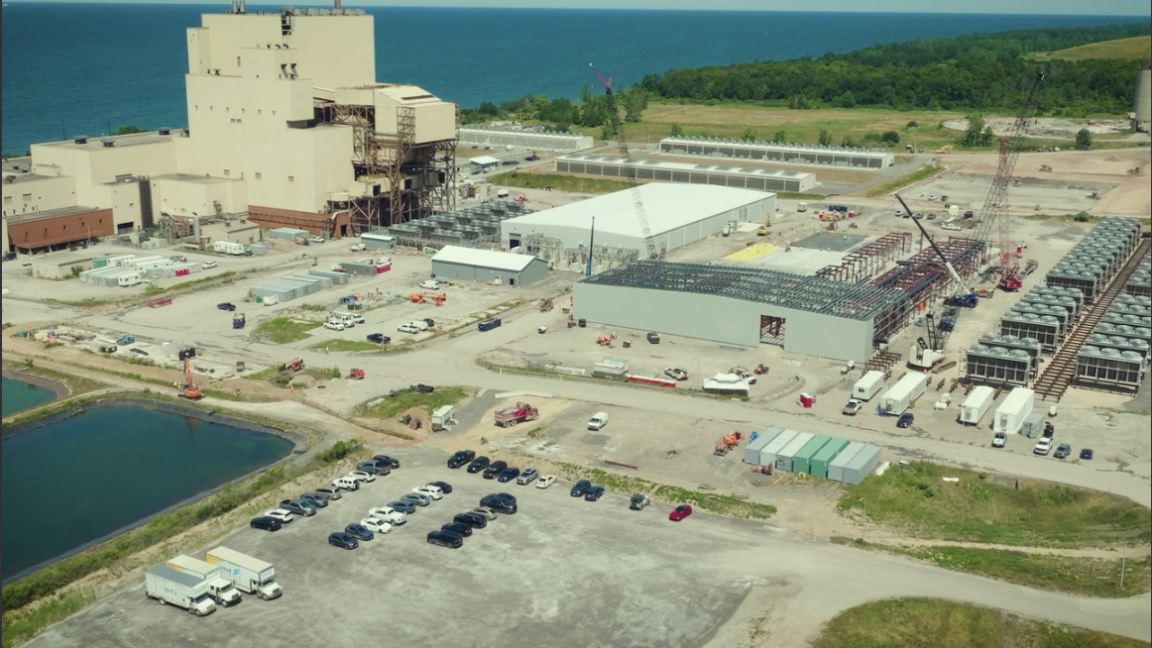
Key Summary
- In early June 2026, a fire broke out at a new Lake Mariner data center building in Somerset, New York. The facility is part of a $3.2 billion AI data center campus.
- Fire Chief Steve Matisz of the Barker Fire Department stated that there were no functioning fire alarms, extinguishing equipment, or operational hydrants at the time of suppression efforts, and that safety documents legally accessible to firefighters were reportedly destroyed in the fire.
- The site is located on a former coal mining area along the shores of Lake Ontario and is one of the largest AI data center construction projects in New York State.
Analysis
Table of Contents
In early June 2026, a fire broke out at a new Lake Mariner AI data center building in Somerset, New York. Fire Chief Steve Matisz of the Barker Fire Department, who was deployed to the scene, stated that not a single fire alarm, extinguishing system, or hydrant was operational. What began as an incident at a $3.2 billion campus is not merely a fire; it is a case that lays bare the accountability vacuum within multi-corporate AI data center structures.
At least four companies are involved in this campus. TeraWulf owns and operates the land and buildings, the UK-based AI company Fluidstack handles operations, Google guarantees Fluidstack’s lease payments and holds warrants for a future 14% equity stake, and Anthropic is included as a compute customer. From a practitioner’s perspective, what stands out is the land lease structure. It is reported that a company owned by TeraWulf’s own CEO leased the land to TeraWulf — a mechanism that appears to blur who holds operational safety obligations.
| Company | Role | Stated Safety Obligations |
|---|---|---|
| TeraWulf | Owner/operator, campus operating company | Acknowledged in official response |
| Fluidstack | Operating entity (UK AI company) | No separate statement |
| Lease guarantor + 14% warrant | No separate statement | |
| Anthropic | Compute customer | No separate statement |
TeraWulf’s Chief Strategy Officer Kerri Langlais officially responded that TeraWulf assumes responsibility for operational safety, emergency response, essential safety equipment, and coordination with local fire authorities. It is a glamorous acknowledgment of responsibility. However, the report that firefighters were unable to access safety documents during the fire and that those documents were destroyed in the blaze plainly illustrates the gap between “having responsibility” and “actually fulfilling that responsibility.”
The author considers this point to be the most significant. Accountability does not refer to a device that prevents a fire; it refers to the channel through which firefighters and the local community can receive information after a fire. In a state where it is not even specified who locks that channel within a multi-corporate AI data center structure, the statement that “TeraWulf takes responsibility” amounts to little more than a legal shield.
The original story was covered in detail in an Ars Technica analysis, and reports that RAM price surges are simultaneously driving up AI infrastructure expansion costs are cross-verified in The Verge’s supply chain analysis.
Where Does the Problem of Singly Attributing AI Data Center Safety Responsibility Originate?
Lake Mariner encapsulates the contradictions of multi-corporate AI data center structures. TeraWulf states it is the responsible party, but what obligations does Google — with its funding guarantees and equity warrants — bear? What about Fluidstack, which holds operational authority, or Anthropic, which generates the demand? If no single company is explicitly legally obligated to contact frontline firefighters directly, then it becomes unclear who to call when a report comes in. This is not a problem unique to Lake Mariner. Nearly every large AI data center campus being built across the United States adopts a similar multi-corporate structure.
Key Issues
- The single entity contractually responsible for operational safety must be clearly designated within multi-corporate AI data center structures.
- Where land leases are arranged with companies owned by the operating firm’s own CEO, conflict-of-interest disclosure obligations should follow.
- Pre-construction fire department awareness and remote access systems for safety documentation should be mandated.
- The scope of emergency response contributions from funding and demand-side players such as Google and Anthropic needs to be defined in advance.
What You Can Do Right Now
- Identify the list of participating companies at AI data center campuses under construction or set to operate near your residence.
- Submit a written request to the operator asking which entity holds safety responsibility and what the emergency contact network looks like.
- Map the locations of data centers within your local fire department’s jurisdiction and subscribe to fire service notification channels.
- Where lease structures overlap with companies owned by the firm’s own executives, raise the disclosure status as an agenda item at shareholder meetings.
- Check whether corporate ESG reports separate data center safety metrics into their own dedicated category.
Frequently Asked Questions
When and where did the Lake Mariner AI data center fire occur?
In early June 2026, a fire broke out at a new Lake Mariner building in Somerset, New York. The facility is part of a $3.2 billion campus being constructed on a former coal mining site along the shores of Lake Ontario.
Why is TeraWulf’s claim of safety responsibility insufficient?
Statements emerged that the safety documents firefighters were legally required to access were destroyed during the fire, and that there were no operational alarms or hydrants. Identifying who the responsible party is and ensuring that responsibility is actually carried out are two separate matters.
What is Google’s and Anthropic’s relationship to this fire?
Google guarantees Fluidstack’s lease payments and holds warrants for a future 14% equity stake. Anthropic participates as a compute customer. Neither company has made any official statement regarding safety obligations.
Why is a land lease structure with a company owned by the firm’s own CEO problematic?
When the lessor is the same individual as the operating company’s CEO, a conflict of interest arises between lease terms and operational decision-making. It becomes difficult for external audits to determine who bears the cost of emergency response funding and who sets facility investment priorities.
Source Article
This article was prepared by verifying the following original source: Ars Technica — The complex corporate web behind a $3.2 billion AI data center
4 Criteria for AI Job Risk — A Checklist to Ease White-Collar Anxiety
Key Takeaways
- Context of the original post: Repeated news that AI is cutting CS jobs has triggered community recommendations to switch to other white-collar fields (accounting, general engineering, law, etc.), and a user who questioned those recommendations ended up concluding that “no job is safe.”
- The reasoning trap in the original post: A tendency to generalize threats at the job level (“if job A is at risk, so is job B”), with the author reaching a conclusion while openly doubting it—writing “Maybe I’m just dumb”—rather than holding a firm view.
- Common solutions surfacing in the community: ① Breaking AI exposure down at the task level rather than the job level; ② Distinguishing licensed and accountability-bound fields (CPA, patent attorney, physician, etc.) from open-market fields; ③ Separating work that requires physical presence, clients, or on-site activity (audits, installations, court appearances, etc.) from work that can be split into document and coding stages.
Analysis
Table of Contents
AI job risk has been a serious topic of conversation among white-collar workers for some time now. The pattern is familiar: a headline says “CS is shrinking,” and within days the anxiety spreads as “won’t every other white-collar job face the same fate?” The same worry keeps surfacing in community threads (a post asking whether any role is safe after leaving CS). I don’t think this question can be brushed off lightly.
Why the Same Anxiety Keeps Repeating
The conclusion that “no job is safe” usually comes from two leaps of generalization. The first is accepting the news that “job A is under threat.” The second is extending that to “jobs B, C, and D are probably in the same boat.” The problem is that the second leap happens at the job level.
When you judge a profession as a single block, you mix tasks that are easy to automate with tasks that aren’t, even though they share the same job title. Under the label “accounting,” routine data entry sits next to auditing and advisory work. Under “engineering,” new design sits next to operations and incident response. In this process, the fact that AI job risk emerges from “task fragments,” not from “occupations,” gets buried.
In my view, this is the most important point. Even within the same occupation, your exposure looks completely different depending on which fragment you sit in.
4 Criteria That Determine AI Job Risk
Synthesizing the analyses that keep appearing in the community, exposure can be broken down into four axes: rule-based and repetitive structure, accountability for outcomes, dependence on physical and relational context, and labor supply oversupply. Map your own tasks against these four and the answer comes from task composition, not job title.
| Criterion | High Exposure | Low Exposure |
|---|---|---|
| Rule-based structure | Standardized input, repetitive documents | Exception handling, new design |
| Accountability | Just receiving and recording results | Approval, audit, advisory |
| Physical / relational | Code and documents on screen | On-site, client meetings, field dispatch |
| Labor supply | Plentiful replacement workforce | Licenses and certifications required |
When you fill in the table, the more of your tasks that fall in the right column, the slower you’ll be swept up by the same wave of AI job risk. This scorecard is a tool that reframes AI job risk in terms of task composition rather than job title.
Common Misconceptions
The advice “since CS is risky, move to another white-collar field” is half right and half wrong. The right half: software development does face automation pressure on the coding fragment. The wrong half: treating accounting, law, and engineering as a safe harbor. Those professions also have their “standardized input” stages, and that’s where humans get pushed out.
Another mistake is equating headlines with the actual rate of automation. On-the-ground reality and news headlines usually differ by 2 to 3 years. If you narrow your career choice to “which field is less risky,” you risk losing your interests and strengths. AI job risk is not a matter of closing the gap between fields—it’s a matter of closing the gap within a field.
What to Do Right Now
- Break your current job into 10 tasks and write a one-line note for each against the 4 criteria (rule-based structure, accountability, context, supply).
- Check whether tasks marked “high exposure” on 3 or more of the 4 criteria make up more than half of your work.
- If a majority of your tasks are high-exposure, propose to your manager within 6 months that you shift toward the safer column within the same organization.
- Set a calendar reminder to recheck every 6 months whether the share of safer-column tasks is growing.
- Track job posting data and actual changes in task composition separately, rather than relying on headlines.
Practical Application Points
The 4-criteria scorecard can be used as-is even when you change industries. Apply the same table to accounting, legal, and operations roles, and the very category of “a safe job” starts to look fuzzy. At that point, the answer to AI job risk comes from task composition, not from job titles.
Even if your scores aren’t great, attempting to renegotiate the mix of tasks within your current organization is usually cheaper than an immediate job change.
Frequently Asked Questions
Which profession has the lowest AI job risk?
Rather than the profession itself, roles whose tasks fall mostly in the “low exposure” column of the 4 criteria are safer. Roles that combine a license, accountability, and on-site presence generally fall into that column.
Are there other safe fields if I cut back on coding?
They exist but aren’t guaranteed. Every profession faces automation pressure at its standardized-input stage, so you need to check directly which fragment you’ll be assigned to.
How much do headlines differ from the actual pace of automation?
On-the-ground estimates put the gap at about 2 to 3 years. If you’re taking AI job risk seriously, you need the habit of tracking job posting numbers and real changes in work content separately.
How do I run a 6-month recheck?
Set a calendar reminder and re-score your 10 tasks against the same 4-criteria scorecard. If any item’s score has improved, negotiate to spend more time on that task.
Six months from now, fill in the same scorecard again. Where the seat you’re sitting in falls on the table—and whether that column is the same as it was six months ago—will be your own personal answer to AI job risk.
Reference
This article was written after reviewing the following original post: r/cscareerquestions — If CS is cooked because of AI, why wouldn’t every other white collar job be either?
Expert Commentary (AI)
Labor Economics Expert
Breaking work down at the task level aligns with standard labor economics, but the 4-criteria model is unfinished because it blends automation risk and labor-market competition into a single axis
The approach of measuring automation exposure at the task-fragment level rather than the occupational level matches almost exactly the standard unit of analysis that Autor’s routine task intensity work and the Acemoglu-Restrepo task-based framework have been building for nearly 20 years. Shifting the anxiety from “no job is safe” to “no task composition is safe” is academically constructive. However, “labor supply oversupply” is a wage-pressure factor driven by labor-market competition, not by technical automation potential. When two fundamentally different risks are merged into a single score, you can’t distinguish a “slowly declining role” from an “automation target role.” Missing variables are also clear: the productivity-amplification potential of using AI as a complement rather than a substitute, the relative size of labor cost versus the cost of adopting automation for a given task, and the ease of acquiring domain data are all absent. The physical and relational context axis is a valid defense line at today’s technology level, but given the rate of improvement in humanoid robots and multimodal agents, this criterion is a dynamic condition that must be revalidated every 3 to 5 years—not a fixed value. In short, the skeleton is valid, but per-criterion weights and an AI-complement strategy axis need to be added before it becomes a practical tool.
HR & Organizational Strategy Expert
A practical shift of the management point from job choice to task redesign—but the design overestimates individuals’ negotiation power inside their organization
Suggesting that you first try to renegotiate the mix of tasks within the same organization rather than switching jobs—a high-cost alternative—is reasonable from a switching-cost perspective, and organizationally rational given that internal labor markets have less information asymmetry than external ones. The 6-month recheck calendar is a device that converts abstract anxiety into a repeatable routine and is genuinely effective for securing execution. However, the success of a task-reassignment negotiation depends on the manager’s handover costs, the organization’s evaluation and compensation system, and the actual bargaining power the individual holds, so the “you can control your task composition” assumption the checklist implies is often significantly overestimated in practice. Self-assessment of your own task exposure is also vulnerable to a cognitive bias that rates your own work as more creative and less routine than it really is, so the scorecard loses reliability without cross-referencing a job description or third-party feedback. The biggest design shortcoming is that the answer it offers only points toward “avoiding” high-exposure tasks. In reality, a stronger survival strategy is a complementarity shift—carrying out high-exposure tasks alongside AI while building capabilities in review, exception handling, and tool operation.
Critical Analyst
The “no job is safe” fear itself is becoming a storefront for someone’s products and courses
The official narrative dresses up the public’s fear as a checklist and sells it as reassurance, which sounds clean on the surface. But look underneath and the biggest beneficiaries of the message that “every white-collar worker is at risk” are the AI-tool vendors and the reskilling, edtech, and career-coaching industries that monetize that anxiety. A striking number of the loudest voices saying “CS is over” are either selling coding agents or are executives looking to cut headcount—and the direction of those arguments lines up with the direction of their profits. In fact, the post-2023 CS hiring contraction lines up almost exactly with rate-hike-era tech restructuring and the cleanup of pandemic-era overhiring, but reading all of that as a single “AI did it” frame completely hides the traditional restructuring underneath. And the prescription to “move from high-exposure tasks to safe tasks within 6 months” is packaged as an individual survival strategy, but from the organization’s point of view it can be repurposed directly as a no-cost workforce-restructuring procedure in which employees reconfigure themselves without a pay raise. What we should really be paying attention to is not the items on the checklist, but where this anxiety is generated and whose revenue it flows into. The next time you see a message that says “your job is at risk too,” check the sender’s financials first.
Underlying Scenarios
- The recommendation to renegotiate task ratios could be repurposed by the organization as a same-pay job-expansion and devaluation tool—if individuals volunteer to move into lower-exposure, lower-value tasks, the organization can complete a workforce restructuring without offering any incentive.
- The timing at which “every profession is at risk” headlines circulate keeps overlapping with AI product launch campaigns and subscription education sales seasons, which is hard to read as coincidence—circumstantial evidence that a significant share of the actual labor-demand decline originated in rate-hike-era tech restructuring supports this delay and distortion.
- Anxiety threads repeatedly surfacing to the top of Reddit-style communities is the result of a recommendation-algorithm structure that amplifies fear responses, and there’s a real possibility that community sentiment is now spreading faster than actual labor-market data—a reversal of the usual order.