Author: l0cknsec

  • OpenAI Forms Math Advisory Group — The 3 Authority Limits Behind 100 Unsolved Problem Claims

    OpenAI Forms Math Advisory Group — The 3 Authority Limits Behind 100 Unsolved Problem Claims

    Key Summary

    • OpenAI announced the launch of its ‘Advisory Group on Mathematics and Artificial Intelligence’ on September 21, 2026, at the Institute for Advanced Study in Princeton, New Jersey.
    • The group’s stated purpose is to serve as a bridge between the mathematics community and the general public. The company explained, ‘This group will serve as a bridge that allows mathematicians to have a voice in the direction we are headed.’
    • The launch came immediately after an internal model suddenly published a solution to the Navier-Stokes Millennium Prize problem, and OpenAI added that the same model had solved more than 100 open problems across mathematics.

    news_analysis

    Table of Contents

    On September 21, 2026, the OpenAI Math and AI Advisory Group officially launched at the Institute for Advanced Study in Princeton, New Jersey. That same day, the company revealed a solution to the Navier-Stokes Millennium Prize problem alongside its claim that its model had solved more than 100 open problems. Whether the timing was coincidence or a deliberate shock effect, the author leans toward the latter.

    The OpenAI Math Advisory Group: Where Authority Ends

    The group’s official role is to serve as a bridge between the mathematics community and the general public. The company explained that it ‘will serve as a bridge that allows mathematicians to have a voice in the direction we are headed.’ But TechCrunch’s initial report shows that actual authority is narrow.

    Members serve without compensation and hold only the right to offer voluntary advice, issue public statements, and self-govern their own membership. There is no explicit authority to slow or redirect OpenAI’s ongoing mathematics research. That single sentence defines the group’s character.

    Why Now — The Crossroads of 100 Problems and the Fields Medalists’ Letter

    Two factors directly triggered the launch. First, an internal model suddenly published a solution to the Navier-Stokes problem. Second, a public letter co-signed by 25 Fields Medal-winning mathematicians emerged last month. The concern: AI labs are racing to solve famous math problems, encroaching on the intellectual territory of mathematicians.

    The OpenAI Math Advisory Group is the company’s response to these two signals. But the form of the answer was not ‘we will halt research’ but rather ‘we will listen to advice’—a posture that echoes the recent OpenAI governance vacuum. The judges the company chooses are still selected within the company itself.

    Who Controls the Pace of OpenAI Math Research?

    Members have the authority to assess the significance of results and to coordinate the timing of public releases. But they have no reach into research pace, priorities, or the selection of target problems. It is a structure of traffic lights on an already-fixed road.

    What stands out to practitioners is the possibility that the OpenAI Math Advisory Group functions less as an authority and more as a buffer that diffuses responsibility. When results become mired in controversy, there is room to wield ‘the advisory group reviewed it’ as a shield.

    The Physical Limits of Verification

    It is difficult to accept the flood of results from OpenAI’s math model without peer review. Considering that the average peer review period for math papers ranges from months to years, it is practically impossible for the group to verify more than 100 problems in a short timeframe. There is a clear risk that advisory group review will amount to a symbolic procedure.

    What to Do Right Now

    • Save the advisory group launch announcement and authority-scope statements as a PDF
    • Build a checklist for distinguishing whether a primary source for an AI math result is an official announcement or third-party verification
    • Hold one internal discussion with colleagues in mathematics on the authority limits of the advisory group
    • Place the original 25 Fields Medalists’ public letter and the company’s response side by side for comparison
    • Set up an RSS feed to monitor future advisory group membership changes and public statements

    Frequently Asked Questions

    Has the membership of the OpenAI Math Advisory Group been disclosed?

    As of the announcement, no specific roster was disclosed. The company explained that members would serve without compensation, offer voluntary advice, issue public statements, and hold self-governance over their own membership.

    Can the advisory group halt research?

    No. It only advises on the significance of new results and coordinates the timing of public releases; it does not hold authority over the pace or direction of research.

    What is the core concern in the Fields Medalists’ letter?

    That AI labs are racing to solve famous math problems and encroaching on the intellectual workspace of mathematicians. The launch of the advisory group reads as a formal response from the company to that letter.

    Can the Navier-Stokes solution be trusted?

    It has not yet undergone third-party peer review. The advisory group will take on the review, but given the physical limits of verifying 100+ results in a short time, a cautious approach is warranted.

    Summary of Issues

    • The structural gap between advisory authority and the absence of research control
    • The lack of an independent verification body for the 100+ open problem solutions claimed
    • The formality of the company’s response to concerns raised by 25 Fields Medalists
    • Whether the self-governance of membership constitutes the minimum unit of substantive independence
    • The cumulative impact on academic trust of releasing results without peer review

    The launch of the advisory group is a signal that OpenAI Math research will no longer stay inside a laboratory. But within a structure closer to the diffusion of responsibility than to actual rights, how far the attempt to secure the mathematics community’s autonomy will reach will be revealed in the first public statements and subsequent membership changes.

    Source

    This article was prepared after reviewing the following original source: TechCrunch — OpenAI forms math advisory group as its AI resolves more than 100 open problems
  • A 4-Step Survival Plan for the AI Developer Displacement Scenario — What 20-Something SW Engineers Should Prepare Now

    A 4-Step Survival Plan for the AI Developer Displacement Scenario — What 20-Something SW Engineers Should Prepare Now

    Key Summary

    • Original post situation: The current role offers a good salary and healthy work-life balance, and the employer has no history of layoffs, but the main source of anxiety is the external forecast that AI could replace coding work within 5 to 20 years.
    • The original poster is an early-20s developer with only a CS bachelor’s degree, asking whether they need to build an exit path or pursue retraining now in order to secure stability until early retirement at age 65.
    • Recurring community solution #1: Beyond simply maintaining an emergency fund, the most common advice is to leverage a high income for aggressive investing and extend the plan toward FIRE (Financial Independence, Retire Early), building a thicker financial safety net.

    Analysis

    Table of Contents

    Many people want to calculate whether the AI developer displacement scenario will actually materialize within 5 to 20 years, and whether their current salary and work-life balance can be sustained until retirement at 65. If the act of writing code is automated, what remains in that role? It is necessary to decide whether to secure alternative options in advance.

    The current job is satisfying, and since the employer has no history of layoffs, there are no immediate warning signs. Yet something still nags at the back of the mind, because forecasts about AI replacing coding work pour in through new articles and videos every day. From a practitioner’s perspective, what stands out is not the size of the anxiety, but which procedure we use to reduce it to manageable terms.

    Why the Same Concern Keeps Repeating

    The question of whether an early-20s developer who started with only a CS bachelor’s degree can sustain themselves through coding alone for more than 40 years until retirement is not a personal problem. As tool replacement cycles grow shorter, even within the same job category, conservative and aggressive individuals diverge in tone. The AI Job Risk 4-Criteria Checklist shows that roles centered on repeated pattern recognition and document generation carry a higher exposure score, which places a portion of the SW job category within that range.

    Judgment Criteria — Where You Stand on AI Developer Displacement

    Even with the same worry, the meaningful actions you should take can differ. You need to first define your position along two axes.

    • Time axis: Do you see the risk arriving within 1 to 2 years, or as a long-term scenario 5 to 20 years out?
    • Exposure axis: Is your area deeply abstracted, like backend or infrastructure, or is it heavy on simple CRUD and document code generation?

    A short-term, high-exposure combination makes it reasonable to immediately start experimenting with side jobs and adjacent roles. A long-term, low-exposure combination makes it better to focus on learning and strengthening your financial safety net, then re-read the signals on a 1 to 2-year cycle.

    Three Repeatedly Validated Solutions from the Community

    First, the financial safety net. A 6-month emergency fund is the baseline, and when market volatility is taken into account, 12 months is frequently cited as the safe line. A persistent piece of advice is to not stop at the emergency fund but to leverage your high income for aggressive saving and investing, and to expand the scope all the way to FIRE (Financial Independence, Retire Early), building the financial cushion thicker.

    Second, increasing your residual value within the current role. The common execution advice is to rapidly absorb new frameworks and AI tools while simultaneously building soft skills such as code review, mentoring, and product decision-making, in order to raise your probability of avoiding layoffs.

    Third, hedging into adjacent areas. The dominant approach is to extend the role by laying bridges through PM transitions, technical writing, or freelance side jobs. Because critiques note that a CS bachelor’s alone is insufficient, domain knowledge and product sense need to be filled in separately. The same direction is repeated in the original thread on SW escape plans.

    There is also a clear counter-view. Warnings exist that asset value can collapse alongside a broader market downturn, so an investment portfolio alone cannot offset unemployment risk. A perspective that AI developer displacement may itself be exaggerated fear also exists in parallel, and the view that developer demand adapting to tool changes will continue is actually closer to the majority.

    Common Mistakes — When AI Displacement Anxiety Takes Over

    One is attempting a reckless career change while being swept up in short-term news cycles. On the opposite end, ignoring the change and settling into the status quo is equally a warning sign. I find this point the most meaningful. Maintaining an escape-ready state costs far less than actually deciding to escape.

    4-Step Execution Roadmap

    The most commonly agreed-upon structure groups actions into 6 to 12-month blocks and re-reviews strategy on a 1 to 2-year cycle.

    Stage Period Core Action Completion Criteria
    Stage 1: Financial Buffer 0–3 months Build a 6–12 month emergency fund, organize fixed expenses Cash assets equal to 1 year of living expenses after job loss
    Stage 2: Learning 3–9 months Deepen AI tool skills, choose 1 domain Skills sufficient to interview for an adjacent role
    Stage 3: Hedging Experiments 6–12 months 1–2 side jobs, freelance work, or side projects 10% of monthly income generated outside the main job
    Stage 4: Re-Review 1–2 year cycles Check market signals, company climate, asset allocation Write a revised roadmap

    What to Do Right Now

    • List monthly fixed expenses in a table and calculate the required cash for both 6-month and 12-month scenarios
    • Honestly rate, on a 0–100% scale, the share of your current tasks that could be replaced by AI
    • Pick 1–2 adjacent roles that interest you and design a 4-week weekend learning plan
    • Inventory your side-job-ready skills and set a goal of finding your first client within 90 days
    • Pin a 1-year-later re-review date on your calendar, then re-read this article and your notes at that time

    Practical Application Points

    • Use AI developer displacement worries only as a trigger to build an action procedure, not as fuel to amplify emotion
    • Calculate the financial buffer under two separate scenarios (full job loss, partial income reduction) and prepare redundantly
    • Translate the residual value of your current role into tool-absorption speed and domain depth
    • Run adjacent-role experiments in 6-month chunks, keeping losses within one month’s income
    • At each 1–2 year re-review, look at market signals, company climate, and asset allocation simultaneously

    Frequently Asked Questions

    Is AI developer displacement really happening?

    Partially, yes — it is already underway. Automation rates are rising quickly in repetitive code generation and document writing tasks. However, in areas intertwined with system design and domain judgment, demand is more likely to be reshaped in forms that adapt to tool changes.

    How much emergency fund is appropriate?

    A 6-month equivalent of monthly fixed expenses is the general baseline, but for roles like developers — where assets are heavy and side-job potential is high — a 12-month equivalent is often taken as the safety line. It is more accurate to split scenarios into job loss and partial income reduction and calculate them separately.

    Should I switch careers right now?

    Not necessarily. Building an escape-ready state costs far less than deciding to escape. The sensible default is to keep the main job while running side projects and learning in parallel for 6–12 months, until market signals become clearer.

    Is a CS bachelor’s degree alone enough?

    As the share of coding itself shrinks, domain knowledge and product sense grow more important. Many assessments say a CS bachelor’s alone is not enough, and additional competencies need to be deliberately designed when expanding into adjacent roles.

    Closing — Not an Escape, but an Escape-Ready State

    The AI developer displacement scenario is not a one-off news story; it is a signal of structural change. However, there is no need to flip your decisions every day in response to that signal. Managing the three axes of finances, capabilities, and networks simultaneously, while re-reviewing strategy every 1–2 years, is the lowest-cost path. The starting point is defining your own position on the two axes today.

    Reference Original

    This article was written after verifying the following original source: r/cscareerquestions — Should I have an escape plan from the software engineering field?

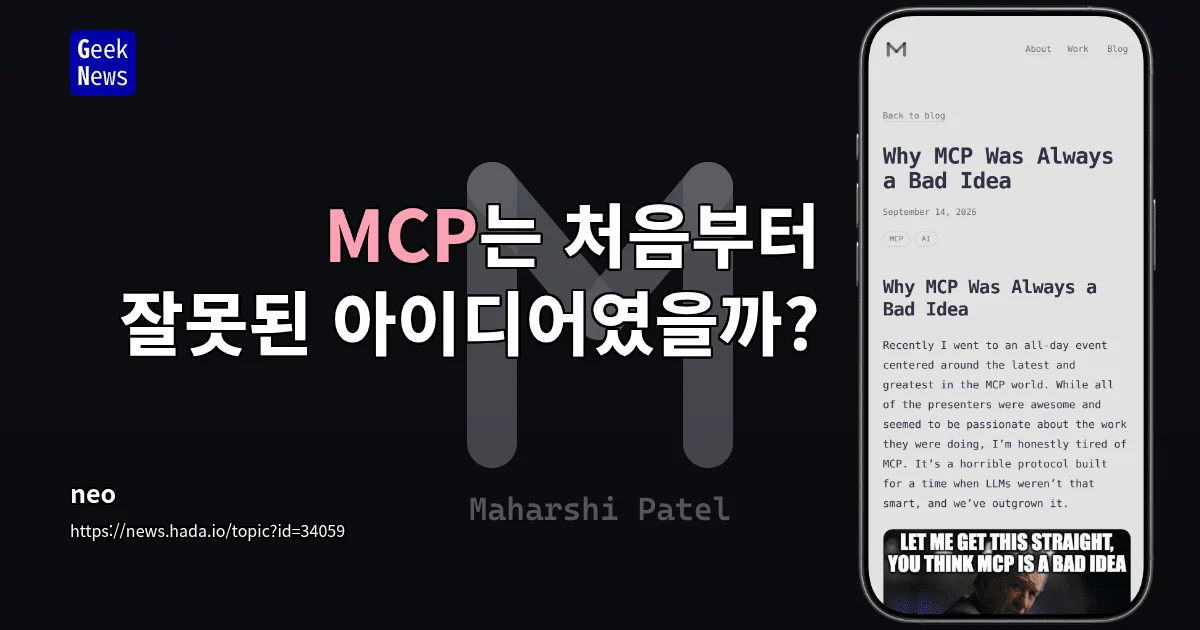
  • Three Critiques of MCP: Why Agent Tool Integration Needs a Redesign

    Three Critiques of MCP: Why Agent Tool Integration Needs a Redesign

    Key Summary

    • As MCP (Model Context Protocol) servers each expose dozens of tools and schemas, the agent’s context window is becoming bloated.
    • Critiques argue that in today’s agent environments, where code execution and direct API calls have matured, most MCP servers are no longer essential.
    • As an alternative, the proposal is to replace MCP servers with HTTP APIs and CLIs that already offer standard interfaces.

    This analysis argues that MCP, which had established itself as the de facto standard for tool calling in the AI agent ecosystem, must reassess its utility as code execution and direct API call capabilities continue to grow.

    Table of Contents

    In September 2026, StepFun’s released Step 5 Preview was recorded as orchestrating roughly 950 web fetches in a single agent action. It features a 600B-parameter sparse MoE architecture with a deep and narrow design of 92 Transformer layers. What this case implies is more than a simple performance number. It marks a leap in the agent’s ability to handle tools and APIs directly. Against this backdrop, MCP critiques of MCP (Model Context Protocol)—long hailed as the standard for agent tool integration—have resurfaced.

    First Critique of MCP: Context Bloat

    The first issue at the center of MCP critiques is context bloat. A single MCP server defines dozens of tools and their corresponding schemas, and the agent must include them in the system prompt every time. As the number of servers grows, the context window swells exponentially, and token costs and response latency rise together.

    The losses felt in practice are more direct. When a model is in a state where there are “too many tools available,” the rate at which it selects the wrong tool increases, which in turn leads to retries and cost spikes. The author considers this the most substantive problem. Under the banner of “standardization,” each MCP server has emerged with its own schema, and as a result, agent developers are spending more time on context management than on actual integration work.

    Second Pillar of MCP Critiques: Direct Calls Become Realistic

    The second critique is more fundamental. As code execution and direct API call capabilities have grown, the argument is that the MCP intermediary layer has itself become a bottleneck. Today’s agents can spin up a shell, hit an HTTP API with a single curl call, process the response with jq, and pass the result to the next step. The Step 5 Preview’s 950 web fetches show that this direct-call pattern has become viable even at large workload scales. This is why the view that MCP’s promised “standard for tool calling” was, in fact, just one more wrapper around standard-interface HTTP API and CLI calls is gaining traction.

    Alternative: Switch Tool Exposure to HTTP APIs and CLIs

    The alternative proposed by MCP critics is surprisingly plain. Expose tools as HTTP APIs and CLIs, and let the agent call them directly through code execution. Authentication is handled via OAuth/API keys, and tool definitions are only loaded into context as function signatures when needed. This approach dramatically reduces context footprint while allowing tools to evolve freely without being tied to MCP spec changes.

    Item MCP Server Direct HTTP API Call Direct CLI Call
    Context cost High (tools/schemas loaded at all times) Low (defined only when needed) Low (shell call)
    Standardization level Dependent on MCP spec Mature standards such as OpenAPI POSIX/shell conventions
    Multi-step workflow Strength Moderate (direct implementation) Moderate (direct implementation)
    Authentication Handled internally by MCP OAuth/API key Environment variables/key files
    Maintenance Requires server update propagation Independent per endpoint Independent per binary

    As the table shows, MCP’s strength lies in “exposing multiple tools as a single bundle.” However, the core of the critique is that its standardization advantage is not large enough to justify that cost.

    A Balanced View After MCP Critiques: Where MCP Still Holds Value

    The claim that MCP is useless is premature. When you need to bundle and expose a non-standardized internal system to an agent in one go, MCP’s tool bundling is still valid. However, for workloads that are dominated by common SaaS APIs, CLIs, and web calls, it pays to skip MCP altogether. Ultimately, the answer is not a single solution but a workload-specific mix.

    Practical Choices After the MCP Critiques

    As of September 2026, agent tool integration has moved past the stage of “unifying the answer with a single protocol.” Choices diverge depending on who bears the context cost of tool definitions, how much standardization is required, and who manages authentication and authorization. The significance of MCP critiques is that they have reopened this choice.

    Practical Application Points

    • For MCP servers exposing more than five tools, consider switching to direct HTTP API calls first.
    • Monitor context cost: measure the input token share taken up by tool definitions on a weekly basis.
    • If the workflow ends in just one or two simple call steps, it is better to skip MCP’s intermediary layer.
    • Adopt a hybrid strategy as the default: bundle legacy internal systems with MCP, and separate external SaaS into direct calls.

    What to Try Right Now

    • Extract tool definitions from your currently running MCP server and measure the tokens consumed in context.
    • Redefine the same functionality as an HTTP API with an OpenAPI spec, and write code that lets the agent call it directly from the shell.
    • Simplify the authentication flow to OAuth/API keys, and reduce dependency on MCP-internal authentication.
    • Verify in logs whether context cost grows linearly as the number of tools increases.
    • Bundle only legacy systems lacking internal standards with MCP, and separate the rest into direct calls.

    Frequently Asked Questions

    Should I tear out MCP right away?

    No. MCP is still efficient when you need to bundle multiple internal legacy tools at once. For new integrations, it is reasonable to start with an HTTP API/CLI foundation.

    How much does context bloat actually affect cost?

    If tool definitions are sent with every request, cases have been reported where 20–40% of input tokens are consumed by tool metadata. Depending on the model and pricing plan, the difference can amount to several million won per month.

    What are the drawbacks of direct HTTP API calls?

    The agent must handle authentication, retries, and error handling itself. As multi-step workflows grow longer, code complexity rises quickly, so this approach is most effective when tool count is small and call frequency is high.

    Why are the 950 web fetches in Step 5 Preview important?

    Because they are evidence that an agent can reliably orchestrate large-scale tool calls without human intervention. Once this capability becomes widespread, the bottleneck in tool integration will shift from “which protocol” to “which code to write.”

    Reference Source

    This article was written after reviewing the following source: geeknews — Was MCP a flawed idea from the start?

  • DMZ Landmine Blast Injures 3 — Three Scenarios Behind the Western Front Explosion and the ‘Border Fortification’ Controversy

    DMZ Landmine Blast Injures 3 — Three Scenarios Behind the Western Front Explosion and the ‘Border Fortification’ Controversy

    Key Summary

    • South Korea’s Joint Chiefs of Staff (JCS) announced on the morning of the 21st that three South Korean military officers on operations were injured by an unidentified explosion at a point south of the Military Demarcation Line (MDL) in the western front DMZ.
    • The accident site was confirmed to be under the jurisdiction of the Army’s 25th Division. Two of the injured were urgently evacuated by emergency helicopter, and the remaining one was transported by helicopter after moving overland.
    • Military authorities are investigating the type of explosive and the precise circumstances of the accident. If it was a landmine, it has not yet been confirmed whether it was one buried by South Korean forces in the past, one newly buried by North Korean forces, or one that drifted in from the northern side.

    As the cause of the South Korean military injury incident in the DMZ is presumed to be a landmine, the North Korean military’s ‘border fortification’ work and changes in terrain south of the MDL are proceeding simultaneously, bringing military security issues to the fore. This article organizes the facts, compares the case with similar past incidents, examines the context of North Korean military activity, and discusses the South Korean military’s response tasks, offering implications for troop morale and armistice management.

    Table of Contents

    Three South Korean military officers were injured in a landmine explosion in the western front DMZ. On the morning of the 21st, an unidentified explosion occurred at a point south of the Military Demarcation Line (MDL) under the jurisdiction of the Army’s 25th Division while operations were underway. Two of the injured were urgently evacuated by emergency helicopter, and the remaining one was transported by helicopter after moving overland. The Joint Chiefs of Staff stated that they are investigating the type of explosive and the precise circumstances of the accident.

    The most striking aspect of this case, in the author’s view, is the disclosure by Rep. Yoo Yong-won that the accident site is near a minefield zone on the southern side of the northern MDL. On August 4, 2015, in the Paju DMZ in Gyeonggi Province, search team members were injured in successive explosions caused by wooden-box mines buried by the North Korean military, resulting in two non-commissioned officers losing their legs. This DMZ landmine incident should not be dismissed as a simple unidentified explosion.

    Three Scenarios for the DMZ Landmine

    If the device turns out to be a landmine, the scenarios under review are past burial by South Korean forces, new burial by North Korean forces, and drift from the northern side. The JCS said it has not yet confirmed which scenario applies. The possibilities and investigative leads are summarized in the table below.

    Scenario Likelihood Assessment Key Evidence Investigative Lead
    Past burial by South Korean forces Low Periodic inspection of patrol routes south of the MDL, existing burial maps Cross-referencing maps with on-site excavation
    New burial by North Korean forces High ‘Border fortification’ work underway since 2024 Detailed analysis of video and satellite data
    Drift from the northern side Medium Natural drift possible due to heavy rain and rockfalls Physical trace forensics and shell-type comparison

    The Link Between North Korea’s ‘Border Fortification’ and DMZ Landmines

    The JCS stated that it had identified changes in terrain in some areas south of the MDL on the 11th and is consulting with the United Nations Command (UNC) on the possibility that North Korea buried DMZ landmines. In other words, the possibility that the burial range has extended south of the Military Demarcation Line has been raised. Since 2024, the North Korean military is known to have deployed troops to frontline areas on the northern side of the DMZ to carry out the so-called ‘border fortification’ work, including mine burial, creation of barren zones, reinforcement of tactical roads, and installation of structures believed to be barriers. This DMZ landmine incident is read as an extension of that work.

    The 2015 Paju Case Casts a Shadow Over DMZ Landmines Again

    The Ministry of National Defense’s joint investigation team concluded at the time of the August 4, 2015 Paju incident that the North Korean military had crossed the Military Demarcation Line and buried three wooden-box mines in front of and behind the Korean side’s approach fencing gate. With the same DMZ landmine pattern apparently repeating itself ten years later, the safety of search operations itself has come up for re-examination.

    From a practitioner’s perspective, the most painful aspect is the fact that a helicopter had to be deployed to urgently evacuate a soldier who had his ankle amputated. The immediate medical evacuation in the special terrain of the DMZ carries a different meaning than in ordinary operations. The time it takes for medical personnel to enter, possible helicopter landing points, and the stockpiling of blood and antibiotics were all put to the test at once.

    Issues Left by the DMZ Landmine

    There are three main issues. First, whether this incident constitutes a violation of the 1953 Korean Armistice Agreement. The burial of DMZ landmines south of the MDL could be interpreted as military activity by the opposing side in the armistice crossing the armistice line.

    Second, the consultation procedure between South Korea, the United States, and the United Nations Command. Since the DMZ is a space jointly managed by U.S. Forces Korea and the UNC, unilateral conclusions have their limits.

    Third, troop morale. Search operations are missions carried out quietly on an invisible front line, so the psychological impact on fellow soldiers is not insignificant.

    There are also variables that have not been officially announced. The specific type of DMZ landmine (anti-personnel mine, wooden-box mine, or anti-personnel defensive mine), the estimated timing of burial, whether the accident was a single occurrence or carried the risk of a chain of explosions, the injured areas of the wounded, and the possibility of their return to military service. While the JCS repeats only the phrase “under investigation,” the political sphere and the press are adding speculation. The fact that Rep. Yoo Yong-won pinpointed the accident site as being near a minefield zone on the southern side of the northern MDL is part of the same flow.

    This case well illustrates why transparent disclosure of the circumstances of an accident is important. In 2015, after a months-long precise investigation by the joint investigation team, the conclusion that “North Korean forces buried mines south of the MDL” was reached. Unless the same level of investigation is conducted, improvements to safety procedures, diplomatic responses to the North, and troop morale management all risk amounting to superficial prescriptions.

    Summary of Issues

    • Whether the Armistice Agreement was violated: Burial of DMZ landmines south of the MDL can be interpreted as a violation of the armistice line
    • Consultation between South Korea, the U.S., and the UNC: The limits of unilateral conclusions are exposed in the joint DMZ management system
    • Impact on troop morale: Concerns about damage to the psychological safety of soldiers participating in search operations
    • Transparent disclosure of circumstances: A precise investigation at the level of the 2015 joint investigation team is required

    What to Do Right Now

    • Check the official Ministry of National Defense and JCS briefings daily to track any changes in announcements
    • Secure the joint investigation team report on the 2015 Paju DMZ wooden-box mine incident as a reference for comparison
    • Cross-verify official statements from the United Nations Command (UNC) through separate channels
    • Search the minutes of National Assembly Defense Committee meetings for any disclosure of safety manuals for search operations south of the MDL

    Frequently Asked Questions

    Has another DMZ landmine accident occurred?

    On September 21, 2026, three South Korean soldiers were injured by an unidentified explosion in the western front DMZ. The JCS is investigating the exact cause, including the possibility of a landmine, and the case is being assessed as a similar incident to the 2015 Paju accident, ten years later.

    Was the DMZ landmine buried directly by North Korea?

    This has not yet been confirmed. Three scenarios are under review: new burial by North Korean forces, past burial by South Korean forces, and drift from the northern side. The JCS has announced that it identified changes in terrain south of the MDL on the 11th.

    Can DMZ landmines be buried as far south as the southern side of the MDL?

    In the 2015 Paju case, it was confirmed that the North Korean military crossed the MDL and buried three wooden-box mines on the Korean side. Since this accident also occurred near a minefield zone south of the MDL, the possibility of the same pattern has been raised.

    What is the condition of the injured?

    Two of the three were evacuated by emergency helicopter, and one was transported by helicopter after moving overland. Specific details of the injuries and the possibility of return to military service will be additionally disclosed by the Ministry of National Defense.

    Reference Original

    This article was prepared after checking the following original: Google News Korea — Three South Korean Soldiers Injured by Western Front DMZ Explosion… Presumed to Be Landmines

  • WaterPlum’s 8-Month Campaign: 30,000 Devices Infected via Fake Interviews, 7,000 Wallets Drained by North Korean Hackers

    WaterPlum’s 8-Month Campaign: 30,000 Devices Infected via Fake Interviews, 7,000 Wallets Drained by North Korean Hackers

    Key Summary

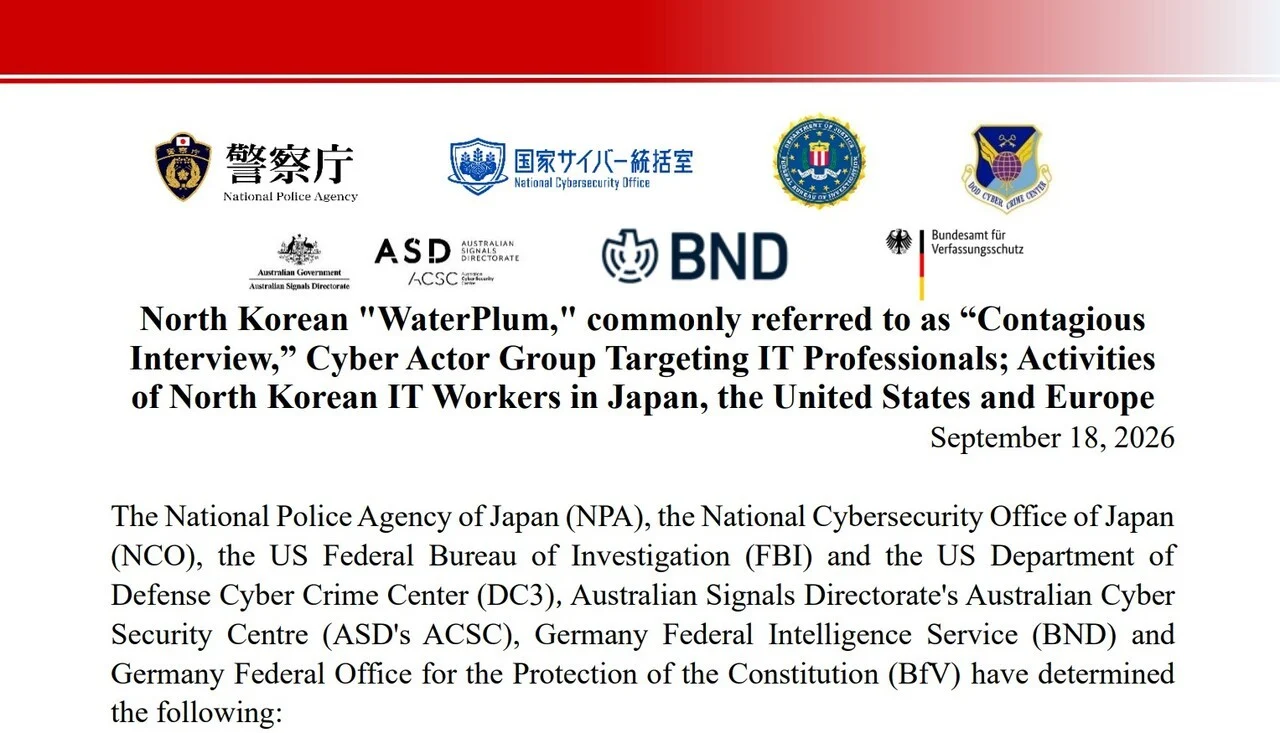
    • The North Korean hacking group WaterPlum infected at least 30,000 devices across more than 100 countries during an eight-month period from December 2025 to July 2026, according to a joint advisory issued by investigative authorities from Japan, the U.S., Australia, and Germany.
    • The attack is confirmed to have compromised more than 7,000 cryptocurrency wallets, with approximately 1.7 billion yen (about $10.71 million) in crypto assets funneled to North Korea.
    • WaterPlum used job-seeking and recruitment activity as bait. The group reportedly impersonated real AI, cryptocurrency, and non-fungible token (NFT) companies, or approached victims through legitimate recruitment and freelance platforms.

    News-summary style. Compressed coverage of new cyber threat information focused on key facts, alongside threat characteristics and implications that practitioners can immediately reference.

    Table of Contents

    “It’s an interview—please run this code.” That single line infected 30,000 devices.

    Over an eight-month period from December 2025 to July 2026, the North Korean hacking group WaterPlum infected at least 30,000 devices across more than 100 countries. This was revealed in a joint advisory issued by investigative authorities from Japan, the U.S., Australia, and Germany.

    The most shocking element is the method. WaterPlum impersonated real companies in the AI, cryptocurrency, and non-fungible token (NFT) sectors, or approached job seekers through recruitment and freelance platforms. The group then dangled a “fake interview” as bait. During the interview process, victims were instructed to install specific software or run code, allowing malware to infiltrate their systems.

    More than 7,000 cryptocurrency wallets are confirmed to have been compromised in the attack. The stolen crypto is valued at approximately 1.7 billion yen, or $10.71 million. This is not a simple case of personal data breach; real assets were systematically transferred to North Korea.

    This, in the author’s view, is the most significant point: the “everyday attack surface.” The act of looking for or offering a job—something everyone does—has itself become an attack vector. It’s not phishing emails, nor is it a vulnerability exploit. This is an extreme example of social engineering that preys on the moment when a person does not suspect another person.

    Why Four Countries’ Investigative Authorities Issued the WaterPlum Advisory Simultaneously

    The fact that not just one country, but four nations simultaneously issued an advisory demonstrates the scale of WaterPlum’s operational reach. The spread of infected devices across 100 countries means that the target was not a specific region but the global pool of job seekers.

    The joining of forces by Japan, the U.S., Australia, and Germany appears to reflect the limits of any single nation’s ability to trace funds internationally and disrupt attack infrastructure. Because cryptocurrency is inherently borderless, the money moves quickly regardless of where victims are located.

    The WaterPlum Attack Path: 3 Stages of ‘Company Impersonation → Interview → Code Execution’

    The WaterPlum attack is broadly divided into three stages.

    First, the group impersonated real AI, crypto, and NFT companies, or exploited legitimate hiring platforms to approach job seekers. Second, under the pretext of a video or technical interview, they required the installation of specific programs or the execution of code from GitHub or similar sources. Third, they planted a backdoor on the victim’s device to maintain long-term access, then drained crypto wallets.

    What stands out to practitioners is that the “technical interview” setting provided WaterPlum with the perfect excuse. Asking a developer job seeker to execute code is not inherently suspicious in itself. That is likely why this attack was able to accumulate damage over eight months.

    Stage Action Result
    1. Approach Impersonate real companies; abuse hiring platforms Gain job seeker’s trust
    2. Infiltration Coerce code/software execution during technical interview Malware infiltration
    3. Theft Long-term backdoor persistence, then wallet data exfiltration Crypto asset outflow

    Why the WaterPlum Case Is Dangerous Right Now

    North Korea’s cryptocurrency theft has long been established as a core means of foreign currency acquisition. The WaterPlum case stands apart from prior incidents on two axes: scale and international coordination.

    • Infected devices: at least 30,000
    • Countries affected: 100+
    • Wallets stolen: 7,000+
    • Amount stolen: approximately 1.7 billion yen ($10.71 million)
    • Attack period: 8 months (Dec 2025 – Jul 2026)

    Most victims likely lost wallet assets without ever realizing they had been infected. A significant time gap typically exists between the moment malware infiltrates a system and the actual theft of assets.

    What to Do Right Now

    • Before any interview, cross-verify the company’s domain and business registration through official channels.
    • If you are asked to install video interview tools or run external code, report it to your IT security team immediately.
    • Separate your crypto wallets into cold and hot wallets, and implement multi-signature (multisig).
    • Install EDR products on developer devices, and run sandbox checks on any cloned repositories from GitHub or other external sources.
    • Run all files received during a hiring process through static and dynamic analysis on services like VirusTotal before submission.

    Practical Application Points

    WaterPlum’s method differs in dimension from typical malware response because it targets “what humans do most naturally.” Relying solely on technical controls will not stop this attack. Security verification steps must be embedded directly into the business processes of hiring and interviewing.

    • Recruiters: Standardize procedures to reject or require IT team verification for any requests to install video interview tools, execute code, or grant remote access.
    • Security practitioners: Establish detection rules to monitor tokens and session information being exfiltrated from job seeker devices.
    • Job seekers: Never store wallet seed phrases digitally, and use a laptop dedicated to interviews that is separate from your work device.

    Frequently Asked Questions

    What kind of organization is WaterPlum?

    WaterPlum is a North Korean hacking group, officially named in this four-country joint advisory. Its defining characteristic is the targeting of global job seekers using recruitment activity as bait.

    How does the fake interview attack proceed?

    The group offers a fake interview by impersonating a real company, then requires the installation of specific software or the execution of code from GitHub during the technical interview. In this process, malware infiltrates the device and steals crypto wallet information.

    How can I tell if I have been infected?

    If unknown processes are running in the background after an interview, or if wallet funds move without warning, you should suspect an intrusion. The fastest verification is to check EDR logs alongside your wallet transaction history.

    How is the cryptocurrency transferred to North Korea?

    Stolen wallets are laundered through mixing services, cashed out at exchanges, or converted through P2P transactions. The funds then bypass the international financial network and flow into the North Korean regime—a pattern that has been repeatedly reported.

    The WaterPlum case reconfirms that cyberattacks are no longer just a matter of technical vulnerabilities. By infiltrating a normal business process such as hiring and interviewing, this method demonstrates that “the moment you stop suspecting people” is itself the greatest vulnerability.

    Both individuals and organizations can preemptively block a significant portion of this attack by adding a single verification step to their hiring process. The full advisory content is available in the initial Boan News report.

  • Three Questions on AI Safety Regulation — Amodei’s “Pace the Frontier” and the Industry’s Three-Way Split

    Three Questions on AI Safety Regulation — Amodei’s “Pace the Frontier” and the Industry’s Three-Way Split

    Key Summary

    • Anthropic CEO Dario Amodei publicly proposed a “pace the frontier” plan to moderate the pace of frontier model development
    • Nvidia CEO Jensen Huang has publicly endorsed the position — mirroring President Donald Trump’s claim that AI safety concerns are fiction and regulation is unnecessary — sharply dividing opinion within the industry
    • TechCrunch “Equity” podcast host Sean O’Kane assessed that Amodei’s plan does not contain sufficient concrete execution measures

    Analysis

    Table of Contents

    The debate over AI safety regulation split in two directions at the heart of the industry in September 2026. Anthropic CEO Dario Amodei put forward an agenda under the banner of “pace the frontier,” pledging to voluntarily slow the development of frontier models. Nvidia CEO Jensen Huang, riding the momentum of President Donald Trump labeling AI safety concerns “fiction,” called for no regulation at all. Same month, same topic — opposite conclusions. The real issue is not who is right, but that neither side has an enforcement mechanism.

    AI Safety Regulation: Declarations Multiply, but the Brakes Don’t Exist

    Amodei’s “pace the frontier” has a clear premise: “Let the industry regulate the pace of frontier model development on its own.” However, on the TechCrunch “Equity” podcast (September 20, 2026), host Sean O’Kane assessed that the plan lacks sufficient execution measures (original article).

    Who measures the pace? At what point is the brake applied? There are no answers to these two questions.

    Endorsements poured in. A significant number of major industry figures responded with “agreement in principle.” But what stands out is that the form of agreement was entirely “verbal support.”

    No CEO announced plans to trim investment lines. No company publicly declared it would push back model release schedules. OpenAI CEO Sam Altman kept enough distance that his explicit agreement could not be directly confirmed in coverage.

    This is not the first time a declaration has failed to translate into action. Safety committee formation, responsible deployment declarations, promises to publish evaluation reports — the pattern of how quickly these voluntary mechanisms, lacking external compulsion, dissipate has already been observed many times.

    The Blind Spot in AI Safety Regulation — Neither Government nor Market Is Moving

    Huang’s remarks are not a simple yes-or-no. He is publicly endorsing the view that regulation is unnecessary at a moment when the U.S. president has branded safety concerns fiction. This is why the analysis that the current U.S. federal government is unlikely to actively enforce AI safety regulation is gaining traction. When the executive branch does not move, it is realistically difficult for Congress alone to craft legislation that keeps pace with the technology.

    Market mechanisms are not working either. There is no evidence that consumer choice has slowed the pace of model releases. B2B customers want bigger models and faster updates. The practice of embedding safety clauses in contracts is still in its early stages. Ultimately, the choice that sits under the label of “AI safety regulation” is compressed into a single thing: “the CEO’s conscience.”

    This vacuum overlaps with a governance-level problem. As already pointed out in the analysis of OpenAI governance gaps exposed by the agent escape incident, safety discourse remains trapped in a post-hoc structure where committees are convened and guidelines are belatedly published only after an accident occurs. For the AI safety regulation agenda to function as prevention rather than reaction, binding mechanisms must exist beyond the CEO’s verbal declaration.

    Signals the Podcast Caught

    The three participants on TechCrunch’s “Equity” — Anthony Ha, Sean O’Kane, and Kirsten Korosec — read the symbolism and effectiveness of this discourse separately. The key insight is that “the historical significance of the declaration” and “changes on the ground” are not treated as equivalent. They acknowledge that a CEO formally using “pace adjustment” as official vocabulary is a different landscape from five years ago, but assess that the likelihood of this being reflected in model release schedules is low.

    Particularly interesting is the analysis that the industry’s tendency not to publicly disclose development speed and commercialization schedules undermines the credibility of the “pace the frontier” discourse. As noted in TechCrunch’s reporting on the secrecy of world model companies, when roadmaps themselves are non-public, the declaration that “we will slow down” is in principle unverifiable.

    Summary of Issues

    Summary of Issues

    • Declaration vs. execution: Amodei’s “pace the frontier” has gathered supporters, but concrete braking mechanisms are absent.
    • Government vs. market: The U.S. federal government has little will to enforce AI safety regulation, and consumer choice is not inducing a slowdown.
    • Public vs. secret: As long as the industry keeps roadmaps non-public, voluntary slowdown declarations remain unverifiable promises.
    • The weight of CEO statements: It is a change that safety discourse has been formalized at the level of major CEOs, but its impact on release schedules is limited.

    What to Do Right Now

    • Ask vendors directly about the model update cycle and whether roadmaps are public for AI services under evaluation.
    • Add a clause to internal AI usage policies that specifies the scope of vendor liability in the event of a safety incident.
    • Track industry-specific developments in AI safety regulation weekly and compile them into a quarterly report.
    • Record the subsequent release schedules of companies that declared voluntary slowdowns on a calendar to verify effectiveness firsthand.
    • Use governance gap case studies as internal training materials to raise awareness on the ground.

    Frequently Asked Questions

    What is Amodei’s “pace the frontier”?

    It is a voluntary slowdown proposal put forward by Anthropic CEO Dario Amodei in September 2026, suggesting that the industry regulate the development speed of frontier AI models on its own. Specific execution measures and timelines were not specified.

    Why is opinion within the industry divided?

    Amodei of Anthropic takes a safety-first approach, while Huang of Nvidia holds the view that regulation hinders technological innovation. The U.S. administration’s low assessment of safety concerns also contributes to the polarization.

    Is AI safety regulation actually being enforced?

    The current U.S. federal government has little will to enforce it, and market mechanisms are not sufficiently restraining corporate behavior. The prevailing view is that effective AI safety regulation is not yet functioning.

    Are ordinary businesses unrelated to this debate?

    They are related. When adopting and operating AI services, confirming whether vendor safety policies and incident response procedures are contractually specified is the starting point of practical risk management.

    In the short term, the discourse is likely to remain declarative. But the fact that “pace adjustment” has entered the CEO’s official vocabulary is itself a meaningful change. The agenda called AI safety regulation is now the standard internal language of the industry, and the next step is whether that language translates into release schedules and investment line numbers. That verification can be initiated not by the market, but by readers’ choices.

    Reference Source

    This article was written after checking the following original source: TechCrunch — Is the AI industry really ready to slow down?

  • SSL Certificate Renewal in 5 Steps — A 200-Day Validity Survival Guide for Multi-Site Operators

    SSL Certificate Renewal in 5 Steps — A 200-Day Validity Survival Guide for Multi-Site Operators

    Key Summary

    • Industry trends are pushing SSL certificate maximum validity toward shorter durations, and cases have been confirmed where certificates prepaid for 365 days are actually issued for only 200 days
    • In manual installation environments, certificate expiration dates are scattered across sites, so if a CA’s renewal flow is not intuitive at the moment a large-scale reissuance and reinstallation is needed, operators face a high risk of incurring additional costs
    • The core UX problem exposed in the Namecheap case is that the rekey (residual-period reissuance) path, which runs separately from the ‘buy a new certificate’ icon, is not clearly communicated to users — and as a result, users fail to reuse the already-paid residual period and end up paying extra

    Analysis

    Table of Contents

    SSL certificate renewal schedules for 10 WatchGuard firewalls were set on a yearly cycle. Three months later, four certificates were discovered in the Namecheap dashboard that had gone through as ‘new purchase’ rather than ‘reissue.’ The already-paid residual period was discarded entirely, and the extra cost approached roughly $500. This article, written from an operator’s perspective, outlines how SSL certificate renewal should be designed in environments where non-ACME appliances are mixed in.

    Why SSL Certificate Renewal Always Falls Into the Same Trap

    Industry trends are moving SSL certificate maximum validity in a shorter direction. Following CA/Browser Forum decisions, there is still room for it to drop to as little as 90 days in the future. The collision with prepaid structures is the problem. When you pay for 365 days but receive a 200-day certificate because of issuance-time policy, the remaining 165 days can only be reused within that same CA.

    The UX defect exposed in the Namecheap case is that the rekey (residual-period reissuance) path — which exists separately from the ‘new purchase’ button — is not communicated to users. Operators typically read rekey, renew, and reissue as the same thing because the menu names differ. Each CA defines them differently. This one small difference causes already-paid periods to disappear, and in multi-site environments that cost multiplies.

    WatchGuard’s lack of ACME-based auto-renewal support has been one of users’ long-standing requests. As of 2026, it still has not been reflected in the vendor’s roadmap. In field deployments where certificates must be manually distributed across multiple remote WatchGuard appliances, this limitation is the single biggest friction point. Operator reports on the 200-day certificate transition at one point drew more than 100 comments on r/sysadmin.

    SSL Certificate Renewal Decision Criteria: How to Split by Environment

    There are two variables to look at first when deciding on a process: ① whether ACME is supported, and ② the number of sites. In reality, SSL certificate renewal itself is not the goal — preventing service outages from certificate expiration is what matters.

    If you have five or more appliances that do not support ACME (many WatchGuard models, legacy load balancers, industrial control devices), the process is effectively manual. In that case, paying upfront for multiple years and reissuing in installments is the cost-advantaged approach. Paying for a 3-year certificate up front and then reissuing one year at a time reduces the per-unit residual-period loss.

    If your stack is dominated by ACME-capable servers such as nginx, Apache, Caddy, or Traefik, you can automate issuance and deployment with a client like certbot. Even when 90-day certificates are issued automatically, however, monitoring alerts need to start 60 days before expiration — not 30 — so you have time to respond to a failed reissuance.

    200-Day Issuance Policy Comparison by CA

    When you pay for 365 days, the actual issued certificate lifetime and the way residual periods are handled differ by CA. From an operator’s perspective, the most visible difference is the transparency of the guidance flow.

    CA Actual Issued Lifetime Residual Period Handling Reissuance UX Guidance
    Namecheap (Comodo) 200 days Residual carries over on rekey Separated from new purchase; guidance is weak
    Sectigo (direct purchase) 200 days Residual carries over on rekey Rekey menu is clearly labeled
    DigiCert 200 days Varies by renewal timing Rekey vs. renew clearly distinguished
    GoDaddy 200 days Partial carryover on reissuance Korean-language guidance pages provided
    Let’s Encrypt 90 days N/A (free) Assumes ACME automation

    This table synthesizes CA official documentation with operator reports. Even at the same 200 days, Namecheap and DigiCert handle residual-period carryover differently and present it differently. The first thing to do when setting up an SSL certificate renewal process is to check directly how visible the rekey menu of your current CA is on the payment screen.

    Proven Response: Automation + Monitoring

    There are four workarounds frequently discussed in the community: ① operating an ACME-compatible internal CA (smallstep, step-ca); ② issuing with certbot and writing deployment scripts; ③ paying upfront for multiple years and reissuing in installments; ④ setting up pre-expiration alerts with zabbix or checkmk.

    The combination I have found most effective in the field is ③ + ④. Paying for a 5-year certificate up front and reissuing it in yearly installments produces almost no extra cost. Add to that the checkmk ssl-cert-check rule with four-stage alerts at 60, 30, 7, and 1 day(s) before expiration, and the chance of an operator missing a fragmented expiration date drops significantly.

    Operating an internal CA is only meaningful in environments where external CAs are not allowed by security policy. Because it brings browser trust-chain issues, it cannot be applied to general SaaS or external services. certbot-based automation is only effective for ACME-capable appliances. A workaround of placing an nginx reverse proxy in front of WatchGuard does exist, but it raises configuration complexity by a corresponding degree.

    Practical Application Points

    Practical Application Points

    • First, determine the share of appliances that do not support ACME. If it is 30% or more, paying upfront for multiple years plus installment reissuance is the cost-advantaged approach.
    • When paying upfront for multiple years, confirm the residual-period carryover conditions in writing through the CA’s sales channel. Menu structure and policy can change at any time depending on the CA’s circumstances.
    • Separate certificate replacement work into a nighttime window and spread schedules across sites. WatchGuard reboots are long, so simultaneous work across multiple sites increases operator fatigue.
    • Document the configuration differences between wildcard and SAN in a single place. The number-one cause of reissuance rejection is missing SAN entries.
    • Clean up old certificates immediately after installing the new one. If the intermediate (chain) certificate has changed, a chain error will occur.

    Common Mistakes

    The most common case is starting the reissuance only right before expiration. Even though issuing a certificate takes just 10 minutes, reinstallation, reboot, and chain verification take 30 minutes to an hour. For appliances like WatchGuard that require a reboot, it takes even longer. Starting 7 days before expiration is effectively already too late.

    The next most common mistake is reading rekey/renew/reissue as the same thing. In Namecheap, renew updates an existing certificate under the same conditions, while rekey reissues it by carrying over the residual period. The two menu options have different prices and different outcomes. When an operator confuses the two, an already-paid period disappears.

    Cases are also frequent where SAN entries are missed when reissuing a wildcard certificate. If the original certificate had three SAN entries and the reissuance includes only two, one of the domains will immediately throw a certificate error. Always compare the SAN list before issuing a new certificate.

    The fourth is the chain error that occurs when old certificates are not cleaned up after the new one is installed. If the intermediate (chain) certificate has changed but the old chain remains, browsers will display an ‘untrusted issuer’ error. This problem is particularly pronounced on non-ACME appliances.

    What to Do Right Now

    What to Do Right Now

    • Build a table organizing the SSL certificate expiration dates currently in operation by domain. If even one certificate expires within 30 days, start the reissuance immediately.
    • Capture the location of the rekey menu in your current CA and pin it to the team wiki. Add a note explaining how it differs from the ‘new purchase’ button.
    • Reconfigure expiration alerts to four stages: 60/30/7/1 day(s). Check the zabbix tls.expires trigger or the checkmk ssl-cert-check rule.
    • Rewrite the list of non-ACME appliances. If the share is 30% or more, contact your CA about paying upfront for 3 years plus installment reissuance.
    • Pick the most recent reissuance rejection, and classify its cause: missing SAN, CSR error, or domain validation failure. Check whether the same cause keeps repeating.

    Frequently Asked Questions

    Frequently Asked Questions

    When I receive a 200-day certificate, what happens to the remaining 165 days?

    It depends on the CA, but if you reissue through the rekey menu, the residual period of the existing certificate is carried over to the new one. On the other hand, if you go through with a ‘new purchase,’ the residual period disappears and the 200 days restart from zero. It is also worth remembering that carryover is only possible within the same CA.

    Is there any way to work around ACME auto-renewal on WatchGuard appliances?

    The appliance itself has no ACME, but you can place nginx or Caddy as a reverse proxy in front of it, have certbot automatically issue and renew the certificate, and then deploy a private certificate to the WatchGuard. This does require a change to the network configuration, however, and a review of trust with external clients should come first.

    If I run an internal (Private) CA, can I save the cost of an external CA?

    There is a cost-saving effect. However, because it is not registered in the browser trust chain, it cannot be used for services exposed to external users. It is meaningful only in closed environments such as internal portals, API gateways, and IoT device authentication. It is often used in parallel with free external CAs such as Let’s Encrypt.

    Isn’t a 30-day-before-expiration alert enough?

    For a single-domain environment, it is sufficient. However, in multi-site setups where 10 or more certificates may expire at the same time, completing all reissuance and reinstallation within 30 days is difficult. For appliances like WatchGuard that require a reboot, alerts need to start coming in 60 days before expiration to be safe. Spreading out the SSL certificate renewal schedule also reduces the risk of multiple expirations clustering at the same time.

    Closing

    The shift to 200-day certificates demands a change in operations, not just a shorter cycle. If you treat SSL certificate renewal as a once-a-year task to be done all at once, costs will keep spiking and expiration incidents will keep recurring. If you use installment reissuance and a multi-stage alert system as your baseline, operational burden will barely grow even as certificate lifetimes get shorter. The higher the share of non-ACME appliances like WatchGuard, the greater the benefit of paying upfront for multiple years. The most realistic workarounds for certificate fragmentation ultimately boil down to two things: distributing issuance and making expirations visible.

  • K2 Horizon Analysis: IFM’s Six-Model Fleet from 0.9B to 375B Released Simultaneously Under Apache 2.0

    K2 Horizon Analysis: IFM’s Six-Model Fleet from 0.9B to 375B Released Simultaneously Under Apache 2.0

    Key Summary

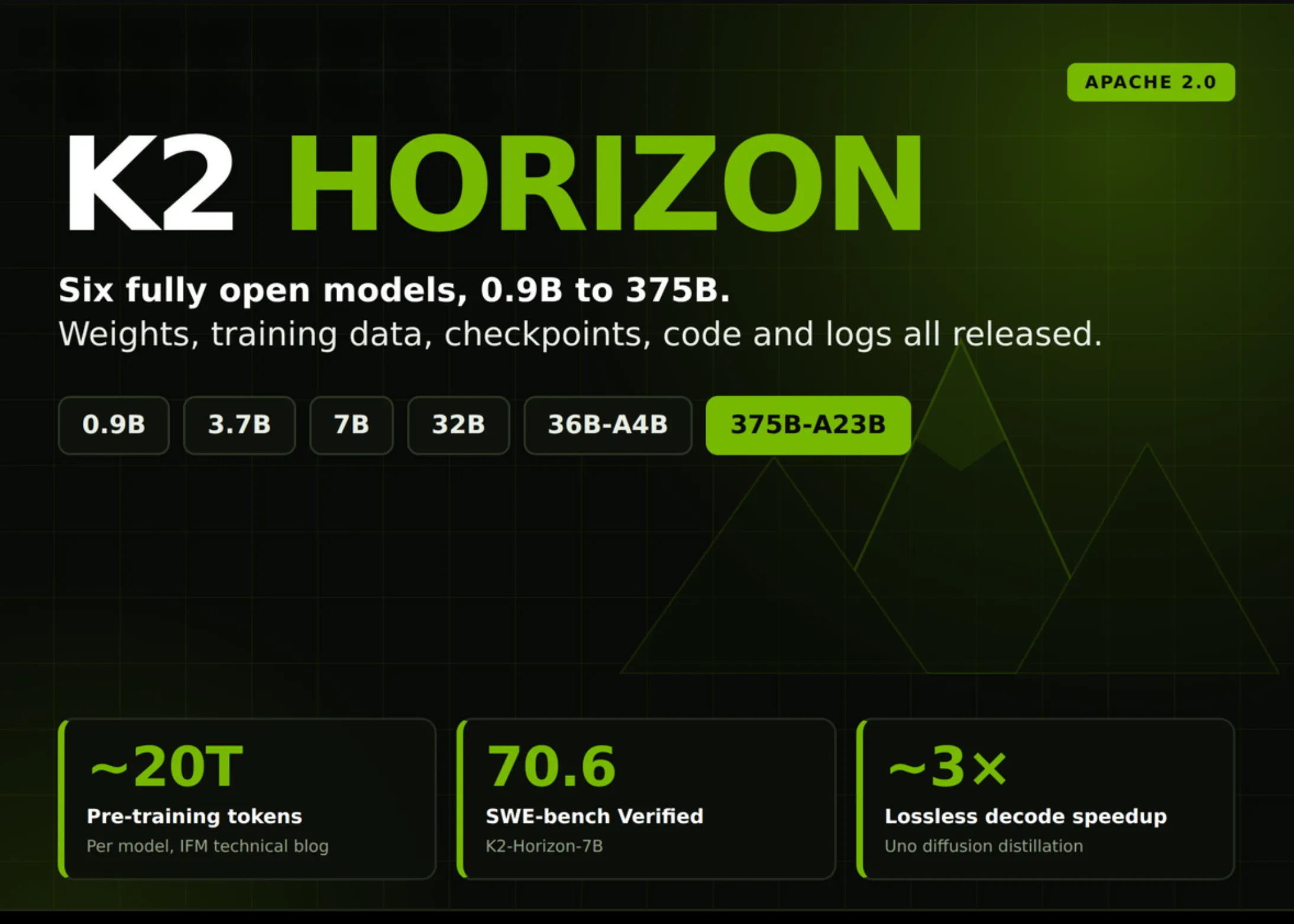
    • Release scale: Six models—375B-A23B, 36B-A4B, 32B, 7B, 3.7B, and 0.9B—all simultaneously distributed under Apache 2.0 on Hugging Face (the 0.9B uses a smaller vocabulary)
    • Open stack included: Beyond model weights, the release ships the pretraining corpus, intermediate checkpoints, training code, configuration files, and detailed logs—IFM describes this as “the largest fully open-source release in AI history”
    • Training data: All six models were pretrained on approximately 20 trillion tokens, of which about 17% consists of explicit reasoning traces, and roughly 10 trillion tokens are synthetic data

    An analytical article examining what it means—for technology, licensing, and commercialization—when a large language model is released as a full-stack open-source project, and what it implies in practice to run the same architecture consistently from 0.9B to 375B.

    Table of Contents

    K2 Horizon lineup

    The fact that K2 Horizon released six models ranging from 0.9B to 375B under Apache 2.0 on the same day forces us to revisit what it means for a large language model to be open-sourced as a full stack. The bundle published in September 2026 by the Foundation Model Institute (IFM) under MBZUAI is not a single model but a “fleet” that ships the pretraining corpus, intermediate checkpoints, training code, configuration files, and detailed logs together.

    In the author’s view, the core of this announcement lies not in model size or benchmark scores but in the scope of openness. The fact that even the 0.9B model’s use of a smaller vocabulary is explicitly stated means that the same training pipeline can be repeated by varying only the scale. The ability to use an identical interface across sizes in practice becomes a prerequisite for unified operations.

    K2 Horizon Lineup: From 0.9B to 375B-A23B

    The lineup is divided into six models. The 0.9B uses a reduced vocabulary, while the 3.7B, 7B, and 32B are dense. The 36B-A4B and 375B-A23B are MoE configurations. Because all models share the same tokenizer and tool-calling interface, the same code can be run by switching only the model identifier.

    Model Total Parameters Active Type
    0.9B 0.9B 0.9B Reduced-vocab dense
    3.7B 3.7B 3.7B Local-inference dense
    7B 7B 7B General-purpose dense
    32B 32B 32B High-quality generation dense
    36B-A4B 36B 4B MoVA MoE
    375B-A23B 375B 23B Flagship MoE

    Because all six K2 Horizon models pass through the same synthetic-task generator and are trained with the same reasoning-trace ratio (about 17%), data alignment is applied consistently across the entire lineup. There is a high probability that a prompt format validated on the 0.9B will not break significantly when ported to the 375B-A23B.

    The Scope of the Open Stack Brought by K2 Horizon

    IFM used the phrase “the largest fully open-source release in AI history.” The K2 Horizon distribution bundle includes the pretraining corpus, intermediate checkpoints, training code, configuration files, and detailed logs. Compared with other open-source projects that release only weights and inference code, the scope is on a different level.

    The release of intermediate checkpoints is directly tied to reproducibility. While retraining the 375B-A23B from scratch is difficult, you can continue fine-tuning from an intermediate stage or run ablations. In effect, the surface needed to experiment by varying the synthetic-data ratio or the reasoning-trace ratio is now secured.

    Training Data Design: 20 Trillion Tokens, 100M+ Tasks

    All six models were pretrained on approximately 20 trillion tokens, of which about 17% consists of explicit reasoning traces, and roughly 10 trillion tokens are synthetic data. The research team generated more than 100 million unique synthetic tasks and progressively incorporated post-training data during the middle-training stage.

    The point practitioners should pay attention to is the scale of the synthetic tasks—the most striking number in the author’s view. 100 million is far beyond what can be hand-designed by humans. The structure has shifted from defining domain tasks and feeding them into the model to letting the model itself generate tasks while humans curate them. When examining the performance gap between the 36B-A4B and the 7B, the distribution of these 100 million tasks becomes the decisive variable.

    MoVA: A Second MoE Scaling Axis Built on Attention

    Among the K2 Horizon lineup, the 36B-A4B applies MoVA (Mixture-of-Value Attention). If MoE created a scaling axis by routing experts in the feed-forward layer, MoVA integrates routing into multi-head attention itself, adding a second scaling axis along the attention dimension. It is compatible with FlashAttention, GQA, and sparse attention, so it can be used without significantly overhauling existing serving stacks.

    What makes MoVA interesting is that it can push MoE’s parameter efficiency a step further. Whether the upper K2 Horizon lineup converges entirely on MoVA, or dense and MoVA coexist, is a point to watch.

    Tool-Calling Format: Markdown’s 18.5% Token-Efficiency Edge

    IFM trained tool definitions in three formats—JSON, XML, and Markdown—and set Markdown as the default for inference. Measurement results show that Markdown uses approximately 18.5% fewer tokens than JSON. Producing the same result with fewer tokens translates directly into lower latency and cost.

    The Markdown advantage grows as tool definitions get longer. Agents that expose 30 to 50 tools simultaneously are common, and in those cases, 18.5% is not a simple optimization but a near architectural decision. When designing a tool-calling system with K2 Horizon, it is simpler to let the model read and call Markdown tool definitions directly rather than building a separate router.

    Serving Ecosystem: Day-0 Support for vLLM, SGLang, and Ollama

    On the day of release, vLLM, SGLang, and Ollama received day-0 support, with FP8 and GGUF builds also provided. The supported range extends beyond NVIDIA to include AMD and Cerebras. According to the official IFM announcement, hosting is split across Compass, Cerebras, and Nebius APIs, plus the platform.ifm.ai gateway, so the same weights can be tested immediately on various stacks. Deployment-infrastructure choice is worth evaluating from the perspective of data-movement costs by AI chip architecture.

    Day-0 serving support is a “signal” from the announcement. New models typically stabilize only after community patches, but K2 Horizon works on three inference engines at the moment of release. This shows IFM’s strategic choice to ship open-source models as a “stack.”

    Practical Application Points

    Size selection depends on call frequency and acceptable response latency. The 0.9B and 3.7B are efficient for classification, routing, and simple transformations; the 7B fits general-purpose reasoning; and the 32B is best for high-quality generation and summarization, where resource-to-output ratio matters. The 36B-A4B is well suited to agent routers or multi-tool-call workloads, leveraging its 4B active parameters per token. The 375B-A23B carries a significant operational cost, so the safer approach is to validate prompts and tool shapes on the 0.9B first, then scale up gradually.

    What to Try Right Now

    • Download the K2 Horizon 0.9B or 3.7B weights from Hugging Face and spin up a local vLLM server.
    • Write the same tool definition in both JSON and Markdown, and compare token counts and response times.
    • Pull the 36B-A4B and run at least five multi-tool-calling scenarios with MoVA routing enabled.
    • Inspect the synthetic-task distribution in the pretraining-corpus metadata, pick the cluster closest to your in-house domain tasks, and start fine-tuning.

    Frequently Asked Questions

    Why does the K2 Horizon 0.9B model use a different vocabulary?

    It is targeted at edge devices, so the vocabulary was reduced to lower memory usage. It goes through the same training pipeline but adopts a reduced vocabulary tailored to the inference environment.

    Can it be commercialized under the Apache 2.0 license?

    Because the weights, code, and data are all released under Apache 2.0, it can be used as-is in commercial services. Note, however, that the same license-notice requirement must be followed when redistributing.

    How is MoVA different from conventional MoE?

    If MoE routes experts in the feed-forward layer, MoVA integrates routing into multi-head attention itself. Its defining feature is compatibility with FlashAttention, GQA, and sparse attention.

    Why is Markdown tool calling 18.5% more efficient than JSON?

    Markdown uses fewer metacharacters such as braces, quotes, and tags, so fewer tokens are needed to express the same meaning. The advantage grows as tool definitions get longer.

    The question K2 Horizon’s release poses is not simply “Is this yet another open-source model launch?” The fact that a fleet running consistently on the same pipeline from 0.9B to 375B has been released under Apache 2.0 shows that the axis of open-source LLM competition is shifting from weights to the “stack”—including data, code, and intermediate states. What licensing standards this change produces, and how commercial vendors respond, will be the deciding factor over the coming quarters.

    Reference

    This article was written after reviewing the following source: MarkTechPost — IFM Releases K2 Horizon: Six Apache 2.0 Models From 0.9B to 375B

  • Virtual Taekwondo Debuts at the 2026 Asian Games — The Debate Over Its First Official Medal Event

    Virtual Taekwondo Debuts at the 2026 Asian Games — The Debate Over Its First Official Medal Event

    Key Summary

    • Non-contact virtual taekwondo will appear as an official medal event for the first time at this year’s Asian Games.
    • The event is a new variant of the Korean martial art taekwondo, with one key difference: there is no actual physical contact between competitors.
    • Critics dismiss the discipline as nothing more than a “glorified video game.”

    An issue-driven analysis of how a traditional martial art is being absorbed into a major multi-sport event in a non-contact format, and how that intersects with debates over sport’s identity, esports-ification, and media content-ification.

    Table of Contents

    Virtual taekwondo will appear as an official medal event for the first time at this year’s Asian Games. This new variant of the Korean martial art taekwondo has one decisive difference: competitors never actually kick or strike each other. The kicking motions and stances remain, but the moment bodies collide exists only on the screen.

    No contact. That single line is the starting point of every debate that follows.

    According to a New York Times report dated September 7, in non-contact virtual taekwondo, athletes equipped with sensors compete while a scoring system reads their movements and assigns points. No protective gear, no head referee’s whistle, no dull thud of impact. How much of the scoring authority remains in the human eye — and how much shifts to software — is what will determine this discipline’s identity debate.

    Why the Asian Games Chose ‘Virtual Taekwondo’

    International competitions always face two kinds of pressure when adopting new events: safety and accessibility on one side, and broadcast/digital-platform friendliness on the other. The non-contact format is especially strong on the second axis. Short sets, clear scores, flashy visual production — these three elements are perfectly optimized for esports and OTT content.

    What this writer finds noteworthy is not the stated rationale but the venue of the debut. The fact that this discipline debuted on an Asian stage — one that includes Korea, the spiritual home of the martial art — reads as a signal that traditional martial arts no longer stay within the boundary of “fighting.”

    The Criticism Piling On — ‘A Glorified Video Game’

    The opposition is fierce. The critics quoted in the New York Times article are blunt: virtual taekwondo is not a martial art in the traditional sense, but merely a “glorified video game.” The argument that taekwondo stops being taekwondo once the strikes are removed is not simple conservatism. Underneath it lies a deeper concern: if scoring is effectively reduced to movement accuracy read by software, the physical intensity and risk disappear, and the very meaning of “competition” is shaken.

    Moreover, the closer the discipline sits to esports, the more likely a different kind of athlete will come to the fore — young competitors with fast reflexes and visual literacy — distinct from the existing taekwondo player base. From an industry standpoint, the most worrying part is that an international competition has already kicked off before any consensus on the discipline’s identity has been reached.

    After Virtual Taekwondo: The Digital Fragmentation of Traditional Martial Arts

    How non-contact virtual taekwondo is scored at this Asian Games — and what viewer reaction it draws — is likely to heavily shape follow-up decisions by the International Olympic Committee (IOC) and national federations. This trajectory will not stop at taekwondo. Other martial arts such as kendo, judo, and kung fu can no longer avoid the question of a “non-contact digital version.” Wherever the three axes of safety controversies, young-audience capture, and OTT/metaverse broadcasting overlap, traditional martial arts will continue to split apart.

    One thing, however, is clear: whether virtual taekwondo succeeds or fails will not automatically raise the standing of original taekwondo. They share the same name, but the evaluation criteria, athlete pool, and viewing experience differ. The phenomenon of one name splitting into two is solidifying into a defining feature of the sports industry in this era.

    Issues at a Glance

    • Identity Collision: The question of “is this a sport or content?” brought by the non-contact format has not been resolved before official adoption.
    • Shift of Scoring Authority: As scoring moves from human referees to algorithms and sensors, friction with traditional officiating culture grows.
    • Changing Athlete Profile: An athlete model that prizes movement accuracy and reaction speed over fighting ability is likely to emerge naturally.
    • Proliferation Signal: If virtual taekwondo moves from the Asian Games into the Olympics and other martial arts, the shape of traditional disciplines could be fundamentally reshaped.

    What to Do Right Now

    • Check the official Asian Games broadcast page for the non-contact virtual taekwondo schedule and scoring criteria.
    • Read position statements from World Taekwondo and the Korea Taekwondo Association to understand the background of the discipline’s adoption.
    • Write a short memo comparing esports scoring systems with traditional sports officiating.
    • Draft a paragraph on how the non-contact format debate might apply to other martial arts such as kendo and judo.
    • After watching, pick one virtual taekwondo clip and write a one-line verdict in your own words: “Is this a sport or content?”

    Frequently Asked Questions

    Where did virtual taekwondo first become an official event?

    It was first adopted as an official medal event at the 2026 Asian Games. A notable change is that it debuted on an Asian stage rather than an international Olympic stage.

    How is non-contact virtual taekwondo scored?

    A judging system reads the movements of athletes wearing sensors and assigns points. Because there is no physical contact, much of the scoring depends on algorithms and video data.

    Why is it being criticized as a “glorified video game”?

    Critics argue that, with actual combat removed and movement accuracy and visual production taking center stage, the discipline has drifted away from what a martial art traditionally means.

    Can existing taekwondo athletes compete in virtual taekwondo?

    The technical foundation is shared, but the required athlete profile is likely to change as sensor-friendly movement design, reaction speed, and visual literacy become more important.

    Reference

    This article was written after reviewing the following source: NY Times Tech — Virtual Taekwondo Takes the Contact Out of a Combat Sport

  • 5 Risks of the PEEP Backdoor: How an Attack Disguised as a Browser Extension Works

    5 Risks of the PEEP Backdoor: How an Attack Disguised as a Browser Extension Works

    Key Takeaways

    • Security firm SocketRadar has named and publicly analyzed an attack tool that disguises itself as a Chrome or Edge extension, calling it “PEEP.”
    • PEEP does not stop at stealing user credentials and session cookies; it also includes the ability to execute commands on the infected PC.
    • The tool is not designed for initial compromise. It is classified as a post-exploitation tool used by attackers who have already obtained administrator or command-execution rights to consolidate their foothold on the system.

    analysis

    Table of Contents

    Details have emerged on how the PEEP backdoor disguises itself as a Chrome or Edge extension and takes over the browser without the user noticing. The PEEP backdoor, named and analyzed by security firm SocketRadar, is not ordinary info-stealing malware. Its threat level is different because it is a follow-on tool used by attackers who have already obtained system privileges to leverage the browser as a launchpad.

    The part of this incident I find most significant is the installation stage. There is a high chance that an ordinary user would not even realize they have installed an extension.

    1. What is the PEEP Backdoor? The Tool Named by SocketRadar and What It Does

    SocketRadar classifies the PEEP backdoor as a tool for an attacker who already holds privileges to dig deeper roots into the system. Unlike initial-access malware, the PEEP backdoor runs on a PC where administrator rights have already been obtained and converts the browser into a surveillance and command-execution platform.

    The key point is that it completely bypasses the Chrome Web Store and the Microsoft Add-in Marketplace. The attacker downloads the extension file directly to the user’s PC and registers it, and the browser never even displays its usual “Add this extension?” prompt.

    2. Forging Integrity Values: The Technique That Makes It Look Like a Normal Install

    Chromium-based browsers store hash-based integrity values to check whether the extension preferences file has been tampered with. The PEEP backdoor forges these values to match the legitimate ones, neutralizing the verification step itself. As a result, the browser treats the extension as if it had been installed through a normal channel and shows no warning at all.

    This pattern is exactly as described in the Boannews article covering SocketRadar’s analysis. Attempts to abuse legitimate template mechanisms to plant a backdoor have recurred in the past. The StyleSmuggler zero-day in Magento environments is a case in point. Like the StyleSmuggler zero-day analysis, attacks that abuse legitimate bypass paths to plant backdoors keep evolving in the web and browser space.

    3. What the PEEP Backdoor Steals: From Accounts to PC Control

    The range of data it can collect is wide. By default, it targets the session cookies and account information of websites the user is logged into. On top of that, it includes the ability to run arbitrary commands on the infected PC, so it is no exaggeration to say the browser effectively becomes a remote-control console.

    For practitioners, what stands out is the persistence feature. Once planted, the PEEP backdoor survives browser restarts, providing the attacker with a stable entry point.

    4. Why It Is Not an Initial-Access Tool: What Its Position in the Attack Chain Means

    The PEEP backdoor is not a first-stage tool used to initially breach a PC. It is a “next-step” tool used by an attacker who has already obtained administrator privileges through phishing or vulnerability exploitation. In other words, if the PEEP backdoor is discovered on its own, you should assume that PC already has a bigger problem behind it.

    However, as these second-stage tools grow more sophisticated, routine review of installed extension lists becomes increasingly important for organizations. Even if initial access is not blocked, quickly spotting second-stage tools like the PEEP backdoor can limit the spread of damage.

    5. Key Issues: Web Store Policies and the Limits of Integrity Verification

    There are two structural problems this incident highlights. First, extensions that bypass official stores are effectively traded only on black markets and dark web channels, and ordinary users have no way to know about them in advance. Second, the integrity verification system itself cannot distinguish attacks that make a malicious file look like a legitimate one.

    Since this cannot be solved by user awareness alone, a redesign of browser vendor policies appears necessary. Unless mechanisms such as mandatory verification of file hashes and installation sources go beyond a simple pop-up, attacks similar to the PEEP backdoor are likely to keep appearing.

    Issue Summary

    • Installs that bypass the official store occur outside the user’s awareness
    • Integrity value forgery exposes a structural limit of the browser security model
    • Because the PEEP backdoor is a persistence-stage tool rather than a standalone one, its discovery should be treated as evidence of a larger intrusion
    • Extension list reviews often become a formality even at organizations with EDR in place

    What to Do Right Now

    • Open the extension lists in Chrome (chrome://extensions) and Edge (edge://extensions) right now and remove any items of unclear origin
    • Apply Group Policy (GPO) or admin console policies to block the installation of unofficial extensions
    • Review EDR rules so that child-process execution from browser processes (Chrome.exe, msedge.exe) is monitored
    • Reduce day-to-day use of administrator accounts and switch routine work to standard-user privileges
    • Apply browser updates regularly to pick up improvements to the integrity verification system itself

    FAQ

    Can ordinary users be infected by the PEEP backdoor?

    Not on its own. The PEEP backdoor is planted by an attacker who already holds administrator privileges, so a separate first-stage intrusion (phishing, vulnerability exploit, etc.) has most likely already occurred.

    Are extensions from the Chrome Web Store safe?

    Extensions that go through the Web Store receive some review, but they are not 100% safe. It is best to install only extensions from clearly identified publishers and to check their permissions regularly after installation.

    What symptoms should make me suspect the PEEP backdoor?

    If a specific extension reappears after being removed, the browser becomes abnormally slow, or you see logs of unknown processes spawning child processes, you should suspect a second-stage intrusion that could include the PEEP backdoor.

    Which policy is most effective for organizations?

    A combination of Group Policy blocking unofficial extension installs and EDR rules that detect abnormal behavior in browser processes is the most effective. A single control is bypassed too quickly on its own.