Author: l0cknsec

  • Benchmark’s Venture Strategy Prioritizes Trust Over Speed

    Benchmark’s Venture Strategy Prioritizes Trust Over Speed

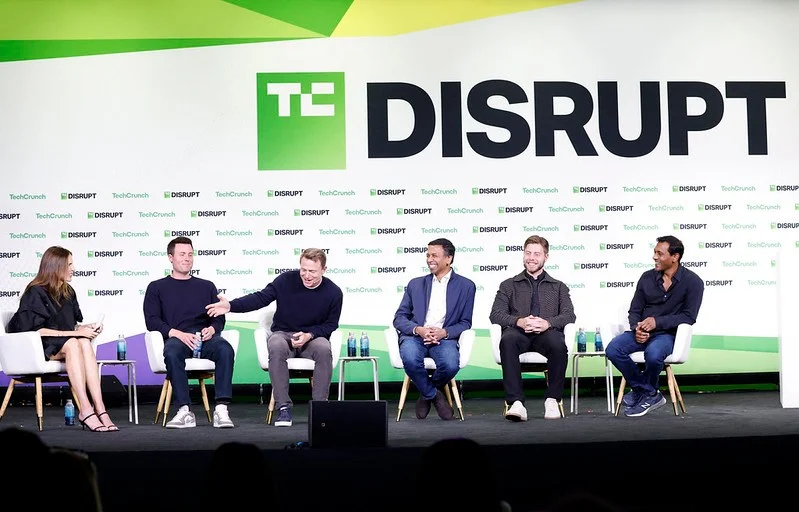
    As the competitive landscape of venture investment expands, Benchmark prioritizes a small number of investments and long-term partnerships over speed. Five general partners gathered on the TechCrunch Disrupt stage clearly demonstrated the firm’s evolution and enduring principles.

    Evolution Over 31 Years and a Growth Fund

    During the summer, Benchmark committed a total of $2 billion across two funds, marking its second-largest primary raise, relative to its usual size, in its 31-year history. Its core fund remained at $500 million for 20 years but was recently adjusted in response to inflation, and Peter Fenton acknowledged that this may have been a strategic misstep.

    The new growth fund was defined as an extension that broadens Benchmark’s existing investment focus, which had centered on early-stage opportunities. Some opportunities that came to Benchmark could have generated returns of 10 to 1,000 times, but the firm’s strategy of concentrating on early-stage investments limited its ability to pursue them, making this a deliberate choice to expand the scope of its venture investment strategy.

    The Concentrating Effect of Fewer Investments

    The growth fund was envisioned to make between four and six investments on a selective basis, or at most seven to eight. If the fund succeeds, 90% of its returns could come from one or two investments, highlighting the strategy’s concentration.

    This structure differs from a strategy focused on increasing the number of investments. Benchmark maintains relationships with early-stage founders that support companies for 10 to 15 years, something that is difficult to replicate with talent and time alone.

    How Five Partners Make Decisions

    Benchmark is currently a small organization composed of five general partners who aim for a higher density of dialogue and more consistent decision-making than a hierarchical investment team. Ev Randall explained that a small partnership allows the partners to make judgments together without navigating a complex organizational structure, and that a relationship built on mutual respect and learning shapes the quality of the organization.

    Jack Altman said Benchmark places greater importance on helping founders and companies than on money or status. A small partnership was more than a limit on headcount; it was a structure that enabled high-density dialogue and a culture of learning together.

    Monday Meetings Without a Fixed Agenda

    The partners meet every Monday but do not set a default agenda. Eric Vishria explained that they freely share the companies they meet, what attracted their interest, and what they observed on boards while looking for directions that would not have been possible six months earlier in a rapidly changing market.

    The agenda-free approach avoids systematization while creating room to respond. Chethan Puttagunta explained that the five partners can immediately become involved when founders need support with executive hiring or strategic partnerships.

    Maintaining Momentum Amid Rapid Change

    Although economic indicators point to risks ahead, Benchmark is not making major changes. Eric Vishria believes some warning signs may be the result of X-fueled hysteria, and the firm continues its existing pace of two to three new investments per partner each year, even as the market accelerates.

    The strategy’s competitive advantage lies not in transaction speed or fund size, but in the trust among five partners, long-standing relationships with founders, and flexible decision-making that enables an immediate response. Rather than pursuing more investments, Benchmark aims to remain alongside companies as they design their next stage. This article is based on TechCrunch’s interview with Benchmark’s partners.

  • Turn Cloud EOL Alerts Into Actionable Remediation Work

    Turn Cloud EOL Alerts Into Actionable Remediation Work

    The most frustrating moment in cloud operations is when an end-of-support notice lands in the inbox, but no one connects it to their team’s workloads. Assets with different lifecycles, including AI model versions, Kubernetes versions, serverless runtimes, and database engines, reach end of support simultaneously. Even when teams know what is about to expire, they still lack the answer to who must change what, and by when. Filling this gap is the essence of cloud EOL management.

    There are several ways to find notices. Service Health, AWS Health, Advisor, vendor emails, and internal scripts each provide different signals, so relying on a single source leaves gaps. The original source also asks whether these channels are used together. The real problem, however, comes after collection. Notices usually reach account or subscription owners, while the impact of an actual change falls on a specific workload team.

    Receiving a Notice Is Only the Start

    Patch management tools alone cannot solve the problem. Software dependency management tools such as Renovate and Dependabot are useful for managing library versions, but they do not automatically track service end-of-support events for managed AI models, Kubernetes versions, or serverless runtimes. Pinning a version in IaC does not guarantee safe deployment by itself. Teams must separately verify when the pinned version will reach end of support.

    Operational standards therefore cannot rely only on whether a notice was received. Each item needs to link its end-of-support schedule, affected accounts, subscriptions, and regions, actual workloads, owning team, replacement path, and response deadline. Only items that have also passed verification should be considered closed. Without such standards, more alerts make it harder for owners to decide what to address first.

    Connect Notices to Workload Owners

    The first step is to normalize notices into a common format. This means consolidating the service type, affected version, end-of-support date, original link, and collection path into a single record. The next step is to connect that record to actual deployment targets using identifiers for accounts, subscriptions, regions, services, and resources. What is needed here is not a static owner list, but rules for keeping ownership information current and a procedure for handling broken connections.

    In practice, it is effective to combine the organization’s asset discovery system with a CMDB or ownership metadata. If organizational structure and deployment metadata remain in separate systems, teams should not designate either as the sole source of truth; instead, they should reconcile them regularly. Notices that cannot be connected should be separated as unassigned items and resolved with the responsible organization rather than assigning owners by guesswork.

    Use Terraform and CI as Final Safeguards

    IaC and CI checks can serve as effective supplemental guardrails. Checking Terraform-pinned versions and deployment pipelines for end-of-support targets can reveal issues before operational rollout begins. However, these checks are safeguards for examining actual deployment configurations; they cannot replace the collection of notices across every account and subscription or the mapping of notices to owners.

    ※ Note: The following configuration is a conceptual simulation example and does not represent an official specification. Actual policies should reflect each organization’s version sources and approval procedures.

    eol_policy:
     reject_unmapped_notice: true
     require_owner: true
     require_replacement_plan: true
     block_deployment_after_end_of_support: true

    Check results should retain more than a simple list of failures. They should also store the deployment targets using the affected version, owning team, candidate replacement versions, and a link to the CI run. Only then can a policy violation become actionable work.

    Manage Status from Receipt Through Regression Testing

    An operational workflow is easier to interpret when it consists of the following statuses. First, record the notice as Received, then use Impact Analysis to confirm actual usage and scope. During the Planning stage, finalize the owning team and response deadline, and apply the new version or alternative architecture during the Replacement stage. Only after traffic migration and regression testing have been confirmed in the final Verification stage should the item move to Closed.

    This status model can be implemented in business systems. Rather than building a complex dedicated platform from the start, it is more realistic to begin with a system capable of connecting notices, assets, owners, and work records. Automation should initially focus on collection, deduplication, suggesting potential owners, and issuing deadline warnings, while replacement decisions should remain with the responsible teams.

    Practical limitations are also clear. If ownership information is neglected, automation cannot route work to the correct owner. Querying multiple accounts and subscriptions increases access requirements and costs, while differences in notice formats across vendors require ongoing maintenance of collection rules. The most dangerous operational approach is to monitor only subscription-owner email or deliver every notice with the same priority. A version-tracking spreadsheet also fails to become an execution-management tool unless it connects owners, response status, and verification results.

    Maturing cloud EOL management requires treating the list of notices as something other than the goal.

    The original discussion on the same topic also asks how notices are found, how they are routed to responsible teams, and whether IaC and CI checks are used.

    In practice, teams can begin by collecting recent end-of-support notices from Service Health, AWS Health, Advisor, and vendor emails, then organizing them into a common list. Each notice should include the account, subscription, region, affected version, end-of-support date, and original link. Teams can then compare the organization’s asset discovery system with its CMDB and deployment metadata to confirm actual workload usage and identify the owning team. Unassigned notices should be resolved with the responsible organization, while end-of-support checks can be added to Terraform-pinned versions and CI pipelines to test pre-deployment blocking and replacement-version validation.

    Practical Implementation Points

    • Confirm coordination and approval paths with relevant teams
    • Conduct advance impact testing in an isolated environment
    • Establish a phased rollout and emergency rollback plan

    Original Source

    This article was written after reviewing the following source: r/devops — How does your team track everything that’s about to be retired in your cloud?

  • DeepSeek Unveils V4.1-Flash-1017 and Web Search APIs

    DeepSeek Unveils V4.1-Flash-1017 and Web Search APIs

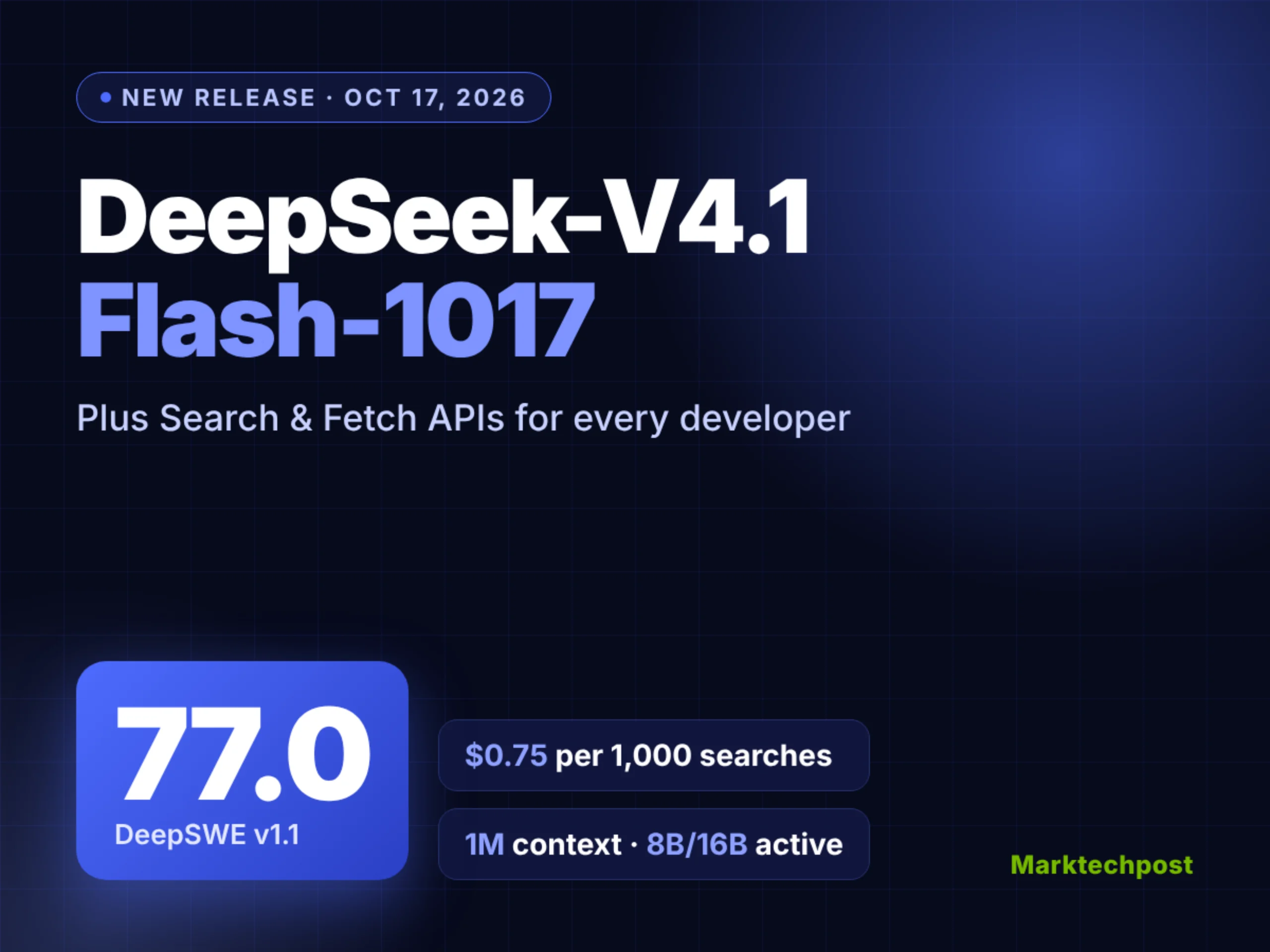
    DeepSeek has released the DeepSeek-V4.1-Flash-1017 model and made it available on its website, in its apps, and through the API as the deepseek-flash model. The new model is a follow-up checkpoint to September’s V4.1-Flash and, according to DeepSeek’s own measurements, achieved leading performance across 11 benchmarks. At the same time, the company opened its Search API and Fetch API to all developers, allowing the model and web information access layer to be configured with a single API key.

    What the 77.0 DeepSWE Score Means for Coding

    DeepSeek said the 1017 checkpoint scored between 2.0 and 11.1 points higher than the previous V4.1-Flash across 11 benchmarks. It recorded a score of 77.0 on DeepSWE v1.1, surpassing the previous V4.1-Flash’s 74.2 and Claude Opus 5’s 74.0. It also posted 60.5 on Automation-Bench and 35.4 on Agents’ Last Exam, leading in those categories as well.

    However, the performance advantage does not extend to every area. The 1017 checkpoint scored 42.6 on HLE without tools, below Claude Opus 5’s 56.3, while Claude Opus 5 also led on Terminal-Bench 4.0, ProgramBench, and NL2Repo. These figures were measured by DeepSeek itself and should be treated as performance claims that require independent verification.

    Model DeepSWE v1.1 HLE without tools
    DeepSeek-V4.1-Flash-1017 77.0 42.6
    DeepSeek-V4.1-Flash 74.2 Not reported
    Claude Opus 5 74.0 56.3

    MoE Architecture and Long-Context Efficiency

    DeepSeek-V4.1-Flash-1017 is based on a multimodal Mixture-of-Experts model that divides 40 Transformer layers into 20 causal encoders and 20 decoders. It has a total size of 552B backbone parameters and 196B Engram parameters, with 8B active parameters for prefill and 16B for decoding on a per-token basis. It supports a maximum context of 1M tokens and output of up to 384K tokens.

    Efficiency features include Causal Encoder-Decoder, Compressed Sparse Attention 2, an FP4 main KV cache, and SWA Bounded Replay. CED projects the decoder’s global KV from the final encoder hidden state, reducing prefill computation by nearly half. CSA2 operates layers in Full, Reindex, and Reuse modes while sharing main KV and indexer keys across layers. The FP4 main KV cache reduces global KV to 890 bytes per token, about one-quarter the level of V4-Flash, while SWA Bounded Replay reduces the persistent KV cache to roughly one-eighth.

    Post-training applied reinforcement learning with self-feedback, and end-to-end project work examples included game development and 3D modeling. The API’s reasoning effort is a scalar from 1 to 100, with low, high, and max corresponding to 50, 75, and 100, respectively.

    Simplifying Web Access with the Search and Fetch APIs

    The Search API returns ranked web search results for queries, while the Fetch API converts a single page into Markdown. Their endpoints are POST /v1/tools/search and POST /v1/tools/fetch, respectively, and both are available through api.deepseek.com. The Search API supports between 1 and 50 results, optional page content, and the site:, lang:, after:, and before: operators. Each result includes a rerank score from 0 to 3 and an authority tier from 0 to 4.

    Pricing and limits are the same for both APIs. The Search API and Fetch API each cost $0.75 per 1,000 successful requests, with no charge for empty results or failed requests. Each account is limited to 5 endpoint requests per second.

    Remaining Constraints on Cost and Open Weights

    The peak price for deepseek-flash is $0.30 per 1M uncached input tokens and $1.20 per 1M output tokens, while off-peak rates are half those amounts. Server-side calls through DeepSeek Harness, Claude Code, and Codex are free until November 1, 2026. The model can be called through OpenAI-compatible and Anthropic-compatible endpoints.

    The 763B-parameter FP8 weights for September’s V4.1-Flash were released on Hugging Face under the MIT license. However, the weights and hardware requirements for the 1017 checkpoint have not been released. Because the company provides the API service alongside web tools, practical selection requires comparing coding quality, long-context throughput, invocation costs, and self-hosting availability. More details are available in MarkTechPost’s public report.

    Source

    This article was prepared by consulting the following source: MarkTechPost — DeepSeek Just Released V4.1-Flash-1017, Scores 77.0 on DeepSWE, Opens Search API

  • Evernorth’s Nasdaq Listing and XRP Institutional Management

    Evernorth’s Nasdaq Listing and XRP Institutional Management

    Digital asset financial services company Evernorth entered the institutional market by ringing Nasdaq’s closing bell under the ticker symbol ‘XRPN’. Ripple CEO Brad Garlinghouse said XRP’s primary use case extends beyond simply holding the asset long term (HODL) to developing institutional products that generate meaningful returns. Evernorth’s XRP institutional management model combines access to digital assets through Nasdaq shares with a structure for reinvesting management income.

    How Nasdaq Shares Change the Accessibility of XRP Investments

    Evernorth holds approximately 47.3 million XRP and has selected Ripple, Kraken, Coinbase, and BitGo as its first institutional trading partners. Asset managers, hedge funds, and family offices can now invest through Nasdaq shares without directly managing wallets or assuming the risks of XRP custody. A recurring model is operating in which income generated by incoming capital is reinvested in XRP. At the core of this structure is whether capital raised through share issuance will be connected to demand for digital assets and productive income-generating activities.

    Ripple CEO Brad Garlinghouse said Evernorth could drive XRP’s performance by building a differentiated strategy and leveraging income opportunities across both on-chain and off-chain markets. Garlinghouse also said institutional XRP management should move beyond passive holdings toward generating meaningful returns.

    Participation by institutional capital further supports this structure. Citigroup Global Markets served as sole private placement agent, while SBI Holdings, Pantera Capital, Arrington Capital, and GSR formed the investor group. NH Investment & Securities participated in a $30 million convertible bond (CB) offering to support XRP acquisitions and ecosystem expansion. The institutional involvement of traditional financial firms is significant because it suggests that institutional XRP management could expand into a separate capital market capable of absorbing institutional investment demand.

    Intrinsic XRP Value per Share and the XRPL Infrastructure

    Market experts are closely watching Evernorth’s ‘intrinsic XRP value per share’ metric. Based on current holdings, a 1% increase in annual holdings would add 4.73 million XRP, a 3% increase would add 14.19 million XRP, and a 5% increase would add 23.65 million XRP.

    Annual Holdings Growth Rate Additional XRP Accumulated Annually
    1% 4.73 million XRP
    3% 14.19 million XRP
    5% 23.65 million XRP

    If Evernorth expands its XRP holdings faster than its share issuance rate, the intrinsic value per share could continue rising. This rationale holds when the dilution in share value caused by new share issuance is considered alongside the expansion of XRP holdings. The actual increase will depend on the scale of issuance, the XRP price, management costs, and whether returns are realized; current holdings alone do not guarantee the outcome.

    XRPL infrastructure to support actual institutional operations is also under development. The XRP Ledger’s (XRPL) XLS-65 Single Asset Vault and XLS-66 Lending Protocol have been presented as core components responsible for XRP custody and lending functions. Both proposals have secured majority support from validators and are accelerating toward adoption. Once this infrastructure is activated, institutions will be able to manage XRP in lending, liquidity provision, and credit markets, potentially shifting Wall Street’s evaluation of XRP from simply tracking price volatility toward treating it as a productive financial asset.

    Validation Challenges Left by Return Realization and Adoption

    For Evernorth’s model to succeed, XRP holdings must expand beyond the share issuance rate, and management income must be demonstrably reinvested. A trading and custody system and institutional capital participation have been established, but the amount of management income generated and the extent to which XLS-65 and XLS-66 are used in real trading environments remain separate areas for observation.

    While this structure has expanded access to institutional XRP management, the standard for measuring the transition from a ‘held asset’ to a ‘managed asset’ lies not in the listing itself but in validating repeatable profitability and intrinsic XRP value per share. Related background can be found in Global Economic’s original report.

    Original Source

    This article was prepared after reviewing the following original source: Global Economic — “If You Think of Selling XRP…” A New Vision Unveiled by Ripple’s CEO

  • Five Bank Chiefs Testify on Data Breach Response

    Five Bank Chiefs Testify on Data Breach Response

    The CEOs of five major banks will appear as general witnesses before the National Assembly’s Legislation and Administration Committee and the Financial Supervisory Service on the 19th to explain their response to the financial sector’s series of hacking incidents and measures to prevent recurrence. KB Financial Group CEO Lee Wan-joo, Shinhan Financial Group CEO Jung Sang-hyuk, Hana Financial Group CEO Lee Ho-seong, Woori Financial Group CEO Jeong Jin-won, and NH Nonghyup Bank CEO Kang Tae-young are reportedly reviewing the circumstances of the incidents and preventive measures in emergency mode, even over the weekend, as they prepare for the audit.

    Data Leak Circumstances and Management Accountability in Focus

    It will be the first time in four years that the five bank CEOs have appeared together as witnesses at an audit, since October 11, 2022. That hearing addressed financial misconduct, including embezzlement, and internal controls. This time, scrutiny is expected to focus on the circumstances surrounding customer data leaks caused by AI-enabled hacking, the incident response of the departments involved, security investments, and management’s accountability for oversight.

    The banks are consulting major law firms while conducting comprehensive system inspections and reviewing their security posture. They are also considering procedures to compensate customers quickly if additional damage occurs. However, the scope of the data leak and the specific method of attack have not been disclosed.

    From Inspections to Larger Budgets and Stronger Security

    The banks are refining their follow-up measures and security enhancement plans. During the audit, they plan to explain in detail how they are determining the causes of the data leaks and what steps they are taking on the ground to prevent recurrence. As security responses continue, there is also a possibility that additional, undisclosed hacking risks will be raised. Financial institutions hope the audit will serve as an opportunity to strengthen their information protection standards.

    There are expectations that discussions in the National Assembly on expanding security budgets and advancing related initiatives will reinforce banks’ security efforts. Meanwhile, some have raised concerns that the hearing could lead to excessive blame or create unnecessary fear. The terms of all five bank CEOs in attendance are scheduled to expire at the end of this year, meaning issues surrounding governance, including succession or contract extensions, may also be raised.

    A financial industry official said the audit should be a practical forum for advancing the industry’s security systems in response to AI-based hacking threats, rather than a venue that amplifies excessive blame or unnecessary customer anxiety. The details disclosed after the audit, including how the data leak occurred, where responsibility for the incident response lies, and whether security enhancement plans and the necessary funding are in place, will provide the basis for evaluating the completeness of the banks’ hacking response. When concrete action plans are presented, it will be necessary to determine whether the response to the hacking incidents will develop into a sustainable security system rather than temporary measures for each institution.

    Detailed coverage can be found in Security News’ article on the five bank CEOs appearing before the National Assembly’s Legislation and Administration Committee.

  • Meta Terms Edit Reveals AI Data Collection Controversy

    Meta Terms Edit Reveals AI Data Collection Controversy

    Meta recently amended its commercial terms to state that content contained in the domains, web pages, or URLs of business accounts could be used to provide, develop, improve, and research its products, as well as train AI models. Legal experts interviewed by Nieman Lab said the provision appeared to authorize the scraping of publishers’ websites that maintained Meta business accounts and the use of that content to train AI models.

    Meta’s Terms and Actual Collection Practices Are Separate Issues

    A Meta spokesperson said the amended terms did not reflect any changes to how the company crawls the web, adding that the consolidated crawling-related conditions applied to its advertising and business products. According to The Verge, the provision that sparked concern was subsequently removed. Reports then emerged that the language had been deleted from Meta’s terms, and the company clarified that “It does not change how Meta uses web crawlers.” TechCrunch’s original report said the provision fueled debate over whether it granted Meta broad authority to collect AI training data.

    Copyright Concerns Remain for Publishers

    Meta won a major lawsuit over copyright infringement last year, but lawsuits against AI companies, including Meta, continue. Because server-side collection and the scope permitted by the terms may differ, publishers and AI companies still need to clarify the legal basis and practical scope of data collection.

    Source

    This article was prepared with reference to the following original source: TechCrunch — Meta removes language that raised scraping and AI training concerns

  • Too Many JavaScript CVEs? Verify Real Artifact Risk

    Too Many JavaScript CVEs? Verify Real Artifact Risk

    JavaScript vulnerability management does not end with generating a dependency list. Generating an SBOM with Syft in CI and uploading it to Dependency-Track is useful for obtaining a reproducible dependency list, but whether that list matches the code actually included in a service remains a separate issue. A lockfile contains many packages, while only some make it into the final bundle, and determining whether the vulnerable code paths are even reachable requires yet another assessment.

    Therefore, artifact vulnerability verification should be the next step after generating an SBOM. Mixing potential vulnerabilities, build-stage vulnerabilities, and direct risks in the final artifact under the same rating can inflate CVE counts because of development packages while obscuring the actual remediation order. The solution is not to abandon lockfile scanning, but to explicitly manage the differences between the lockfile and deployed artifacts.

    Why the Full Lockfile Becomes an Excessive Candidate List

    A lockfile records packages that never enter the final browser code, including development servers, bundlers, and test tools. For an SPA, excluding devDependencies can mitigate this to some extent, but in a Laravel structure, NPM packages are placed in devDependencies, making it difficult to describe the server-side build configuration based on that classification alone. Therefore, the first question is not the category name, but whether the package remains in the deployed artifact.

    The same problem appears in a original thread about scanning JavaScript CVEs. Its central question is how to distinguish packages in the lockfile from packages included in the bundle, and it also presents an experience suggesting that generating sourcemaps can significantly reduce the results. Sourcemaps are useful clues, but they are not verification results that can be included with public assets.

    Do Not Mix Two SBOMs into One Result

    The recommended pipeline is to scan source dependencies and deployed artifacts separately. At the source stage, generate a lockfile-based SBOM to manage missing dependencies and update candidates. At the deployment stage, rescan the built public assets or final container image. In Dependency-Track, do not treat both results as identical evidence for the same asset; preserve the difference between the potential source list and the deployed inclusion list as a separate stage.

    The source directory and build output can be managed as separate artifacts.

    ※ Note: The following is a conceptual simulation example (Illustrative Example, not official spec)

    The following commands are a basic form of generating package lists for the working directory and build output.

    npm ci
    npm run build
    syft dir:. -o cyclonedx-json > sbom-source.json
    syft dir:public/build -o cyclonedx-json > sbom-build.json
    

    Actual paths and build scripts should be adapted to the project structure. For a Laravel application, separately verify whether NPM dependencies are included in the final build configuration. The build output and files included in the deployment image should serve as the basis, rather than the classification in package.json.

    Compare Inclusion in Bundles and Deployment Images

    For typical frontend assets, inspect the final app.js and, if necessary, analyze the sourcemap generated during the build to compare bundle inclusion. Keep sourcemaps as analysis artifacts and exclude them from deployment images. The criterion should be the code paths that remain in the final bundle, not the number of lockfile entries.

    Deployment verification must go one step further. Scanning the container image created in CI as-is makes it possible to confirm the separation between build tools and runtime files. Items in the artifact vulnerability verification results that are included in operational assets should receive a high remediation priority, while development, build-stage, and reproducibility-verification items should be managed under a separate policy.

    Can You Trust Sourcemaps Alone?

    Sourcemaps are important clues when comparing the lockfile with the bundle, but they do not prove inclusion in the deployed artifact by themselves. Therefore, use sourcemaps as supporting evidence and verify the files inside the deployment image and reachable code paths together.

    Unconditionally upgrading every package because the CVE count is low is also risky. Updates should be decided only after checking whether the vulnerable package is included in the deployed artifact, whether its execution path is reachable, and whether the code is used. This approach preserves lockfile scanning while avoiding indiscriminate changes intended merely to reduce CVE counts.

    In practice, store the lockfile SBOM as the list of potential source dependencies and identify the location of public assets after the build. Generate SBOMs for the source and build outputs separately with Syft, compare their differences, and identify runtime packages separately in the final container image. Add a CI rule that checks deployment inclusion and execution paths whenever an upgrade alert is received.

    Practical Implementation Points

    • Confirm coordination and approval paths with relevant teams
    • Conduct advance impact testing in an isolated environment
    • Establish a phased rollout and emergency rollback plan

    Original Source

    This article was written after reviewing the following original source: r/devops — How do I actually scan for CVEs for Javascript?

  • Kubernetes AI Agents Cut Idle Resources With Snapshots

    Kubernetes AI Agents Cut Idle Resources With Snapshots

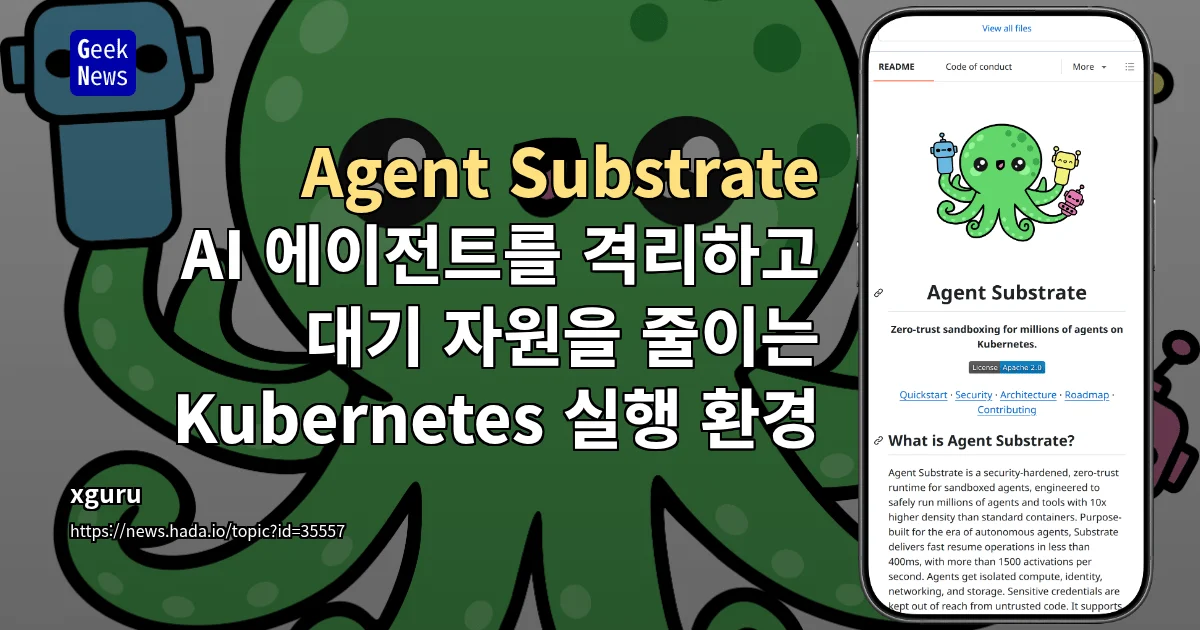
    This infrastructure tool runs multiple AI agents in isolated sandboxes while reclaiming resources left idle during waiting periods. It saves memory and file state while waiting for model responses or tool execution, then restores that state and resumes work when a request arrives. Its goal is to reduce the cost of always-running Kubernetes workloads while maintaining AI agent isolation.

    A microVM architecture that supports Pod reuse

    Agent Substrate has a small pool of preprepared Kubernetes Pods that multiple agents take turns using. It isolates execution environments with microVMs based on gVisor or Cloud Hypervisor, but does not support running agents in standard Linux containers alone. Because it can use standard OCI container images, it is not tied to specific models or agent SDKs.

    Saved state can be restored on another worker, preserving sessions and working environments even when execution moves to a different location. This architecture addresses the Kubernetes resource management challenges of maintaining a Pod for each agent and leaving resources idle for extended periods through state saving and restoration.

    External requests protected by gateways and policies

    API keys and credentials are managed outside the sandbox, and a gateway injects them only into permitted external requests. The system can also distinguish agent identities, separate network access, and integrate with policies for external authentication and data exfiltration prevention. As a result, AI agent isolation covers not only the execution environment but also authentication boundaries and data movement policies.

    Kubernetes deployment and remaining operational requirements

    Agent Substrate deploys directly to Kubernetes and requires PostgreSQL and a snapshot store. It also provides local kind and GKE development environments. Before production adoption, teams should validate microVM isolation, snapshot restoration, worker migration, and credential injection boundaries together. These details can be confirmed in the original Agent Substrate information.

    Source

    This article was prepared with reference to the following source: geeknews — Agent Substrate – A Kubernetes runtime that isolates AI agents and reduces idle resources

  • Australia Proposes an Algorithm Switch for Social Media

    Australia Proposes an Algorithm Switch for Social Media

    The Australian government has proposed a bill to parliament requiring social media platforms to provide an “algorithm switch” that lets users turn off recommendation algorithms. The key feature of the switch is that, when turned on, users see only posts from accounts they follow rather than recommended content. The bill also includes a duty of care, a legal obligation for online services to act reasonably to protect users’ safety.

    Two People Who Could Not Escape Unwanted Content

    The proposal is grounded in experiences in which recommendation algorithms can worsen users’ vulnerabilities at critical times. Varsha Yajman, who was recovering from an eating disorder, said that weight-loss content continued to appear even after she used every safety setting and blocked every related term. She said she began using social media at age 13 and was exposed to an environment that fostered obsessions with appearance and food as she encountered exercise videos and dangerous calorie challenges in her feed. She recalled that in the past, she watched posts from people who documented everything they ate, telling herself, “I do not need to eat. I can just watch what other people eat”.

    Flynn Martin’s experience showed toxic masculinity content exacerbating his symptoms. In his twenties, posts by influencers including Andrew Tate dominated his feed, and he said he believed their rhetoric during a period of anxiety and frustration. He later recovered from mania and left that content environment through hospitalization, but said that looking back at his former self gave him compassion for the emotions and tastes he had at the time. Neither person blamed social media alone for their worst moments, but both cited it as a contributing factor because unwanted content amplified their problems.

    Keep the Default, Require Choice: Campaign Calls for Stronger Regulation

    Fix Our Feeds, a consent education campaign led by Chanel Contos, called for recommendation algorithms to be off by default and activated only when users wanted them. More than 15,000 people participated in the campaign, which was supported by two former prime ministers, members of parliament, mental health professionals, and online safety experts. The Australian government said in September that it had accepted the campaign’s demands. However, its announcement stopped short of requiring recommendation features to be switched off automatically and only required platforms to provide an optional control.

    Prime Minister Anthony Albanese described the measure as giving people choice rather than allowing the government to control algorithms. As he put it, a gap remains between guaranteeing users the freedom to keep exploring dangerous content and designing defaults that reduce exposure to recommendation algorithms. Merely offering the option to switch the feature off may not address fatigue, low digital accessibility, or, most importantly, the psychological burden of repeated exposure. The effectiveness of an algorithm switch depends not only on whether the function exists, but also on how easily users can discover and activate it.

    Platform Objections and the Duty of Care Debate

    Social media companies argue that the risks of recommendation algorithms are exaggerated and that they already provide effective safety tools. However, court cases across several jurisdictions and internal disclosures have raised claims that companies knew about the risks but delayed action to preserve engagement and revenue. Chanel Contos said content designed to provoke strong emotions such as anger, fear, desire, and anxiety keeps people scrolling. Treating recommendation algorithms as a driver of engagement requires scrutiny not only of giving users the ability to switch them off, but also of how platforms are designed and how they determine recommendation rankings.

    The duty of care imposed on online services is central to this debate. If recommendation exposure is left entirely to individual choice, responsibility for algorithmic structures that create repeatable consumption environments may be diluted. Conversely, critics argue that excessive regulation of platforms’ deterministic recommendations could undermine freedom of expression and the diverse ways people use services. The effectiveness of legislation must therefore be assessed by whether the recommendation switch is genuinely selected, whether platforms apply safe defaults after recognizing risks, and what liability follows violations.

    A Broader Regulatory Direction Emerging from the UK’s AI Safety Debate

    Although it does not address precisely the same issue as Australia’s social media bill, concern about the spread of AI and technological safety is growing within Britain’s Labour government. One Labour politician identified the possibility that the concentrated power of superintelligent technology could fall into the hands of dangerous actors as the greatest fear. Ed Miliband said in a speech at the AI Action Summit that the interests of technology companies must not come at the expense of the safety of children or humanity as a whole.

    These debates point in a direction that extends beyond recommendation algorithms. Society must determine whether the features platforms provide broaden users’ choices or serve as tools that shape behavior and consumption through repeatable exposure. Australia’s algorithm switch is a policy that explicitly guarantees choice, but its practical effectiveness depends on default settings, accessibility, and the enforcement of the duty of care. BBC reporting on the algorithm switch and The Guardian’s analysis of AI safety share the view that technology regulation must begin with user choice and extend to the risks created by systems.

    Sources

    This article was prepared with reference to the following source: BBC Tech — Toxic algorithms wouldn’t let them go – now Australia wants an off switch

  • DB Savings Bank Data Breach Raises Security Concerns

    DB Savings Bank Data Breach Raises Security Concerns

    An incident believed to have exposed the personal data of 142 people at DB Savings Bank, including employees and project contractors, has occurred. The leaked information was reportedly used in an attempt to check loan limits, although no actual financial transactions took place. Because the data breach led to an attack involving financial transactions, access rights for outsourcing projects and post-transaction controls have emerged as key security management issues.

    Incident Timeline and Anomalous Access

    According to a Financial Supervisory Service incident and system failure report submitted to lawmaker Shin Dong-wook’s office on the National Assembly’s Committee on Policy and Administration, the incident occurred in the bank’s internet banking and mobile web systems. It began at 12:28 p.m. on the 10th and was detected at 6 p.m. the following day.

    Those affected included 122 employees, including retirees, and 20 project contractors. Four types of information were exposed, including internet banking user IDs, names, resident registration numbers, and mobile phone numbers. Contractors involved in the digital channel modernization project conducted since November 2024 were identified as a possible route for the data leak, but the circumstances surrounding their involvement and whether it was intentional have yet to be confirmed.

    Subsequent anomalous loan-limit checks followed the exposure of the information. DB Savings Bank said it had blocked all transactions in accordance with company policy and that no secondary damage had occurred as of the time of its statement. Following the incident, the bank added the attacking IP addresses to a firewall blocklist and continued monitoring for similar patterns.

    Contractor Access Management and Supply-Chain Security

    The central issue revealed by this case is that the impact of a personal data breach did not end when the data was initially exposed. The personal information accessed by contractors subsequently resulted in anomalous access, including loan-limit checks. In practical operations, it is important to manage project participants’ data access scopes, permission approval and revocation procedures, and activity records for personnel within the supply chain together.

    Firewall blocking and transaction blocking serve as evidence of defenses that prevented the activity from developing into actual financial transactions. However, blocking attacking IP addresses alone cannot eliminate every malicious access attempt, so a continuous detection system that distinguishes normal transactions from anomalous patterns is also necessary. Supply-chain management should likewise go beyond simply granting access and include verifying where personal information is being used.

    DB Savings Bank advised those affected to remain alert to secondary damage through unwanted methods, including spam and phishing emails. The bank said it would establish a compensation system through channels such as its customer center, the Personal Information Protection Commission, and the Financial Supervisory Service if actual damage occurs. The response to a personal data breach must extend beyond servers and firewalls, requiring follow-up security measures that connect affected individuals with guidance and victim compensation procedures.

    Security News’ report on the suspected DB Savings Bank personal data breach shows that access controls for contractors and anomalous transaction detection need to be combined to address this type of incident.