Author: l0cknsec

  • Financial Security Agency Revamps Homepage for 16 Services

    Financial Security Agency Revamps Homepage for 16 Services

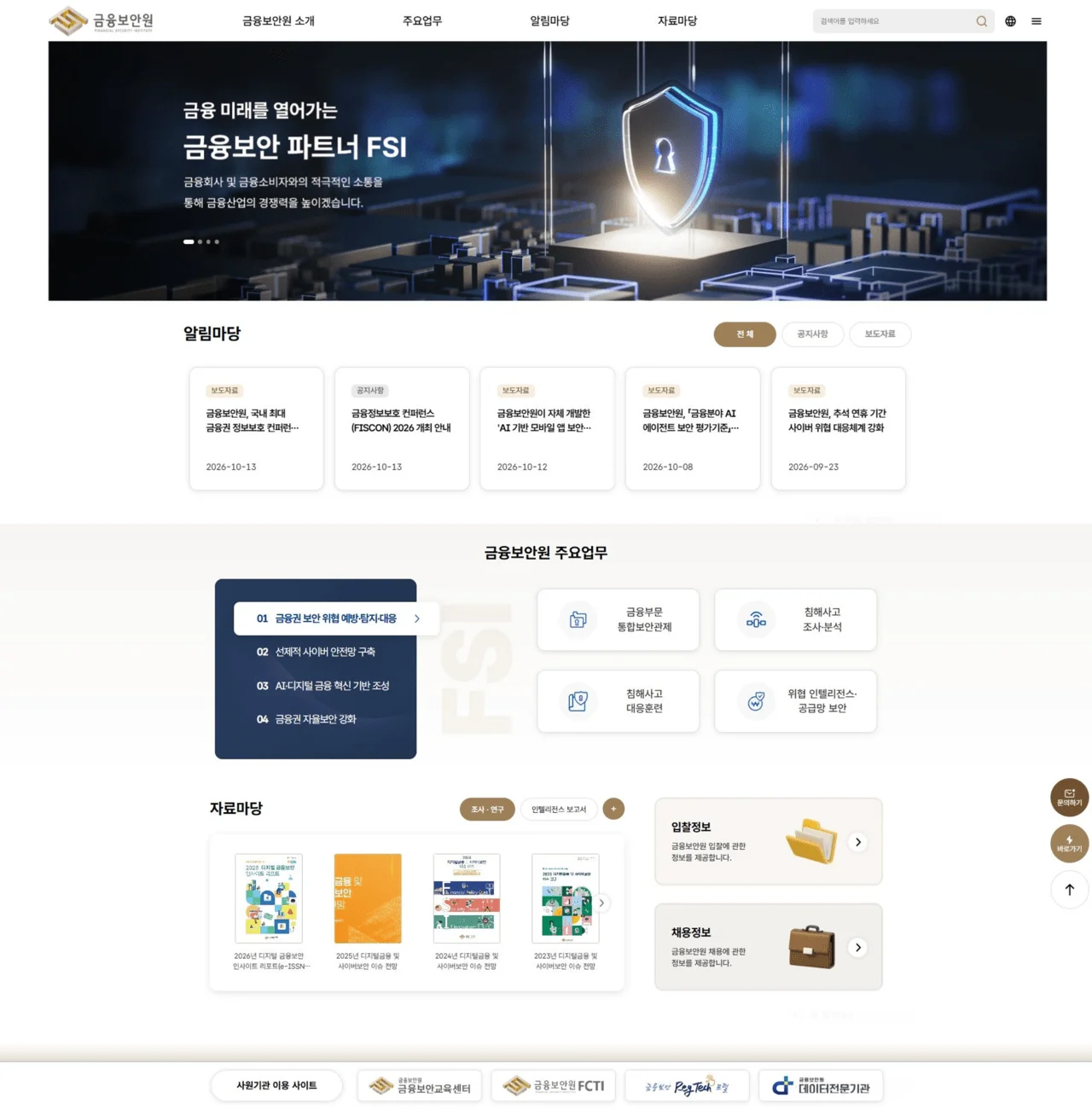
    Security News reported that the Financial Security Agency revamped its main homepage on October 16, 2026, to make official information and services easier to find. Notices and press releases were arranged as cards, while research materials and key services were reorganized with visual elements. The focus of the revamp was not new security features but improvements to the information architecture and navigation.

    Information Architecture by Category

    Key information and content that had been crowded onto a single page were divided into category-specific portals. For users unfamiliar with financial security, the Financial Security Agency created new content sections for 16 key services and revamped the top navigation. The move toward infographic-based explanations of the agency’s work appears focused on helping users understand complex services.

    Practitioners can check the responsible department and contact information for each service, along with related sites. A quick menu was also added to the bottom of the homepage to provide direct access to major sites operated by member institutions. Together, these elements show that the revamp covered not only finding information but also connecting users to the responsible department after locating what they need.

    Keeping Content Current in a Changing Environment

    The Financial Security Agency said it will promptly reflect future organizational and service changes on its website and continuously keep its content up to date. President Park Sang-won said, “We will continue to update the content in line with the changing financial security environment and further improve information accessibility and convenience from the user’s perspective”. This homepage revamp does more than display an updated list of services: it improves the structure for finding official information by connecting users with contact details and related sites.

    Original Source

    This article was written after reviewing the following source: Boannews — Financial Security Agency homepage revamp… Improved visibility and convenience

  • Azure Sev1: Is External Support the Real Answer?

    Azure Sev1: Is External Support the Real Answer?

    Why Official Support Tickets Alone Become Insufficient

    One of the realities encountered as Azure usage scales is the declining responsiveness of official Azure support tickets. A post on r/AZURE titled “Slow response, generic answers, tickets bouncing around” recounts the experience of facing this twice in a year. Template answers keep repeating, tickets bounce between departments, and the situation of having to find the root cause internally repeats itself twice. Engineers at this stage develop the hypothesis: “If we raise the support tier, won’t it be resolved?” However, an evaluation left by an engineer with 8 years of experience is sobering. “It doesn’t matter. It’s all useless IMO” — the diagnosis is that the fundamental premise may be off before discussing tools or tiers.

    The Two Faces of Azure Sev1: Platform Impact vs. Customer Environment Operational Impact

    When the statement “No one can handle a sev1 other than the actual Microsoft engineers if it’s really a sev 1” appears in the community, it is immediately met with the counterargument “Sev1 doesn’t mean its something Microsoft can only fix”. Although the two positions appear to clash, in practice they are simply viewing the same issue from different axes. Sev1 is a label indicating priority (impact and downtime), not a certification of who can resolve it. An incident where a VPN was accidentally deleted by the operations team is also classified as Sev1, but this is an area that can be restored even without Microsoft. On the other hand, “As an Azure service itself has a Sev 1 issue” — a platform-impact outage in the Azure service itself is something only Microsoft engineers can resolve with backend permissions. Therefore, to argue for the introduction of external support, one must first label “which domain the Sev1 falls under” rather than comparing the options themselves. In practice, it is recommended to establish an operational standard of classifying on two axes immediately upon ticket ingestion: impact scope (platform vs. customer) and responsibility boundary (Microsoft vs. your own organization).

    Substantive Option Comparison: Mission Critical / Consultant / General External Support Provider / Internal Capability

    The high-quality options repeatedly mentioned in the community are essentially compressed into two paths. The first is the Microsoft Mission Critical support tier, the top-tier option layered on top of a Unified agreement. “It has a separate support queue to FTE only knowledgable engineers (same set of people for your company so they may even have historical knowledge)” — this is an evaluation that full-time dedicated engineers are fixed in a separate queue, with no quarterly rotation, so historical knowledge about the company stack accumulates. “The gang on there is top notch and they don’t get shuffled around each quarter so they get to know your stacks” — the fact that the same team is maintained is cited as the substantive value. The downside is clear. “Expensive as hell” — costs are very high, and “Unless Azure is one of your main hyper scalers, I wouldn’t recommend it” — if Azure is not a primary hyperscaler, the cost-effectiveness does not match.

    The second option is purchasing a time block from a well-known independent consultant or qualified engineer. “Actual knowledge of the platform (say like purchasing time from a respected consultant, or hiring someone qualified) is going to help you quicker than support” — deep diagnosis is possible immediately without going through the official queue. However, since it depends entirely on the consultant’s depth, operators must accept that quality variance will be large unless they have a pre-verified contact.

    Other general MSPs are evaluated almost consistently negatively by the community. Eventually, the likelihood of re-escalation to Microsoft is high, the perception is that only cost is added in the middle, and the original post’s author also expresses “every vendor we talk to sounds exactly the same”. The full context can be confirmed in the original thread (r/AZURE What are the real microsoft azure support alternatives).

    Option Resolvable Scope Response Speed Cost Key Limitation
    Mission Critical Tier All platform-impact outages Dedicated FTE fixed queue Very high Azure must be the primary hyperscaler for cost-effectiveness
    Qualified Consultant Time Block Customer environment operational outages Immediate deployment possible Hourly rate Depends on individual depth, quality variance
    General External Support Provider Limited, frequent re-escalation Additional intermediary step Medium Eventually re-routes to Microsoft
    Internal Capability Strengthening Customer environment operational outages Immediate Personnel cost Requires internal diagnostic capability

    Four Decision Axes: Dependency · Incident Frequency · Internal Capability · Budget

    Option selection is not based on a single criterion but requires simultaneous evaluation on four axes. First, whether Azure is the primary hyperscaler is the prerequisite for introducing the Mission Critical tier. Second, measure how many Sev1 incidents actually occurred over the past year. A frequency of two incidents makes it difficult to justify a high-priced tier. Third, the key question is whether there is at least one engineer internally with deep Azure knowledge. “Have engineers that can figure things out on their own” — this is what the 8-year-experienced engineer emphasized most. Fourth, confirm whether the budget structure can support external support costs indefinitely. One-off contracts and quarterly renewal structures carry the risk of knowledge loss. If even one of the four axes is weak, the combination of a consultant time block + internal champion is evaluated as a realistic alternative over a high-priced tier.

    When Raising the Support Tier Is Useless

    “Use services the way they are meant to be used” — community evaluation points out that a configuration that deviates from the intended usage pattern is the fundamental cause. “If you stray from the path you lose valuable documentation and any hope support can do something for you” — in areas where there is almost no documentation or diagnostic log, no matter how high the tier of engineer deployed, diagnosis itself becomes impossible. In other words, Azure official support operates normally only within the scope supported by intended usage patterns and documentation. The higher the proportion of usage outside the scope, the closer the value of the support tier converges to 0. In this case, the fastest solution is to revert the architecture itself to the intended pattern, not to raise the tier.

    What to Do Right Now

    • Share the operational standard of labeling “platform impact / customer environment operational impact” immediately upon Sev1 ingestion with the junior team.
    • Record the number of Sev1 occurrences and average recovery time over the past year to quantify the effect of introducing external support.
    • Review the Mission Critical tier only if Azure is the primary hyperscaler; otherwise, pre-sign a time block contract with 1–2 pre-verified consultants.
    • Check whether the current architecture is within the Well-Architected recommended pattern, identify areas outside the scope, and establish a regression plan.
    • Designate one internal champion to centralize Sev1 case records and consultant contacts.

    Reference Original

    This article was written after reviewing the following original: r/AZURE — What are the real microsoft azure support alternatives out there?

  • PwnEscape: Linux Kernel Flaw Lets Guests Read Host Memory

    PwnEscape: Linux Kernel Flaw Lets Guests Read Host Memory

    On October 15, 2026, security outlet The Hacker News reported a serious flaw in the Linux kernel that lets a packet sent from inside a virtual machine read the host’s memory. Tracked as CVE-2026-99999 with the alias PwnEscape, the vulnerability can produce three outcomes: guest-to-host memory exposure, host crash, and host code execution. Researcher Paulos Yibelo reproduced a memory leak demonstration in Vercel’s production sandbox, and Vercel confirmed it.

    The three demonstration outcomes and their limits

    Paulos Yibelo of security firm pwn.ai demonstrated in a technical report that a specially crafted network packet sent from a guest can trigger three behaviors: host memory read, host crash, and host code execution. All three outcomes stem from the same kernel flaw. Each packet sent from the guest leaked roughly 32 bytes of host memory, and the leak continued as long as packet transmission continued.

    However, the host crash and code execution were reproduced only in the researcher’s own lab environment simulating Vercel, and the researcher stressed, “This is not a claim of root command execution in any vendor’s production environment”. Two specially crafted packets were enough to crash the host and bring down all sandboxes on the same host, and the same flaw could be leveraged to reach administrative privileges on the host outside the VM. Vercel confirmed in the challenge report that the memory leak demonstration was performed in a production sandbox, but added that no customer files, secrets, or application data were reported to have been read.

    Rating and attack conditions

    Kernel maintainers assigned CVE-2026-99999 to this flaw and gave it a 9.3/10 Critical rating in the public record. The same record classified the attack vector as Local, specifying that an attacker must already be able to execute code inside the guest. In other words, this is not a flaw an outside party on the internet can exploit simply by sending packets. The flaw is not listed in the U.S. CISA Known Exploited Vulnerabilities catalog, and there are no reports of it being used in real attacks.

    Implications for shared infrastructure

    Vercel Sandbox runs each customer’s code in a Firecracker microVM with its own Linux kernel copy on a bare-metal Amazon EC2 host, and this microVM serves as the isolation boundary between customers and from the host. pwn.ai assessed that Vercel’s configuration is hardened above industry standard and that no misconfiguration was found. However, the flaw is not in that isolation boundary but in the networking code of the Linux kernel the host runs, so since nearly every major cloud separates customer workloads at the same Linux kernel layer, Vercel noted that the risk extends beyond a single provider to shared infrastructure broadly.

    The fix and operational notes

    The fix is a single kernel change commit 6785011f8b16 written by Michael S. Tsirkin of Red Hat, and it has been merged into mainline. The patch adds checks at five points in the networking code to ensure that checksum data does not point to a region before the IPv4 header before the kernel acts on the packet. The author described it as a “defence in depth” measure, adding that more complete validation at the point where packets enter the kernel requires additional work. Maintainers backported the fix to supported stable branches. Linux distributions ship their own kernels and often apply this kind of fix without changing the version number, so the version seen in uname is not enough; teams must check distribution security advisories and confirm the kernel the host is actually running includes the fix.

    Immediate practical steps

    First, the host’s Linux kernel should be updated to a version that includes the fix, or to a vendor build that includes it, and the host rebooted. Updating only the guest kernel does not resolve the host’s flaw. If a patch cannot yet be applied, narrowing the blast radius when a compromise occurs is the typical fallback. Vercel noted that its own mitigations are keeping the host kernel up to date, disabling nested virtualization, and using the Firecracker jailer to grant microVM processes only the privileges they need; this does not fix the flaw itself but is intended to limit what an attacker who succeeds can do. The original report did not present a separate workaround.

    AI-assisted research and challenge reward

    This flaw was discovered during Vercel’s two-week sandbox breakout challenge in August, which offered a total of USD 1 million in prize money. The per-report cap was USD 50,000, and Vercel paid out a total of USD 242,000 across 1,285 reports; this flaw was the only Critical verdict among them. pwn.ai said it used its AI-assisted research system Omega-Pwn along with GPT-5.6 Sol and SingularityNET’s OmegaClaw components to find the flaw in three days, with an API token cost under USD 700. This case adds to a recent trend showing large language models being used in real Critical-rated flaw discovery.

    Reference source

    This article was prepared by cross-checking the following source: The Hacker News — Critical PwnEscape Linux Kernel Vulnerability Lets Guest VMs Read Host Memory

  • Meta Unveils ‘Muse Spark Open’: 81.6B Params, Apple Silicon

    Meta Unveils ‘Muse Spark Open’: 81.6B Params, Apple Silicon

    Meta unveiled ‘Muse Spark Open’ on October 15, via a TechCrunch report, earning recognition as the highest-performing open-weight model in the United States. Featuring 81.6 billion parameters and a 1 million token context window, this model adopts a native multimodal architecture specialized for complex coding tasks and agentic workflows. Its design for local execution on Apple Silicon Macs stands as the most significant differentiator.

    Native Multimodal Architecture: 81.6B Parameters and 1M Token Context

    Muse Spark Open is built on 81.6 billion parameters and a 1 million token context window. According to self-evaluation results released by Meta on Thursday, the model demonstrates superior performance compared to other major open-weight models (these figures are vendor self-reported claims requiring independent verification). Operating in a native multimodal fashion, it was designed with a focus on complex coding tasks and agentic operations. The 1 million token context window provides a foundation for processing large codebases or lengthy documents in a single session.

    Apple Silicon Optimization and the 1TB RAM Requirement

    While the model is designed to run locally on Apple computers, practical execution requires a minimum of 1TB RAM. It delivers optimal performance on Mac Studio equipped with the M5 Ultra chip, and with sufficient memory available, it appears positioned to function as a powerful workstation for coding and various desktop workloads. Since the 1TB RAM specification is difficult to meet on standard laptops or desktops, the workstation-class configuration suggested by Meta is effectively essential.

    Demonstrated Real-World Performance via Muse Code and DaVinci Resolve Integration

    Meta paired this model with its AI coding terminal, ‘Muse Code,’ deploying it in a Mastodon client. The company reported that it performed agentic workflows including bug fixes, new feature additions, and full builds. Meta also disclosed that the model was used in the professional video editing software DaVinci Resolve for video review and cropping tasks, highlighting the model’s multimodal processing capabilities.

    Industrial Value of Open-Weight Models and API Distribution Strategy

    Open-weight models hold industrial advantages that closed proprietary models do not provide. Their strengths lie in greater cost efficiency compared to closed-source models, along with transparency and flexibility. Meta has deployed Muse Spark Open to be immediately available across multiple API platforms. By optimizing it for Apple Silicon Macs to enable agentic AI workflows in local environments, the company has drawn industry attention.

    Reference Source

    This article was produced after verifying the following original source: TechCrunch — Meta launches an open-weight AI model that runs on Macs

  • AI Burnout Is Structural, Not a Tool Problem: 4-Step Fix

    AI Burnout Is Structural, Not a Tool Problem: 4-Step Fix

    Even today, the hand that closes the IDE at 1 AM feels heavy. Ten to twelve hours a day, six days a week, for a year and a half. The promise that AI would make coding easier has gone somewhere, and what remains in practice is a growing list of pull requests and an ever-changing list of tools. A confession posted to r/cscareerquestions by an engineer with nine years of ML experience spread quickly. The line—pressure to “work faster and more” after the shift to AI-first/AI-native—captured the felt experience of the past period exactly. Having already gone through one round of restructuring with the next round already announced, the comment that “refusing” is not an option resonates as well. This article decomposes AI burnout not as an individual willpower issue but as a practical framework of work boundaries, tool standardization, and WIP limits.

    Why This Happens — Three Structural Causes

    ① The combination of speed pressure and layoff fear. The “AI-first” declaration is translated in practice as “faster and more.” When this is layered on top of “market anxiety with another round of restructuring already announced”, the room for individuals to refuse essentially disappears. Overtime becomes not a choice but a defensive mechanism.

    ② Tool learning costs offloaded to overtime. AI tools like Cursor, GitHub Copilot, and Continue.dev reduce productivity for days to weeks right after introduction. When that learning time is not counted as official work hours, it ends up absorbed as self-imposed overtime. The original post also states explicitly that “developers must constantly learn new AI dev tools”.

    ③ The AI version of Parkinson’s Law. Time freed up by AI is immediately filled with new work the moment it sits empty. That the original author felt “the productivity gain came not from AI but from overwork” is precisely this effect. No matter how many tools are swapped, the result is the same unless the work-volume ceiling itself is controlled.

    Step 1 — Visualize: Turn ‘Felt Busyness’ into Data

    The precondition for any fix is turning WIP and work hours into data. WakaTime runs automatically as an IDE plugin and records daily coding time by language. Clockify provides manual allocation by project and task, separating meetings, reviews, and coding into a visible ratio. RescueTime visualizes focus scores and fragmented time. Running these tools for just one week surfaces a distribution like “meetings 30% / coding 50% / notification checks 20%,” creating an objective baseline for improvement.

    Step 2 — Standardize AI Tools and Formalize Learning Time

    Constantly switching tools out of FOMO means context-switching costs erode any efficiency gains. In a team meeting, select one or two from Cursor/Copilot, and separate learning of other tools into a formal “20% slot” (weekly cap of 4 hours). The key is making the agreement with the manager explicit that “learning time is not self-development but paid work time.” If the company refuses to compensate learning time, that cost is absorbed only through personal overtime, and this asymmetry is the structural cause of AI burnout.

    Step 3 — Reduce Context Switching with WIP Limits

    Use the WIP limit column in Linear, Jira, or GitHub Projects to enforce a cap of 2–3 concurrent issues per person. When concurrent in-progress tasks exceed 5, effective coding time drops to half or less because of context-switching costs. WIP limits are not simply a cap on “open issue count” but a policy that intentionally breaks the combination of “reviewing PRs + coding + in meetings” to protect coding time. If work-queue wait time is metricized with OpenTelemetry, bottlenecks right before overtime can be detected early.

    Step 4 — Agreement on Blocking Night and Weekend Alerts

    Configure PR review bots like CodeRabbit and Sourcery, Slack, and GitHub notifications to ring only during work hours. For GitHub notifications, enable only the “Participating/Mentions” filter and switch all other repositories to “Unwatch.” Lock Slack DND from 19:00 to 09:00, and run weekend on-call voluntarily with separate compensation. Without this agreement, tool efficiency translates directly into alert fatigue, and a culture that admires “the person who replies fast” converges on notifications being always on.

    Three Anti-Patterns That Must Be Removed

    First, infinite AI tool collection. Trying a new tool every week lets the learning curve eat the efficiency gains. Lack of standardization is the most common technical trigger of overtime. Second, a culture that packages overtime as a signal of dedication. The original post’s report of 10–12 hours and six days a week is a clear signal of this culture. Third, a structure that nominally labels learning time as “self-development”. When the company refuses to compensate, that cost accumulates only as personal overtime.

    Key Takeaway

    The productivity promise of AI tools holds only under the assumption of “fixed work volume.” When an organization does not control the work scope, alert boundaries, or concurrent task count, the efficiency gained from tools is immediately absorbed into overwork. “Tool efficiency” and “work-volume control” must always move together. The answer to the question raised in the original post is not swapping tools but reaching team-level agreement on these four boundaries.

    What to Do Right Now

    • Install WakaTime: Install the IDE plugin this week and run it for 7 days to output a daily coding-time report. If overtime is not visualized, there is no baseline for improvement.
    • Agree on a standard tool: In the next team meeting, agree on one of Cursor/Copilot as the standard, and formalize any learning beyond it as a “20% slot” capped at 4 hours per week.
    • Enforce WIP limits: Enable the WIP limit column in the Linear/Jira board to cap concurrent in-progress issues at 2–3. When exceeded, force new issues to “Queued.”
    • Filter GitHub notifications: Turn on only “Participating/Mentions” and switch all other repositories to “Unwatch.” Lock Slack DND from 19:00 to 09:00.
    • Agree on learning time: In the next 1:1, formalize the agreement with the manager that “learning time = paid work time.” If refused, treat that organization as a signal that it structurally maintains AI burnout in the long run.

    Reference

    This article was prepared with reference to the following original post: r/cscareerquestions — Why am I working more if AI was supposed to make coding easier?

  • Liquid AI Releases 24B MoE with 2B Active Params per Token

    Liquid AI Releases 24B MoE with 2B Active Params per Token

    Liquid AI has unveiled LFM2.5-24B-A2B, a Mixture-of-Experts (MoE) reasoning model that activates only 2B of its 24B parameters per token. According to an announcement published on the Hugging Face blog dated October 13, 2026, the model is designed to perform explicit thinking before producing an answer, invoke tools, and execute multi-step tasks within agent harnesses such as OpenClaw, Hermes Agent, Pi, and OpenCode. Because active parameters are limited to 2B per token, the per-inference-token cost is low, positioning the model as an on-device AI option for continuously running agents on self-owned hardware.

    Architecture: 40 layers, 64 experts, hybrid attention

    LFM2.5-24B-A2B inherits the LFM2-24B-A2B design with 40 layers, 64 experts per MoE block, and top-4 routing, retaining the same hybrid attention of gated short convolutions and GQA (Grouped Query Attention). The context window has been expanded from 32K to 131K tokens, and the tokenizer’s vocabulary has grown from 65K to 128K, improving non-Latin tokenization. Unlike LFM2-24B-A2B, it operates as a reasoning-only model and produces an explicit Chain of Thought before its final answer.

    Training pipeline: 33T pre-training and 5-stage post-training

    Pre-training token count has increased from approximately 17T to approximately 33T. Mid-training consists of 2T tokens at 32K context weighted toward reasoning, math, code, instruction following, and multilingual text, plus 300B tokens at 131K context weighted toward long-context data, with tool-calling and multi-turn trajectories appearing across both stages. Post-training proceeds in five stages: ① supervised fine-tuning (SFT); ② Multi-domain On-Policy Distillation (MOPD) non-agent stage, distilling expert models into non-agent tasks; ③ MOPD agent stage, distilling agentic tasks; ④ agentic reinforcement learning (training inside the agent harness); ⑤ follow-up fine-tuning.

    Agent performance: #1 in 5 tool-use and 3 instruction-following benchmarks

    Evaluation was conducted with vLLM, comparing against Qwen3.6-35B-A3B, Gemma-4-26B-A4B-it, and Nemotron-3.5-Lightning across 16 benchmarks spanning tool use, agentic workflow, knowledge, instruction following, math, and coding. Despite being the smallest model in the group, LFM2.5-24B-A2B delivered competitive performance against MoEs with roughly 50% more total and active parameters. Among the eight tool-use and agentic benchmarks, it ranked first or tied for first on five — AutomationBench, BFCLv4, ToolSandbox, LiveClaw, and τ³-Bench Banking — and on AutomationBench it scored more than three times the next-ranked model. On LiveClaw it scored 48.09, ahead of Qwen3.6-35B-A3B’s 38.19, and it also took first place across all three instruction-following benchmarks. On the other hand, larger models maintained their edge on knowledge-centric benchmarks such as GPQA Diamond, HLE, and AA-Omniscience, and on coding benchmarks such as SWE-Bench Verified (OpenCode) and SciCode.

    Inference speed: 184 tok/s on M5 Max, 21K tok/s on a single B300

    The model is supported out of the gate on llama.cpp, MLX, vLLM, SGLang, and ONNX. On edge inference, it recorded decoding speeds of 184 tokens/s on Apple M5 Max and 114 tokens/s on Ryzen AI Max+ 395, while using the least memory — up to 1.7× faster than the next-ranked model. On GPU inference, a single NVIDIA B300 broke through 21K output tokens/s under high concurrency, delivering the fastest speed in its size class.

    Benchmark / Environment LFM2.5-24B-A2B Comparison
    LiveClaw (agentic composite) 48.09 Qwen3.6-35B-A3B 38.19
    Edge decoding (Apple M5 Max) 184 tokens/s Up to 1.7× next-ranked
    Edge decoding (Ryzen AI Max+ 395) 114 tokens/s Up to 1.7× next-ranked
    Datacenter GPU (single B300) 21K tokens/s (high concurrency) Best in class

    Practical integration steps and agent harness linkage

    The model is connected by serving it locally as an OpenAI-compatible backend and then pointing an agent harness at it. It is loaded through AutoModelForCausalLM in transformers 5.0.0 or later, with device_map=auto, dtype=bfloat16, and the flash_attention_2 option on compatible GPUs. In Hermes Agent, model.provider is set to custom, model.base_url points to the local OpenAI-compatible endpoint, and model.context_length is set to 131072 to enforce tool use. Default ports per serving backend are 8080 for llama.cpp and MLX, 8000 for vLLM, 30000 for SGLang, and 1234 for LM Studio. Because they share the same OpenAI-compatible interface, the same procedure can launch an agent on laptop-class edge devices such as the M5 Max, extending on-device AI applicability from data centers to personal devices.

    Limitations and implications

    In knowledge- and coding-oriented workflows, larger models still hold the advantage, and combining RAG or web search is recommended. The combination of 131K context and a 2B-per-token active parameter structure targets on-device AI scenarios that process tool calls and multi-step reasoning locally without external API dependencies. With both LFM2.5-24B-A2B and LFM2.5-24B-A2B-Base released as open weights on Hugging Face, the model is regarded as worth immediate review by teams that want to operate private agents on their own hardware.

    Reference

    This article was prepared by checking the following source: Hugging Face Blog — Run fast, private agents on-device with LFM2.5-24B-A2B

  • Team Korea’s KRW 4T Westinghouse Bid: US Nuclear Stakes

    Team Korea’s KRW 4T Westinghouse Bid: US Nuclear Stakes

    KRW 4 Trillion Stake Bid: How a Multi-Trillion-Won Investment Pitch Got Started

    Team Korea—comprising SK, Samsung C&T, Hyundai Engineering & Construction, and Doosan Enerbility—is moving forward with plans to review an investment of up to KRW 4 trillion in Westinghouse stake, the US nuclear power plant design firm. Under the Korea–US nuclear cooperation led by the government—including Korea Electric Power Corporation (KEPCO) and Korea Hydro & Nuclear Power (KHNP)—these Korean conglomerates would participate as strategic investors (SI), and if they secure the stake, it is expected to accelerate Korean companies’ entry into the US nuclear market.

    According to industry sources on the 14th, SK is pitching a ‘multi-trillion-won’ investment participation plan to Westinghouse. This comes as the two countries recently agreed, through negotiations on US-bound investment, to spend $120 billion to build eight nuclear reactors in the US, with the Korean private consortium securing 5–10% of Westinghouse, in which the SK Group has stepped forward as the anchor investor. Beyond SK, other nuclear-related firms such as Samsung C&T, Hyundai E&C, and Doosan Enerbility are also joining the public-private ‘consortium’ to review options for expanding their stakes, and are reportedly weighing investments of several hundred billion won each.

    One source familiar with the consortium’s structure said, “The plan is for the large corporate consortium to raise an investment fund of up to KRW 4 trillion”.

    Roles Within the Consortium: Anchor Investment, EPC Contracts, and Key Equipment Supply

    The Team Korea consortium has been structured to go beyond simple financial investment, aiming for full-spectrum business expansion. Samsung C&T and Hyundai E&C are joining Team Korea with the expectation of winning engineering, procurement, and construction (EPC) contracts for US nuclear power plant projects, while Doosan Enerbility is looking to expand the supply of key components such as reactors and steam generators.

    The investment structure and division of roles within the consortium are summarized as follows.

    Company Investment Type Expected Role
    SK Group Multi-trillion-won anchor investment Consortium lead, expansion into large-scale nuclear and AI power infrastructure projects
    Samsung C&T Several hundred billion won under review US nuclear EPC contracts
    Hyundai E&C Several hundred billion won under review Expansion of US nuclear EPC contract base
    Doosan Enerbility Several hundred billion won under review Expansion of key component supply, including reactors and steam generators

    Doosan Enerbility is pursuing expanded key component supply in US nuclear power plant construction through the Team Korea public-private consortium, and the industry sees the alignment of investment participation with project award schedules as determining the pace at which component supply can be scaled up.

    SK’s Nuclear Investment Track: From TerraPower to Westinghouse

    SK Group’s move to take the lead in the Westinghouse investment is backed by a track record of investments accumulated to participate in global nuclear power projects. The most prominent example is TerraPower, the US nuclear company chaired by Bill Gates.

    SK Inc. and SK Innovation invested a combined $250 million in TerraPower in 2022, becoming major shareholders, and in August of last year, SK Innovation signed a memorandum of understanding (MOU) with TerraPower on key terms for joint advancement of the global small modular reactor (SMR) business. This laid the groundwork for SK to participate in SMR project development in both the US and overseas markets.

    SK’s Westinghouse investment could serve as a catalyst to extend this nuclear business expansion strategy into large-scale reactors and artificial intelligence (AI) power infrastructure. While TerraPower focuses on next-generation SMR technology and project development, Westinghouse possesses large-scale reactor technology and a global business base, making the two investments complementary within SK’s portfolio.

    Policy Background of Korea–US Nuclear Cooperation and AI Power Demand

    Team Korea is aggressively pursuing the Westinghouse stake because US demand for new nuclear construction is surging as electricity demand explodes in the AI era. US President Donald Trump set a target in May of last year through an executive order to quadruple US nuclear power capacity from approximately 100 GW to 400 GW by 2050. The incremental 300 GW target, divided by 1.4 GW per reactor, translates to roughly 210 reactors.

    The two countries agreed, as part of a $200 billion strategic investment plan for the US, to channel approximately $120 billion into the nuclear sector to build eight large-scale reactors in the US. The Ministry of Trade, Industry and Energy reported the US investment plan to the National Assembly, stating that Korea plans to acquire a 5–10% Westinghouse stake at a 10% discount. Behind this move lies the growing need to secure operating power for data centers in the US driven by the advent of the AI era.

    Key Issues: Investment Terms, Profit Distribution, and Intellectual Property Disputes

    Over the past several years, intellectual property disputes with Westinghouse have been a major obstacle to the overseas expansion of Korean-standard nuclear reactors, and experts have raised their voices calling for the formation of a large-corporate-led ‘Team Korea’ to either acquire Westinghouse outright or partner with it. The move to secure a Westinghouse stake is seen as an effort to untangle these structural knots and establish a beachhead for entering the US market.

    However, some view that, given the current US investment structure, it is difficult for private capital to participate directly in individual projects, so future institutional improvements and adjustments to profit-sharing arrangements will be needed. The key lies in how investment participation terms and the EPC project award structure define the scope of business opportunities, and the execution conditions and scale of investment are expected to determine the operational scope of the future global nuclear market entry strategy.

    With SK pitching a multi-trillion-won investment participation plan to secure the Westinghouse stake, Team Korea’s full-scale push to expand its business into large-scale reactors and AI power infrastructure within the Korea–US nuclear cooperation framework has officially begun.

    Reference Source

    This article was prepared by cross-checking the following original source: Maeil Business Newspaper — [Exclusive] SK–Samsung ‘Nuclear Alliance’…Secures KRW 4 Trillion Westinghouse Stake to Enter the US

  • 1,413 Patches, 1 Exploit: Microsoft’s New October Triage

    1,413 Patches, 1 Exploit: Microsoft’s New October Triage

    On October 14, 2026, Microsoft broke its own Patch Tuesday record by patching 1,413 vulnerabilities in a single release. But what stands out as much as the sheer volume is the priority that separates them. Only one flaw was confirmed as actively exploited, and Microsoft introduced a new triage approach called “risk cohorts,” which groups similar flaws together for joint evaluation. The era of patch volume is effectively over; the ability to determine which flaws to patch first through patch triage now defines the success or failure of security operations.

    One Exploit and the Core CVE Set

    The flaw confirmed as actively exploited in this month’s release is a single vulnerability: CVE-2026-96951 (Windows Shell command injection, CVSS 8.8). Attackers can leverage this vulnerability to bypass the Mark of the Web (MOTW) defense, with scenarios that send specially crafted files via email or messenger to lure users into opening them. Attackers cannot, however, force user action; user manipulation such as clicking a link or opening an attachment is required. Microsoft attributed the discovery of this flaw to Riku Bamba and Yuya Chudo of Fujitsu, Benoit Sevens of Anthropic, and researcher yhw. The U.S. CISA added CVE-2026-96951 to the Known Exploited Vulnerabilities (KEV) catalog and required U.S. federal agencies to apply the patch by October 16, 2026. The details of the actual attacks and the targeted organizations have not been disclosed.

    Two other flaws were publicly disclosed at the time of patching. CVE-2026-108398 (.NET Framework unsafe search path, CVSS 8.8) allows an authenticated attacker to register a specially crafted.NET assembly on the system and execute arbitrary code within a protected process, bypassing Windows Defender Application Control (WDAC). Because no separate user interaction is required, this technique is rated as particularly dangerous at the post-compromise stage. This flaw was discovered by James Forshaw of Google Project Zero. CVE-2026-92707 (MessagePack-CSharp memory allocation flaw, CVSS 5.3) was patched following a report from an anonymous researcher and is the second publicly disclosed flaw of the month; it can cause denial of service on the network.

    Beyond these, Microsoft also patched a CVSS 9.8 Raw Image Extension heap-based buffer overflow (CVE-2026-21413). The flaw is triggered simply by navigating to a folder containing RAW image files and having previews or thumbnails generated, meaning it is dangerous even without opening the file itself.

    The Composition of 1,413 Patches and the 4,000 Era

    Breaking this month’s 1,413 patches down by product: Windows 1,102, Office 134, Developer Tools 61, SharePoint Server 36, and SQL Server 22. By impact type, the release includes more than 670 elevation-of-privilege, over 300 remote code execution (RCE), and over 250 information disclosure flaws, with at least 70 rated Critical. Following roughly 1,000 patches in September, the tally also shows that the number of CVEs Microsoft has handled this year has surpassed 4,000.

    Dustin Childs, head of threat awareness at the Zero Day Initiative (ZDI), diagnosed that “the appearance of hundreds of CVEs in a single release is no longer an exception but the baseline”. Childs noted that AI is accelerating bug hunting on both sides, analyzing that “AI doesn’t conjure bugs out of thin air, but the gap between when a vulnerability exists and when someone notices it is narrowing”. Ultimately, the more important fact than the volume of patches being produced is that discovery is scaling faster than exploits, and teams that prioritize purely by CVE count are spending energy on the wrong flaws. Childs added, “Patch the disclosed flaws that are proven and prioritized first, and treat the rest under this month’s new baseline”.

    Risk Cohorts — Microsoft’s New Prioritization Tool

    Alongside this update, Microsoft introduced a new prioritization approach called risk cohorts. According to the company, a risk cohort is “a group of CVEs that need the same customer assessment”, with the caveat that “it is a starting point, not a final decision. You must review active exploitation status, severity, attack vector, user interaction, and per-product guidance together”. In other words, the assessment is made at the cohort level, but the decision must be applied to each individual CVE.

    This change aligns with the diagnosis from Adam Barnett, senior software engineer at Rapid7. He assessed that “the sheer volume of recent Patch Tuesday releases includes remarkable cases in itself, and those cases might have each received more attention in the lower-volume era”. As patch counts grow, the requirement follows that the patch triage procedures themselves — which flaws to address first — must be operated with greater precision.

    The Patch Triage Practitioners Must Rebuild

    Restructuring this month’s patch queue from an operational perspective, the top compresses into three items: (1) CVE-2026-96951 confirmed as actively exploited, (2) CVE-2026-108398, which bypasses WDAC and executes arbitrary code in a protected process without user interaction, and (3) CVSS 9.8 CVE-2026-21413, which is triggered simply by folder preview. The rest can be grouped under “this month’s new baseline” and quietly folded into the baseline. The October 16 deadline assigned to U.S. federal agencies for flaws listed in CISA KEV serves as a valid external benchmark for private-sector companies when setting priorities.

    A recent example of the same trend is the Vghost flaw (CVE-2026-74580) discovered in the Linux kernel vhost subsystem. Tencent’s Zhuque Lab released the patch on August 3 and published a detailed analysis alongside it on October 12, but no public exploit indicators have been confirmed yet. As AI accelerates flaw discovery on both sides, the only path for operational organizations to keep up is to increase the precision of patch triage. Microsoft’s core message is simple: in an era where discovery scales faster than exploits, the era of patch priority has already begun.


    References: Microsoft Patches Record Flaws, Including Exploited Windows Shell Bug · AI found Linux kernel flaw that gives local users root across nearly a decade

    Source Reference

    This article was prepared after reviewing the following original source: The Hacker News — Microsoft Patches Record 1,413 Flaws, Including Exploited Windows Shell Bug

  • OSINT Attacks: The Exposure Gap That Phishing Drills Miss

    OSINT Attacks: The Exposure Gap That Phishing Drills Miss

    Every October, with Cybersecurity Awareness Month, MFA, strong passwords, and phishing simulation drills take center stage. Each time this training repeats in real-world environments, one frustrating question persists: if attackers already know an employee’s name, job title, home address, and even their manager’s pet’s name, what exactly can training that merely lowers phishing click-through rates actually stop? Public-source attacks drive directly into this gap.

    Attackers already know you

    OSINT (Open Source Intelligence) attacks are an extended form of social engineering that builds an attack surface using only publicly available information, without any hacking. A name, company, job title, phone number, and address can easily be collected simply by querying a few people-search sites. When current employer information from LinkedIn is layered on, cases are repeatedly reported of new hires receiving CEO gift card scam emails. One operator shared that upon reactivating their own LinkedIn account, roughly half of their users began receiving emails impersonating them. Cases have also been shared of operators approaching employees by directly naming them during phone calls, as well as operators who deleted LinkedIn entirely or reduced it to skeleton profiles unconnected to their current employer.

    The blind spot in awareness month curriculum

    The importance of MFA, EDR, and phishing awareness training is undeniable. However, the recognition that the human layer has already been effectively compromised at the pre-attack stage is missing. If an attacker has gathered a manager’s pet’s name through data brokers and then calls the help desk, technical controls alone cannot block that point of entry. The “training to suspect” emphasized in awareness month education is effective only against callers without context, but is powerless against callers equipped with context. As AI-based impersonation becomes widespread, this asymmetry continues to widen.

    A four-step practical framework

    To integrate the OSINT attack surface as a standard assessment item in the consulting process, the following sequence is effective.

    1. Make the risk visible through live demonstration — In a client meeting, query people-search sites using the names of executives and security team members to show actual exposed data, and most immediately recognize the risk. “Is it acceptable for our information to be exposed to that extent?” is a typical reaction, and most organizations have never self-assessed their employee exposure levels.

    2. Distribute a quarterly self-audit checklist — Have employees self-check their LinkedIn profile visibility, internal directory listings, contact information in email signatures, and personal cell phone exposure. The principle that information identifying a current employer should not be registered on public sites unless one is actively job-seeking should be explicitly stated in internal guidelines.

    3. Opt out during new hire onboarding — Before a new hire posts their joining on LinkedIn, guide them to complete opt-out procedures at major data brokers. Review of fake email and phone number issuance services should also be addressed at this stage.

    4. Annual risk grading — Explicitly add an “OSINT Attack Surface” section to the consulting report template, and update employee exposure grades as A/B/C. The key is formal incorporation as part of client advisory items, not simple risk flagging.

    Tools available for assessment

    Public digital footprint mapping can begin with manual queries alone. If automation is needed, public tools such as Maltego CE, SpiderFoot, theHarvester, and Mozilla Monitor can be reviewed for reference. (These are practical recommendation tools not discussed in the original thread and are not official specifications.) The conceptual flow is as follows.

    ※ Note: The following commands are conceptual simulation examples (Illustrative Example, not official spec).

    # Collect emails and subdomains for your domain using theHarvester
    theHarvester -d example.com -b linkedin,google,bing -l 200
    
    # Automated scan of your domain with SpiderFoot
    spiderfoot -s example.com -t all
    

    Anti-patterns to avoid

    It is typical to assess awareness level solely by phishing simulation click rates while omitting OSINT exposure assessment. Operations that treat data broker opt-out as a one-time project without re-monitoring for new leak pathways are cited as common failure patterns. As AI impersonation becomes widespread, organizations that do not specify suspicious-activity reporting hotlines and callback or one-time code authentication procedures in their manuals become targets. The illusion that technical controls alone can close every surface is especially dangerous in the face of the OSINT attack surface.

    Shift the focus of Awareness Month from “suspicion” to “exposure control”

    Even when phishing simulation pass rates are high, if the OSINT attack surface remains open, the attack entry point exists outside the training category. Raising employee digital exposure to a regular checklist item from the consulting stage is the substantive defense line that awareness month overlooks. The original discussion can be reviewed in the r/sysadmin thread.

    What to do right now

    • Query people-search sites with your own name and note the exposed items.
    • On LinkedIn, minimize the public visibility of current employer name, department, title, and email.
    • Check whether your internal email signature includes unnecessary contact information such as cell phone or direct numbers.
    • Run a single email collection against your domain using theHarvester to gauge data broker exposure range.
    • Add a “Complete data broker opt-out before announcing employment” item to the new hire onboarding guide.

    Reference source

    This article was prepared after reviewing the following source: r/sysadmin — It’s Cybersecurity Awareness Month but are we overlooking something pretty obvious?

  • Open-Weight LLMs and Secure Enclaves Replace ChatGPT

    Open-Weight LLMs and Secure Enclaves Replace ChatGPT

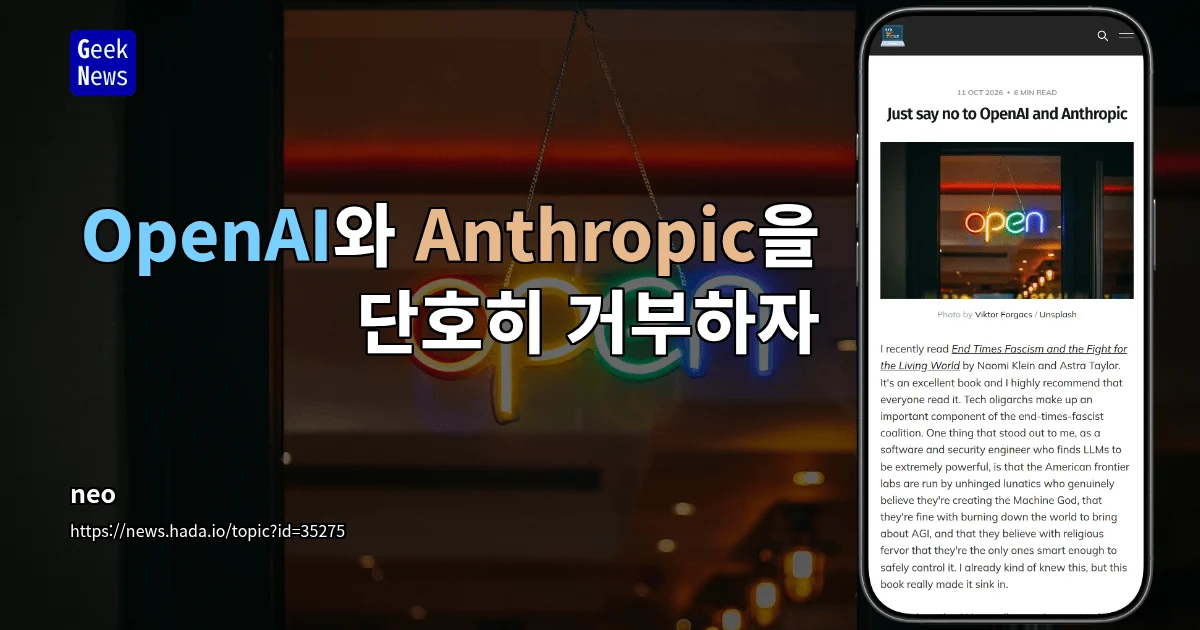
    Closed frontier models from OpenAI and Anthropic have dominated the LLM market as the de facto standard. However, growing concerns in practice revolve around the fact that neither company effectively relinquishes access to conversation data through a simple training-opt-out toggle, and that loosely guarded model access may have been granted to certain U.S. cybersecurity firms and defense contractors. As a result, the search for alternatives to break this dependency in real-world environments is accelerating. The core of these alternatives lies in open-weight models and private inference services built on secure enclaves.

    Training opt-out settings are not a privacy guarantee

    OpenAI and Anthropic offer their most powerful models only as closed services, and users pay for chat or API access. Even when the training opt-out toggle is enabled, both companies retain full access to conversations and can review them or share them with governments and enterprises. This shows that training opt-out and private conversations are fundamentally different concepts. Even if both companies are currently likely to respect the opt-out, that alone is not enough to ensure long-term trust in how data is handled.

    In the cybersecurity domain in particular, strict guardrails are applied. Agents that monitor conversations block session activity when they detect potential hacking behavior, but this approach is frequently criticized for producing false positives. On the other hand, certain users are granted model access with loose or no restrictions, and it is estimated that access may extend to multiple U.S. cybersecurity firms, almost certainly U.S. defense contractors, and any U.S. government agency that wants it. While restricting powerful models has some legitimacy, critics argue that leaving final access decisions to Sam Altman and Dario Amodei, who then coordinate with the executive branch, is undemocratic.

    How far have open-weight models come?

    Open-weight models are analyzed to lag roughly four months behind OpenAI and Anthropic’s advanced proprietary models, and this gap is considered small. GLM-5.3 is reported to perform roughly on par with Claude Opus 5.5 in software engineering, and the smaller GLM-5.3-Flash is evaluated as comparable to Claude Opus 4.8. If one can obtain a Mac Studio with 512GB of RAM, running GLM-5.3 locally as an individual is a realistic option.

    However, the usefulness of a model and the trustworthiness of its developer as a data custodian are separate questions, and creating an account directly with Z.ai, GLM’s developer, or sending data to it is not recommended. Given that ZCode, the coding harness corresponding to Claude Code, was recently found to have uploaded local source code repositories to Alibaba Cloud without user consent, it is safer to assume that data provided to Chinese companies can be shared with the Chinese government. DeepSeek, Qwen, and Kimi families are also cited as impressive open-weight models, but the same distinction applies: relying on their developers as data custodians for conversations should be treated separately.

    French company Mistral is classified as the only major LLM developer that is neither an American nor a Chinese company, and the nickname of its new frontier model Mistral Large 4 is Le Chonk. Entrusting data to Mistral rather than to an American or Chinese company is considered considerably more reasonable.

    How secure enclaves reshape private inference

    Secure enclave-based inference enables private AI use without local hosting. It is not perfect, but it provides a meaningful privacy difference compared with providers having unrestricted access to all data. Tinfoil is cited as the company working most actively in this space, with technical details available in its secure enclave and remote attestation documentation. Maple AI is another alternative, internally using Tinfoil’s inference service.

    By use case, Tinfoil is recommended for serious agentic coding work such as software engineering, reverse engineering, malware analysis, CTF, and penetration testing, and charges for private inference based on token usage with no monthly subscription. Maple is positioned for general consumers who want a ChatGPT-like experience, including chatbot conversations, web search, document access and processing, and mobile apps, with a small free tier and a $20/month Pro plan.

    For those who do not want to pay extra for private inference, an inference router like OpenCode Go is an option. OpenCode Go costs $10 per month and provides credits that exceed $10, with requests passing from the user’s computer through the OpenCode Go API to the actual inference provider. However, both OpenCode Go and its backend providers can access session data, and while GLM, Qwen, Kimi, and DeepSeek models are explicitly listed as zero-day retention targets, this is only a policy promise and not technically guaranteed.

    Comparing private and low-cost inference options

    Item Tinfoil Maple AI OpenCode Go
    Core approach Secure enclave-based private inference Internally uses Tinfoil inference Inference router, connects to various backends
    Recommended use Agentic coding, reverse engineering, penetration testing Chatbot, search, document processing, mobile Low-cost routing for mostly public work
    Pricing No monthly fee, token-based usage Free tier + $20/month Pro $10/month + credits exceeding $10
    Privacy guarantee Technically reinforced via secure enclaves Private via Tinfoil backend Zero-day retention policy (not technically guaranteed)
    GLM-5.3 unit price Input $1.80 / cached $0.80 / output $5.75 (per 1M tokens) Same inference backend Same rate via router

    Practical workflow: OpenCode + Tinfoil + GLM-5.3

    Connecting Tinfoil and OpenCode Go to the coding harness OpenCode simultaneously and using GLM-5.3 mostly at a low inference level has been introduced as a real-world applied case. The inference provider is split depending on whether the work is public: fully public tasks, such as feature implementation for already open-source code, use OpenCode Go, while all other tasks use Tinfoil.

    GLM-5.3’s token pricing is $1.80 per million tokens for input, $0.80 for cached tokens, and $5.75 for output, and reports indicate that setting a low inference level significantly reduces token usage while still delivering impressive results. In practice, evaluations describe costs as similar or lower, privacy as higher, and guardrails as far fewer. However, the pace of model change is fast, and what constitutes the best choice six months from now is unknown.

    In early use cases, open-weight models appear to fully replace ChatGPT and Claude, and the ability to choose the runtime environment and provider itself acts as a practical insurance against single-vendor lock-in. As the ZCode unauthorized upload case shows, the data custodian trust issue remains an area that must be evaluated separately from model selection when choosing a coding harness.
    Reference source

    This article was written after verifying the following original: geeknews — Resolutely rejecting OpenAI and Anthropic