Author: l0cknsec

  • Agent-Based Development Handles 70% of PRs — How Uber Kept Costs Flat Through 7x Usage Growth

    에이전트 기반 개발
    How Uber built and runs a software factory by embedding AI agents across the entire development pipeline—and the metrics behind it

    Key Takeaways

    • Over 70% of PRs are handled by local and cloud agents, with agents acting as the first line of development
    • Automation runs at scale: more than 3,600 agent skills execute over 30,000 times per day
    • Between February and mid-August 2026, weekly users grew 7x and agent requests grew 9.4x

    Analysis

    Table of Contents

    Agent-based development is now automatically handling over 70% of pull requests across Uber’s codebase. This is not simple code autocompletion—agents running both locally and in the cloud act as the first line of PR work. The operational metrics Uber has published put concrete numbers behind this shift.

    The reason this case caught my attention is that it is less a “tool that writes code for you” and more an operating system that runs the entire PR pipeline. How Uber operates its software factory reveals both the scale and the cost structure of agent-based development at the same time.

    What “Software Factory” Really Means

    Uber calls its development system a “software factory.” The core idea is not a single agent, but a building-block design in which role-specific agents are stacked together. PR creation, review, merge candidates, and post-merge monitoring are all closed loops inside the agents. Humans are left with only the final gatekeeping role.

    The Numbers Behind the Scale

    More than 3,600 agent skills run over 30,000 times per day. From February through mid-August 2026, weekly users grew 7x and agent requests grew 9.4x. Over 70% of PRs are now handled by agents as the first pass.

    Metric Value
    Daily skill executions Over 30,000
    Share of PRs handled by agents Over 70%
    Weekly user growth (Feb–Aug) 7x
    Agent request growth 9.4x
    Active skills Over 3,600
    Cost curve (since April) Remains flat

    Despite this explosive growth, the cost curve flattened after April. Usage and cost have been decoupled on the graph.

    Why Costs Stayed Flat in Agent-Based Development

    What Uber did to control costs is not a single trick. Around-the-clock optimization runs on every front: caching, routing, mixing of small and large models, and per-request token reduction. For practitioners, the most meaningful point is that cost was designed not to scale proportionally with usage.

    The real issue in agent-based development is not model performance but how this decoupling structure is operated. The same pattern is observed repeatedly in real-world tooling contexts as well.

    Design Considerations for Large-Scale Codebases

    Running agents across an environment like Uber’s mix of monoliths and microservices requires three prerequisites. Codebase indexing and search infrastructure must be fast enough; PR-level permissions and accountability boundaries must be organized to a level that can be delegated to agents; and the human gate for final merge decisions must be unambiguous.

    If any one of these is missing, the gains of automation turn into a net negative.

    Risks and Limits of Agent-Based Development

    Organizations that let agent-based development handle over 70% of their PRs take on new risks: the potential for security policies to be bypassed, ambiguity in accountability, and the paradox of “humans re-reviewing code produced by agent-based development.” Uber’s case shows what is possible, but what to control on top of it is something each organization has to answer for itself.

    This multi-agent behavior is not unrelated to the spontaneous swarm patterns observed in the agent ecosystem.

    Practical Application Points

    • Codify which PR stages are delegated to agents and which remain human-gated.
    • Plot cost and usage on the same graph to find the inflection point.
    • Operate an internal standard for the agent skill catalog.

    What to Try Right Now

    • Pick 5 PRs from this week and note which stages could be replaced by agents.
    • Plot usage and cost on one graph and mark an inflection point like April.
    • Draft an initial agent skill catalog with no more than 10 items.
    • Put together a one-page document for PR merge permissions and accountability matrix.

    Frequently Asked Questions

    Why can cost be decoupled from usage in agent-based development?

    When optimizations such as caching, routing, and model mixing are applied continuously, per-token cost falls. In the Uber case, costs staying flat even as usage grew 9.4x is the result of this decoupling structure.

    Which stages does Uber’s 70% PR automation cover?

    It goes well beyond simple code generation, broadly covering PR creation, review, and merge candidate generation. The key assumption is that humans keep the final gate.

    Can small and mid-sized organizations adopt agent-based development?

    Yes. However, codebase indexing infrastructure and PR gate design must be prepared first for the automation to be meaningful. Starting at 10–20% rather than aiming for 70% out of the gate is more realistic.

    What is the biggest risk as agent dependency grows?

    Security policy bypass, ambiguity in accountability, and the cost of having humans re-verify agent outputs. If these three are not managed together, the gains of automation erode quickly.

    Reference Source

    This article was written after reviewing the following source: geeknews — How to Operate a Software Factory at Uber’s Scale Efficiently

    Expert Commentary (AI)

    LLM Systems Engineer

    What the usage-cost decoupling proves: the battleground in agent development is the inference platform, not the model

    The decoupling of usage growth from the cost curve is the most honest metric for measuring the maturity of an agent operations platform, and the combination of caching, model routing, and token reduction is the canonical composition of LLM inference optimization. If costs stayed flat even as requests grew 9.4x, it is highly likely that cache hit rates and small-model delegation ratios have reached a substantial level—results at the platform level that cannot be achieved through one-off prompt tuning. However, as small-model delegation increases, silent degradation in PR creation and review quality becomes more likely, and without quality-weighted metrics such as acceptance rate, rollback rate, and post-merge defect rate, it is impossible to tell whether cost savings are cannibalizing quality. Managing the freshness of skill and context caches in a rapidly changing large codebase is also a practical challenge; if this breaks down, optimization gains return as rework costs. Even so, layering an orchestration layer on top of heterogeneous models to control unit economics is a direction that is likely to become standard infrastructure, like CI/CD.

    Rating: 8/10 – The optimization stack of caching, routing, and model mixing is a proven canonical approach, but the evaluation system to catch quality regressions from low-cost model delegation has not yet been observed

    Software Engineering Expert

    Delegating 70% of PRs to agents is promising, but without accountability and verification structures complete, the bottleneck has been moved rather than removed

    A structure in which agents take the first line from PR creation through review, merge candidates, and post-merge monitoring while humans hold the final gate is a natural next stage of evolution for modern development organizations where code review is the bottleneck. Running a skill catalog as an internal standard to prevent tool fragmentation and codifying delegation scope in stages is a valid organizational control mechanism. However, once 70% of PRs pass through agents, the human role shifts from code understanding to output auditing, and the risk of reviews becoming ritualized through automation bias grows. A structure in which humans re-verify agent outputs does not eliminate the bottleneck; it moves the bottleneck into verification capability. If per-skill rollback rates and post-merge defect tracking are not performed in parallel, automation rates will rise while quality accountability blurs. Security policy bypass and accountability issues cannot be resolved without institutional mechanisms such as agent identifier signing, PR-level permission matrices, and audit logs, so adopting organizations should complete gate design before pursuing automation rates.

    Rating: 7/10 – Phased delegation design and skill standardization are valid, but accountability arrangements and safeguards against review ritualization remain at the conceptual stage

    Critical Analyst

    The 70% automation and cost-flattening numbers are, before they are a technical achievement, likely a polished corporate narrative whose key question is who defined the terms

    The biggest beneficiary of this metric release is Uber itself. In a single announcement, it can simultaneously secure a growth narrative without headcount expansion, employer branding amid AI-era hiring uncertainty, and a price-negotiation card with model providers backed by massive volume. The “70% of PRs handled by agents” figure has not had its definition and denominator disclosed—if low-difficulty PRs such as dependency upgrades, formatting, and minor cleanups were heavily included, the measured rate could be far higher than the real development automation rate. “Costs flat since April” also does not reveal how much platform build-out labor and infrastructure depreciation are included, so the picture could be reproduced not by pure efficiency but by accounting reclassification of costs. Set against the recent industry pattern of large tech companies lining up to release AI productivity figures, this case reads as preemptive positioning against peer pressure. What we should really pay attention to is not the 70% number but whether third-party verification exists to audit it.

    Underlying Scenarios

    • Possibility of a strategic disclosure as a workforce narrative — As large tech companies’ timing of AI productivity disclosures tends to overlap with workforce planning or earnings cycles, the chart of “costs flat despite 7x user growth” can easily function as justification for growth without hiring.
    • Possibility of favorable metric definition design — If low-difficulty automated PRs are heavily included in the denominator of “PRs handled by agents,” the 70% can be reproduced as an inflated automation rate, and with definitions and measurement criteria non-public, room remains to read it that way.


    Official narrative persuasiveness: 5/10 – Surface persuasiveness is high thanks to specific numbers, but since metric definitions, verification parties, and cost scoping are all undisclosed, the basis is thin for accepting the official narrative as is

  • Apple CEO Change: A New Chapter After 15 Years — Tim Cook’s Legacy and What Awaits Ternus

    Key Summary

    • John Ternus succeeds Tim Cook as Apple’s new CEO
    • Outgoing CEO Tim Cook will remain with the company as executive chair, stepping back from day-to-day operations while retaining influence at the board level
    • According to the NYT report, the incoming CEO takes the helm at a moment when Apple faces major shifts on both the technology and business fronts simultaneously

    Analytical — Examining the organizational and strategic significance of a Big Tech CEO transition and tracing the axes of change that will shape Apple’s next decade

    Table of Contents

    On September 1, 2026, the official announcement of Apple’s CEO change was made. Tim Cook will move to the executive chair position, and John Ternus, who led hardware engineering for 15 years, will take over as the new CEO. As first reported by the NYT, this decision carries particular weight because it marks the departure of one of the longest-serving sitting CEOs among Big Tech companies.

    Tim Cook became CEO in August 2011, succeeding Steve Jobs. Over 15 years, he grew the company’s market capitalization from several hundred billion dollars to the 3-trillion-dollar range and expanded the share of services revenue from single digits to the mid-20% range. During the same period, criticism that “innovation has stalled” followed consistently. This writer believes these 15 years cannot be read as a simple binary of success or failure.

    Apple CEO Change: The Key Facts Confirmed by the NYT

    The Apple CEO change can be distilled into two facts. One is the inauguration of John Ternus; the other is Tim Cook’s remaining as executive chair. This effectively formalizes a dual-leadership structure, distinct from the one-person system of the Jobs era when the board chair also served as CEO. The detailed timeline, changes in board composition, and the timing of the new CEO’s first official remarks fall outside the scope of verification and remain gaps to be filled by follow-up reporting.

    What It Means That Tim Cook Remains as Executive Chair

    It is easy to read this as an honorary role, but operationally it is different. The executive chair holds a voice in designing the board’s agenda and in reviewing CEO succession, personnel, and strategy. Cook has stepped back from the front line of decision-making, but he will remain in the meetings that set the major direction. The key question is the degree of autonomy the successor CEO will have within this structure.

    If the chair position steps up to play a strategic guiding role, the new CEO’s hands will be tied; if it self-restrains to the level of advisor, synergy emerges. The next year will be the focal point of where this balance settles.

    The Four Axes of Change Ternus Will Inherit at Once

    The NYT described the incoming CEO as “facing major shifts on both the technology and business fronts simultaneously.” Unpacked, four overlapping axes emerge.

    Axis Current Situation Ternus’s Year-One Task
    Hardware Lineup iPhone market share stagnant, new category absent Set direction for next-gen form factors and AR glasses
    Services Share Revenue in the mid-20% range, signs of growth deceleration Redesign revenue model across subscriptions, ads, and fintech
    AI Competition Post-Apple Intelligence roadmap undisclosed Make on-device and cloud AI strategy visible
    Supply Chain & China Risk U.S.–China tensions, exchange-rate and tariff variables Calibrate pace of expanding production share in India and Vietnam

    The four axes are intertwined. If the AI strategy is weak, new-category hardware loses its persuasiveness, and if services revenue wobbles, defending market capitalization becomes difficult. Rather than solving all of these at once, the new CEO’s first-year tone will most likely reveal which axis is being prioritized.

    Tim Cook’s 15 Years: Legacy and Unfinished Tasks

    Tim Cook’s 15 years were a textbook case of operational efficiency and global supply chain optimization. At the same time, they left intact a product portfolio disproportionately weighted toward the iPhone. A structure in which more than half of revenue comes from a single lineup is the first area the new CEO must address.

    What stands out from a practitioner’s perspective is the “pace of decision-making.” Under the Cook era, decisions were made public only after conservative review. In areas where time itself is competitive advantage, such as AI and AR, how quickly Ternus can make decisions will be the test of his first quarter.

    The Apple CEO Change and the Trade-offs of Dual Leadership

    This Apple CEO change also contrasts with succession models at other Big Tech firms. When Microsoft replaced its CEO with Satya Nadella in 2014, the outgoing CEO departed completely. When Sundar Pichai became CEO of Alphabet in 2019, Google likewise chose board chair separation. Apple alone has kept its outgoing CEO in the executive chair seat. Whether this choice becomes a source of stability or a ball and chain will be judged by the personnel and strategic messages that follow.

    Outlook: Short-term Signals and Long-term KPIs

    The signals that investors, developers, and consumers need to confirm within a year are different. Investors should watch the guidance personally shaped by the new CEO in the first earnings call; developers should watch the breadth of AI and toolchain at WWDC 2027’s keynote; consumers should watch the launch timing of new-category candidates (AR, foldables, home robots). Long-term KPIs worth tracking are three: iPhone dependency, services revenue share, and the ratio of AI-related R&D spending to revenue.

    Summary of Key Issues

    • How much the outgoing CEO’s retention as executive chair constrains the successor’s autonomy is the biggest variable for the next year.
    • With three tasks — iPhone dependency, services growth deceleration, and the pace of AI transition — all open at once, priority selection itself becomes the face of leadership.
    • Compared with Microsoft and Google, which chose chair separation, it is necessary to watch closely what signals Apple’s dual structure sends.

    What to Do Right Now

    • Mark Apple’s first earnings call date after September on your calendar via the investor relations page.
    • Set keyword alerts for “John Ternus” on the NYT, Bloomberg, and Reuters to receive follow-up reporting immediately.
    • Download the last four quarters of the Tim Cook era as PDFs and build a comparison table against the next two quarters’ numbers.
    • Create a personal watchlist note to track WWDC 2027 schedule and 10-K filings.

    Frequently Asked Questions

    When was the Apple CEO change announced?

    It has been confirmed that the official announcement was made based on the NYT report on September 1, 2026. Detailed timing may be updated as follow-up reporting comes in.

    Is Tim Cook leaving the company entirely?

    No. He will remain as executive chair, retaining influence at the board level. He steps out of the front line of decision-making, but does not fully depart.

    Who is John Ternus?

    He is the head of Apple’s hardware engineering division and has led the design and supply chain of the product lineup for 15 years. He had been mentioned as the leading internal candidate for this Apple CEO change.

    What impact will this Apple CEO change have on Apple’s stock price?

    In the short term, it is being read as an event that resolves uncertainty, and in the medium to long term, the direction will be determined by the speed at which the new CEO makes the AI and services strategy visible.

    Source Article

    This article was written after reviewing the following original source: NY Times Tech — John Ternus Replaces Tim Cook as Apple CEO

    Expert Commentary (AI)

    Corporate Strategy & Management Expert

    While acknowledging the assessment of a stability-oriented succession, the core risk lies in how the overlapping executive chair structure burdens the successor’s autonomy

    Cook’s 15 years belong to the textbook of large-enterprise management, lifting market cap into the 3-trillion-dollar range through supply chain optimization and the services pivot, and the gradual succession of picking the successor internally is itself a reasonable choice from the standpoint of minimizing market shock. The problem is the dual structure in which the outgoing CEO steps back from the front line yet remains as executive chair. Compared with Microsoft’s Nadella succession, in which the predecessor departed completely, a structure in which the chair position involves itself in strategy and personnel has historically produced more cases in which the organization adapted to dual power while the successor’s authority was eroded. Ternus’s hardware background is also a double-edged sword: the execution proven through the Apple Silicon transition is a strength, but the Cook-style diplomatic capabilities in services, regulation, and investor communication may remain a gap. Ultimately, if the boundaries of authority between chair and CEO are not codified within the next one to two years, a seat designed as a safety net may function as a ball and chain, and the success or failure of this structure will determine the historical evaluation of the succession.

    Rating: 6/10 — The stability of an internal succession is a validated choice, but with the authority rules of the overlapping executive chair structure not pre-established, the possibility of paralyzing the successor’s management remains open

    AI & Product Strategy Analyst

    A succession built on hardware strengths, but carrying a fundamental tension: the narrow intersection with the software and services leadership required in this AI transition era

    Ternus’s track record of leading the Apple Silicon transition and new product line design is logical as a CEO appointment for a hardware-centric company, and the directional persuasiveness of the appointment is reinforced by the fact that all next-category candidates — AR glasses, foldables, home robots — require hardware integration capabilities. However, the urgent tasks Apple currently faces are not in hardware but in software and AI: the underperformance of Apple Intelligence, the delay in the Siri rebuild, and the unresolved state of the on-device and cloud AI strategy. Within a structure in which the iPhone accounts for more than half of revenue, a gap of roughly 3–5 years is expected before a new category becomes profitable, so the incoming CEO must pursue both services growth recovery and AI competitiveness in parallel with the hardware cycle. The risk is the possibility of reducing every problem back to specs and form factor competition; the opportunity, conversely, is the ability to repackage the vertical integration of hardware and software into a differentiated strategy of privacy-centric on-device AI. Taken together, this appointment applies the past’s success formula to the future’s problems, and who is placed in the software/AI leadership role will determine the substantive success or failure of the succession.

    Rating: 6/10 — The hardware integration capabilities proven through Apple Silicon are solid, but the AI and services transition capabilities that the times demand have yet to be validated

    Critical Analyst

    Behind the packaging of an orderly generational change, the board’s calculation in choosing this specific moment and this specific structure lies hidden

    The official narrative is a “planned succession for the first time in 15 years.” But looking beneath the surface, the fact that the succession card was played at a moment when the market’s assessment of falling behind in AI competition and antitrust regulatory pressure were both intensifying makes it hard to read as simply the completion of a personnel plan. If the change were a perfectly scheduled replacement, there would be no need to keep the outgoing CEO on as executive chair. The fact that Apple chose a design diametrically opposite to Microsoft’s, which fully sent off its predecessor during the Nadella succession, suggests this may be the result of conditional negotiation in which Cook sought to preserve his own decision-making network and personnel lines. Asking who benefits most, in the short term it is management and the board, who buy stock-price stability with a “seamless succession” narrative, and in the long term it is Cook himself, who plants a watchdog on the board to ensure his era’s legacy is not eroded. The paradox of a hardware chief with no AI experience being named new CEO is, rather than a misstep, arguably a blank-slate delegation designed to install a new signatory not bound by the Cook era’s AI decisions. What we should really pay attention to is the timing of the announcement and the first follow-up personnel moves — who takes the software/AI leadership seat, and when the chair’s authority is documented, will reveal whether this succession is inheritance or proxy, and the cleaner the announcement, the more worth suspecting the pieces cut at the negotiating table.

    Behind-the-Scenes Scenarios

    • It is possible that the board preempted a controlled succession scenario and put it to the market before institutional investors and activist funds’ criticism of an “absence of succession planning” intensified — the timing of the announcement, which appears to be aligned with earnings and shareholder meeting schedules, is circumstantial evidence.
    • Cook’s retention as executive chair is, rather than an honorable retirement, likely a negotiated condition to preserve the Cook line’s personnel and the supply chain and privacy decision-making legacy — the exact opposite structural design from the Microsoft case, which chose full departure of the outgoing CEO, is the basis for this reading.
    • Heading into sensitive AI partnership renegotiations such as reducing reliance on external foundation models, there may be an intent to install a new signatory unconstrained by the existing commitments of the Cook era — the paradox of choosing a hardware-origin CEO with no AI expertise is instead read as a trace of blank-slate delegation.

    Official narrative persuasiveness: 5/10 — The official story of an “orderly succession” is clean, but a persuasive explanation is missing for why an unusual executive chair overlap was chosen and why at this particular moment

  • JFrog Vulnerability 4-Step Audit — Admin Token Theft Just Days After CVE-2026-82329 Patch

    JFrog vulnerability
    Security threat: the authentication-bypass vulnerability (CVE-2026-82329) in JFrog Artifactory is being actively exploited shortly after disclosure

    Key Summary

    • CVE-2026-82329 is an authentication-bypass vulnerability in JFrog Artifactory, rated critical with a CVSS score of 9.8
    • The flaw enables administrative-level access on default configurations
    • Threat actors began exploiting the vulnerability in real-world attacks within days of patch disclosure, according to watchTowr

    A practitioner’s perspective to help security operators quickly assess the risk of the JFrog Artifactory vulnerability and review their patching, detection, and containment procedures

    Table of Contents

    JFrog vulnerability CVE-2026-82329 admin token theft

    The JFrog vulnerability CVE-2026-82329 was exploited in real-world attacks just days after its patch was disclosed. It is an authentication-bypass flaw that allows an administrative privilege token to be minted on a default-configured Artifactory instance. A CVSS 9.8 rating effectively means “every instance left at default settings is a target.” The watchTowr report featured on The Hacker News explicitly highlighted this time gap.

    What Is the JFrog Vulnerability CVE-2026-82329?

    Artifactory is an artifact repository used by many organizations for software build and distribution. Code, binaries, and container images all converge in one place. Once an attacker gains a foothold, the entire software supply chain is affected.

    This JFrog vulnerability bypasses the authentication layer itself. It means there was a path to mint an administrator token without any credentials. A CVSS 9.8 is an uncommon score: the rating is awarded when network access alone is sufficient to exploit the flaw with no privileges required.

    Default Settings Are the Most Dangerous

    The flaw is exploitable on default configurations. Instances running without hardened authentication, IP restrictions, or a separate gateway are affected as-is. Artifactory operated within internal build pipelines is usually not directly exposed externally, but if a VPN or SSO bypass route exists, the same flaw still applies.

    The Gap Between Patch and Exploitation of the JFrog Vulnerability

    Immediately after the patch was disclosed, watchTowr analyzed that threat actors had begun using this JFrog vulnerability in real attacks. The time from exposure to exploitation keeps shrinking. During the 2021 Microsoft Exchange incident it took several weeks; today it is resolved in a matter of days.

    From a practitioner’s standpoint, the most dangerous aspect of the JFrog vulnerability incident is this time gap. While patch application is pushed to next week’s work, tokens may already have been issued. You need to review logs under the assumption that “it may already be too late,” not merely as a “patch recommendation.” Without that mindset, even after the patch is applied, an intrusion can persist using tokens that were already minted.

    Token Theft Is Not an Isolated Incident

    Around the same time, KrebsOnSecurity reported that the FBI is investigating a case in which 153 million driver’s license records are being sold. There is no direct link, but the same trend is clear: identity and authentication credentials have become the common currency of attack. Admin tokens, session keys, and identity information — these three are now the core resources of the current threat landscape.

    Comparison: Exposure-to-Exploitation Timeline

    Incident Year Exposure → Exploitation
    Microsoft Exchange Proxylogon 2021 About 2–3 weeks
    Log4Shell 2021 About 1–2 weeks
    VMware vCenter 2021 About 3–5 days
    JFrog vulnerability CVE-2026-82329 2026 Within a few days

    As the table shows, the unit of time has shifted from “weeks” to “days” over the past five years. The next shift is likely to “hours.”

    What to Do Right Now

    • Check your Artifactory version and immediately upgrade to the patch version announced by JFrog.
    • Perform a full audit of administrator token issuance logs from the past 30 days to identify any unauthorized token IDs.
    • Verify whether your Artifactory instance is exposed externally and check for any bypass routes outside of VPN/SSO.
    • Add SIEM rules for anomalous administrator login patterns involving unusual IPs, countries, or time zones.
    • Until the emergency patch is applied, restrict access to the admin console to a whitelist of IPs at the WAF/reverse proxy layer.

    Practical Application Points

    One common failure I see in the field is closing out a vulnerability as “resolved” immediately after applying a patch, without auditing tokens. With an incident like this JFrog vulnerability, that attitude itself is risky. The following four items should be elevated in priority.

    • Redefine your patch SLA by severity tier. Establish a principle of applying CVSS 9.0+ within 72 hours.
    • Promote token issuance events on critical infrastructure to real-time alerting.
    • Re-audit the external exposure surface of internal build pipelines every quarter.
    • Run patching and log investigation in parallel, based on the assumption that the exposure-to-exploitation window is shrinking.

    Frequently Asked Questions

    How do I check whether we use Artifactory?

    Check whether the build/CI systems used by your software development teams include Artifactory. A quick way to identify it is to search CI tool configuration files (such as Jenkins or GitLab CI) for the Artifactory domain or repository URL.

    I don’t know the patch version. Where can I check?

    The patch version and download link for CVE-2026-82329 are available in the official JFrog security advisory. First check the current version in the About menu of your instance’s admin console.

    What if an admin token has already been issued?

    Immediately revoke the affected token ID and reissue all credentials for the same account. Simultaneously trace how far that same token was called from build servers, deployment systems, and container registries.

    Is a WAF alone sufficient to block the attack?

    A WAF alone is not enough. It is a temporary mitigation; patch application and token audit are the essential remediation. There is always a possibility that a bypass route will emerge.

    The time from exposure to exploitation is no longer measured in days. The JFrog vulnerability case has compressed that window to hours. It is time to redesign the priority framework for your internal infrastructure around CVSS severity tiers.

    Reference Source

    This article was prepared by verifying the following original source: The Hacker News — Attackers Exploit Critical JFrog Artifactory Flaw to Mint Admin Tokens Days After Disclosure

    Expert Commentary (AI)

    Information Security Specialist

    The CVSS 9.8 authentication-bypass incident is a textbook example showing that the response center is not “patching” but “token lifecycle management”

    An authentication bypass that allows administrator tokens to be minted without credentials, using only network access, precisely meets the conditions for a CVSS 9.8 rating; and given the asset nature of an artifact repository, a successful intrusion can spread immediately to contaminate the entire build and deployment pipeline. The essential problem with this type of breach is that even after a patch is applied, tokens issued during the attack remain valid — therefore auditing token issuance logs and fully revoking/reissuing them must become a response procedure on par with patching. The fact that real-world exploitation began within days of disclosure indicates that the ecosystem of automated vulnerability scanning and exploit resale has matured, making an aggressive patch SLA such as 72 hours for CVSS 9.0+ no longer excessive. However, score-based prioritization alone fails to reflect per-asset exposure and real-world exploitation indicators (e.g., KEV), so a transition to risk-based vulnerability management should proceed in parallel. Looking ahead, short-lived tokens, workload identity-based authentication, and default non-exposure of admin consoles will become standardized requirements for repository-class products.

    Rating: 8/10 — The threat severity and the principle of running “patch + token audit” in parallel align precisely with security practice, but the fact that the authentication bypass works on default configurations reveals structural immaturity in product security default policies

    DevSecOps / Software Supply Chain Security Architect

    Artifact repositories are the top strategic target in supply chain attacks, and this incident directly exposes the absence of secure-by-default design and credential lifecycle management

    A central repository like Artifactory, where code, binaries, and container images are concentrated, is both a single breach point and the gateway to supply chain contamination, so a single successful authentication bypass extends effective damage far beyond the repository itself to the entire downstream distribution. Boundary defense premised on internal network operation is neutralized the moment a VPN or SSO bypass route exists; repository infrastructure must have admin-console non-exposure by default, OIDC/mTLS-based workload authentication, and fine-grained access policy as architectural defaults. Fundamental blocking starts from secure-by-default product design, and operational blocking comes from multi-layer defense such as artifact signing and SBOM verification that lowers the effectiveness of malicious artifact injection after token theft. That said, long-lived credentials embedded in CI configurations are widespread in the field, and the transition to short-lived tokens with automatic rotation hits an organizational bottleneck in practice. This incident should be read as an inflection point that calls for classifying repositories not as “developer convenience tools” but as “production infrastructure,” subject to the same availability and security control standards.

    Rating: 6/10 — The strategic importance of the repository as core supply chain infrastructure is clear, but a design that allows authentication to be bypassed on default configurations and the long-lived token practices show that maturity in this domain is still at an early stage

    Critical Analyst

    The “exploitation within days” narrative benefits the industry that discovers, sells, and treats the threat more than the threat itself

    On the surface, this is a textbook crisis narrative of “a critical vulnerability was rapidly exploited,” but looking beneath the surface, the biggest beneficiaries are not the vendor that distributed the patch but the detection market that sells exposure validation and attack surface monitoring as products. In a structure where exploitation-timed reporting functions as marketing proof of a service’s reason to exist, the “within days” timeline narrative is likely to operate as the most powerful sales pitch pushing enterprise security budgets and SIEM/exposure management adoption. The gap between CVSS 9.8 and actual exploitation — i.e., the initial intrusion vector, actor attribution, and damage scale — tends to be covered surprisingly narrowly in public information, and that blank space leaves the right to interpret the threat narrative squarely with whoever controls it. Linking adjacent incidents like the driver’s license sale investigation as “the same trend” can also be a convenient narrative that skips verification of individual cases and repackages them into the grand discourse of the credential economy. What we should really pay attention to is not the claim that attacks have sped up, but exactly who is on the list of entities that profit from that claim.

    Underlying Scenarios

    • The fact that exploitation began immediately after the patch was disclosed suggests that detailed technical information may have leaked almost simultaneously through the resale channel along with the security advisory and patch binary distribution, and the unusually short interval between the time normally required for dipping and the “within days” report serves as circumstantial evidence.
    • The “exploitation within days” report may be intertwined with the periodic marketing cycle that drives demand in the exposure management and attack surface validation market, and the underlying rationale is the stakeholder structure in which the first party to report the exploitation timing is itself a direct business in that market.

    Official Narrative Persuasiveness: 5/10 — The official narrative focused on CVSS scoring and patch-to-exploitation timing is logical, but the lack of verifiable public disclosure around the initial breach path and actor attribution clearly limits it as a narrative heavily dependent on detection-vendor reporting

  • Claude 5.1 Price Cut of 25–45% — The Structural Shift Behind Eliminating Cache Fees

    Claude 5.1
    Anthropic unveils Claude Fable 5.1 and Mythos 5.1, addressing debates over pricing, data retention, and safeguards

    Key Summary

    • The Verge reports that Anthropic has simultaneously launched two new AI models: Fable 5.1 and Mythos 5.1
    • Fable 5.1 is priced approximately 25% lower for general tasks and up to 45% cheaper for complex agentic work
    • The core of the price reduction lies in eliminating fees on already processed and stored cache data

    An analysis article that frames the new model launch along two axes—price competitiveness and safeguard redesign—and interprets the structural significance of the cache fee cut and the broader industry debate over the safety-performance balance from a practitioner’s perspective

    Table of Contents

    Claude 5.1 has been unveiled with concrete numbers—a 25–45% price reduction. According to The Verge’s report, Anthropic released two models, Fable 5.1 and Mythos 5.1, on the same day, and the core of the price cut lies in the structural elimination of cache data fees.

    Anyone who has run agentic workflows will immediately grasp the significance. The structure in which token costs accumulate when repeatedly passing the same context is genuinely heavy. The pricing change in Claude 5.1 strikes precisely at that point. The company announced price drops of approximately 25% for general tasks and up to 45% for complex agentic work—a result of reducing fees on already processed and stored cache data.

    To understand how the cache fee reduction changes practical work, it means the margin structure of RAG pipelines or multi-turn agents with many repeated calls can shift. The math now works out to running more calls with the same budget.

    The changes on the safeguard side are more subtle. Fable 5.1 ships with refined safeguards that lower the blocking probability for routine cases like “basic biology questions.” Mythos 5.1, on the other hand, maintains the same restrictions in the biology domain as the previous model. The fact that both models were released on the same day is significant in itself. It amounts to Anthropic explicitly demonstrating a dual policy of “loosening capability while keeping high-risk domains tightly controlled.”

    Industry reactions came in quickly. Every CEO Dan Shipper offered this assessment: “It’s the strongest coding model we’ve used, but now it’s fast, token-efficient, and crucially actually speaks like a normal person.” The quote highlights not just coding capability but also the naturalness of the response tone. Box CEO Aaron Levie added that Fable 5.1 caught the subtleties and ambiguities in data that Fable 5 had missed in the same test.

    Analysis channel Lisan al Gaib noted that Mythos 5.1’s lower reasoning mode scored on par with the previous model’s maximum reasoning mode. This signals that Claude 5.1’s reasoning efficiency has been significantly elevated.

    The element I find most significant in the Claude 5.1 announcement is the appearance of the term “cache fee.” It signals that model price competition is moving beyond per-token pricing into operational cost structures such as caching, routing, and reprocessing. The timing—coinciding with the case covered in Wired’s report on OpenAI’s hold on disclosing Astra’s cyber capabilities—is also impossible to ignore. It reads as part of a broader trend among major model companies recalibrating the balance between safety frameworks and release procedures.

    What stands out from a practitioner’s perspective is that the magnitude of the price cut varies by workload. Without first classifying your own call patterns before adopting Claude 5.1, you could be dazzled by the “up to 45%” figure and overestimate the actual savings. Pipelines with higher cache hit rates will see gains closer to the upper bound.

    Comparison Item Fable 5.1 Mythos 5.1
    Price reduction 25% for general tasks, up to 45% for agentic Disclosed separately (same cache fee structure presumed to apply)
    Safeguard direction Refined (relaxed blocking for routine biology questions) Biology domain restrictions maintained
    Accompanying release Project Glasswing
    Initial external evaluation Improvements in both coding capability and response tone (Dan Shipper) Lower reasoning mode on par with previous model’s maximum reasoning mode (Lisan al Gaib)
    Suitable domains Routine coding, documents, and multi-turn agents Biology, medical research, and other domains with strict safety guidelines

    Practical Application Points

    Teams running agentic workloads need to reclassify their call patterns by “cache hit rate.” Even with the same model, pipelines that lean more heavily on cache utilization will see gains closer to the 45% savings mark. If most calls are one-off, the 25% reduction becomes the practical upper limit. The best way to minimize the risk from the safeguard changes is to pre-divide domains that require Mythos 5.1—such as biology and medical research, where safety guidelines are strict—from those suited to Fable 5.1. Finally, it’s advisable to bundle the OpenAI Astra capability-disclosure holdback case together with your own product’s release criteria review materials.

    What to Do Right Now

    • Calculate the cache hit rate from your current API call logs and simulate the savings from adopting Claude 5.1.
    • Separate your model mapping so that biology and medical domain workloads route to Mythos 5.1, while coding and document tasks route to Fable 5.1.
    • Add regression tests for response tone and instruction-following rate to your coding agent’s internal evaluations to compare before and after applying Claude 5.1.
    • Document the OpenAI Astra cyber capability disclosure holdback case in your team wiki to revisit your own product’s capability disclosure criteria.
    • Review your cache TTL and prefix structure to identify room for improving hit rates.

    Frequently Asked Questions

    What is the biggest change in Claude 5.1?

    The core is a structural change: by removing fees on cache data, prices have dropped approximately 25% for general tasks and up to 45% for complex agentic work. What makes it significant is not the discount magnitude itself but the fact that the provider directly revised cache fees—an operational cost line item—rather than offering a simple discount.

    What is the difference between Fable 5.1 and Mythos 5.1?

    Fable 5.1 refined its safeguards to lower the blocking probability for routine biology questions, while Mythos 5.1 maintains the biology domain restrictions unchanged and was released alongside Project Glasswing. It amounts to a dual policy unveiled on the same day.

    Is the reduction effect the same for agentic workloads?

    No. According to the announcement, savings widen to up to 45% for agentic tasks, and pipelines with higher cache hit rates benefit more. If your calls are mostly one-off, the 25% reduction becomes the practical upper limit.

    How does this relate to the OpenAI Astra case?

    Read alongside OpenAI’s hold on disclosing Astra’s cyber capabilities, it can be interpreted as a broader trend in which major model companies are redesigning the balance between capability disclosure and safety frameworks. Claude 5.1’s domain-specific safeguard separation fits the same context.

    Reference Source

    This article was prepared after reviewing the following source: The Verge — Anthropic launches Claude Fable 5.1 and says it’s up to 45 percent cheaper for agentic work

    Expert Commentary (AI)

    LLM Infrastructure Engineer

    The cache fee removal is an operational cost restructuring that goes beyond per-token pricing competition, but its benefits depend heavily on workload type

    The direction is sound in that it precisely targets the fact that cache reuse costs are the dominant line item in total agentic workload costs. In RAG and multi-turn pipelines where repetitive context injection accumulates, reducing the cache reuse rate cuts perceived costs far more than reducing the per-token rate—which also aligns with the inference provider’s actual cost structure, where KV cache reuse is cheaper than recomputation. However, the “up to 45%” is an upper bound that only holds for workloads with high cache hit rates, so deciding on adoption without classifying call patterns carries significant risk of overestimating savings. Additionally, teams that have redesigned their prompts to fit the prefix cache structure are effectively locked into the vendor’s cache layer, and switching costs will spike if TTL policies or cache write fees change. The shift of price competition from per-unit pricing to operational cost design including routing and caching is welcome, but a cache hit rate-based simulation is effectively a mandatory prerequisite before adoption.

    Rating: 8/10 – A validated direction targeting the practical bottleneck of cache reuse costs, but the discount range is so dependent on cache hit rates that it cannot yet be seen as a universal price cut

    AI Safety and Governance Expert

    Differentiated safeguards by threat model are a reasonable solution to the over-blocking problem, but if boundary definitions and bypass possibilities are not managed, it becomes retreat rather than refinement

    An approach that differentiates safeguards by threat model across models is reasonable in that it can reduce the over-blocking problem created by uniform restrictions. The policy of blocking even routine biology questions has blocked legitimate demands such as learning, cooking, and hobbies, and refining this while separately retaining a restricted model for high-risk domains reads as an attempt to balance practicality and safety. However, if it is not clear where the boundary of a “basic biology question” lies, and which model rejects which dual-use query on what basis, refinement in name could become a retreat in safety boundaries. When two models with different safety levels are released on the same day, downstream developer misconfiguration in domain routing could create new management concerns by allowing the looser model’s standards to be used to bypass the stricter model’s rejection criteria. For this approach to become an industry standard, external transparency of biological uplift evaluations and red team results is essential.

    Rating: 7/10 – The threat model-based dual-track design is sound, but biology domain boundary definitions and evaluation transparency remain undetermined

    Critical Analyst

    Behind the gift wrapping of a price cut, a cache lock-in strategy and competitive timing capture overlap

    On the surface it is a customer-friendly price cut, but peering underneath, the first question that remains is “why now?” Coming at a time when competitors are in trouble over safety controversies, the simultaneous delivery of a dual narrative of “cheaper and more refined safeguards” reads as a news cycle capture combined with a market positioning strategy. The biggest beneficiaries are likely large enterprise customers with high cache hit rates, and the provider itself, which protects margins through a Jevons effect where cheaper call costs are offset by usage expansion. The cache fee cut can create a lock-in effect that raises switching costs by prompting customers to optimize their prefix structure to the provider’s cache design—a classic structure in which short-term discounts lead to long-term dependency. What we should truly pay attention to is not the magnitude of the discount but which line items (TTL reductions, cache write fees, data retention conditions) the cost will be passed through to, and a year from now, we need to verify how much the actual billed amount for the same workload exceeds today’s expectations.

    Underlying Scenarios

    • The “up to 45%” figure may be a marketing upper bound back-calculated from a small number of flagship customer workloads with extremely high cache hit rates, and the fact that the median of the actually measured savings distribution has not been disclosed serves as circumstantial evidence.
    • The simultaneous release of the two models coinciding in timing with reports of competitors’ capability disclosure holdbacks may not be a mere coincidence but a release schedule designed to capture domain-specific customer share and seize the safety narrative.

    Official explanation persuasiveness: 6/10 – The official explanation for workload-differentiated discounts and release timing is plausible, but gaps remain in persuasiveness due to the absence of the pass-through cost structure and the measured savings distribution

  • TimesFM-3: Google’s Next Move Aiming 330M Parameters at Multivariate Time Series

    TimesFM-3
    Google AI’s time series foundation model ‘TimesFM-3’ release and the shift to multivariate forecasting

    Key Summary

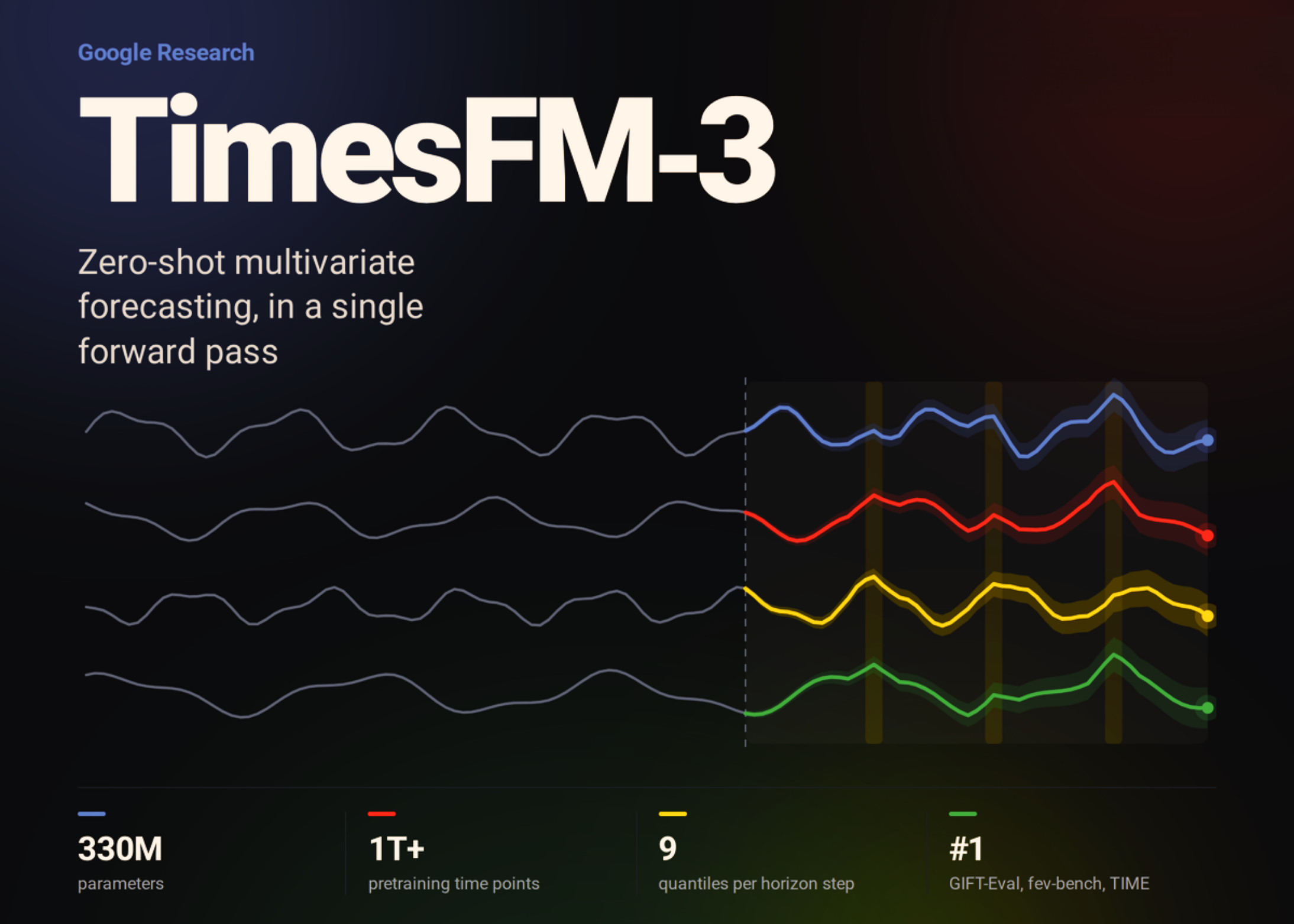
    • TimesFM-3 is a 330M-parameter time series foundation model that predicts multiple related time series simultaneously in a single forward pass.
    • Every TimesFM checkpoint up to 2.5 was univariate-only, but TimesFM-3 was pretrained from scratch for multivariate forecasting.
    • It was pretrained on real and synthetic time series data spanning over 1 trillion time points and accepts multiple targets, past covariates, and past-future covariates in a zero-shot manner without per-task fine-tuning.

    Analysis

    Table of Contents

    The Multivariate Era Declared by TimesFM-3

    To define TimesFM-3 in one sentence: it is Google’s new foundation model that takes multivariate time series as zero-shot input with 330M parameters and forecasts multiple related series at once in a single forward pass. The point I find most significant here is that every TimesFM checkpoint up to 2.5 was univariate-only. Earlier versions forecast a single series—temperature or revenue—independently, forcing practitioners to hand-engineer the correlations between variables into the model every time. TimesFM-3 marks a clean break because it is the first version designed as multivariate-native from the ground up.

    Core Changes in TimesFM-3: 1T Time-Point Training and Zero-Shot Covariates

    Let’s start with the core numbers. 330M parameters, pretraining on real and synthetic data across more than 1 trillion time points, with the decoder-only transformer retained. The model size itself is not a dramatic shift from before, but the training data scale and input design are fundamentally different. The most striking change is how it handles covariates. It accepts multiple targets, past covariates, and past-future covariates in a zero-shot manner, without any separate fine-tuning. In other words, the model performs forecasts while taking known-future signals—such as the weather forecast saying “it will rain tomorrow”—into account.

    Three Architectural Highlights

    As I dug into the architecture, three elements stood out from a practitioner’s perspective.

    • 32-Step Patch Tokenizer: Consecutive time points are grouped into 32-step patches, reducing the transformer input length. Because each series is normalized independently, scale differences (e.g., revenue in the millions and conversion rates between 0 and 1) don’t introduce cross-channel noise.
    • 2D Grid Attention: Input tokens pass through a 2D grid (series axis × time axis) and are processed by two alternating attention mechanisms. This separates inter-variable dependencies from temporal patterns during learning.
    • Lookahead Covariate Encoding: Past-future covariate tokens are input by combining the current patch with future patches. This is the part of the design that lets the model be aware of scheduled events in advance.

    This structure is reminiscent of the data-flow separation thinking discussed in the 6 AI chip architectures piece. How you slice a time series’ “data” and where you reassemble it is what determines performance.

    Benchmarks: First Place Across All Three

    Evaluation was carried out on three fronts: the GIFT-Eval, fev-bench, and TIME leaderboards. Across all three benchmarks, it achieved the highest average rank among pretrained foundation models on both point metrics and probabilistic metrics. What is especially interesting is the first-place finish on probabilistic metrics as well. Existing foundation models often do well on point predictions but tend to be weak at estimating uncertainty distributions. TimesFM-3 appears to learn covariance structures more naturally because it takes multivariate input from the ground up.

    TimesFM Series Comparison

    Item TimesFM-2.5 TimesFM-3
    Parameters ~200M 330M
    Input Design Univariate Multivariate native
    Covariates Not supported Past and future covariates, zero-shot
    Benchmarks Single leaderboard First place on GIFT-Eval, fev-bench, and TIME
    Weight License Research use timesfm-non-commercial-v1.0

    The Asymmetry of the TimesFM-3 License

    The repository code is Apache-2.0. In other words, the code can be freely reviewed and modified. The problem lies in the weights. The TimesFM 3.0 weights are distributed under the timesfm-non-commercial-license-v1.0. According to the detailed MarkTechPost report, benchmark evaluation is permitted, but deploying the model into a production forecasting API is not allowed under the license.

    This is similar to the strategy Meta has taken with Llama in the LLM space: open up research while keeping commercial advantage for itself. Even if a data science team files a report saying “Let’s adopt TimesFM-3,” the legal team is likely to flag it first, because hosting the weights as-is in a service would constitute a license violation. This asymmetry will be the biggest variable shaping how Korean companies approach adoption going forward.

    Questions for Practitioners

    For a multivariate time series foundation model to matter in practice, it ultimately has to prove two things. First, it needs a cost-of-operation advantage over traditional statistical models (ARIMA, Prophet) or lightweight ML approaches (LightGBM). Second, forecast quality must be preserved when input variables are added or removed, without retraining. TimesFM-3’s zero-shot design is itself an attempt to answer the second question, while the first will only be settled as cases accumulate showing “accuracy improved once we added covariates.”

    That said, because the weights are closed, Korean companies are effectively blocked from fine-tuning them to build internal models. Workarounds such as continued training on synthetic data or distillation are likely to dominate the conversation. This trend connects with the LLM circumvention strategies covered in the Guardbreaker analysis. When a model’s weights are closed, differentiation ultimately happens in input design and data processing.

    Practical Application Points

    • Before evaluating TimesFM-3, first ask whether “a single variable is enough” in your own forecasting pipeline. Without verifying that multivariate dependencies actually exist, there will be no cost-to-benefit gain.
    • Prepare internal data in advance that could serve as covariates. Draft a candidate list of past and future covariates—promotion schedules, price changes, holiday flags—and it will help regardless of which model you end up choosing.
    • Note that the weight license is non-commercial. For production deployment, check the Google Cloud TimesFM API route, and if self-hosting is required, keep the door open for a separate license negotiation.
    • Prioritize backtest results on your own dataset over benchmark scores. Even a first-place finish on GIFT-Eval can vanish when domain-specific patterns in wholesale, retail, or manufacturing differ.

    What to Try Right Now

    • Clone the TimesFM code from the GitHub repository and review the architecture and input interface within the Apache-2.0 scope.
    • Build a multivariate input shape (multiple targets + covariates) using 5–10 of your own time series.
    • Run a backtest over the same period against your existing univariate model and produce a comparison table of MAPE and CRPS.
    • Check whether the TimesFM API is exposed on Google Cloud Vertex AI, along with pricing, SLA, and quotas.
    • Ask the legal team in advance whether running an internal PoC on non-commercial weights is permissible.

    Frequently Asked Questions

    How is TimesFM-3 different from the previous TimesFM-2.5?

    The biggest difference is input design. Up to 2.5, only univariate input was accepted, but TimesFM-3 takes multivariate input from the start. It handles multiple targets and past-future covariates in a zero-shot manner.

    Can I download the weights and use them in a commercial service?

    No. The weights are distributed under timesfm-non-commercial-license-v1.0, which restricts commercial and production use. Only the code is Apache-2.0.

    Which evaluation gave it the first-place finish?

    It ranked first on both point and probabilistic metrics among pretrained foundation models across all three leaderboards: GIFT-Eval, fev-bench, and TIME.

    Can Korean companies start using it right away?

    Direct self-hosting of the weights is restricted by the license. The code and interface are open, so it can be used for PoCs and research, but commercial production requires going through the Google Cloud API route.

    Expert Commentary (AI)

    Time Series ML Engineer

    The shift to native multivariate and zero-shot covariates targets real-world bottlenecks; the small model’s expressiveness and domain generalization remain open questions

    Shifting input design to native multivariate while keeping the model at 330M is a reasonable choice, aligned with the practical reality that forecast quality hinges more on inter-variable dependencies than on long-range patterns in a single variable. Combining the 32-step patch tokenizer with per-series normalization eliminates scale collisions when million-scale revenue and 0–1 conversion rates are fed in together, and the 2D grid attention that splits the variable and time axes into separate learning paths is an efficient design for the parameter count. In particular, lookahead encoding of past-future covariates absorbs strengths that ARIMA or LightGBM pipelines used to hand-engineer—feeding known-future signals like promotion schedules, holidays, and price changes in zero-shot. If variable addition and removal without retraining actually works, that is a clear differentiator in operational cost. The strong performance on probabilistic metrics matters for CRPS-based inventory and capacity decisions, and the argument that multivariate input aids covariance structure learning is sound. However, how much complex multi-variable interaction a 330M-parameter model can capture, and whether the leaderboard first place reproduces across domain-specific patterns in wholesale, retail, and manufacturing, cannot be judged without backtests on your own data.

    Rating: 8/10 – The native multivariate design and zero-shot covariates are a solid technical shift squarely aimed at real-world problems, but the expressiveness limits of a small model, the absence of domain-specific validation, and the constraints on the fine-tuning path remain unresolved

    AI Licensing and Data Governance Expert

    The asymmetric structure of open code and non-commercial weights is a textbook strategy for ecosystem capture and cloud monetization; the opacity of the commercial path is the biggest risk

    Open the repository code under Apache-2.0 while tying the 330M weights to a non-commercial license is a pattern proven since Llama: free verification and citation from the research community, while commercial demand is funneled to the company’s own cloud API. From an enterprise standpoint, PoCs and internal research are possible, but the moment production application comes up, legal review enters the picture and the entire adoption decision becomes structurally dependent on whether the Google Cloud API is available, along with its price, SLA, and quota. With weight-based fine-tuning blocked, workarounds such as retraining on synthetic data or distillation are being discussed, but these approaches heighten compliance uncertainty around interpreting license-generated artifacts and are difficult to recommend from a legal risk management perspective. What is disappointing is that explicit commercial pricing, partner programs, and on-premise hosting options are not released in parallel, making legal and procurement review the bottleneck. The time series domain has stronger data sovereignty and on-premise requirements than LLMs due to its finance and manufacturing characteristics, so the practical utility of non-commercial weights may be even more limited. If a competing open-weight time series model with commercial permission emerges, this asymmetric strategy will erode quickly.

    Rating: 7/10 – The balance between openness and monetization is cleverly designed, but the opacity of pricing and licensing on the commercial path remains the biggest variable in enterprise adoption decisions

    Critical Analyst

    The packaging of openness with the reality of closure — a triple-crown announcement paired with non-commercial weights reads as a bundle deal that channels commercial demand into the cloud

    Cui bono is clear. Timing the triple-crown benchmark headline for maximum buzz and then locking the weights under a non-commercial license reads as a design that harvests free verification and publicity from researchers while sending commercial demand to Vertex AI’s payment page. The official narrative credits community contribution, but the fact that only the code and interface are released under Apache-2.0 deserves attention. There is essentially no external party capable of bearing the pretraining cost on 1 trillion time points, so the substantive scope of openness amounts to architecture appreciation, with reproducibility existing only on paper. The narrative that it swept even the probabilistic metrics lends legitimacy to the multivariate shift, but the fact that the leaderboard revisions expanding scoring to multivariate and covariate inputs coincide with the new model’s release is rarely highlighted amid the celebratory tone. What we should really pay attention to is not the technical lead but the battle for defaults. If a time series foundation model locks in the position of the obvious default choice, corporate forecast data and pipelines flow toward the cloud, and the lock-in outlasts model performance. If a future version suddenly loosens the license, that is more likely a signal that an open-weight competitor has been spotted in the rearview mirror than a gesture of goodwill.

    Underlying Scenarios

    • The leaderboard selection itself may have been a favorable arena. The fact that the three benchmarks all adopted configurations recently extended to score multivariate and covariate inputs overlaps with evaluation designs that structurally benefit a new model trained on those input formats.
    • The non-commercial weights may be an intentional filter. By permitting PoC-level internal use, companies are made to bear the cost of validating the model on their own data, and at the moment of production transition, the funnel converges on a Cloud API contract, with legal review playing a natural gatekeeper role.
    • Workarounds like distillation may be tacitly tolerated. As ecosystem usage broadens, non-commercial users effectively become a pool of potential customers for subsequent commercial license negotiations, so the current stage is one where leaving such usage unaddressed is more profitable than immediate enforcement.

    Credibility of the official explanation: 5/10 – The benchmark numbers and architectural description are internally consistent, but no explanation is provided for the link between non-commercial weights and the Cloud API revenue path, nor for the overlap between the release timing and the leaderboard revisions

  • 5 Analyses of Kim Yong-beom’s Resignation — The Control Tower That Crumbled Just Two Days After the Cabinet Reshuffle

    Kim Yong-beom's resignation
    Analysis of the sudden resignation of Blue House Policy Chief Kim Yong-beom under the Lee Jae-myung administration and its background

    Key Summary

    • Blue House Policy Chief Kim Yong-beom expressed his intention to resign on the 1st, and President Lee accepted the resignation the same day, making it official. Kang Yu-jeong, senior Blue House spokesperson, held an unscheduled briefing that morning to announce the news.
    • This replacement is the first high-level Blue House staff change in the 1 year and 3 months since the Lee Jae-myung administration took office, and is regarded as the first reshuffle of senior secretaries and secretaries-general level personnel.
    • The timing of Chief Kim’s resignation came just two days after the President replaced key economic and housing policy officials on the 30th, including Deputy Prime Minister Koo Yun-cheol (who also serves as Minister of Economy and Finance) and Minister of Land, Infrastructure and Transport Kim Yoon-deok. This is interpreted as a signal that the administration is also replacing the command center of economic policy to shift the course of governance.

    A cross-verification analysis examining the timing, background, and policy implications of the Blue House policy chief’s resignation immediately following the cabinet reshuffle, while simultaneously checking the room for and limits of personnel changes spreading across the entire economic policy spectrum

    Table of Contents

    Kim Yong-beom’s resignation was officially announced through an unscheduled morning briefing on the 1st. The Blue House policy chief expressed his intention to resign that day, and President Lee immediately accepted the resignation. It is the first high-level staff replacement in the 1 year and 3 months since the Lee Jae-myung administration took office, and comes just two days after the preceding reshuffle of economic ministries. This is not a simple personnel change; it is a signal showing how the ruling camp reads the current situation in which public sentiment and policy credibility are being shaken simultaneously.

    The point I find most significant in this event is timing. Just one day before resigning, at the final daily issue inspection meeting, Chief Kim said, “It was an honor to serve as the first policy chief, and this is a time when the Lee Jae-myung administration needs new energy.” That same evening, a Facebook post appeared reading, “There is still much to do, but I believe the time has come for me to step aside so that the next people can take on their share.” That is far too composed for someone packing up. It means he had already made peace with his decision.

    What Happened in the 5 Days Before Kim Yong-beom’s Resignation

    Let’s rewind the timeline.

    • August 27 — Democratic Party of Korea Rep. Kim Young-jin publicly criticized, saying “Those who introduced leveraged ETFs must bear a certain degree of responsibility.” This marks the point at which calls for policy accountability within the ruling party began to take formal shape.
    • August 29 — One day before the cabinet reshuffle announcement. Chief Kim reiterated his policy resolve on Facebook, writing, “If the three mega projects were an investment for the great leap forward of Korea’s industry, now we must also begin investing in the re-leap of each and every citizen.”
    • August 30 — Replacement of key economic and housing policy personnel, including Deputy Prime Minister Koo Yun-cheol and Minister of Land, Infrastructure and Transport Kim Yoon-deok. The opposition and some media outlets sharply criticized the move, saying “They left the control tower in place and merely swapped out the ministers.”
    • August 31 — Chief Kim was absent from the National Assembly’s Special Committee on Budget and Accounts review of non-economic ministries, citing an “emergency meeting” as his reason. His scheduled events were canceled one after another.
    • September 1 — Senior spokesperson Kang Yu-jeong officially announced the resignation at an unscheduled morning briefing. That same evening, the expression of intent to resign, the acceptance of the resignation, and the Facebook post were all released at once.

    Why Did Three Lines of Responsibility Erupt Simultaneously

    The Blue House explained, “The average tenure of Blue House staff ranges from about 1 year and 2 months to 1 year and 6 months, and a kind of staff rotation is part of providing smooth momentum for policy execution.” But the picture painted by the political circle is different. Three lines of discontent had been building up.

    First, controversy over housing supply policy. With the presale market in Seoul and the metropolitan area slowing, frustration among the middle class and actual demanders grew simultaneously as the pace of deregulation and the timing of housing supply were repeatedly adjusted. Second, the expansion of stock market volatility caused by the introduction of single-stock leveraged ETFs. As individual investors — so-called “ants” — crowded into high-volatility stocks, losses accumulated, which directly fed into Rep. Kim Young-jin’s call for accountability.

    Third, the downward trend in President Lee’s approval ratings. With no clear means of recovering public sentiment beyond personnel cards, replacing the control tower effectively functioned as a last-resort option.

    A ruling party official predicted, “The direction of economic policy is decided by the president; it doesn’t change just because a working-level official changes,” and forecast no major immediate shift in policy direction. However, what stands out from a working-level perspective is the fact that housing, ETFs, and approval ratings are all intertwined. Because three issues overlapped — not just one — the weight of responsibility converged on a single designer.

    Summary of Key Issues

    • Where does the boundary of responsibility lie? — The line of responsibility between the policy designer (policy chief) and the executor (minister) is ambiguous. This replacement is a case in which the designer’s side stepped down first, and it is likely to set a precedent in similar future situations.
    • Will the policy direction be maintained? — The ruling party draws a firm line, saying “the direction is decided by the president” and that there will be no major change, but the execution speed and priorities of financial, supply, and three mega project policies in practice have ample room to be readjusted.
    • Is this the beginning of a Year Two reorganization? — With the subsequent appointment of senior secretary and secretary-general level personnel expected, Kim Yong-beom’s resignation may not be a one-off event but rather the starting gun for a full-scale Blue House personnel overhaul.
    • The cost of a control tower vacuum — While the deputy prime minister and ministers have been replaced, decision-making across the budget, finance, and housing tracks may be temporarily dispersed during the policy chief vacancy period.

    Who Are the Candidates to Replace the Blue House Policy Chief

    No official list of candidates has been announced yet, but given the need to address three issues simultaneously — housing, ETFs, and approval ratings — the successor profile narrows down to three types. This is because three criteria must work at the same time: policy continuity, prevention of political isolation, and recovery of public sentiment.

    Successor Type Strengths Risks
    Fiscal and financial expert (former or current vice-minister level) Ensures continuity of budget and financial policy, immediate deployment of follow-up measures for ETFs and housing Lack of political communication skills, weak coordination with the National Assembly and ruling party
    From the National Assembly or ruling party (former ministers, former senior secretaries) Secures bipartisan consensus lines, prevents political isolation Expertise in economic and industrial policy needs to be verified
    From civic or social circles (economic civic groups, labor, academia) Image of public sentiment recovery, policy diversification Period needed to adapt to Blue House working-level operations, potential resistance from the bureaucratic organization

    Which additional variables are reflected in the actual selection process will be important. Because the three issues of housing, ETFs, and approval ratings were intertwined, if the successor is a single-track expert, a second shock could come quickly.

    Policy Tasks Left Behind by Kim Yong-beom’s Resignation

    The Blue House and the ruling party’s explanation is: “The direction of policy is decided by the president, and the direction doesn’t change just because a working-level official changes.” That is correct. Major tasks such as the three mega projects, investment in the United States, next year’s budget, the expansion of housing supply, and tax reform are all agendas that the president himself has emphasized. However, with the working-level execution layer having changed, the “speed” and “messaging” will inevitably differ.

    In particular, regarding the single-stock leveraged ETF, the question of “who forced the introduction through” has not yet been resolved. The fact that Chief Kim was the designer is hard to deny, and Hankyoreh’s analysis also identified “housing and leverage responsibility” as the direct background for the resignation. According to JTBC reporting, the dominant assessment is that ETF public sentiment was the biggest weight in the decision to accept the resignation.

    In my view, the real test of this personnel change lies not in whether short-term shocks are absorbed, but in how quickly a follow-up policy package is put together. With voices within the ruling party publicly calling for someone to “take responsibility,” as seen in Rep. Kim Young-jin’s remarks on August 27, the Blue House’s personnel explanation alone will not be enough. As shown in the controversy over Rep. Yong Hye-in’s retention of her seat, which revealed the internal ruling party blame game, the possibility of this devolving into a partisan political battle must also be left open. In comparison with global cases, it is worth referencing Apple’s first CEO change in 15 years — how long a leadership change takes to restore public sentiment ultimately depends on the follow-up cards.

    What You Can Do Right Now

    • Check your holdings in single-stock leveraged ETFs and set principles in advance for adjusting your allocation during periods of market volatility.
    • Hold off on purchase decisions until a follow-up policy package on housing supply and tax reform is announced, and separately track subscription schedules and any changes in the DSR regulation.
    • When the successor senior secretary and secretary-general level appointments are announced, verify their official career history and compare what expertise is coming into the economic and financial track.
    • Check national approval ratings and KOSPI and housing transaction volume indicators on the same cycle, and numerically verify how quickly policy cards are reflected in actual markets.

    Frequently Asked Questions

    What is the official reason for Kim Yong-beom’s resignation?

    The Blue House explained it as “part of efforts to provide smooth momentum for policy execution.” In contrast, the political circle sees it as the result of overlapping housing and leveraged ETF responsibility issues and declining approval ratings. The gap between these two explanations is the essence of this event, and how quickly the follow-up policy package fills that gap will be key.

    Why did single-stock leveraged ETFs become a problem?

    As cases of individuals crowding into high-volatility stocks and suffering daily losses accumulated, a logic was formed that “the policy designer who forced the introduction through bears responsibility.” Rep. Kim Young-jin’s remark about “a certain degree of responsibility” was the signal that formalized this framework, and the dominant assessment is that it directly contributed to the background of Kim Yong-beom’s resignation.

    Will the policy direction change?

    The ruling party signaled that the direction will be maintained, saying “the direction is decided by the president.” However, the execution speed and messaging of housing supply, financial policy, and the three mega projects have ample room to be adjusted depending on the successor policy chief. The first policy package after Kim Yong-beom’s resignation will effectively serve as the market’s test.

    What type of successor is most likely?

    Three candidate groups are mentioned: fiscal and financial experts, those from the National Assembly or ruling party, and those from civic and social circles. Because three issues — housing, ETFs, and approval ratings — must be addressed simultaneously, the prevailing view is that a multi-track figure is more likely than a single-track expert. A visible signal of the selection is expected within about two weeks after Kim Yong-beom’s resignation.

    Expert Commentary (AI)

    Politics and Public Administration Expert

    A swift display of accountability, but only a half-measure: it leaves a vacuum at the control tower during budget season and carries the contradiction of a “maintain direction, retire the designer” responsibility logic

    Replacing the policy chief within 48 hours of the cabinet reshuffle was a rapid decision to overhaul the economic policy command center, and can be read as a strong move to secure governing momentum by visualizing responsibility in seeking a turning point. However, with a vacancy at a time when next year’s budget review, the three mega projects, and investment in the United States are all proceeding simultaneously, decision-making and coordination functions may be dispersed — making the speed and expertise of the successor selection virtually decisive. The “average staff tenure” argument amounts to typical post-hoc justification and fails to bridge the gap with the actual responsibility structure of housing, ETFs, and approval ratings. The official formula that the designer steps down while the line is maintained reveals a mismatch between authority and responsibility and leaves a precedent cost: in similar future situations, “a chief replacement is effectively a signal of policy revision.” Whether this decision ends as one-off apology politics or becomes the starting gun for a governance reshuffle linked to follow-up senior secretary and secretary-general level personnel changes and a policy package will depend on the follow-up cards within two weeks.

    Rating: 6/10 — A swift recovery that visualizes responsibility and supplements the incompleteness of a reshuffle that only swapped ministers, but the decision-making vacuum during budget season and the contradiction in the responsibility attribution logic remain unresolved

    Financial Markets and Housing Policy Expert

    Single-stock leveraged ETFs, which spread without safety nets, show a classic failure pattern of financial innovation, and combined with repeatedly adjusted housing supply communication failures, eroded policy credibility

    Single-stock leveraged ETFs are high-risk products that structurally amplify loss exposure for individual investors. Beyond the introduction itself, the question of how well investor suitability systems, margin and leverage limits, and volatility buffers were designed in advance should have been verified first. That losses accumulated to the point of triggering accountability calls within the ruling party suggests that risk warnings and the internalization of safety nets lagged behind the stated goal of “market revitalization” more than the existence of the product itself. In housing as well, the repeated adjustments to the pace of deregulation and the timing of supply — destabilizing demand expectations — were the core of the middle class and actual demander backlash. Unless the basic design changes beyond the chief replacement, if the follow-up package does not include substantive measures such as a redesign of leverage regulation and the prior announcement of a supply roadmap, the market may experience a renewed shock after short-term stability. Conversely, if this personnel change leads to ETF institutional improvements and greater transparency in the supply plan, there is still room for the crisis to turn into an opportunity for institutional improvement.

    Rating: 5/10 — The direction of diversifying financial products and expanding supply is worth examining, but it was executed without investor protection measures and communication design, undermining institutional credibility

    Critical Analyst

    A resignation two days after the cabinet reshuffle reads not as a “rotating appointment” but as the second stage of a pre-agreed sequential withdrawal scenario

    The official explanation is that this is a “replacement closer to staff rotation,” but the circumstances tell a different story. The absence from the budget review committee, the calmly released farewell messages starting three days earlier, and the precise timing immediately after the reshuffle all erase the impression of an impromptu departure. The biggest beneficiary is the presidential office, which draws the line that “the direction is decided by the president,” funneling responsibility onto a single designer and erecting a firewall that blocks scrutiny of the entire decision-making chain — including the party leadership, financial authorities, and the presidential approval stage. The announcement coming just five days after Rep. Kim Young-jin’s accountability remarks became formalized can also be read as a political timetable designed to preemptively absorb internal party backlash, and the intention to keep the successor position vacant for about two weeks likely represents the securing of discretionary room to package it with the next reshuffle card. What we should really pay attention to is not who stepped down, but where the other hands that signed alongside them at that desk stand in terms of how much responsibility they are allowed to escape.

    Underlying Scenarios

    • The resignation may have been the second stage of a sequential withdrawal designed together with the cabinet reshuffle — anticipating that criticism of “leaving the control tower in place” would erupt over the ministerial replacement, the flow of remarks at the final meeting and the Facebook farewell post, calmly prepared over three days, serves as circumstantial evidence.
    • The fact that leveraged ETF responsibility was isolated to the chief personally may be an intentional firewall — the situation is read as a structure in which issues that should have been subject to scrutiny including the party leadership, financial authorities, and the presidential approval stage are sealed by a single departure.

    Official explanation persuasiveness: 4/10 — The official explanation of “average staff tenure” is not an objective statistic but a typical post-hoc justification, and it absorbs none of the circumstantial evidence of the budget review committee absence, the pre-prepared farewell messages, or the two-days-after-reshuffle timing

  • Apple CEO Change Confirmed for the First Time in 15 Years — 3 Key Battles Ahead of the September 9 iPhone Event

    Apple CEO Change
    Apple CEO Change: First Leadership Transition in 15 Years, from Tim Cook to John Ternus

    Key Summary

    • Tim Cook stepped down as Apple CEO on September 1, and former hardware chief John Ternus officially took over as his successor.
    • John Ternus, formerly VP of Hardware, is known for having overseen Apple’s hardware business internally for many years.
    • Johny Srouji has been appointed as the new Chief Hardware Officer (CHO), taking charge of the entire hardware lineup.

    Analytical — An industry analysis examining the managerial and political legacy Tim Cook’s 15-year era left at Apple, and the environmental and strategic challenges facing new CEO Ternus, a hardware expert

    Table of Contents

    Apple’s CEO change was officially confirmed on September 1. Tim Cook concluded his 15-year tenure as CEO, and former VP of Hardware John Ternus officially took the helm. The most significant variable is that the decision came just 8 days before the September 9 iPhone event.

    What caught this writer’s attention was the timing of the announcement. Cook had a tradition of not stepping aside right before a product event, and even this time it is highly likely that Ternus himself will lead the event. The very image of the hardware roadmap lead taking the stage is itself a message. This Apple CEO change is, in effect, a replacement of Apple’s identity.

    Apple CEO Change: What Tim Cook’s 15 Years Left Behind

    Cook, who took the seat as Steve Jobs’s successor in 2011, grew Apple into a multinational corporation. Market capitalization, which stood at $350 billion at the time of his appointment, surpassed $3 trillion, and the share of services revenue climbed from single digits to the mid-20% range. Systematizing share buybacks and dividend policy was also his hallmark.

    However, during the same period, as the share of Chinese production rose, a new dependency grew. Apologies over forced labor reports and censorship demands were repeated, and criticism from human rights groups was sharp. The answer Apple chose between supply chain efficiency and values was, in effect, a retreat. This shadow will continue to weigh at the next CEO change as well.

    Cook’s Diplomatic Tightrope — How It Worked and Its Limits

    Cook is known as the figure who moved directly between the Trump administration and Chinese President Xi Jinping. Through repeated visits to the White House and meetings with Chinese officials, he eased tariff shocks and the threat of App Store removal. As seen in The Verge’s coverage, the prevailing assessment is that this diplomatic line was effective in the short term.

    From an operational standpoint, what stands out is the sustainability of this approach. A strategy that depends on one CEO’s personal network does not transfer intact to a successor. The question of whether Ternus holds the same trust from both the White House and Chinese officials is already being raised in the market.

    Who Is Ternus — Strengths and Limits of an Internal Hardware Pick

    John Ternus is an internal hardware expert who has led the Mac, iPhone, and iPad lineups since joining in 2001. He is known as a figure who brokered compromises between chip design and industrial design. At a time when the AI chip architecture race is accelerating, the fact that the person who knows Apple’s silicon roadmap better than anyone is now sitting in the CEO seat carries significant meaning.

    Johny Srouji was simultaneously appointed as the new Chief Hardware Officer (CHO). It was the first personnel decision immediately after the Apple CEO change. Given that both figures come from a hardware background, it is read as a signal that the coming years will place greater weight on internal solidity than external expansion.

    Three Key Battles in the Ternus Era

    Issue Cook Era Ternus Era Challenge
    China Supply Chain Deepened dependence, partial India diversification Accelerate India/Vietnam share
    AI Competition Apple Intelligence late entry On-device model differentiation
    Regulatory Environment Defensive response to Digital Markets Act Redesign App Store revenue structure

    Supply chain must be addressed first. India’s production share has risen to the 15% range, but dependence on China is still close to half. If additional U.S. tariffs are imposed, prices and margins will take a direct hit.

    AI is even more urgent. Apple Intelligence in the Cook era was a late entrant, and on the generative AI battlefield it was categorized as a backmarker. a16z raising $9.6 billion in just 4 days shows how rapidly capital is flooding into the AI value chain. The key question is how far Apple can catch up, leveraging its in-house chips and OS integration as weapons.

    Regulatory pressure is no small matter either. The EU Digital Markets Act and U.S. antitrust lawsuits are proceeding simultaneously, and the App Store commission model is the biggest sticking point. If this structure is shaken, it will directly affect services revenue.

    What the Apple CEO Change Means: The End of ‘Buffer Management’

    Cook’s management style was close to ‘buffering.’ A way of delivering results without antagonizing any stakeholder. Ternus is different. He is someone who solved problems inside the product, and he is likely to seek answers from the internal roadmap rather than external socializing. The Apple CEO change also means a change in management style.

    The first answer will come from the iPhone unveiled on September 9. The very fact that a hardware-focused executive is sitting in the CEO seat is a signal that Apple is trying to redefine itself. This Apple CEO change is not a simple personnel move, but the starting point for designing the next ten years.

    Key Issues Summary

    The Apple CEO change is not a mere personnel swap, but a shift in management paradigm. First, it remains to be seen whether Cook’s ‘endure through diplomacy’ approach will work the same way in the Ternus era. Second, if Apple cannot leverage its chip-OS integration advantage in the AI race, it will be hard to escape its late-mover disadvantage. Third, the speed of India/Vietnam supply chain diversification will be determined by tariff policy and regulatory timelines. Lastly, the September 9 iPhone event itself is Ternus’s first credibility test as CEO.

    What to Do Right Now

    • Check the Apple IR page for the September 9 event livestream in real time, and compare post-announcement stock prices with supply chain partner trends immediately after the new product lineup is unveiled.
    • Track the latest earnings of partners most sensitive to shifts in India/Vietnam production share under different tariff scenarios (Foxconn, Pegatron, etc.).
    • Check Apple Developer documentation directly for Apple Intelligence on-device Korean language support timelines, and note areas applicable to your own services.
    • Monitor EU Digital Markets Act and U.S. antitrust progress on a weekly basis, and incorporate the possibility of App Store commission changes into your scenarios.

    Frequently Asked Questions

    Why is Apple changing its CEO?

    At the point where Tim Cook had served as CEO for 15 years, the company determined that a next-generation leadership transition was necessary. The company assessed that Ternus, an internal executive who has directly led the hardware roadmap, is well-suited to continue product-centric management.

    Who is John Ternus?

    He is a hardware expert who joined Apple in 2001 and led the Mac, iPhone, and iPad lineups. He is known as the figure who coordinated the M-series chips and the silicon transition internally, and he has now taken over as Tim Cook’s successor.

    Where does Tim Cook go after the CEO change?

    As of now, no official successor role has been announced. Advisory roles such as Chairman of the Board are being mentioned, but the company has not yet disclosed a specific position.

    What will be announced at the September 9 iPhone event?

    A new iPhone lineup and Apple Watch updates are most likely. As it will likely be the first event where CEO Ternus takes the stage himself, it is expected to be a moment that reveals his product philosophy.

    Reference Source

    This article was prepared after reviewing the following source: The Verge — John Ternus takes over as Apple’s new CEO

    Expert Commentary (AI)

    Corporate Management Strategy Expert

    Between Internal Succession Stability and Political Vacuum — The Dual Challenge of the Engineering CEO Era

    The diagnosis that product philosophy was relatively diluted under the operational leadership that grew the organization to a $3 trillion scale over 15 years was prevalent across the industry, and the rise of an engineering-origin chief is read as a rational choice to restore that balance. The fact that the figure who coordinated Apple’s silicon transition internally now sits at the top aligns well with the strategic direction of on-device AI differentiation, making it possible to directly push the structural advantage of chip-OS integration from the very top of management. On the other hand, the CEO’s actual work has already shifted away from products to negotiation tables in Washington, Beijing, and Brussels, and since Cook-style diplomacy based on personal connections cannot be transplanted as an organizational asset, the diplomatic capability vacuum is the greatest risk. The fact that the outgoing executive’s post-departure role has not been finalized in a 15-year succession suggests the board may have made the decision under time pressure before completing the succession design, leaving it unfinished from a governance standpoint. In a structure where a hardware executive leads a company whose services business approaches a quarter of revenue, redesigning the App Store revenue model and making subscription and content decisions will be the hidden test of this succession. In short, this succession places two open questions—diplomacy and services—on top of the clear answer of a product-centric return.

    Rating: 7/10 – Internal succession and an engineering-centric shift are a proven approach, but the geopolitical diplomatic vacuum and the unresolved legacy leader’s post-transition role remain structural weaknesses

    Semiconductor & Supply Chain Strategy Expert

    The Bet Placed on Chip-OS Vertical Integration: Is This the Only Card to Flip Apple from AI Laggard to Contender?

    Filling both the CEO and Chief Hardware Officer positions with executives from the silicon and hardware line is a decision that re-affirms through management composition that Apple’s source of competitiveness lies in SoC design and vertical integration. In the on-device generative AI race, unified memory architecture, NPU, and power efficiency are genuinely scarce assets Apple holds, so the appointment of a chief who knows the chip roadmap can accelerate AI strategy execution. However, the industry’s center of gravity has already shifted toward data-center-scale foundation models and cloud infrastructure, and the fact that strengthening hardware internalities does not guarantee the recovery of AI leadership is the largest strategic uncertainty of this personnel configuration. On the supply chain side, moving beyond the half-level of Chinese dependence to India and Vietnam must be tied to the time issue of packaging and component ecosystem maturity, going beyond mere policy risk response, and there is virtually no short-term margin defense if tariffs worsen. If the App Store commission structure is shaken by the Digital Markets Act and antitrust lawsuits, high-margin services will be compressed, directly tying into the scale of resources available for chip development and AI investment. Ultimately, the key contest shifts from ‘a better chip’ to whether chip differentiation can be leveraged to complete AI service differentiation, and whether the top executive from a hardware pedigree can handle that transition is the focal point of the next three years.

    Rating: 7/10 – The directional setting of the vertical integration strategy is persuasive, but the roadmap to bridge the gap between a reality where AI hegemony has moved toward software and data and hardware-centric appointments has yet to be validated

    Critical Analyst

    Succession Announcement 8 Days Before Product Reveal: The Celebration May Be a ‘Stock Defense Narrative’ Rather Than a ‘Generation Change’

    The official narrative is a ‘natural generational change after 15 years,’ but swapping the top executive right before a major product announcement is an act that directly breaks a cardinal rule of corporate personnel management, so the timing is too precise to dismiss as coincidence. Asking who benefits, the first beneficiaries are the board and the new CEO — at a time when market sentiment was shaken by AI laggard controversy and tariff risks, the narrative of ‘the return of the person who makes the products’ can function immediately as a stock defense narrative. Setting the announcement 8 days before the event is read as a pre-emptive cutoff of succession rumors and a two-stage separation of the news cycle—separating the personnel news from the product news so the event becomes the new CEO’s first stage. The fact that the outgoing executive’s post-departure role was never made public suggests, beneath the ‘harmonious succession’ packaging, that either the conditional negotiation with the board was not fully concluded or that board control was intentionally left in place. What we should really focus on is not the spec sheet of September 9, but the AI partnership structure and board seat arrangement that appear nowhere in the announcement. Whether this succession is a generation change or a course correction will answer itself when we see how much of the Cook-era personnel and policy the board rolls back in the first earnings announcement.

    Behind-the-Scenes Scenarios

    • The board may have finalized the succession earlier than originally planned, unable to withstand institutional investor pressure over the functional delays of Apple Intelligence and stock price stagnation—the timing where three circumstances—AI laggard debate, tariff risk, and announcement just before a flagship event—overlap is the basis for this.
    • The undisclosed post-departure role of the outgoing executive suggests the departure was a product of conditional negotiation with the board rather than a voluntary generational change, and the fact that the chairmanship has not been formalized may be a device for gauging the size of residual authority.

    Official explanation persuasiveness: 6/10 – The official logic of a 15-year gap and internal succession is acceptable on its own, but the timing of the announcement 8 days before the event and the unresolved question of the outgoing executive’s role remain unexplained

  • 6 AI Chip Architectures — Why GPUs, TPUs, and LPUs Split Over Data Movement

    AI Chip Architecture

    Key Takeaways

    • Single-thread CPU performance grew at 52% per year in the 1980s, but that rate had dropped to just 3% by 2018, making general-purpose CPUs structurally inadequate for AI compute demand
    • AI compute became the center of the Domain-Specific Architecture (DSA) race, with NVIDIA GPU, Google TPU, AMD Instinct, Cerebras WSE, AWS Trainium, and Groq LPU each entering the market with their own design philosophy
    • Each chip adopts a different data-movement strategy, so FLOPs alone cannot determine real-world workload efficiency

    Analysis

    AI chip architectures have long since stopped converging on a single answer. Single-thread CPU performance climbed 52% every year through the 1980s, but by 2018 that growth rate had collapsed to 3%. Once the era of free lunches from Moore’s Law ended, AI compute demand began demanding its own design language to fill the gap.

    The most meaningful point at this stage, in the author’s view, is that “how data moves,” not “how a chip is built,” has become the central axis of AI chip architecture competition. Two chips may quote identical FLOPs yet deliver very different real-world workload efficiency. That gap is each vendor’s design philosophy in action.

    Why AI Chip Architectures Diverged

    The performance growth rate that fell to 3% in 2018 does not apply cleanly to the large-scale matrix operations behind transformer training. NVIDIA opened the market first with GPU-based AI chip architecture, while Google shipped TPUs designed around its own workloads. With AMD Instinct, Cerebras WSE, AWS Trainium, and Groq LPU all joining in, the Domain-Specific Architecture (DSA) race truly began.

    Cerebras WSE chose an extreme approach, treating an entire wafer as a single die. Groq LPU fixes data flow at compile time to sidestep memory bandwidth bottlenecks. AWS Trainium targets price-to-performance, while Google TPU pairs tensor cores with high-bandwidth memory (HBM) to accelerate matrix math. All grouped under AI chip architecture, the operating principles differ sharply.

    Data Movement Decides Real AI Chip Architecture Efficiency

    What stands out to practitioners is that FLOPs spec sheets do not translate directly into workload performance. Memory hierarchy and interconnect design decide how much efficiency you get for the same compute. NVIDIA GPUs combined HBM with NVLink and NVSwitch to handle bandwidth and scalability at once, while TPUs focused on data-center-scale expansion through pod-level topology.

    Groq LPU’s defining difference is not where data lives but when it moves. It uses deterministic execution to remove memory latency variance. Cerebras WSE maximized on-die SRAM to cut external memory round-trips altogether. Even within the same AI chip architecture category, the answer to data movement has split.

    How the Transformer Training Stage Shapes the Equation

    Training and the prefill stage of a transformer carry a heavy matrix-matrix multiplication share. That stage leans more on compute throughput than memory bandwidth. Chips like the H100, MI300, and TPU v5p paired tensor cores with HBM to push throughput higher. According to GeekNews’s AI chip architecture topic, this layout has become the central axis of the domain-specific silicon race.

    By contrast, the decode stage, where token-by-token generation repeats, runs into a memory bandwidth bottleneck. The same AI chip architecture struggles to cover both ends well, so in practice it has become common to mix and match chips based on workload ratios. As explored in a16z’s full-stack AI value chain strategy, chip selection has shifted from simple spec comparison to per-workload decision-making.

    Where the Debate Stands

    AI chip architecture competition converges into three streams. First, GPUs leverage generality and ecosystem dominance. Second, TPUs and Trainium pursue cost efficiency through in-house workload optimization. Third, Cerebras and Groq LPU offer alternative paths that avoid memory bottlenecks. Which one wins depends on the workload.

    Metrics You Must Check When Selecting an AI Chip Architecture

    The 52% to 3% collapse in single-thread CPU performance growth is not just a retrospective figure but the starting point for today’s decisions. Comparing chips on FLOPs alone falls into the same trap. Memory bandwidth (GB/s), HBM capacity, interconnect topology (NVLink, ICI, Ethernet), and per-stage workload throughput must all be considered together to surface real efficiency.

    A common mistake observed in the field is picking a chip solely because its benchmark score looks strong. In real training and inference pipelines, data preprocessing and communication overhead can eat up 30–50% of total time. That share has to be weighed against the AI chip architecture’s memory hierarchy.

    What to Do Right Now

    • Profile the stage-by-stage time ratio of your current training and inference pipeline (preprocessing, training, communication, decode).
    • Tabulate the target chip’s HBM capacity and memory bandwidth in GB/s and match it to your batch size.
    • For workloads with a high decode share, evaluate LPUs; for training- and prefill-heavy workloads, review mixed GPU/TPU deployment scenarios.
    • Simulate whether interconnect topology (NVLink, ICI, Ethernet) becomes a bottleneck during multi-node scaling.
    • Track each chip vendor’s release notes quarterly and log improvements in memory hierarchy and data-movement design.

    Frequently Asked Questions

    What is the most important metric in AI chip architecture?

    FLOPs alone is not enough. Memory bandwidth, HBM capacity, interconnect topology, and per-stage workload time ratios must all be examined together to surface real efficiency.

    How is Groq LPU different from a GPU?

    Groq LPU uses deterministic execution to remove memory latency variance. It cuts external memory round-trips, giving it a clear edge in token-by-token decode-stage generation.

    Should I choose TPU or Trainium?

    If your in-house workload stays within Google Cloud, TPU has the edge. If you are tied to the AWS environment and prioritize price-to-performance, Trainium is a candidate. Both are domain-specific chips, but their ecosystem dependencies differ.

    What kind of environment is Cerebras WSE suited for?

    It is worth considering when a single model must handle parameter sizes that exceed HBM limits. For typical training and inference pipelines, securing a cost-effective ROI is difficult.

    Expert Commentary (AI)

    AI Semiconductor Architect

    Data-movement-centric domain-specific design is a technically settled direction, but the real contest will be decided by the software stack and economics

    The shift to Domain-Specific Architecture (DSA) after the end of Dennard scaling and the slowdown of Moore’s Law is a settled direction the computer architecture community long anticipated, and the framing that “data movement dominates energy and latency over compute itself” is architecturally sound. Groq LPU’s static-scheduling-based deterministic execution, despite its constraints on model size and flexibility due to on-chip SRAM dependence, has proven real differentiation in low-latency inference. Cerebras’s wafer-scale approach, even with yield and cost challenges, presents a unique solution that bypasses the memory wall. That said, the real battleground in this competition is not only hardware indicators like HBM capacity or interconnect topology but also compiler maturity, kernel coverage, and the completeness of the CUDA-alternative ecosystem. Considering the roadmap leading into chiplets (UCIe), HBM generational upgrades, and optical interconnects, the current architectural fragmentation is closer to a transitional landscape before convergence. The diagnosis that the optimal point differs by workload is correct, but the hidden risk in this picture is that architectural diversity inflates ecosystem fragmentation costs and becomes a barrier to entry for mid-sized and smaller adopters.

    Rating: 8/10 — The direction of data-movement-centric design and per-workload optimization is technically validated progress, but the flip side of hardware diversity, ecosystem fragmentation and unresolved economics, remains an open problem

    ML Infrastructure Engineer

    Prefill-decode bottleneck separation and mixed-chip deployment match field experience, but multi-stack operating costs and supply chain variables sit between the ideal and the real

    The distinction that prefill is compute-bound and decode is memory-bandwidth-bound aligns directly with established practitioner knowledge spanning continuous batching, PagedAttention, and prefill-decode disaggregated serving, and using workload profiling as the starting point for chip selection is the right approach. However, real-world chip choice is driven first by CUDA kernel compatibility, distributed training framework support, instance availability, and HBM supply conditions rather than by spec sheets alone. Theoretically optimal mixed GPU/TPU/LPU deployment carries significant operational cost from maintaining different toolchains and model formats simultaneously. Groq’s deterministic execution has clear strengths in low-latency serving for smaller models, but its support for large-scale training is limited, so applying the “LPU for decode” correspondence to a real pipeline requires model portability validation up front. The cost efficiency of TPU and Trainium is conditional on each cloud ecosystem, so whether an organization can tolerate vendor lock-in becomes effectively the first decision criterion. Over the next two to three years, benchmark reproducibility and migration tool maturity will determine the success of chip diversification strategies.

    Rating: 7/10 — The principle of workload-based chip selection has strong field validity, but when multi-hardware stack operating costs, portability risk, and supply chain realities are factored in, the picture is less complete

    Critical Analyst

    The biggest beneficiaries of the “FLOPs are meaningless” narrative are challengers who cannot win on peak-spec competition and hyperscalers looking to recoup margin

    On the surface, the “data movement is what matters” insight reads as technically neutral, but a closer look reveals that the parties who benefit most from this narrative are challengers who cannot catch up to NVIDIA in peak FLOPs competition, and hyperscalers looking to recapture the margins they have been paying to merchant silicon. The interpretation that TPU and Trainium’s in-house chip expansion is a negotiation card and profit-structure reshuffle against NVIDIA’s pricing power, formed during the H100 supply crunch, rather than a pure architectural superiority claim, is the more natural read. The conclusion that “chips are mixed per workload” can also be read as a direction that inflates total chip consumption, leaving open the possibility that the ultimate beneficiary of the diversification narrative is the chip-selling side as a whole. What truly deserves attention is who is redefining benchmark evaluation criteria and in which direction, and the choice of “which metrics to trust” is itself already on the table of competing interests.

    Underlying Scenarios

    • Challengers like Groq and Cerebras may have propagated the “FLOPs comparison is a trap” framing into industry discourse. This is a textbook positioning move to shift the battlefield onto axes where they are favored (per-token latency, per-user throughput).
    • Google and AWS’s in-house chip expansion likely functioned as substantive negotiation leverage against NVIDIA’s pricing power, characterized by supply shortages and high margins. The fact that the timing of in-house chip announcements and expansion overlaps with the H100 shortage and the AI capex race supports this reading.

    Persuasiveness of the official explanation: 6/10 — The data-movement-centric framing is technically persuasive on its own, but the economic context in which the narrative is aligned with specific vendors’ and hyperscalers’ interests, and the identity of the party redefining evaluation criteria, is entirely absent

  • 3 Flashpoints in Rep. Yong Hye-in’s Seat Retention — ‘Cheating’ vs. ‘Extra-Parliamentary Party Crisis’ Showdown

    Yong Hye-in seat

    Key Summary

    • Rep. Yong Hye-in of the Basic Income Party, nominated as Minister of Gender Equality and Family, reversed her resignation announcement and declared she would keep her seat, igniting a new controversy.
    • Yong cited the difficulty of the Basic Income Party becoming an extra-parliamentary party if she resigned as the rationale for retaining her seat.
    • Former Justice Party Rep. Jang Hye-young appeared on CBS Radio’s “Park Sung-tae News Show” on January 1 and labeled the seat-retention decision a “sophistry” wrapped in the “special circumstances of a satellite party.”

    An analytical piece that decomposes the controversy along four axes: the legitimacy of satellite-party seats, the principles of seat succession for minor parties, the constitutional and institutional questions surrounding a minister’s dual office-holding, and the moral vetting of nominees. It includes intra-progressive criticism to avoid one-sided partisan commentary.

    Sharp criticism is mounting that Rep. Yong Hye-in’s decision to keep her seat amounts to a “seat obtained by cheating.” Appearing on CBS Radio’s “Park Sung-tae News Show” on January 1, former Justice Party Rep. Jang Hye-young described the seat-retention plan of Yong — the Basic Income Party leader nominated as Minister of Gender Equality and Family — as a sophistry disguised by the “special circumstances of a satellite party.” According to a Hankyoreh report, former Rep. Jang took aim in turn at the legitimacy of the seat, the minister’s capabilities, and the inconsistency of Yong’s stated positions.

    1. The Facts — From the January 16 Luncheon to the Seat-Retention Reversal

    Walking through the events in order makes things simple. President-elect Lee Jae-myung held a luncheon with party leaders, including the floor leaders of both the ruling and opposition parties, on January 16 to discuss minister- and vice-minister-level personnel. At that meeting, Rep. Yong Hye-in, a proportional representation lawmaker of the Basic Income Party, was floated as a candidate for Minister of Gender Equality and Family.

    Yong reportedly expressed her intention to resign immediately after being nominated, but reversed course the following day, arguing that “if I resign, the Basic Income Party will become an extra-parliamentary party,” and announced she would retain her legislative seat. This Yong Hye-in seat-retention reversal is the starting point of the saga. Once it hardened into the party’s official position, uncomfortable glares began emerging even from figures within the same political camp.

    2. The Three Points Raised by Former Rep. Jang Hye-young

    Former Rep. Jang’s criticism splits into three threads. The first is the legitimacy of the seat. Given the original purpose of satellite-party seats, the argument goes, the logic of using a seat as a weapon to secure a ministerial post and then holding onto that very seat is a sophistry disguised as “the special circumstances of a satellite party.”

    The second is the minister’s capacity to perform the job. Former Rep. Jang defined the role as “one that requires the ability to take a stand against the government,” then added, “This person is far too quick to read the room.” The implication is that a “politically savvy appointee” in a ministry like Gender Equality and Family, which must chart an independent line on policy issues, becomes a wild card depending on the choices she makes.

    The third is consistency of position. Yong previously welcomed the abolition of the prosecution’s supplementary investigation authority, and former Rep. Jang pointed out that such an attitude amounts to “shifting one’s stance on the rights of the socially vulnerable according to personal political interest.” It carries weight that even a fellow party figure has been unable to narrow down an “official position.”

    3. The Structure of the Satellite-Party Seat and the ‘Cheating’ Debate

    Proportional representation satellite-party seats were introduced to compensate for a structural weakness: it is difficult for voters to reflect party intent through the candidate list itself. In other words, because satellite-party candidates are elected on a separate slate from the parent party, the use of those seats after election should also be bound by a separate commitment from the parent party.

    Given that Yong has broken that commitment by taking a ministerial post while keeping her seat, the criticism that she is “participating in state affairs but refusing to bear responsibility as a lawmaker” follows naturally. The Justice Party previously turned down a similar satellite-party participation offer, so it is worth noting that former Rep. Jang’s criticism this time does not conflict with her former party’s official line.

    4. Progressive Self-Reflection and the Conservative Legislative Offensive

    Criticism of Yong Hye-in’s seat-retention decision has also emerged from within the progressive camp. Rep. Park Ji-hyun made her opposition to dual office-holding clear, saying “you have to put down one of the two rice cakes in your hands,” and even called on President Lee Jae-myung to reconsider the nominee. The fact that words like “deception of the public” and “inappropriate” have come from within the same camp is evidence of strong social pressure on personnel vetting.

    The conservative side is more hard-line. People Power Party Rep. Kim Jae-won announced he would introduce a bill cutting off state subsidies to any party whose lawmaker performs ministerial duties without first resigning from the National Assembly. Rep. Na Kyung-won quickly followed with a “state-subsidy cutoff” bill that explicitly targets the Basic Income Party. Because party subsidies are the lifeblood of minor-party survival, passage of such legislation could effectively shake the Basic Income Party’s standing. Viewed as a so-called “institutional squeeze” to block a personnel pick, it is an attempt not at partisan squabbling but at rewriting the rules of the game itself.

    5. The Author’s View — The Void Where the ‘No Dual Office-Holding’ Principle Should Be

    The author views the essence of the Yong Hye-in seat-retention saga as lying less in “the morality of the individual” and more in “the institutional absence of a no-dual-office-holding principle.” A minister nominated by the president must go through a National Assembly confirmation hearing, and in practice the only realistic option short of resignation is something close to a suspension of legislative duties. The more frequently this pattern repeats — a parent party lending out a seat and a satellite party walking away with a ministerial post — the more glaringly that void is exposed.

    Ultimately, the Yong Hye-in seat-retention controversy is a collision between the party-interest logic of “avoiding extra-parliamentary status” and the constitutional intuition that “representative legitimacy and executive-branch responsibility cannot be held simultaneously.” Whichever way the choice falls, any inconsistent decision will come back as a political cost.

    Closing — Two Timelines Going Forward

    There are two paths ahead. The first is for the nominee to voluntarily resign her seat and devote herself to the ministerial role. In that case, the party-subsidy dispute is unlikely to surface, and the confirmation hearing has room to proceed relatively smoothly. The second is to hold onto the seat and face the hearing anyway. In that scenario, intra-progressive discontent is likely to surface, conservative bill introductions will accelerate, and the political burden on the president will grow.

    If the reader takes away just one thing, the author hopes it is this: the real issue is not simply “should Yong Hye-in keep her seat,” but an institutional question of who bears the cost when satellite-party seats and ministerial dual office-holding combine. As long as that answer remains unsettled and similar cases keep piling up, the word “cheating” will be heard more and more often.

    Issue Summary

    • The core of Yong Hye-in’s seat-retention logic is “extra-parliamentary party avoidance,” but the prevailing view is that it conflicts with the original purpose of satellite-party seats.
    • Former Rep. Jang Hye-young’s characterization of the move as “sophistry” aligns with the official line of fellow progressive figures, giving it significant political weight.
    • With progressive self-reflection and the conservative legislative offensive advancing in parallel, the president’s room to reconsider the personnel pick is shrinking.
    • The institutional absence of a no-dual-office-holding principle is the recurring structural cause, and the party-subsidy cutoff bill is emerging as a proposed fix.

    What You Can Do Right Now

    • Check the National Assembly’s legislative pre-announcement system directly for the schedule and sponsors (the offices of Reps. Kim Jae-won and Na Kyung-won) of the party-subsidy cutoff bills.
    • Compare cases of satellite-party seat retention side by side with foreign cases where dual office-holding is permitted (e.g., the United Kingdom’s cabinet ministers suspending their House of Commons duties).
    • Look up the Basic Income Party’s 2024 financial statement and 2025 party-subsidy receipts in public disclosures from the National Election Commission to gauge its subsidy dependency.
    • Collect Rep. Yong’s past statements on the rights of the socially vulnerable in chronological order and verify for yourself whether her positions have shifted.
    • Track the confirmation hearing schedule and the list of those subject to confirmation through the National Assembly website to prepare for any schedule changes.

    Frequently Asked Questions

    What does it mean for Yong Hye-in to keep her seat?

    It means she will not resign from her proportional representation seat in the Basic Income Party and will simultaneously serve as Minister of Gender Equality and Family. She cited as her reason the burden that the party would face if it became an extra-parliamentary party upon her resignation.

    Why does the satellite-party seat legitimacy debate keep recurring?

    Although satellite-party proportional representation lawmakers are elected on a slate separate from the parent party, there is only weak social consensus on how those seats should be used after election. The more the combination of “state-affairs participation + seat retention” repeats, the louder the “cheating” controversy grows.

    Why is former Rep. Jang Hye-young, a fellow progressive, criticizing the decision?

    The Justice Party has previously refused to participate in a satellite party, and it has maintained the principle that satellite-party seats must be exercised with legitimacy. Because the criticism comes from within the same political camp, it carries greater political weight.

    How likely is the party-subsidy cutoff bill to pass?

    It is currently at the introduction stage, and passage will depend on whether it makes it onto the plenary agenda through negotiation between the ruling and opposition parties. Because the issue concerns the survival of minor parties, both the legislative calendar and the president’s will will affect the outcome.

    Expert Commentary (AI)

    Constitutional Law & Separation of Powers Expert

    Holding a legislative seat and a ministerial post simultaneously is not a legal disqualification but a constitutional question about the nature of delegated authority, and the satellite-party seat maximizes that flaw.

    Under current law there is no explicit prohibition on a lawmaker simultaneously holding a ministerial post, and the matter has been left to practice, such as suspension of duties. This case is the first time that gap has surfaced as a major political issue. Given the Constitutional Court’s holding that even proportional representation lawmakers owe a duty of full-time service to the entire nation, the party has no legal means to force a seat surrender, and the matter ultimately depends on the individual’s own judgment and public vetting. The problem is that, for a lawmaker elected on a satellite-party slate, the mandate granted by voters is tightly bound to a coalition commitment with the parent party, so converting that commitment into the dual benefit of a ministerial post and a retained seat, while not illegal, undermines the essence of the mandate. If a pattern in which the executive branch effectively absorbs legislative voting power becomes routine, checks-and-balances functions will erode; conversely, a blanket mandate of resignation could give parties a pretext to control seats, so institutional design cannot be simple in either direction. The desirable direction, therefore, is not an outright ban but, when a minister is appointed, an automatic resignation or suspension of duties as a principle limited to proportional representation lawmakers, combined with a duty of prior disclosure at the satellite-party slate announcement stage requiring explicit indication of any intention to participate in state affairs. This case will stand as a benchmark showing just how vulnerable the joint connecting a dual-appointment structure under a presidential system with proportional-representation mandates really is.

    Rating: 5/10 — It is significant in that it has dragged the institutional gray zone into the public square, but the current structure, which still leaves matters to practice and individual judgment, carries within it the seeds of the same conflict repeating.

    Party System & Political Funding Expert

    A minor party’s survival logic and the abuse of the satellite-party mechanism have collided within a single case, and subsidy-cutoff legislation may be not a remedy but the seed of a new distortion.

    From the Basic Income Party’s perspective, becoming extra-parliamentary translates directly into reduced subsidies, diminished media exposure, and the loss of a candidate-nomination base for the next general election, so the choice to retain the seat falls within a predictable range of party-interest reasoning. However, the satellite-party strategy born between a quasi-linked proportional system and a 5% threshold already damaged the system’s intent in the 2024 general election through the so-called “strangulation party” controversy, and this seat retention creates a precedent that allows the post-election use of seats to be similarly discretionary, which is dangerous. Because party subsidies are a device that supports party pluralism with taxpayer money, legislation targeting a specific party for subsidy cutoff inevitably shakes the very rationale of the subsidy system and invites constitutional counterarguments of infringement on freedom of expression and association. At the same time, if a subsidy-dependent minor party’s incentive to secure financial stability by linking up with government personnel grows stronger, the satellite party risks being transformed from an entity with an independent policy identity into a power-access device. Reasonable complementary measures include a general overhaul of subsidy-eligibility criteria, a duty of disclosure for satellite-party slates, and the codification of succession rules for linked proportional seats — reforms aimed at the structure rather than at targets. In the end, this case is a sample showing how vulnerable the minor-party ecosystem is to the political-funding structure.

    Rating: 4/10 — The survival logic is understandable, but the picture is regrettable in that it amplifies the dual distortions of accumulating satellite-party precedents and targeted legislative confrontation.

    Critical Analyst

    Behind the official rationale of “extra-parliamentary party avoidance” lies a two-birds-with-one-stone scheme of securing both a legislative seat and a ministerial post at once, overlaid with a targeted financial-cleansing game dressed up in the language of subsidies.

    The official narrative is “an unavoidable survival choice for a minor party,” but when you look beneath the surface, the biggest beneficiary is not the Basic Income Party but the ruling camp mainstream, which effectively gets a minister for free while keeping the seat intact. The speed at which the personnel process unfolded — personnel coordination at a luncheon with floor leaders first, then nomination, then a resignation declaration, then a reversal, all in a chain within a day — suggests that this was not a “reversal” but the staged disclosure of a scenario agreed from the start. The conservative subsidy-cutoff bills are wrapped in principled language, but the fact that they explicitly target a specific party makes them read less as regulation than as a partisan tool aimed at financial purge. Even intra-camp criticism may function as an opening move to put down the verification risk before the confirmation hearing arrives, so the critics themselves may not be entirely outside the map of benefit. What we should really focus on is not who keeps the seat, but the question of what price the slate commitments promised to voters have been exchanged for at the negotiating table between the party and the executive branch.

    Behind-the-Scenes Scenarios

    • It is possible that the ruling camp mainstream and the Basic Income Party effectively pre-agreed on “simultaneous retention of a ministerial post and a legislative seat” at the personnel-coordination luncheon stage — the fact that less than two days passed from the resignation declaration to the reversal, and that the individual’s reversal immediately hardened into the party’s official position, is cited as circumstantial evidence.
    • The subsidy-cutoff bill may be a publicity card aimed at media coverage effects rather than at completing the legislative process — a textbook pattern of a “legislative offensive” premised on constitutional review, in which the primary gain reads as conservative consolidation and public-opinion mobilization rather than passage.

    Official narrative persuasiveness: 4/10 — The official explanation of “extra-parliamentary party avoidance” sounds plausible given the financial structure, but the circumstances of the personnel process being preceded by in-house coordination and the targeted nature of the bill introductions remain unexplained by the official narrative.

  • Three Cognitive Biases — How the Trojan Horse and Socrates Proved Humans Are Security’s Weakest Link

    cognitive bias

    Key Summary

    • The second installment of Professor Kim Jeong-deok’s special series, covering the core theme of Part 1, ‘hacking perspectives’
    • Companies pour massive capital into firewalls and multiple layers of advanced security solutions to defend their cyber territory, a period the author calls ‘the era of the most formidable digital walls in history’
    • As technical defenses grow stronger, major security breach incidents paradoxically continue to occur, and the cause lies not in technology but in ‘human psychology and cognitive biases’

    Analysis

    Cognitive bias brings systems down more often than the most expensive piece of security equipment. In 2024 alone, more than 70% of security breach incidents worldwide began with human error or social engineering. Episode 2 of ‘Hacking Security,’ serialized on Boan News, tackles this point head-on. The stronger the technology gets, the more the human becomes the entry point.

    The Trojan Horse and the Lesson of Cognitive Bias

    The Trojan Horse story began after a ten-year siege, when the Greek forces left a giant wooden horse outside the city walls and withdrew. The Trojans brought the offering inside. Tradition tends to emphasize this far, but the more important question is why they brought it in without suspicion.

    What fell here was not a physical fortress. What fell was the gods — that is, trust and loyalty, the reverence owed to a god and an object of worship. The attacker exploited not the city wall but the recipient’s trust structure. Three thousand years later, the structure is the same. Email attachments, phone calls disguised as legitimate contacts, and ransomware masquerading as a trusted tool are all Trojan Horses in the form of an ‘offering.’

    What the author highlights in this example is not the sophistication of the attack. It is the recipient’s decision, rationalized within their own belief system. What stopped the doubt was not technology but perspective.

    Socratic Questions: Conversational Attacks That Target Cognitive Bias

    Socrates kept asking his students endless questions. He never gave answers; instead, he let the other person recognize the logical gaps in their own replies. This dialectic method is a core technique of classical philosophy.

    Yet the same structure is the archetype of social engineering. Attackers stimulate a target’s cognitive bias with questions like ‘Have you ever experienced something like this?’ The user, driven by a desire to help or by deference to authority, hands over information voluntarily. That information is often an account, a card number, or access credentials to an internal system.

    Here is a concrete example. In an attack on a call center employee, the question ‘May I ask you a few questions to verify the customer’s identity?’ is indistinguishable from a normal work process. At the end of that question sits a password. From a practitioner’s perspective, this pattern works more precisely than signature-based detection.

    Hacking Perspectives: The Layer Technology Cannot Reach

    Professor Kim Jeong-deok’s ‘hacking perspectives’ pinpoints this exact issue. Attackers don’t break the code — they change the person’s perspective. This is not a problem of cryptographic algorithms or firewall rules.

    What companies spend on defending their cyber territory grows every year. Despite that, major breach incidents never stop. In an era when even Claude AI accounts are being stolen through infostealers, technology alone cannot provide the answer. This is an era of ‘the most formidable digital walls in history’ and, at the same time, the era in which the most breaches are being recorded. Within it, the cognitive bias of the human resident remains the weakest link.

    Why Human Security Must Be Redesigned in the AI Era

    Generative AI crafts convincing phishing emails in seconds. There are no grammatical errors. It references the target’s job title, department, and recent projects. The speed at which cognitive biases become a target operates on a completely different scale from the past.

    That said, AI is also part of the solution. Behavior-based anomaly detection, user behavior analytics, and short micro-trainings at the moment of decision can supplement human cognition. Yet technology cannot replace cognitive bias. It is only an auxiliary tool.

    What to Do Right Now

    • Hold links in emails and messages from unclear sources for 24 hours, then reconsider whether to click.
    • Establish a team rule that ‘urgent’ requests from someone in authority must be verified once more through a separate channel (phone, in person).
    • If you are asked for identity verification or payment information, hang up on any channel and call back through the official main number.
    • Run a team-wide phishing simulation once a month, and share click-through rates and reporting rates as KPIs.
    • Place a note by your desk that says, ‘If someone asks for it, I do not give it.’

    Key Issues at a Glance

    Responding to perspective hacking starts with culture design, not tool adoption. The Trojan Horse recipient did not fail to know the danger — it was a belief system that did not question the offering’s identity that allowed the infiltration to pass. The same structure operates today at the very front line of decisions: internal rules, payment approval procedures, and trust placed in external contacts.

    • The 10-second rule before deciding: For every external request, ask yourself, ‘Can I push this decision back by 10 seconds?’
    • Role-based permission redesign: Structure access so that two or more people must approve before the same information is exposed, reducing individual bias.
    • Cognitive bias branch training: Train with cases around three biases — confirmation bias, authority bias, and urgency bias.

    Frequently Asked Questions

    You say cognitive bias is the biggest vulnerability in cybersecurity — is the human problem really larger than the technology problem?

    Industry statistics for 2024 show that more than 70% of major breach incidents began with human error or social engineering. That is higher than the proportion of technical flaws. Attacks that bypass human cognition also slip past signature-based detection more easily.

    Does the Trojan Horse example still apply to security today?

    The form is different, but the essence is the same. Attachments, phone calls disguised as legitimate contacts, and ransomware masquerading as a trusted tool are all Trojan Horses in the form of an offering. The structure of attacking the recipient’s trust is no different from 3,000 years ago.

    AI has made social engineering more sophisticated — how should an ordinary office worker prepare?

    Shifting your default stance from ‘trust’ to ‘verify’ is the starting point. Assume that any request for identity verification, payment, or a password is fraudulent by default, and confirm through an official channel. That habit alone reduces significant risk.

    What does the Socratic method have to do with attack techniques?

    Socrates used questions to let the other person recognize their own logical gaps. Attackers use the same structure to stimulate the target’s psychological gaps and induce voluntary information disclosure. It is the archetype of conversational design that creates cognitive bias.

    Ultimately, the strongest line of defense is not in the code. It lies in the user’s awareness and judgment. What the Trojan Horse demonstrated, and what the Socratic method has repeated for more than 2,400 years, is that the human mind is both the most sophisticated channel and the most decisive vulnerability. Advanced security solutions must be redesigned from the starting point of acknowledging this fact. Cognitive bias is a weakness, but once recognized, it becomes the most powerful first line of defense.

    Expert Commentary (AI)

    Information Security Specialist

    The diagnosis that ‘humans are the weakest link’ is industry orthodoxy, but the real challenge is designing verification defaults that hold up even when people make mistakes, not individual vigilance

    The diagnosis that most breach incidents originate in human factors aligns with major industry statistics such as the Verizon DBIR, and the direction is valid as a check on the practice of pouring budgets into firewalls and solutions alone. Suggestions such as verification through a separate channel, two-person approval structures, and decision-delay devices are controls whose effectiveness has been proven in practice and align with zero trust’s ‘verify, then trust’ principle. However, the frame of ‘humans as the weakness’ easily translates into a culture of blaming users, and research has documented the side effect that this lowers incident-reporting rates and actually delays initial response. Using phishing-simulation click rates as KPIs also tends to invite metric gaming and employee pushback, and accumulated research confirms the time-decay problem of training effectiveness. As a complement, technical safety nets that make human error non-fatal are essential alongside: email authentication such as DMARC, phishing-resistant authentication (passkeys), and withdrawal delays and limits. The industry outlook is that as generative AI raises the difficulty of impersonation, security awareness training must move beyond a one-off session toward an ongoing operational system of human risk management.

    Rating: 8/10 — The topic selection that the human factor is the key attack surface is supported by both statistics and practical experience, but if the solution stops at emphasizing individual vigilance, it hits the documented limits of blame culture and training-effectiveness decay.

    Behavioral Science & Cognitive Bias Researcher

    Treating cognitive bias at the moment of decision as an attack surface is theoretically sophisticated, but the gap between knowing a bias and resisting it is the biggest weakness of this topic

    The view that authority bias, urgency bias, and confirmation bias serve as infiltration paths for social engineering aligns with the dual-process theory of Systems 1 and 2, and the insight that attacks target the heuristics of the decision moment rather than logic is accurate. A decision-delay device like the ’10-second rule’ is a simple nudge that forces System 2 to engage, and it connects to the way its effects have been reported in pre-commitment studies. However, the evidence that knowledge of bias translates into actual resistance behavior consistently appears weakly in meta-analyses of bias training, and the limited effect of one-off case training is a structural limitation of this topic. Considering the evidence that environmental redesign — such as default changes and approval workflow enforcement — has a larger effect size than individual training, ‘culture design’ must be translated into concrete procedural changes or it will not translate into substantive defense. The analogy between the Socratic method and phishing dialogue is rhetorically attractive, but it is worth noting that the psychological mechanisms are actually opposite: the former induces reflection, while the latter stimulates heuristics. In the AI era, the success of defense will be determined not by a speed race with threats but by the habituation of verification procedures and whether they are embedded in the environment.

    Rating: 7/10 — The bias-based attack model and intervention at the moment of decision are behaviorally sound in skeleton, but reflecting the limits of bias-awareness training transfer and the superiority of environmental design, the completeness is only at the halfway point.

    Critical Analyst

    Behind the narrative of ‘the era of the most formidable digital walls’ lies a structure in which the human security market and the book/serialization ecosystem profit

    On the surface, it reads like a deep insight pointing out the limits of technology investment, but if you first ask cui bono, the picture changes. ‘Humans are the weakest link’ is an orthodoxy repeated for more than 20 years, and the reason this orthodoxy is renewed with each cycle may well be that the markets for security awareness training, phishing simulations, and human risk management platforms are sold on top of this very narrative. The structure in which the serialization starts from a summary of a specific professor’s Part 1 and links to a news serialization and external blogs reads as a funnel that draws readers toward the book and follow-up content. The timing of generative-AI phishing fear also aligns precisely with the message that ‘now is the time to spend money on people and culture,’ steering in a direction that fuels demand for education vendors and consulting. That the click-rate and reporting-rate KPIs that appear in the action guide are also the dashboard metrics of phishing simulation products is hard to read as coincidence. What we should really pay attention to is the fact that the orthodoxy of cognitive bias is being distributed on top of a stakeholder map of ‘who sells that training and tool, and who pays the money,’ and readers need to think for themselves about whose revenue this formidable-wall narrative ultimately justifies.

    Underlying Scenarios

    • Funnel hypothesis of serialization-book-lecture pipeline: Given that the article openly states it is a ‘core theme of Part 1 of the book’ and links to a Boan News serialization and external blogs, this piece may not be independent analysis but content marketing aimed at book promotion and follow-up paid content (lectures, consulting) demand generation.
    • Vendor demand-creation hypothesis: The emphasis on generative-AI phishing threats and the recommendation of ‘monthly phishing simulations with click-rate and reporting-rate KPIs’ overlapping in timing is, circumstantially, a message aligned with industry stakeholders whose growth narrative benefits from the human risk management solutions and security awareness training markets.

    Official narrative persuasiveness: 5/10 — The core claim that human factors outweigh technology investment is backed to some extent by industry statistics, but undisclosed promotional context, the repackaging of a 20-year-old orthodoxy, and an unverifiable 70% figure noticeably cut the official narrative’s persuasiveness.