
Key Summary
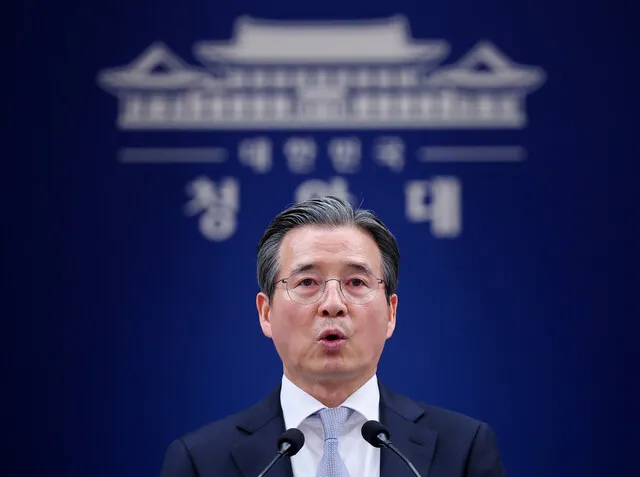
- Blue House Policy Chief Kim Yong-beom expressed his intention to resign on the 1st, and President Lee accepted the resignation the same day, making it official. Kang Yu-jeong, senior Blue House spokesperson, held an unscheduled briefing that morning to announce the news.
- This replacement is the first high-level Blue House staff change in the 1 year and 3 months since the Lee Jae-myung administration took office, and is regarded as the first reshuffle of senior secretaries and secretaries-general level personnel.
- The timing of Chief Kim’s resignation came just two days after the President replaced key economic and housing policy officials on the 30th, including Deputy Prime Minister Koo Yun-cheol (who also serves as Minister of Economy and Finance) and Minister of Land, Infrastructure and Transport Kim Yoon-deok. This is interpreted as a signal that the administration is also replacing the command center of economic policy to shift the course of governance.
A cross-verification analysis examining the timing, background, and policy implications of the Blue House policy chief’s resignation immediately following the cabinet reshuffle, while simultaneously checking the room for and limits of personnel changes spreading across the entire economic policy spectrum
Table of Contents
- Key Summary
- What Happened in the 5 Days Before Kim Yong-beom’s Resignation
- Why Did Three Lines of Responsibility Erupt Simultaneously
- Summary of Key Issues
- Who Are the Candidates to Replace the Blue House Policy Chief
- Policy Tasks Left Behind by Kim Yong-beom’s Resignation
- What You Can Do Right Now
- Frequently Asked Questions
- Reference Source
Kim Yong-beom’s resignation was officially announced through an unscheduled morning briefing on the 1st. The Blue House policy chief expressed his intention to resign that day, and President Lee immediately accepted the resignation. It is the first high-level staff replacement in the 1 year and 3 months since the Lee Jae-myung administration took office, and comes just two days after the preceding reshuffle of economic ministries. This is not a simple personnel change; it is a signal showing how the ruling camp reads the current situation in which public sentiment and policy credibility are being shaken simultaneously.
The point I find most significant in this event is timing. Just one day before resigning, at the final daily issue inspection meeting, Chief Kim said, “It was an honor to serve as the first policy chief, and this is a time when the Lee Jae-myung administration needs new energy.” That same evening, a Facebook post appeared reading, “There is still much to do, but I believe the time has come for me to step aside so that the next people can take on their share.” That is far too composed for someone packing up. It means he had already made peace with his decision.
What Happened in the 5 Days Before Kim Yong-beom’s Resignation
Let’s rewind the timeline.
- August 27 — Democratic Party of Korea Rep. Kim Young-jin publicly criticized, saying “Those who introduced leveraged ETFs must bear a certain degree of responsibility.” This marks the point at which calls for policy accountability within the ruling party began to take formal shape.
- August 29 — One day before the cabinet reshuffle announcement. Chief Kim reiterated his policy resolve on Facebook, writing, “If the three mega projects were an investment for the great leap forward of Korea’s industry, now we must also begin investing in the re-leap of each and every citizen.”
- August 30 — Replacement of key economic and housing policy personnel, including Deputy Prime Minister Koo Yun-cheol and Minister of Land, Infrastructure and Transport Kim Yoon-deok. The opposition and some media outlets sharply criticized the move, saying “They left the control tower in place and merely swapped out the ministers.”
- August 31 — Chief Kim was absent from the National Assembly’s Special Committee on Budget and Accounts review of non-economic ministries, citing an “emergency meeting” as his reason. His scheduled events were canceled one after another.
- September 1 — Senior spokesperson Kang Yu-jeong officially announced the resignation at an unscheduled morning briefing. That same evening, the expression of intent to resign, the acceptance of the resignation, and the Facebook post were all released at once.
Why Did Three Lines of Responsibility Erupt Simultaneously
The Blue House explained, “The average tenure of Blue House staff ranges from about 1 year and 2 months to 1 year and 6 months, and a kind of staff rotation is part of providing smooth momentum for policy execution.” But the picture painted by the political circle is different. Three lines of discontent had been building up.
First, controversy over housing supply policy. With the presale market in Seoul and the metropolitan area slowing, frustration among the middle class and actual demanders grew simultaneously as the pace of deregulation and the timing of housing supply were repeatedly adjusted. Second, the expansion of stock market volatility caused by the introduction of single-stock leveraged ETFs. As individual investors — so-called “ants” — crowded into high-volatility stocks, losses accumulated, which directly fed into Rep. Kim Young-jin’s call for accountability.
Third, the downward trend in President Lee’s approval ratings. With no clear means of recovering public sentiment beyond personnel cards, replacing the control tower effectively functioned as a last-resort option.
A ruling party official predicted, “The direction of economic policy is decided by the president; it doesn’t change just because a working-level official changes,” and forecast no major immediate shift in policy direction. However, what stands out from a working-level perspective is the fact that housing, ETFs, and approval ratings are all intertwined. Because three issues overlapped — not just one — the weight of responsibility converged on a single designer.
Summary of Key Issues
- Where does the boundary of responsibility lie? — The line of responsibility between the policy designer (policy chief) and the executor (minister) is ambiguous. This replacement is a case in which the designer’s side stepped down first, and it is likely to set a precedent in similar future situations.
- Will the policy direction be maintained? — The ruling party draws a firm line, saying “the direction is decided by the president” and that there will be no major change, but the execution speed and priorities of financial, supply, and three mega project policies in practice have ample room to be readjusted.
- Is this the beginning of a Year Two reorganization? — With the subsequent appointment of senior secretary and secretary-general level personnel expected, Kim Yong-beom’s resignation may not be a one-off event but rather the starting gun for a full-scale Blue House personnel overhaul.
- The cost of a control tower vacuum — While the deputy prime minister and ministers have been replaced, decision-making across the budget, finance, and housing tracks may be temporarily dispersed during the policy chief vacancy period.
Who Are the Candidates to Replace the Blue House Policy Chief
No official list of candidates has been announced yet, but given the need to address three issues simultaneously — housing, ETFs, and approval ratings — the successor profile narrows down to three types. This is because three criteria must work at the same time: policy continuity, prevention of political isolation, and recovery of public sentiment.
| Successor Type | Strengths | Risks |
|---|---|---|
| Fiscal and financial expert (former or current vice-minister level) | Ensures continuity of budget and financial policy, immediate deployment of follow-up measures for ETFs and housing | Lack of political communication skills, weak coordination with the National Assembly and ruling party |
| From the National Assembly or ruling party (former ministers, former senior secretaries) | Secures bipartisan consensus lines, prevents political isolation | Expertise in economic and industrial policy needs to be verified |
| From civic or social circles (economic civic groups, labor, academia) | Image of public sentiment recovery, policy diversification | Period needed to adapt to Blue House working-level operations, potential resistance from the bureaucratic organization |
Which additional variables are reflected in the actual selection process will be important. Because the three issues of housing, ETFs, and approval ratings were intertwined, if the successor is a single-track expert, a second shock could come quickly.
Policy Tasks Left Behind by Kim Yong-beom’s Resignation
The Blue House and the ruling party’s explanation is: “The direction of policy is decided by the president, and the direction doesn’t change just because a working-level official changes.” That is correct. Major tasks such as the three mega projects, investment in the United States, next year’s budget, the expansion of housing supply, and tax reform are all agendas that the president himself has emphasized. However, with the working-level execution layer having changed, the “speed” and “messaging” will inevitably differ.
In particular, regarding the single-stock leveraged ETF, the question of “who forced the introduction through” has not yet been resolved. The fact that Chief Kim was the designer is hard to deny, and Hankyoreh’s analysis also identified “housing and leverage responsibility” as the direct background for the resignation. According to JTBC reporting, the dominant assessment is that ETF public sentiment was the biggest weight in the decision to accept the resignation.
In my view, the real test of this personnel change lies not in whether short-term shocks are absorbed, but in how quickly a follow-up policy package is put together. With voices within the ruling party publicly calling for someone to “take responsibility,” as seen in Rep. Kim Young-jin’s remarks on August 27, the Blue House’s personnel explanation alone will not be enough. As shown in the controversy over Rep. Yong Hye-in’s retention of her seat, which revealed the internal ruling party blame game, the possibility of this devolving into a partisan political battle must also be left open. In comparison with global cases, it is worth referencing Apple’s first CEO change in 15 years — how long a leadership change takes to restore public sentiment ultimately depends on the follow-up cards.
What You Can Do Right Now
- Check your holdings in single-stock leveraged ETFs and set principles in advance for adjusting your allocation during periods of market volatility.
- Hold off on purchase decisions until a follow-up policy package on housing supply and tax reform is announced, and separately track subscription schedules and any changes in the DSR regulation.
- When the successor senior secretary and secretary-general level appointments are announced, verify their official career history and compare what expertise is coming into the economic and financial track.
- Check national approval ratings and KOSPI and housing transaction volume indicators on the same cycle, and numerically verify how quickly policy cards are reflected in actual markets.
Frequently Asked Questions
What is the official reason for Kim Yong-beom’s resignation?
The Blue House explained it as “part of efforts to provide smooth momentum for policy execution.” In contrast, the political circle sees it as the result of overlapping housing and leveraged ETF responsibility issues and declining approval ratings. The gap between these two explanations is the essence of this event, and how quickly the follow-up policy package fills that gap will be key.
Why did single-stock leveraged ETFs become a problem?
As cases of individuals crowding into high-volatility stocks and suffering daily losses accumulated, a logic was formed that “the policy designer who forced the introduction through bears responsibility.” Rep. Kim Young-jin’s remark about “a certain degree of responsibility” was the signal that formalized this framework, and the dominant assessment is that it directly contributed to the background of Kim Yong-beom’s resignation.
Will the policy direction change?
The ruling party signaled that the direction will be maintained, saying “the direction is decided by the president.” However, the execution speed and messaging of housing supply, financial policy, and the three mega projects have ample room to be adjusted depending on the successor policy chief. The first policy package after Kim Yong-beom’s resignation will effectively serve as the market’s test.
What type of successor is most likely?
Three candidate groups are mentioned: fiscal and financial experts, those from the National Assembly or ruling party, and those from civic and social circles. Because three issues — housing, ETFs, and approval ratings — must be addressed simultaneously, the prevailing view is that a multi-track figure is more likely than a single-track expert. A visible signal of the selection is expected within about two weeks after Kim Yong-beom’s resignation.
Reference Source
This article was written after checking the following original source: Google News Korea — [News Analysis] Amid housing and leverage responsibility claims… Kim Yong-beom steps down two days after the cabinet reshuffle – Hankyoreh
Expert Commentary (AI)
Politics and Public Administration Expert
A swift display of accountability, but only a half-measure: it leaves a vacuum at the control tower during budget season and carries the contradiction of a “maintain direction, retire the designer” responsibility logic
Replacing the policy chief within 48 hours of the cabinet reshuffle was a rapid decision to overhaul the economic policy command center, and can be read as a strong move to secure governing momentum by visualizing responsibility in seeking a turning point. However, with a vacancy at a time when next year’s budget review, the three mega projects, and investment in the United States are all proceeding simultaneously, decision-making and coordination functions may be dispersed — making the speed and expertise of the successor selection virtually decisive. The “average staff tenure” argument amounts to typical post-hoc justification and fails to bridge the gap with the actual responsibility structure of housing, ETFs, and approval ratings. The official formula that the designer steps down while the line is maintained reveals a mismatch between authority and responsibility and leaves a precedent cost: in similar future situations, “a chief replacement is effectively a signal of policy revision.” Whether this decision ends as one-off apology politics or becomes the starting gun for a governance reshuffle linked to follow-up senior secretary and secretary-general level personnel changes and a policy package will depend on the follow-up cards within two weeks.
Financial Markets and Housing Policy Expert
Single-stock leveraged ETFs, which spread without safety nets, show a classic failure pattern of financial innovation, and combined with repeatedly adjusted housing supply communication failures, eroded policy credibility
Single-stock leveraged ETFs are high-risk products that structurally amplify loss exposure for individual investors. Beyond the introduction itself, the question of how well investor suitability systems, margin and leverage limits, and volatility buffers were designed in advance should have been verified first. That losses accumulated to the point of triggering accountability calls within the ruling party suggests that risk warnings and the internalization of safety nets lagged behind the stated goal of “market revitalization” more than the existence of the product itself. In housing as well, the repeated adjustments to the pace of deregulation and the timing of supply — destabilizing demand expectations — were the core of the middle class and actual demander backlash. Unless the basic design changes beyond the chief replacement, if the follow-up package does not include substantive measures such as a redesign of leverage regulation and the prior announcement of a supply roadmap, the market may experience a renewed shock after short-term stability. Conversely, if this personnel change leads to ETF institutional improvements and greater transparency in the supply plan, there is still room for the crisis to turn into an opportunity for institutional improvement.
Critical Analyst
A resignation two days after the cabinet reshuffle reads not as a “rotating appointment” but as the second stage of a pre-agreed sequential withdrawal scenario
The official explanation is that this is a “replacement closer to staff rotation,” but the circumstances tell a different story. The absence from the budget review committee, the calmly released farewell messages starting three days earlier, and the precise timing immediately after the reshuffle all erase the impression of an impromptu departure. The biggest beneficiary is the presidential office, which draws the line that “the direction is decided by the president,” funneling responsibility onto a single designer and erecting a firewall that blocks scrutiny of the entire decision-making chain — including the party leadership, financial authorities, and the presidential approval stage. The announcement coming just five days after Rep. Kim Young-jin’s accountability remarks became formalized can also be read as a political timetable designed to preemptively absorb internal party backlash, and the intention to keep the successor position vacant for about two weeks likely represents the securing of discretionary room to package it with the next reshuffle card. What we should really pay attention to is not who stepped down, but where the other hands that signed alongside them at that desk stand in terms of how much responsibility they are allowed to escape.
Underlying Scenarios
- The resignation may have been the second stage of a sequential withdrawal designed together with the cabinet reshuffle — anticipating that criticism of “leaving the control tower in place” would erupt over the ministerial replacement, the flow of remarks at the final meeting and the Facebook farewell post, calmly prepared over three days, serves as circumstantial evidence.
- The fact that leveraged ETF responsibility was isolated to the chief personally may be an intentional firewall — the situation is read as a structure in which issues that should have been subject to scrutiny including the party leadership, financial authorities, and the presidential approval stage are sealed by a single departure.
Leave a Reply