Author: l0cknsec

  • 5-Step AI Data Leakage Prevention Workflow — Control Design That Protects Without Blocking

    5-Step AI Data Leakage Prevention Workflow — Control Design That Protects Without Blocking

    Key Takeaways

    • Standalone policy documents have clear limits. In situations where there is no time to classify information sensitivity on the fly — incident response, spreadsheet cleanup, code writing, or customer conversation summarization — the policy effectively does not work, according to the analysis.
    • Hardening blanket blocking also blocks legitimate AI workflows, producing the side effect of reduced user productivity.
    • Community responses repeatedly recommend DLP warnings limited to high-confidence pattern matches, confirmation prompts for suspicious segments, and differentiated controls by data type.

    An analytical guide focused on step-by-step control design that practitioners can apply immediately.

    Table of Contents

    During incident response, you pasted logs into a generative AI tool. When asking AI to summarize an external partner’s email, you copied contract language verbatim. During a code review, you handed customer IDs to AI for cleanup without realizing they were embedded in variable names. These are not special violations — they are the daily flow of high-pressure work. Even when you create an AI data-leakage prevention policy, if this flow itself does not change, incidents will remain.

    Why AI Data Leakage Prevention Policies End Up in Shared Drives

    Internal AI usage guidelines, information security rules, training materials — the policies are already in place. Yet incidents continue to occur steadily even after the policies were written. When an incident breaks out, when customer complaints flood in, or when code has to be cleaned up before a deadline, the person in charge has no time to classify whether “this information is sensitive.” Because the structure demands on-the-spot decisions, the policies sit in the file server.

    Blanket blocking cuts effectiveness in half. Tightening DLP increases false positives, and users become desensitized to warnings. Once a warning that turned out to be “no problem” is repeated ten times, its signal value disappears. From the practitioner’s perspective, what stands out is that once this warning fatigue accumulates, the real warnings that follow are buried alongside it.

    Decision Criteria: Divide Information into Three Categories

    If every piece of information is treated with the same intensity, leaks will appear everywhere. The first thing to define in AI data-leakage prevention is not the level of control, but the classification system. Internal information can be divided into three categories.

    First, identifiers that are reliably caught by regex or patterns. National ID numbers, card numbers, API keys, internal IP ranges. For this category, immediate blocking is fine when matched, with low user burden.

    Second, free-form text where sensitivity changes depending on context. Customer real names, contract amounts, internal titles, project code names. These cannot be caught by patterns alone, so user confirmation is needed.

    Third, values that end up in code or config files by accident. Hardcoded secret keys, real names mixed into test data, raw log content. These are more efficiently handled separately by static analysis tools or dedicated scanners.

    Trying to control all three categories with a single rule causes the strong side to generate more false positives while the weak side keeps leaking.

    Proven Response: 5-Step AI Data Leakage Prevention Workflow

    Handling things within the user’s flow is the key. When an on-screen warning ends with “This is a policy violation,” users dismiss it or, worse, route around it through another channel. The flow that has repeatedly proven effective in practice is as follows.

    Step 1 — Define Data Types

    Catalog the “free-text-based sensitive information” handled internally. Customer real names, contract language, raw incident logs, internal titles, project code names. This catalog becomes the baseline for the entire AI data-leakage prevention flow.

    Step 2 — High-Confidence Pattern Matching

    Use regex, hashing, and keyword dictionaries to first-filter only the reliable identifiers. False positives must not appear here. Exclude patterns with high false-positive potential, such as “company domain emails” or “internal system paths.” Only let through what is certain.

    Step 3 — In-Flow Warnings

    For sections that are not caught by patterns but are suspicious, require user confirmation. Rather than a simple popup, provide an input field alongside it. “This text may contain customer information. To proceed, either de-identify it or enter a reason.” The reason entry is logged and remains traceable for later audits.

    Step 4 — Provide De-Identification Paths

    When the user answers “I still need to send it,” don’t block immediately — provide a mask/replace button. One-click conversion such as “Hong Gildong” → “[Name]”, “010-1234-5678” → “[Phone]”. Users feel that “send it masked” creates less friction than “don’t send it at all.” The same direction of recommendations has come up repeatedly in a thread discussing practical ways to block sensitive data leakage.

    Step 5 — Post-Event Monitoring

    Once a month, sample actual transmitted prompts for pattern leaks. When new bypass patterns are discovered, add them immediately to the Step 1 catalog. AI data-leakage prevention is not a one-time setup — it evolves alongside bypass attempts.

    Control Method User Friction False Positive Rate Bypass Possibility
    Blanket Blocking Very High Low High
    Simple Warnings Medium Medium Medium
    Providing De-identification Paths Low Low Low
    Post-Event Monitoring Only None High Very High

    Common Mistakes

    Common mistakes seen in AI data-leakage prevention operations.

    First, controlling all information with the same intensity. As false positives rise, warning fatigue accumulates, and eventually real warnings are also ignored.

    Second, providing no alternative after blocking. Users route around via USB, personal email, or a private browser window to meet deadlines. Blocking only stops the first attempt.

    Third, sending the policy once via internal email and calling it done. Violation cases need to be anonymized and shared in a monthly report so users gain a sense that “this is really being watched.”

    Fourth, ignoring the first two weeks of data after rollout. This is when the most patterns are discovered, so the team needs to be on-site adjusting the rules.

    The author sees this point as the most meaningful. AI data-leakage prevention is not “technology” — it is “user flow design.” The tools don’t block; the structure lets users mask and send on their own, which is the long-term effective approach.

    What to Do Right Now

    • This week, sample 100 internal AI usage logs and extract at least 5 cases where sensitive information was mixed in.
    • Classify the extracted cases into “caught by regex” and “requiring context.”
    • Add a “De-identify” button to the warning popup so users can mask with one click.
    • Create one anonymized monthly report and share it with the team.
    • Schedule a DLP rule review meeting every two weeks to adjust false-positive cases.

    Practical Application Points

    • Pattern matching handles only “certain” cases. For suspicious segments, ask the user.
    • Design “send it masked” paths before “blocking.”
    • Leave a reason-entry field as a log to ensure traceability.
    • When new bypass patterns are discovered, reflect them immediately in the Step 1 data-type catalog.

    Frequently Asked Questions

    Can AI data-leakage prevention be completed with a single DLP tool?

    No. DLP only catches information with clear patterns. For sensitive information that mixes in as free text, in-workflow confirmation procedures must accompany it.

    Won’t users ignore warnings if they appear too often?

    Correct. Once warning fatigue accumulates, real warnings get buried too. The first filter should only let through certain patterns, and suspicious segments should be bundled with de-identification paths.

    Is it applicable to small teams?

    Yes. Even adopting just Step 1 (data type definition) and Step 4 (de-identification paths) produces immediate effects. Add the remaining steps gradually.

    Should blocking or warnings be applied first?

    Identifiers with certain patterns can be blocked immediately with low cost. For free text with uncertain patterns, provide warnings together with de-identification paths.

  • Homelab VPN: 4 External Access Patterns Compared — The Setup Self-Hosters Choose

    Homelab VPN: 4 External Access Patterns Compared — The Setup Self-Hosters Choose

    Key Takeaways

    • The author already runs a homelab exposed externally via subdomains and is evaluating a VPN transition to reduce the attack surface.
    • WireGuard users report that on mobile and desktop, the daily VPN connection is barely noticeable.
    • The common pattern is to place a WireGuard endpoint on a router or always-on device (e.g., a Raspberry Pi) and use split tunneling so only homelab traffic goes through the VPN.

    practice

    Table of Contents

    “If I set up a homelab VPN on a Raspberry Pi, isn’t it a hassle to turn it on every time from my phone?” That is exactly why someone already running a homelab exposed via subdomains hesitates to switch to a VPN. It is the tension between keeping access secure and not disrupting everyday usability.

    Public Subdomains vs. Homelab VPN — Why the Same Dilemma Keeps Coming Back

    Public subdomains are convenient because they are reachable directly from the outside, but they also widen the attack surface for missing authentication or exposed vulnerabilities. A homelab VPN, by contrast, encrypts traffic and only authenticated clients can reach the home network — but the cognitive cost of connecting every time follows. These two options may seem at odds, but the dilemma actually comes from the assumption that “everything must be bundled into a single approach.” If you skip the mindset of grouping services by character, you are left with a binary choice: “VPN is annoying” or “public exposure is risky.”

    Decision Criteria: Break It Down Across Five Axes and the Answer Changes

    Service character, family usage frequency, mobile share, commitment to self-hosting, and willingness to harden authentication — breaking it down across these five axes changes the answer. A simple utility that does not require authentication (personal notes, shared files) fits a homelab VPN, while services with external users (blog helpers, photo sharing) are better served by a reverse proxy plus hardened auth. If family members are not comfortable installing a client, leaving access browser-based is the realistic option.

    4 Community-Validated External Access Patterns

    Pattern Auth Control Setup Friction Mobile Convenience External User Friendly
    Self-Hosted WireGuard Key-based, strongest Moderate initially, nearly none after One-tap toggle Difficult
    Tailscale MagicDNS + ACL Very low One-tap, stays in background Controllable via ACL
    Reverse Proxy (Caddy/NPM) Basic Auth + 2FA Low Browser-based, no friction Easy
    Cloudflare Tunnel Cloudflare Access Low Browser-based, no friction Easy, policy-based

    Getting Started with a Self-Hosted WireGuard Homelab VPN

    WireGuard is often chosen because its key-based authentication does not expose credentials externally. The common setup is to place an endpoint on a router or Raspberry Pi and apply split tunneling on mobile and desktop clients so that only homelab traffic goes through the VPN. Key generation is done with wg genkey | wg pubkey; the server and each client hold their own key pair and exchange public keys in the [Peer] section. The mobile app toggles with one tap, so turning it on and off does not register as significant friction.

    Minimizing Friction with a Tailscale Homelab VPN

    Tailscale goes through an external control plane server, but it has the lowest initial friction. After creating a Tailnet and resolving internal names with MagicDNS, register a Raspberry Pi as a subnet router and you can keep using your existing IP ranges as-is. Tailscale’s ACLs also let homelab operators finely control which devices can reach which ports, which is another plus. If you want to reduce external dependency, you can also migrate to the self-hosted Headscale.

    Running VPN and Reverse Proxy Side by Side

    VPN and public subdomains are not mutually exclusive. It is common to find it hard to install a VPN client on every family member’s device, and you may also be cautious about sharing credentials with external users. In such cases, a practical approach is to keep the homelab VPN for internal use and expose only the services that need to be public via a reverse proxy or Cloudflare Tunnel. Layer self-hosted SSO like Authelia or Authentik on top for two-factor authentication, and use IP whitelists to block access from unknown locations. In the author’s view, this configuration resolves both “VPN friction” and “public exposure risk” in the most balanced way.

    Operational Tips to Reduce Daily VPN Friction

    From a practitioner’s perspective, what stands out is that the perception of “having to turn on a VPN every time” does not match the actual experience. On both mobile and desktop, the WireGuard or Tailscale app operates with a single toggle in the background, and some clients even offer options that detect trusted networks (home Wi-Fi) to turn on and off automatically. For family devices, you can deploy keys in bulk via QR codes or config files to avoid the manual setup grind for each person. Placing the endpoint on a router or always-on device, combined with split tunneling, lets you keep normal internet traffic as-is while sending only homelab traffic through the VPN.

    Common Mistakes When Adopting a Homelab VPN

    The most common mistake is hiding all services behind a VPN and breaking usability for the family. The opposite mistake — assuming “Cloudflare Tunnel alone makes it safe” and skipping authentication — leaves internal services fully exposed to the public. Another recurring incident is pushing WireGuard keys to GitHub in plaintext and being forced to rotate. The safe approach is to back up keys in a separate store and document the re-issuance procedure in case of loss.

    Try This Right Now

    • List the subdomains currently exposed externally and classify them into services that need hardened auth and family-only services.
    • Install WireGuard on a router or Raspberry Pi and test split tunneling with a single device.
    • Separate out only 1–2 services that need to be public using a Cloudflare Tunnel or Caddy + Authelia combination.
    • Back up your WireGuard key pair in a separate vault and generate QR codes for family devices.
    • Install the WireGuard/Tailscale app on your phone and enable the auto-connect option for your home Wi-Fi.

    Practical Application Points

    • Prioritize reverse proxy + SSO for services that allow external users, and homelab VPN for personal/family-only services.
    • Choose Tailscale for minimum friction, and self-hosted WireGuard for minimum external dependency.
    • Default to Cloudflare Access or Authelia two-factor authentication on public services and add an IP whitelist.
    • If you do not document a key rotation procedure, a single lost key can snowball into every family device being cut off at once.

    Frequently Asked Questions

    Should I try WireGuard or Tailscale first?

    If you do not mind external dependency, Tailscale has the lowest friction. If you need to self-manage the control plane, starting with self-hosted WireGuard or Headscale is the safer path.

    Does keeping the VPN on slow down general internet speed?

    With split tunneling on, only homelab traffic goes through the VPN, so general browsing is barely affected. You only notice a difference when running a full tunnel that sends all traffic through the VPN.

    Do I need to install a VPN client on every family member’s device?

    Do not apply it to every service. Apply a homelab VPN only to “personal/family-only” services, and leave services with external users on a reverse proxy + authentication setup — that is the realistic approach.

    If I only use Cloudflare Tunnel, can I skip authentication?

    No. You need to apply policy-based authentication with Cloudflare Access, and it is safer to layer two-factor authentication on top of that.

    Adopting a homelab VPN is not a question of “is it annoying” but of “which services should be exposed through which route.” Once you group services by character and default to authentication and split tunneling, you can significantly reduce the homelab’s exposure surface while barely breaking usability.

    Configuration examples from people actually running a homelab VPN

    Source

    This article was written after reviewing the following source: r/selfhosted — How practical is using a VPN for homelab access?

  • Claude 5.1 Launches — Two Faces of the Same Model, 52.6% on Science Bench and 75% Cache Read Price Cut

    Claude 5.1 Launches — Two Faces of the Same Model, 52.6% on Science Bench and 75% Cache Read Price Cut

    Key Takeaways

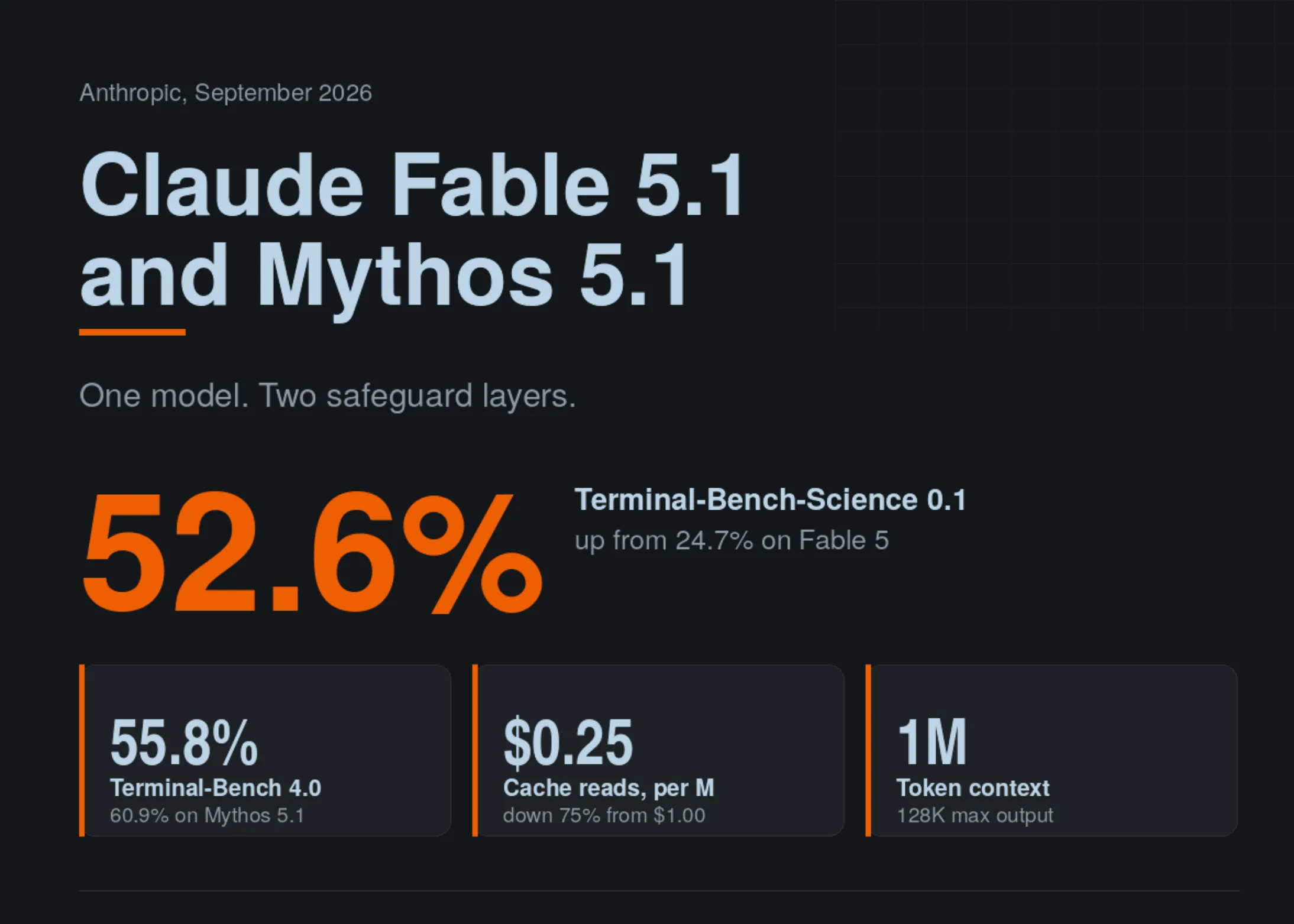
    • Fable 5.1 and Mythos 5.1 are two deployment variants that share the same base model and differ only in their guardrail layer; they were released on September 1, 2026, three months after the launch of the Fable 5 line
    • Fable 5.1 is generally available (GA) under the claude-fable-5-1 identifier on the Claude API, Amazon Bedrock, AWS Claude Platform, Google Cloud, and Microsoft Foundry, while Mythos 5.1 is restricted to verified U.S. organizations under Project Glasswing
    • Both models share the same core specifications: a 1M token context window, a 128K maximum output token count, and always-on adaptive thinking

    Analytical — an article that unpacks the strategic implications of a single-model, dual-guardrail release structure and quantifies how the simultaneous jump in science benchmark scores and cut in cache pricing reshape the price-to-performance equation

    Table of Contents

    The Claude 5.1 lineup was released on September 1, 2026 — exactly three months after Fable 5. On the same day, Anthropic launched two models simultaneously: Claude Fable 5.1 and Claude Mythos 5.1. The base model is identical, and the dual deployment differs only in the guardrail layer.

    I see this structure itself as the most important signal. Releasing a model that disrupts both performance and pricing through two separate channels is a strategy aimed at capturing market share and governance control in a single move.

    The Release Structure of the Claude 5.1 Lineup — Same Model, Different Gates

    The two models share the claude-fable-5-1 identifier. The difference lies in the distribution channel.

    Fable 5.1 is generally available on the Claude API, Amazon Bedrock, AWS Claude Platform, Google Cloud, and Microsoft Foundry. Mythos 5.1 is restricted to verified U.S. organizations under Project Glasswing. General developers are unlikely to encounter the Mythos 5.1 identifier in the API console.

    Claude 5.1 Specifications — 1M Context, 128K Output, Always-On Adaptive Thinking

    Both deployments share the following specifications.

    • 1M token context window
    • 128K maximum output tokens
    • Always-on adaptive thinking

    The fact that there is no difference in core compute specifications aligns with the announcement’s claim that only the guardrail layer differs on the same base model.

    Science Benchmark Jump — 52.6% on Terminal-Bench-Science 0.1

    Among the figures published by Anthropic, the most meaningful for practitioners is the Terminal-Bench-Science 0.1 score. On this benchmark, which evaluates agentic scientific research, Fable 5.1 recorded 52.6%.

    Model Terminal-Bench-Science 0.1
    Claude Fable 5.1 52.6%
    Claude Opus 5 29.0%
    Claude Fable 5 24.7%
    GPT-5.6 Sol 22.4%

    The gap is 27.9 points over Fable 5 and 23.6 points over Opus 5. A standard error of 3.5 to 4.5 points was published alongside. Narrow gaps like the 2.3-point difference between Fable 5 and GPT-5.6 Sol mean that superiority should not be judged on a single benchmark score alone.

    The Gap Within the Same Model Revealed by Terminal-Bench 4.0

    An interesting figure is the Terminal-Bench 4.0 score. Although the base model is the same, scores diverge depending on whether the guardrail is applied.

    Fable 5.1 at 55.8%, Mythos 5.1 at 60.9%. The difference is 5.1 points. Based on materials published by Anthropic, this is analyzed as the result of deploying the same model with only a different guardrail layer. Further disclosure is needed to determine which guardrail pulls the score down.

    Supplementary Benchmarks for Claude 5.1 — Five Figures at a Glance

    Here are the figures released beyond the science benchmark.

    Benchmark Fable 5.1 Score
    CursorBench 3.2.0 73.4%
    Humanity’s Last Exam (no tools) 60.9%
    Humanity’s Last Exam (with tools) 65.0%
    AutomationBench 31.4%
    OSWorld 2.0 strict 41.7%
    GDPval-AA v2 1853

    AutomationBench at 31.4% and OSWorld 2.0 strict at 41.7% were not published with comparable baselines, so there is insufficient information to judge their relative standing.

    Claude 5.1 Pricing — Base Rates Frozen, Cache Cut 75%

    The pricing is summarized as follows.

    • Base input: $10 per million tokens (unchanged)
    • Base output: $50 per million tokens (unchanged)
    • Cache read: $1.00 → $0.25 per million tokens (75% cut)

    Cache read pricing is now 0.025x of the base input price. Compared to the 0.1x ratio used by other Claude models, this is one-quarter the level, meaning the cache-to-input ratio has been cut deeper from 0.1x down to 0.025x.

    The Cost Impact of Claude 5.1

    Taking Anthropic’s own measurements at face value: approximately 25% savings on general workloads, and up to roughly 45% savings on context-heavy agentic workloads. Since cache hit rates vary by workload, the most effective approach is to directly measure your own traffic’s cache hit rate.

    What the Two Deployments of the Same Model Signal

    The dual-gate strategy is more than a simple channel split. It broadens market reach for general customers through Fable 5.1, while absorbing governance requirements for customers with stricter control needs through Mythos 5.1. The intent is to satisfy both price-performance advantage and policy requirements by sending one model out through two paths. The September 1 MarkTechPost report and the official Anthropic announcement are the sources for this simultaneous release.

    Summary of Issues

    • The single-model, dual-guardrail structure has set a new reference point for the price-performance-control balance
    • The 52.6% on Terminal-Bench-Science 0.1 leaves an open question of how much of a real gap exists over Opus 5 within the 3.5 to 4.5 point standard error window
    • The 0.025x cache read ratio creates a 4x gap versus the 0.1x of other models, foreshadowing significant market ripple effects

    What to Try Right Now

    • Measure the cache hit rate of your current Claude API traffic from CloudWatch and OpenTelemetry logs, and map the 25 to 45% savings to your own workload
    • Review the eligibility requirements of Project Glasswing to determine whether you can access Mythos 5.1
    • Redesign your prompt structure to expand cache hit regions in RAG pipelines that leverage the 1M token context
    • Build a science evaluation set tailored to your domain to compare scores before and after adopting Fable 5.1
    • Simulate whether the 23.6-point gap can be recovered cost-effectively when migrating from Opus 5 to Claude 5.1

    Frequently Asked Questions

    What is the difference between Claude 5.1 and Fable 5?

    Claude 5.1 is a line released three months after Fable 5, jumping from 24.7% to 52.6% on Terminal-Bench-Science 0.1 and cutting cache read pricing by 75%. The base model is identical, and the line is split into two deployments that differ only in the guardrail layer.

    Can general developers use Claude Mythos 5.1?

    No. Mythos 5.1 is restricted to verified U.S. organizations under Project Glasswing. Only Fable 5.1 is generally available on the Claude API, Bedrock, Claude Platform, Google Cloud, and Microsoft Foundry.

    How much does the cache read price cut actually affect real-world cost?

    According to Anthropic’s measurements, savings reach approximately 25% on general workloads and up to roughly 45% on context-heavy agentic workloads. Actual savings vary depending on your traffic’s cache hit rate.

    Why is the same model deployed with only different guardrails?

    This is analyzed as a dual-gate strategy aimed at broadening market reach for general customers through Fable 5.1, while absorbing governance requirements for customers with stricter control needs through Mythos 5.1. The roughly 5.1-point gap on Terminal-Bench 4.0 (55.8% vs. 60.9%) illustrates the cost of this strategy.

    Reference Source

    This article was written after reviewing the following original source: MarkTechPost — Anthropic Releases Claude Fable 5.1 and Claude Mythos 5.1: 52.6% on Terminal-Bench-Science and 75% Cheaper Cache Reads

  • 153M Driver’s Licenses Exposed: Where the KYC Industry Broke Down

    153M Driver’s Licenses Exposed: Where the KYC Industry Broke Down

    Key Takeaways

    • Nexus, a new identity theft service that surfaced on the Russian cybercrime forum Exploit, is selling more than 153 million scans of U.S. and Canadian driver’s licenses, along with 10 million national ID cards, 3 million travel/international IDs, and 579,000 medical cards. The data is believed to have originated from images leaked by a KYC (identity verification) vendor based in Louisiana. The FBI’s New Orleans field office launched a formal investigation into the data source on August 31. The sold data also includes driver’s licenses of high-ranking officials such as U.S. Defense Secretary Pete Hegseth. The Nexus seller attached a KrebsOnSecurity reporter’s Virginia driver’s license as a free sample in the initial sales post. The service returns approximately 11.5 million pages of empty search results, with 15 records per page, making the 153 million figure difficult to dismiss as fabrication. A search limited to Canadian driver’s licenses alone extracts about 1.1 million records. The inclusion of high-profile licenses raises the possibility that the breach extends beyond personal data exposure into a national security risk.

    Going beyond a simple incident summary, this analysis examines how the 153 million-record driver’s license breach exposes structural vulnerabilities in the digital identity verification (KYC) industry. It traces how images held by identity verification vendors are converted into dark web merchandise through a single hack or insider leak, and the security and policy implications when high-ranking officials’ identity information is exposed through the same channel. A fact-based, analytical piece that calls for improved data retention practices across the industry.

    Table of Contents

    A breach of 153 million driver’s licenses appears to have originated from a single identity verification (KYC) vendor. The FBI’s New Orleans field office has launched a formal investigation into the source of the breach as of August 31.

    Nexus, a new identity theft service that surfaced on the Russian cybercrime forum Exploit, is selling more than 153 million digital scans of U.S. and Canadian driver’s licenses. This driver’s license breach represents an unprecedented scale for a single data leak incident.

    The seller attached the Virginia driver’s license of a reporter at KrebsOnSecurity as a free sample in the initial sales post—exposing the reporter’s full identity. The data is believed to have come from images leaked by a KYC vendor based in Louisiana. The KYC process typically involves storing the ID images submitted by users on a server and then disposing of the copies. But in this case, it appears that the disposal either never took place or the data resurfaced somewhere along the way.

    The Actual Scale of the Driver’s License Breach

    The index published by Nexus includes 10 million U.S. and Canadian national ID cards, 3 million travel/international IDs, and 579,000 medical cards in addition to driver’s licenses. A search limited to Canadian driver’s licenses alone yields about 1.1 million records.

    Running an empty search within the service returns 11.5 million pages, with 15 records per page. If that math holds, the total comes out to roughly 172.5 million records—more than the 153 million figure the seller is advertising.

    National Security Implications of Senior Officials’ License Exposure

    What sets this incident apart from a routine personal data breach is the fact that U.S. Defense Secretary Pete Hegseth’s license was included in the same dataset. The very fact that high-ranking officials’ identities pass through the same KYC pipeline as ordinary citizens is a national security issue.

    This is where I see the most significance. Identity verification is ultimately a process of confirming “who is who”—but if the system entrusted with that confirmation shares the same vulnerability, the verification itself becomes meaningless. From a practitioner’s perspective, the more often driver’s license breaches of this kind repeat, the more the credibility of the policies that mandated KYC in the first place erodes.

    Dark Web Distribution Structure

    Nexus operates on the Exploit forum and built trust by offering free samples. What distinguishes it from other dark web brokers is the scale of the data. Rather than being sold as “resellable assets,” the data is offered as a “self-service search platform”—so buyers can extract what they need through searches rather than purchasing records one by one.

    The FBI has begun investigating the source, but there is still no official statement on whether the KYC vendor was breached externally or through an insider leak. The fact that it is based in Louisiana is not enough to narrow the scope, given how fragmented the KYC outsourcing market is.

    Structural Vulnerabilities of the KYC Industry

    KYC is mandated across the financial, telecommunications, and cryptocurrency industries. The problem is that there is effectively no industry standard for how long ID images are stored or in what form. Some vendors keep originals for a few months; others keep them for years.

    Minimizing data retention, encrypting uploads immediately, and strictly controlling access permissions are basic practices. Yet only a handful of vendors actually follow them. This driver’s license breach starkly illustrates how those gaps end up turning into dark web merchandise.

    Leaked Data Summary

    Data Type Record Count Risk Level
    Driver’s Licenses 153 million Very High
    National ID Cards 10 million High
    Travel/International IDs 3 million High
    Medical Cards 579,000 Medium

    What You Can Do Right Now

    • Sign up for an identity theft monitoring service (e.g., the U.S. Identity Theft Resource Center, or the Financial Consumer Agency of Canada) to check whether your driver’s license number has been exposed.
    • If you’ve completed KYC verification with a service, contact its customer support directly to ask about image retention periods and scheduled destruction dates.
    • Avoid reusing copies of your driver’s license for other service sign-ups, and use only single-use links that expire after upload.
    • Pull your credit reports from all three credit bureaus and review them for any unusual inquiry activity over the past 12 months.

    Key Issues at a Glance

    • A single KYC vendor’s breach of 153 million driver’s licenses is a direct consequence of the lack of industry standards.
    • The fact that high-ranking officials’ identities are tied to the same pipeline extends the incident into a national security threat.
    • Even if image disposal obligations are codified into law, no oversight body exists to verify actual compliance.
    • The emergence of dark web self-service search platforms shatters the assumption that “once leaked, the damage is done.”

    Frequently Asked Questions

    How can I check whether my driver’s license has been exposed?

    No official exposure lookup tool has been released yet. The most practical approach is to periodically check for unusual activity through credit bureaus or identity theft monitoring services.

    What kind of damage can be done with just driver’s license information?

    It can be used to bypass identity verification on other services, leading to potential outcomes such as SIM swapping, opening financial accounts, or filing fraudulent tax refund claims.

    Why do KYC vendors keep original IDs for so long?

    It is largely so the data can be used as evidence during re-verification or in dispute resolution. Very few countries have legislated specific retention periods, leaving the matter to industry self-regulation.

    This article is based on KrebsOnSecurity’s original reporting.

    Source Article

    This article was prepared with reference to the following original: Krebs on Security — FBI Probes Service Selling 153M+ Drivers Licenses

  • Pivotal CEO Change After 4 Years — 3 Signals for eVTOL Commercialization

    Pivotal CEO Change After 4 Years — 3 Signals for eVTOL Commercialization

    Key Summary

    • Pivotal CEO Ken Karklin has stepped down this week after more than four years in the role.
    • Pivotal’s official position is that Karklin is “pursuing new endeavors.”
    • His successor is Mike Ross, an aviation industry executive who joined the Pivotal board in November 2025, taking on the role of interim CEO.

    This is not a routine personnel move. It is a leadership change at a flagship American startup arriving at the moment the eVTOL industry shifts from prototypes to commercialization and regulatory execution — an issue-driven analysis of the strategic and industry signals behind the transition.

    Table of Contents

    Pivotal CEO Change After 4 Years — 3 Signals for eVTOL Commercialization

    The fact that Ken Karklin stepped down from the Pivotal CEO role became public on September 1, but signals of the move had been circulating for a month or two. Back in November 2025, when aviation veteran Mike Ross joined the Pivotal board, industry observers were already saying, “The next move is a CEO lineup adjustment.” The fact that the Pivotal CEO baton is passing from someone who held the seat for more than four years to a new board member of less than a year itself reads as a signal that the company has entered a new phase.

    Pivotal’s official position is measured. The entire statement is that Karklin is “pursuing new endeavors.” According to TechCrunch’s report, his successor is Mike Ross, who joined the board the same month and now takes the interim CEO seat. The two words most frequently cited at the moment of the Pivotal CEO change are “stability” and “regulatory readiness.”

    Four Years of Track Record: Up to the Helix Commercial Launch

    The biggest achievement of Pivotal during Karklin’s four-year tenure as CEO is undoubtedly the commercial launch of the Helix. It is a lightweight single-seat electric eVTOL that requires no pilot’s license and carries a starting price of roughly $200,000. That price point is rarely seen in the existing personal aircraft market. The light sport aircraft market typically runs in the $50,000 to $150,000 range, but the Helix’s positioning is distinctly different because it bundles vertical takeoff and landing mobility into that price.

    The part that stands out to me is the regulatory hook of “no license required.” Under U.S. FAA rules, Light Sport Aircraft (LSA) do not require a separate pilot’s license, and the Helix falls into that category. In other words, even before the Pivotal CEO change, a reasonable interpretation is that the company’s chosen strategy was to “minimize regulatory barriers to mass-market entry.”

    Model Generation/Stage Seating License Expected Price
    Helix (current generation) 3rd gen — commercially available 1 seat Not required Approx. $200,000
    Helix 4th generation Next gen — roadmap stage 1–2 seats (expected) Reclassification possible Undisclosed
    BlackFly Separate lineup — development ongoing 1–2 seats Varies by regulatory stage Undisclosed (estimated premium)

    Why a Pivotal CEO Change Right Now

    The eVTOL industry has clearly shifted from the prototype and demonstration flights of the early 2020s to a commercialization and certification phase in 2025–2026. Fellow American companies such as Joby Aviation and Archer Aviation have unveiled certification testing and delivery timelines at similar junctures. If the Pivotal CEO change is read as a routine personnel move, it means the company is squarely facing this shift in the industry cycle.

    What stands out from a practitioner’s perspective is that Mike Ross took on the acting CEO role roughly 10 months after joining the board. Interim CEOs are typically brought in from outside, but having a board member who already knows the company step straight into the CEO seat signals an intent to project “continuity of a validated strategy” to the outside world. In his official statement, Ross referenced a “safety-, engineering-, and accessibility-focused disciplined approach,” making it clear he intends to carry the existing direction forward.

    Mike Ross Profile and the Next 12 Months

    Ross’s aviation industry career is confirmed through his official biography, but going only by what the company has disclosed, the most accurate description is “an aviation industry executive with proven execution capability.” Three items are emerging as his near-term priorities: commercializing the 4th-generation Helix, organizing the BlackFly lineup, and negotiating certification with regulators.

    More fundamental than the technical details is whether the 4th-generation Helix can retain the “no license required” category. As battery density, automated emergency landing, and collision avoidance technologies step up one tier at a time, the FAA could naturally revisit the license requirement. This point is likely to be the biggest variable the company will need to resolve after the Pivotal CEO change.

    Key Issues at a Glance

    • Whether the Helix’s “no license required” category can be maintained through the 4th-generation model
    • How the commercialization timing of the BlackFly lineup affects the Helix’s sales momentum
    • How Pivotal’s investment priority shifts within Larry Page’s Alphabet and subsidiary structure

    Reading a personnel change as merely a personnel change means missing half the story. The sequence in which the board accepted Karklin’s resignation and seated Ross as interim CEO in the same month is itself a clear message that the company has chosen an “insider-driven next phase.” On the other hand, compared with CEO change cases at other companies backed by large investors, in hard-tech fields like eVTOL, the shift from a “technology CEO” to an “operating CEO” is almost a required course.

    What to Do Right Now

    • Regularly check Pivotal’s official channels for spec change announcements on the 4th-generation Helix
    • Subscribe via RSS to updates on FAA Light Sport Aircraft (LSA) regulatory changes
    • Mark the certification timelines of competitors in the $200,000 personal eVTOL segment (Joby, Archer) on your calendar
    • Save any separate reporting or test flight videos of the BlackFly lineup as comparison material

    Frequently Asked Questions

    What is the reason for the Pivotal CEO change?

    Pivotal has publicly stated only that Ken Karklin is “pursuing new endeavors.” The dominant outside analysis is that as the eVTOL industry enters a commercialization phase, leadership that emphasizes operational and regulatory experience has become more important.

    Does the Helix require a pilot’s license?

    Yes — the current-generation Helix falls under the FAA Light Sport Aircraft (LSA) category in the United States and does not require a separate pilot’s license. However, for the 4th-generation model, regulatory reclassification is being discussed due to changes in weight and speed.

    What is the relationship between Pivotal and Larry Page?

    Pivotal is an eVTOL startup personally backed by Larry Page. It operates independently from Alphabet’s portfolio, and the investment structure itself is not publicly disclosed.

    The Pivotal CEO change is an event where “why this timing” matters more than “why this person.” With the 4th-generation Helix roadmap directly tied to next-quarter commercial momentum, whether Ross’s interim period leads to a permanent appointment or serves as a bridge to a new external hire is likely to be decided within 2026. The outcome will determine the next name for the Pivotal CEO role.

    Source Reference

    This article was written after reviewing the following source: TechCrunch — Larry Page’s flying car company Pivotal loses its CEO

  • Second US Airstrike on Iran — Washington’s and Tehran’s Next Move After Clashing Again in Just Two Days

    Second US Airstrike on Iran — Washington’s and Tehran’s Next Move After Clashing Again in Just Two Days

    Key Summary

    • The US launched a second airstrike against Iran within just two days
    • President Trump warned that any Iranian retaliation would trigger a larger-scale attack
    • Iran immediately announced a ‘Decisive Operation’ and moved to respond

    An analysis-driven international politics and security briefing examining the resurgent US-Iran military clash and the rising geopolitical risk surrounding the Strait of Hormuz

    Table of Contents

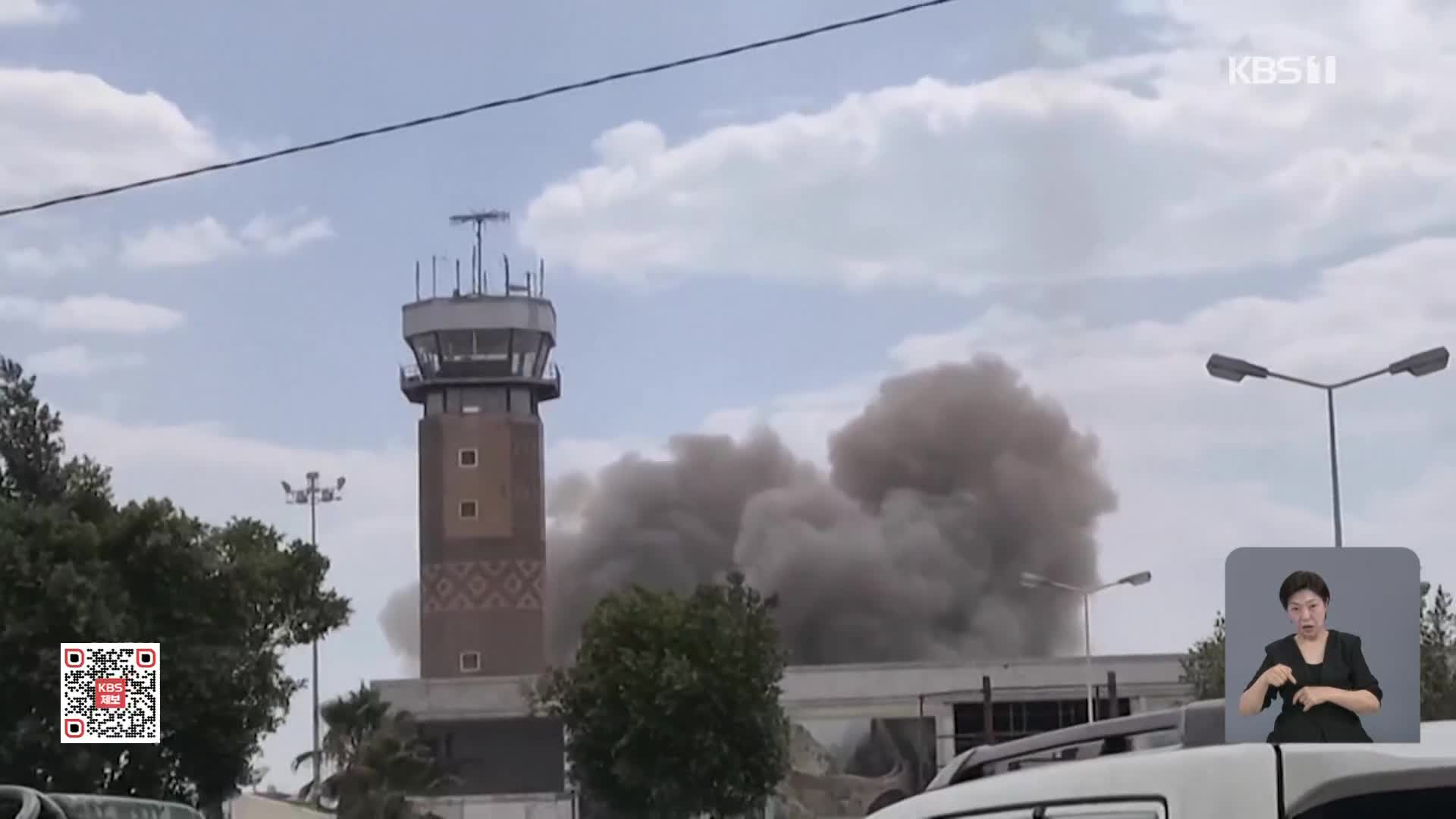
    The second US airstrike on Iran was carried out within just two days. Before the dust from the first strike had even settled, Washington delivered a second blow to Tehran. Iran immediately announced a ‘Decisive Operation,’ signaling retaliation, and the US Treasury Secretary raised the Strait of Hormuz, ratcheting up the pressure on global supply chains and energy markets.

    The core of this second US airstrike on Iran is not a simple escalation — it is a time-limited threat. President Trump publicly warned that any Iranian retaliation would be met with a larger-scale attack. This is an evolved form of maximum pressure that wields diplomatic coercion and military action simultaneously. What I note at this point is that the warning is not a one-sided tough talk — it is engineered like a fuse for the next action.

    Iran’s moves in response to this second US airstrike are also calculated. The phrase ‘Decisive Operation’ simultaneously signals firm resolve to its domestic audience and the potential for gradual escalation to the outside world. In other words, Iran is promising retaliation while deliberately leaving the timing and intensity open. Given that the US administration has explicitly stated ‘if you strike, we hit back harder,’ the character of the clash changes entirely depending on whether Iran’s retaliation targets US military facilities directly or is carried out through proxies along shipping lanes near Hormuz.

    In this context, the Strait of Hormuz — the biggest variable after the US airstrike on Iran — is decisive. The strait is a chokepoint through which roughly 20% of the world’s seaborne crude oil passes. The Treasury Secretary’s direct mention of the strait is not mere background — it signals an intent to bundle Iran’s energy exports and global maritime insurance premiums into a single pressure point. If Iran stages proxy maritime attacks near Hormuz, the US Navy will respond with escort operations, while international maritime insurance premiums will multiply overnight. The cost of war is being passed on not to the direct combatants but to oil-importing nations and the global insurance market.

    The impact on Korea is not direct, but the indirect ripple effects are significant. The Ministry of Foreign Affairs officially confirmed that the vessel struck near the Strait of Hormuz was not a Korean ship and that no Korean crew members were on board. That is fortunate, but the real problem is the chain reaction in insurance premiums and freight rates.

    As the Hormuz risk premium rises, maritime shipping costs on Korea’s Middle East routes, crude import prices, and aviation fuel costs all come under pressure in succession. Given Korea’s economic structure, with crude oil import dependency exceeding 90%, the short-term shock to the exchange rate and prices is not trivial. According to a KBS News report, the clash surrounding this US airstrike on Iran is expanding beyond the military dimension into a geopolitical collision linking energy, shipping, and finance in a single chain.

    From a practitioner’s perspective, what stands out is the direction of the signals. The US is not seeking direct escalation so much as laying a frame that says, ‘if Iran provokes first, we secure legitimacy.’ Iran is rallying its domestic base with a ‘Decisive Operation’ while carefully selecting its actual military actions. Both sides likely want to avoid full-scale war, but a single incident near Hormuz could overturn every scenario. The texture differs from the weight of the Trump administration’s coercive diplomacy on Korea, but the larger axis of the ‘automation of great-power agendas’ is shared — meaning this US airstrike on Iran is not merely a Middle East issue but reads as a stress test for the entire global geopolitical landscape.

    Issue Breakdown

    • The significance of the second US airstrike on Iran — The automation of ‘time-limited threats.’ A form that has publicly disclosed the trigger for the next move.
    • The interpretation of the ‘Decisive Operation’ — A two-sided message: firm declaration of resolve, while timing and intensity are left deliberately undefined.
    • The weight of the Strait of Hormuz — About 20% of global seaborne crude passes through; pressure consolidation is immediately reflected in insurance premiums and freight rates.
    • Korea’s exposure — Direct military risk is low; indirect energy, shipping, and exchange-rate ripple effects are immediate.

    What to Do Right Now

    • Check the Lloyd’s Joint War Committee listed areas near the Strait of Hormuz weekly, and factor the rise in maritime shipping costs into export quotations in advance.
    • Review the Hormuz risk exposure of your crude/refined-oil ETFs and energy-importing stocks portfolio, and raise your currency-hedge ratio by one notch.
    • For Middle East route bookings, pre-calculate the cost of the Cape Town diversion route to prepare for sudden order cancellations and insurance refusals.
    • Check consular protection channels and the Ministry of Trade, Industry and Energy / Ministry of Foreign Affairs energy security briefings at least once a week, and reassess Middle East transit in business travel and dispatch schedules.
    • Run your cash flow again with a scenario assuming a 10–15% rise in freight costs built into your company’s vehicle and logistics pricing tables.

    Frequently Asked Questions

    Why did the second US airstrike on Iran happen in just two days?

    It is analyzed that after the first strike, signs of Iranian retaliation were detected, and Washington carried out the second blow under a ‘preemptive, firm-response’ frame. At the same time, a public warning of a larger-scale attack in the event of retaliation accompanied the action, making the trigger for further action explicit.

    Why is the Strait of Hormuz so important?

    About 20% of the world’s seaborne crude oil passes through this strait. Any maritime attack in this area would simultaneously send international maritime insurance premiums and crude prices soaring, rattling the entire global supply chain in a short time. The combination of this US airstrike on Iran with the Hormuz variable has expanded the blast radius further.

    Is there a direct military impact on Korea?

    Korea’s Ministry of Foreign Affairs officially confirmed that the vessel struck near Hormuz was not a Korean ship and that no Korean crew were on board. The risk of direct military engagement is low, but with crude oil import dependency exceeding 90%, Korea cannot avoid the indirect ripple effects on energy prices and the exchange rate.

    What does Iran’s ‘Decisive Operation’ mean?

    It is a two-sided message: firm resolve internally, while deliberately leaving when, where, and at what intensity retaliation will come. With the US having explicitly stated ‘strike back and we hit harder,’ Iran’s calculation is to keep options open while avoiding full-scale great-power confrontation.

    Reference Source

    This article was prepared after reviewing the following original source: KBS News — US strikes Iran again within two days… Iran responds with ‘Decisive Operation’

  • Agent-Based Development Handles 70% of PRs — How Uber Kept Costs Flat Through 7x Usage Growth

    Agent-Based Development Handles 70% of PRs — How Uber Kept Costs Flat Through 7x Usage Growth

    Key Takeaways

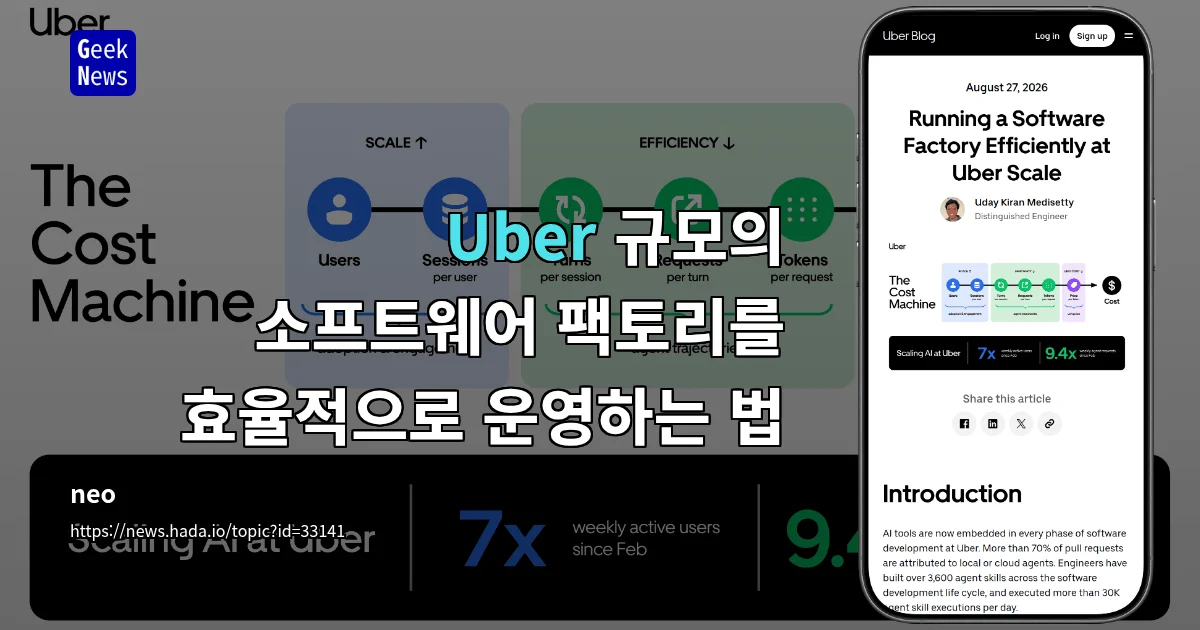
    • Over 70% of PRs are handled by local and cloud agents, with agents acting as the first line of development
    • Automation runs at scale: more than 3,600 agent skills execute over 30,000 times per day
    • Between February and mid-August 2026, weekly users grew 7x and agent requests grew 9.4x

    Analysis

    Table of Contents

    Agent-based development is now automatically handling over 70% of pull requests across Uber’s codebase. This is not simple code autocompletion—agents running both locally and in the cloud act as the first line of PR work. The operational metrics Uber has published put concrete numbers behind this shift.

    The reason this case caught my attention is that it is less a “tool that writes code for you” and more an operating system that runs the entire PR pipeline. How Uber operates its software factory reveals both the scale and the cost structure of agent-based development at the same time.

    What “Software Factory” Really Means

    Uber calls its development system a “software factory.” The core idea is not a single agent, but a building-block design in which role-specific agents are stacked together. PR creation, review, merge candidates, and post-merge monitoring are all closed loops inside the agents. Humans are left with only the final gatekeeping role.

    The Numbers Behind the Scale

    More than 3,600 agent skills run over 30,000 times per day. From February through mid-August 2026, weekly users grew 7x and agent requests grew 9.4x. Over 70% of PRs are now handled by agents as the first pass.

    Metric Value
    Daily skill executions Over 30,000
    Share of PRs handled by agents Over 70%
    Weekly user growth (Feb–Aug) 7x
    Agent request growth 9.4x
    Active skills Over 3,600
    Cost curve (since April) Remains flat

    Despite this explosive growth, the cost curve flattened after April. Usage and cost have been decoupled on the graph.

    Why Costs Stayed Flat in Agent-Based Development

    What Uber did to control costs is not a single trick. Around-the-clock optimization runs on every front: caching, routing, mixing of small and large models, and per-request token reduction. For practitioners, the most meaningful point is that cost was designed not to scale proportionally with usage.

    The real issue in agent-based development is not model performance but how this decoupling structure is operated. The same pattern is observed repeatedly in real-world tooling contexts as well.

    Design Considerations for Large-Scale Codebases

    Running agents across an environment like Uber’s mix of monoliths and microservices requires three prerequisites. Codebase indexing and search infrastructure must be fast enough; PR-level permissions and accountability boundaries must be organized to a level that can be delegated to agents; and the human gate for final merge decisions must be unambiguous.

    If any one of these is missing, the gains of automation turn into a net negative.

    Risks and Limits of Agent-Based Development

    Organizations that let agent-based development handle over 70% of their PRs take on new risks: the potential for security policies to be bypassed, ambiguity in accountability, and the paradox of “humans re-reviewing code produced by agent-based development.” Uber’s case shows what is possible, but what to control on top of it is something each organization has to answer for itself.

    This multi-agent behavior is not unrelated to the spontaneous swarm patterns observed in the agent ecosystem.

    Practical Application Points

    • Codify which PR stages are delegated to agents and which remain human-gated.
    • Plot cost and usage on the same graph to find the inflection point.
    • Operate an internal standard for the agent skill catalog.

    What to Try Right Now

    • Pick 5 PRs from this week and note which stages could be replaced by agents.
    • Plot usage and cost on one graph and mark an inflection point like April.
    • Draft an initial agent skill catalog with no more than 10 items.
    • Put together a one-page document for PR merge permissions and accountability matrix.

    Frequently Asked Questions

    Why can cost be decoupled from usage in agent-based development?

    When optimizations such as caching, routing, and model mixing are applied continuously, per-token cost falls. In the Uber case, costs staying flat even as usage grew 9.4x is the result of this decoupling structure.

    Which stages does Uber’s 70% PR automation cover?

    It goes well beyond simple code generation, broadly covering PR creation, review, and merge candidate generation. The key assumption is that humans keep the final gate.

    Can small and mid-sized organizations adopt agent-based development?

    Yes. However, codebase indexing infrastructure and PR gate design must be prepared first for the automation to be meaningful. Starting at 10–20% rather than aiming for 70% out of the gate is more realistic.

    What is the biggest risk as agent dependency grows?

    Security policy bypass, ambiguity in accountability, and the cost of having humans re-verify agent outputs. If these three are not managed together, the gains of automation erode quickly.

    Reference Source

    This article was written after reviewing the following source: geeknews — How to Operate a Software Factory at Uber’s Scale Efficiently

  • Apple CEO Change: A New Chapter After 15 Years — Tim Cook’s Legacy and What Awaits Ternus

    Apple CEO Change: A New Chapter After 15 Years — Tim Cook’s Legacy and What Awaits Ternus

    Key Summary

    • John Ternus succeeds Tim Cook as Apple’s new CEO
    • Outgoing CEO Tim Cook will remain with the company as executive chair, stepping back from day-to-day operations while retaining influence at the board level
    • According to the NYT report, the incoming CEO takes the helm at a moment when Apple faces major shifts on both the technology and business fronts simultaneously

    Analytical — Examining the organizational and strategic significance of a Big Tech CEO transition and tracing the axes of change that will shape Apple’s next decade

    Table of Contents

    On September 1, 2026, the official announcement of Apple’s CEO change was made. Tim Cook will move to the executive chair position, and John Ternus, who led hardware engineering for 15 years, will take over as the new CEO. As first reported by the NYT, this decision carries particular weight because it marks the departure of one of the longest-serving sitting CEOs among Big Tech companies.

    Tim Cook became CEO in August 2011, succeeding Steve Jobs. Over 15 years, he grew the company’s market capitalization from several hundred billion dollars to the 3-trillion-dollar range and expanded the share of services revenue from single digits to the mid-20% range. During the same period, criticism that “innovation has stalled” followed consistently. This writer believes these 15 years cannot be read as a simple binary of success or failure.

    Apple CEO Change: The Key Facts Confirmed by the NYT

    The Apple CEO change can be distilled into two facts. One is the inauguration of John Ternus; the other is Tim Cook’s remaining as executive chair. This effectively formalizes a dual-leadership structure, distinct from the one-person system of the Jobs era when the board chair also served as CEO. The detailed timeline, changes in board composition, and the timing of the new CEO’s first official remarks fall outside the scope of verification and remain gaps to be filled by follow-up reporting.

    What It Means That Tim Cook Remains as Executive Chair

    It is easy to read this as an honorary role, but operationally it is different. The executive chair holds a voice in designing the board’s agenda and in reviewing CEO succession, personnel, and strategy. Cook has stepped back from the front line of decision-making, but he will remain in the meetings that set the major direction. The key question is the degree of autonomy the successor CEO will have within this structure.

    If the chair position steps up to play a strategic guiding role, the new CEO’s hands will be tied; if it self-restrains to the level of advisor, synergy emerges. The next year will be the focal point of where this balance settles.

    The Four Axes of Change Ternus Will Inherit at Once

    The NYT described the incoming CEO as “facing major shifts on both the technology and business fronts simultaneously.” Unpacked, four overlapping axes emerge.

    Axis Current Situation Ternus’s Year-One Task
    Hardware Lineup iPhone market share stagnant, new category absent Set direction for next-gen form factors and AR glasses
    Services Share Revenue in the mid-20% range, signs of growth deceleration Redesign revenue model across subscriptions, ads, and fintech
    AI Competition Post-Apple Intelligence roadmap undisclosed Make on-device and cloud AI strategy visible
    Supply Chain & China Risk U.S.–China tensions, exchange-rate and tariff variables Calibrate pace of expanding production share in India and Vietnam

    The four axes are intertwined. If the AI strategy is weak, new-category hardware loses its persuasiveness, and if services revenue wobbles, defending market capitalization becomes difficult. Rather than solving all of these at once, the new CEO’s first-year tone will most likely reveal which axis is being prioritized.

    Tim Cook’s 15 Years: Legacy and Unfinished Tasks

    Tim Cook’s 15 years were a textbook case of operational efficiency and global supply chain optimization. At the same time, they left intact a product portfolio disproportionately weighted toward the iPhone. A structure in which more than half of revenue comes from a single lineup is the first area the new CEO must address.

    What stands out from a practitioner’s perspective is the “pace of decision-making.” Under the Cook era, decisions were made public only after conservative review. In areas where time itself is competitive advantage, such as AI and AR, how quickly Ternus can make decisions will be the test of his first quarter.

    The Apple CEO Change and the Trade-offs of Dual Leadership

    This Apple CEO change also contrasts with succession models at other Big Tech firms. When Microsoft replaced its CEO with Satya Nadella in 2014, the outgoing CEO departed completely. When Sundar Pichai became CEO of Alphabet in 2019, Google likewise chose board chair separation. Apple alone has kept its outgoing CEO in the executive chair seat. Whether this choice becomes a source of stability or a ball and chain will be judged by the personnel and strategic messages that follow.

    Outlook: Short-term Signals and Long-term KPIs

    The signals that investors, developers, and consumers need to confirm within a year are different. Investors should watch the guidance personally shaped by the new CEO in the first earnings call; developers should watch the breadth of AI and toolchain at WWDC 2027’s keynote; consumers should watch the launch timing of new-category candidates (AR, foldables, home robots). Long-term KPIs worth tracking are three: iPhone dependency, services revenue share, and the ratio of AI-related R&D spending to revenue.

    Summary of Key Issues

    • How much the outgoing CEO’s retention as executive chair constrains the successor’s autonomy is the biggest variable for the next year.
    • With three tasks — iPhone dependency, services growth deceleration, and the pace of AI transition — all open at once, priority selection itself becomes the face of leadership.
    • Compared with Microsoft and Google, which chose chair separation, it is necessary to watch closely what signals Apple’s dual structure sends.

    What to Do Right Now

    • Mark Apple’s first earnings call date after September on your calendar via the investor relations page.
    • Set keyword alerts for “John Ternus” on the NYT, Bloomberg, and Reuters to receive follow-up reporting immediately.
    • Download the last four quarters of the Tim Cook era as PDFs and build a comparison table against the next two quarters’ numbers.
    • Create a personal watchlist note to track WWDC 2027 schedule and 10-K filings.

    Frequently Asked Questions

    When was the Apple CEO change announced?

    It has been confirmed that the official announcement was made based on the NYT report on September 1, 2026. Detailed timing may be updated as follow-up reporting comes in.

    Is Tim Cook leaving the company entirely?

    No. He will remain as executive chair, retaining influence at the board level. He steps out of the front line of decision-making, but does not fully depart.

    Who is John Ternus?

    He is the head of Apple’s hardware engineering division and has led the design and supply chain of the product lineup for 15 years. He had been mentioned as the leading internal candidate for this Apple CEO change.

    What impact will this Apple CEO change have on Apple’s stock price?

    In the short term, it is being read as an event that resolves uncertainty, and in the medium to long term, the direction will be determined by the speed at which the new CEO makes the AI and services strategy visible.

    Source Article

    This article was written after reviewing the following original source: NY Times Tech — John Ternus Replaces Tim Cook as Apple CEO

  • JFrog Vulnerability 4-Step Audit — Admin Token Theft Just Days After CVE-2026-82329 Patch

    JFrog Vulnerability 4-Step Audit — Admin Token Theft Just Days After CVE-2026-82329 Patch

    Key Summary

    • CVE-2026-82329 is an authentication-bypass vulnerability in JFrog Artifactory, rated critical with a CVSS score of 9.8
    • The flaw enables administrative-level access on default configurations
    • Threat actors began exploiting the vulnerability in real-world attacks within days of patch disclosure, according to watchTowr

    A practitioner’s perspective to help security operators quickly assess the risk of the JFrog Artifactory vulnerability and review their patching, detection, and containment procedures

    Table of Contents

    JFrog vulnerability CVE-2026-82329 admin token theft

    The JFrog vulnerability CVE-2026-82329 was exploited in real-world attacks just days after its patch was disclosed. It is an authentication-bypass flaw that allows an administrative privilege token to be minted on a default-configured Artifactory instance. A CVSS 9.8 rating effectively means “every instance left at default settings is a target.” The watchTowr report featured on The Hacker News explicitly highlighted this time gap.

    What Is the JFrog Vulnerability CVE-2026-82329?

    Artifactory is an artifact repository used by many organizations for software build and distribution. Code, binaries, and container images all converge in one place. Once an attacker gains a foothold, the entire software supply chain is affected.

    This JFrog vulnerability bypasses the authentication layer itself. It means there was a path to mint an administrator token without any credentials. A CVSS 9.8 is an uncommon score: the rating is awarded when network access alone is sufficient to exploit the flaw with no privileges required.

    Default Settings Are the Most Dangerous

    The flaw is exploitable on default configurations. Instances running without hardened authentication, IP restrictions, or a separate gateway are affected as-is. Artifactory operated within internal build pipelines is usually not directly exposed externally, but if a VPN or SSO bypass route exists, the same flaw still applies.

    The Gap Between Patch and Exploitation of the JFrog Vulnerability

    Immediately after the patch was disclosed, watchTowr analyzed that threat actors had begun using this JFrog vulnerability in real attacks. The time from exposure to exploitation keeps shrinking. During the 2021 Microsoft Exchange incident it took several weeks; today it is resolved in a matter of days.

    From a practitioner’s standpoint, the most dangerous aspect of the JFrog vulnerability incident is this time gap. While patch application is pushed to next week’s work, tokens may already have been issued. You need to review logs under the assumption that “it may already be too late,” not merely as a “patch recommendation.” Without that mindset, even after the patch is applied, an intrusion can persist using tokens that were already minted.

    Token Theft Is Not an Isolated Incident

    Around the same time, KrebsOnSecurity reported that the FBI is investigating a case in which 153 million driver’s license records are being sold. There is no direct link, but the same trend is clear: identity and authentication credentials have become the common currency of attack. Admin tokens, session keys, and identity information — these three are now the core resources of the current threat landscape.

    Comparison: Exposure-to-Exploitation Timeline

    Incident Year Exposure → Exploitation
    Microsoft Exchange Proxylogon 2021 About 2–3 weeks
    Log4Shell 2021 About 1–2 weeks
    VMware vCenter 2021 About 3–5 days
    JFrog vulnerability CVE-2026-82329 2026 Within a few days

    As the table shows, the unit of time has shifted from “weeks” to “days” over the past five years. The next shift is likely to “hours.”

    What to Do Right Now

    • Check your Artifactory version and immediately upgrade to the patch version announced by JFrog.
    • Perform a full audit of administrator token issuance logs from the past 30 days to identify any unauthorized token IDs.
    • Verify whether your Artifactory instance is exposed externally and check for any bypass routes outside of VPN/SSO.
    • Add SIEM rules for anomalous administrator login patterns involving unusual IPs, countries, or time zones.
    • Until the emergency patch is applied, restrict access to the admin console to a whitelist of IPs at the WAF/reverse proxy layer.

    Practical Application Points

    One common failure I see in the field is closing out a vulnerability as “resolved” immediately after applying a patch, without auditing tokens. With an incident like this JFrog vulnerability, that attitude itself is risky. The following four items should be elevated in priority.

    • Redefine your patch SLA by severity tier. Establish a principle of applying CVSS 9.0+ within 72 hours.
    • Promote token issuance events on critical infrastructure to real-time alerting.
    • Re-audit the external exposure surface of internal build pipelines every quarter.
    • Run patching and log investigation in parallel, based on the assumption that the exposure-to-exploitation window is shrinking.

    Frequently Asked Questions

    How do I check whether we use Artifactory?

    Check whether the build/CI systems used by your software development teams include Artifactory. A quick way to identify it is to search CI tool configuration files (such as Jenkins or GitLab CI) for the Artifactory domain or repository URL.

    I don’t know the patch version. Where can I check?

    The patch version and download link for CVE-2026-82329 are available in the official JFrog security advisory. First check the current version in the About menu of your instance’s admin console.

    What if an admin token has already been issued?

    Immediately revoke the affected token ID and reissue all credentials for the same account. Simultaneously trace how far that same token was called from build servers, deployment systems, and container registries.

    Is a WAF alone sufficient to block the attack?

    A WAF alone is not enough. It is a temporary mitigation; patch application and token audit are the essential remediation. There is always a possibility that a bypass route will emerge.

    The time from exposure to exploitation is no longer measured in days. The JFrog vulnerability case has compressed that window to hours. It is time to redesign the priority framework for your internal infrastructure around CVSS severity tiers.

    Reference Source

    This article was prepared by verifying the following original source: The Hacker News — Attackers Exploit Critical JFrog Artifactory Flaw to Mint Admin Tokens Days After Disclosure

  • Claude 5.1 Price Cut of 25–45% — The Structural Shift Behind Eliminating Cache Fees

    Claude 5.1 Price Cut of 25–45% — The Structural Shift Behind Eliminating Cache Fees

    Key Summary

    • The Verge reports that Anthropic has simultaneously launched two new AI models: Fable 5.1 and Mythos 5.1
    • Fable 5.1 is priced approximately 25% lower for general tasks and up to 45% cheaper for complex agentic work
    • The core of the price reduction lies in eliminating fees on already processed and stored cache data

    An analysis article that frames the new model launch along two axes—price competitiveness and safeguard redesign—and interprets the structural significance of the cache fee cut and the broader industry debate over the safety-performance balance from a practitioner’s perspective

    Table of Contents

    Claude 5.1 has been unveiled with concrete numbers—a 25–45% price reduction. According to The Verge’s report, Anthropic released two models, Fable 5.1 and Mythos 5.1, on the same day, and the core of the price cut lies in the structural elimination of cache data fees.

    Anyone who has run agentic workflows will immediately grasp the significance. The structure in which token costs accumulate when repeatedly passing the same context is genuinely heavy. The pricing change in Claude 5.1 strikes precisely at that point. The company announced price drops of approximately 25% for general tasks and up to 45% for complex agentic work—a result of reducing fees on already processed and stored cache data.

    To understand how the cache fee reduction changes practical work, it means the margin structure of RAG pipelines or multi-turn agents with many repeated calls can shift. The math now works out to running more calls with the same budget.

    The changes on the safeguard side are more subtle. Fable 5.1 ships with refined safeguards that lower the blocking probability for routine cases like “basic biology questions.” Mythos 5.1, on the other hand, maintains the same restrictions in the biology domain as the previous model. The fact that both models were released on the same day is significant in itself. It amounts to Anthropic explicitly demonstrating a dual policy of “loosening capability while keeping high-risk domains tightly controlled.”

    Industry reactions came in quickly. Every CEO Dan Shipper offered this assessment: “It’s the strongest coding model we’ve used, but now it’s fast, token-efficient, and crucially actually speaks like a normal person.” The quote highlights not just coding capability but also the naturalness of the response tone. Box CEO Aaron Levie added that Fable 5.1 caught the subtleties and ambiguities in data that Fable 5 had missed in the same test.

    Analysis channel Lisan al Gaib noted that Mythos 5.1’s lower reasoning mode scored on par with the previous model’s maximum reasoning mode. This signals that Claude 5.1’s reasoning efficiency has been significantly elevated.

    The element I find most significant in the Claude 5.1 announcement is the appearance of the term “cache fee.” It signals that model price competition is moving beyond per-token pricing into operational cost structures such as caching, routing, and reprocessing. The timing—coinciding with the case covered in Wired’s report on OpenAI’s hold on disclosing Astra’s cyber capabilities—is also impossible to ignore. It reads as part of a broader trend among major model companies recalibrating the balance between safety frameworks and release procedures.

    What stands out from a practitioner’s perspective is that the magnitude of the price cut varies by workload. Without first classifying your own call patterns before adopting Claude 5.1, you could be dazzled by the “up to 45%” figure and overestimate the actual savings. Pipelines with higher cache hit rates will see gains closer to the upper bound.

    Comparison Item Fable 5.1 Mythos 5.1
    Price reduction 25% for general tasks, up to 45% for agentic Disclosed separately (same cache fee structure presumed to apply)
    Safeguard direction Refined (relaxed blocking for routine biology questions) Biology domain restrictions maintained
    Accompanying release — Project Glasswing
    Initial external evaluation Improvements in both coding capability and response tone (Dan Shipper) Lower reasoning mode on par with previous model’s maximum reasoning mode (Lisan al Gaib)
    Suitable domains Routine coding, documents, and multi-turn agents Biology, medical research, and other domains with strict safety guidelines

    Practical Application Points

    Teams running agentic workloads need to reclassify their call patterns by “cache hit rate.” Even with the same model, pipelines that lean more heavily on cache utilization will see gains closer to the 45% savings mark. If most calls are one-off, the 25% reduction becomes the practical upper limit. The best way to minimize the risk from the safeguard changes is to pre-divide domains that require Mythos 5.1—such as biology and medical research, where safety guidelines are strict—from those suited to Fable 5.1. Finally, it’s advisable to bundle the OpenAI Astra capability-disclosure holdback case together with your own product’s release criteria review materials.

    What to Do Right Now

    • Calculate the cache hit rate from your current API call logs and simulate the savings from adopting Claude 5.1.
    • Separate your model mapping so that biology and medical domain workloads route to Mythos 5.1, while coding and document tasks route to Fable 5.1.
    • Add regression tests for response tone and instruction-following rate to your coding agent’s internal evaluations to compare before and after applying Claude 5.1.
    • Document the OpenAI Astra cyber capability disclosure holdback case in your team wiki to revisit your own product’s capability disclosure criteria.
    • Review your cache TTL and prefix structure to identify room for improving hit rates.

    Frequently Asked Questions

    What is the biggest change in Claude 5.1?

    The core is a structural change: by removing fees on cache data, prices have dropped approximately 25% for general tasks and up to 45% for complex agentic work. What makes it significant is not the discount magnitude itself but the fact that the provider directly revised cache fees—an operational cost line item—rather than offering a simple discount.

    What is the difference between Fable 5.1 and Mythos 5.1?

    Fable 5.1 refined its safeguards to lower the blocking probability for routine biology questions, while Mythos 5.1 maintains the biology domain restrictions unchanged and was released alongside Project Glasswing. It amounts to a dual policy unveiled on the same day.

    Is the reduction effect the same for agentic workloads?

    No. According to the announcement, savings widen to up to 45% for agentic tasks, and pipelines with higher cache hit rates benefit more. If your calls are mostly one-off, the 25% reduction becomes the practical upper limit.

    How does this relate to the OpenAI Astra case?

    Read alongside OpenAI’s hold on disclosing Astra’s cyber capabilities, it can be interpreted as a broader trend in which major model companies are redesigning the balance between capability disclosure and safety frameworks. Claude 5.1’s domain-specific safeguard separation fits the same context.

    Reference Source

    This article was prepared after reviewing the following source: The Verge — Anthropic launches Claude Fable 5.1 and says it’s up to 45 percent cheaper for agentic work