
Key Summary
- MiniCPM5-2B is a dense causal language model with 2,516,756,480 parameters (1,981,982,720 excluding embeddings), adopting 42 layers and grouped-query attention (16 query heads, 2 key/value heads).
- The native context window is 131,072 tokens, and because the architecture is standard LlamaForCausalLM, it runs on vLLM, SGLang, Transformers, llama.cpp, Ollama, LM Studio, MLX, and FlagOS without custom kernels or model code forks.
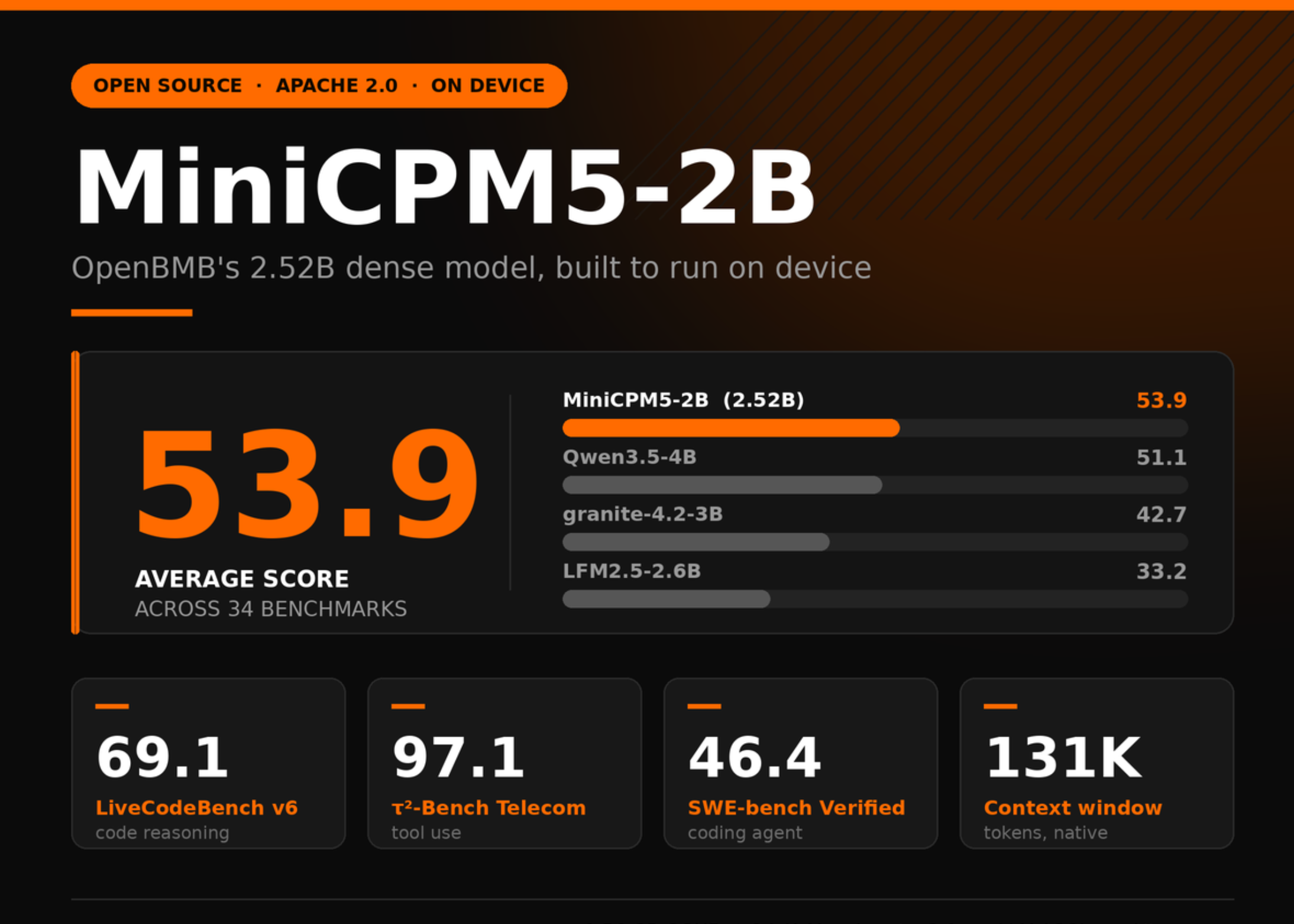
- Licensed under Apache 2.0, it is benchmarked against same-class peers such as LFM2.5-2.6B, Qwen3.5-2B, and Gemma-4-E2B-it, with references including Qwen3.5-4B (51.1), granite-4.2-3B (42.7), and LFM2.5-2.6B (33.2).
Analysis
Table of Contents
- Key Summary
- MiniCPM5-2B Architecture: Standard Llama Fork for Instant Compatibility with 8 Inference Engines
- What the 53.9 Average Across 34 Benchmarks Means for MiniCPM5-2B
- Strengths: Dominating the Baseline in Code Reasoning and Tool Use
- Trade-offs: Long-Context Variability by Benchmark and General-Knowledge Limits
- Training Pipeline: UltraData → 400B SFT → JustRL II → 16-Expert Distillation
- What to Try Right Now
- Practical Application Notes
- Frequently Asked Questions
- Reference Sources
MiniCPM5-2B debuted on September 7 with a spec sheet of 2,516,756,480 parameters and a native context window of 131,072 tokens. Its 53.9 average across 34 benchmarks is 2.8 points ahead of the best same-lineup baseline, Qwen3.5-4B at 51.1. With less than half the parameters, it posts a higher overall score. For the author, the real significance of this model lies in numerically proving that “small doesn’t mean incapable.”
MiniCPM5-2B Architecture: Standard Llama Fork for Instant Compatibility with 8 Inference Engines
MiniCPM5-2B is a dense causal language model with 42 layers and grouped-query attention (16 query heads, 2 key/value heads). Excluding embeddings, it has 1,981,982,720 parameters. The key point is that the architecture is standard LlamaForCausalLM. Eight inference engines—vLLM, SGLang, Transformers, llama.cpp, Ollama, LM Studio, MLX, and FlagOS—run it as-is, without custom kernels or model code forks. Combined with the Apache 2.0 license, this makes it one of the lowest-friction options for teams looking to deploy a 2–3B-class model in real services.
What the 53.9 Average Across 34 Benchmarks Means for MiniCPM5-2B
The single score of 53.9 alone doesn’t tell the full story. Broken down by domain, MiniCPM5-2B’s character becomes clearer. The same-class comparison set includes LFM2.5-2.6B, Qwen3.5-2B, and Gemma-4-E2B-it, while reference points include Qwen3.5-4B (51.1), granite-4.2-3B (42.7), and LFM2.5-2.6B (33.2). The overall 53.9 is the highest figure in this reference pool.
| Benchmark | MiniCPM5-2B | Best Baseline | Gap |
|---|---|---|---|
| 34-benchmark overall average | 53.9 | Qwen3.5-4B 51.1 | +2.8 |
| LiveCodeBench v6 | 69.1 | 56.4 | +12.7 |
| SWE-bench Verified | 46.4 | 33.6 | +12.8 |
| τ²-Bench Telecom | 97.1 | — | — |
| BFCL v4 | 66.6 | — | — |
| τ³-Bench Banking | 20.8 | 6.8 | +14.0 |
| NoLiMa | 68.1 | 43.5 | +24.6 |
| AA-LCR | 59.0 | 61.0 | −2.0 |
| LongBench v2 | 43.7 | 47.3 | −3.6 |
| MMLU-Pro | 70.8 | 78.0 | −7.2 |
| Humanity’s Last Exam | 8.9 | 9.9 | −1.0 |
Strengths: Dominating the Baseline in Code Reasoning and Tool Use
The largest gap is in code. MiniCPM5-2B scored 69.1 on LiveCodeBench v6 and 46.4 on SWE-bench Verified, beating the baseline of 33.6 by 12.8 points. A 2.5B model hitting 46.4 on SWE-bench means it achieves nearly a 50% success rate on tasks that go beyond simple code completion to include multi-turn debugging.
Tool use is even steeper. The τ²-Bench Telecom score of 97.1 is essentially near-perfect, and BFCL v4 at 66.6 and τ³-Bench Banking at 20.8 (baseline 6.8) also far exceed what you’d expect from a 2.5B-class model in function calling and routing. These numbers most directly demonstrate that MiniCPM5-2B is a credible candidate for real agent workloads.
Trade-offs: Long-Context Variability by Benchmark and General-Knowledge Limits
It doesn’t lead on every metric. Long-context results vary by benchmark. On NoLiMa (68.1 vs. baseline 43.5) it leads by 24.6 points, but on AA-LCR (59.0 vs. 61.0) and LongBench v2 (43.7 vs. 47.3) it actually trails. Even with a 131K-token window, there are areas where measured accuracy falls short of the baseline.
General knowledge shows a similar pattern. MMLU-Pro (70.8 vs. 78.0) and Humanity’s Last Exam (8.9 vs. 9.9) are both slightly behind. It’s natural that a model with roughly half the parameters can’t beat a 4B-class model on broad factual recall, so it’s more accurate to view MiniCPM5-2B not as an “all-rounder” but as a “coding- and agent-specialized compact model.”
Training Pipeline: UltraData → 400B SFT → JustRL II → 16-Expert Distillation
Behind these scores lies a staged training design. Base training ran in stable and decay phases using UltraData’s hierarchical data management, followed by 400B-token deep-thinking SFT after mid-training. The RL stage covered four separate domains—math, code, agentic, and writing—with a critic-based teacher called JustRL II guiding the training. The pipeline finishes with on-policy distillation that merges 16 expert models into a single checkpoint.
The model card separately labels rows from Artificial Analysis and internal reproductions, proactively flagging evaluation-consistency issues—a sign that reproducibility was a deliberate priority.
What to Try Right Now
- Download MiniCPM5-2B via Ollama or llama.cpp and measure inference latency directly on a Mac or a single RTX 3090 GPU.
- Pick 30 coding problems from your own domain, run multi-turn debugging, and compare response quality against Qwen3.5-2B and Gemma-4-E2B-it.
- Build 10 BFCL-style function-calling scenarios and re-evaluate tool-use accuracy against your in-house data.
- Stuff 50K tokens of internal documents into the 131K context and check retrieval and summarization accuracy yourself, just like NoLiMa, AA-LCR, and LongBench.
- Confirm Apache 2.0 applicability with your legal team and verify there are no licensing risks around your in-house fine-tuning data.
Practical Application Notes
- When evaluating 2–3B-class models, don’t rely on a single overall average—weight domain benchmarks like LiveCodeBench, SWE-bench, and BFCL into your scoring.
- If you’re considering MiniCPM5-2B for agent workloads, validate function-calling routing separately. Don’t assume the τ²-Bench 97.1 score generalizes to your case.
- If long context is critical, judge models on measured benchmarks like AA-LCR and LongBench rather than the 131K window size alone.
- For on-device deployment, note that the grouped-query attention’s 2 key/value head configuration keeps attention cache memory small but can lower batch throughput, so measure per scenario.
- Once licensing is cleared, the practical sequence is to stand up a first baseline with vLLM or SGLang, then bolster weak areas with JustRL II-style RL fine-tuning.
Frequently Asked Questions
Can MiniCPM5-2B be used directly in commercial projects?
The Apache 2.0 license permits both commercial use and redistribution. However, responsibility for the model’s outputs rests with the user, so it’s safer to decide on adoption after domain-specific evaluation.
A 2.5B model scores higher than Qwen3.5-4B—is it really usable?
The 53.9 average across 34 benchmarks is real. But the lead is concentrated in code and tool use, while it trails by more than 7 points on general-knowledge benchmarks like MMLU-Pro. You’ll need to re-weight the evaluation by domain.
Does MiniCPM5-2B actually run on-device?
Yes—because it’s standard LlamaForCausalLM, it runs out of the box on llama.cpp, Ollama, LM Studio, and MLX. In practice, though, it’s more realistic to use 8K–32K slices than the full 131K context on mobile.
Is there a reason to migrate from previous MiniCPM models?
Context window and code/agent scores have both been lifted compared to the previous generation. For new projects, start with MiniCPM5-2B; for existing systems, compare token usage and response latency before migrating gradually.
The original source material was verified via MarkTechPost’s MiniCPM5-2B coverage. Comparison-group information referenced the same outlet’s IFM K2 Horizon launch article.
Reference Sources
This article was written after checking the following original sources: MarkTechPost — OpenBMB Releases MiniCPM5-2B: A 2.52B Dense Model Averaging 53.9 Across 34 Benchmarks and Built to Run On Device
Leave a Reply