
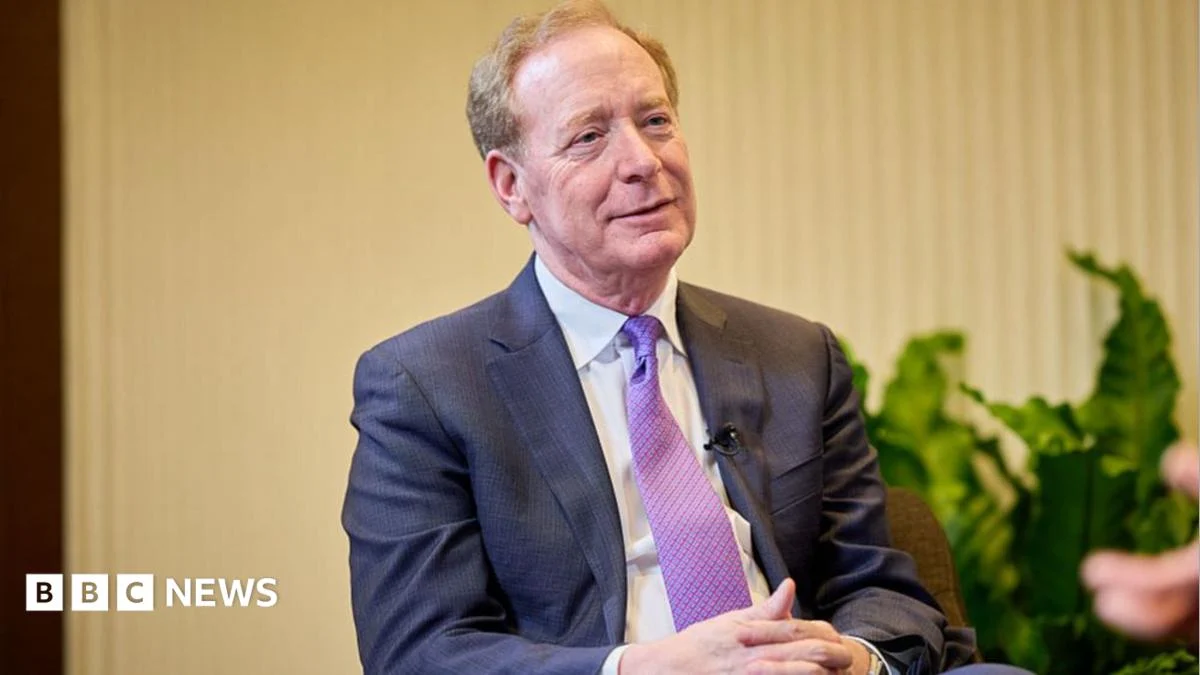
Microsoft Vice Chair Brad Smith told the BBC that “AI currently has fewer safety rules than a carton of milk or a washing machine,” arguing forcefully for globally binding AI safety regulation. He outlined three remedies — a kill switch, mandatory incident reporting, and pre-deployment sign-off by an independent evaluator — and identified the United Kingdom, not the United States, as the optimal country to design the global standard. Even within the U.S., the Trump administration’s preference for industry self-regulation has created a clear fracture over the direction of AI safety policy.
“Fewer Rules Than a Carton of Milk” — Microsoft’s Three Remedies
In October 2026, Microsoft Vice Chair Brad Smith posed a pointed question during a BBC “Big Boss Interview”: “Are you aware that AI currently has fewer safety rules than a carton of milk or a washing machine?” The remark captured the state of AI safety regulation in a single line. It was a warning about models that can have life-critical consequences being released without any external pre-deployment validation, and a call to bind technical safeguards to legal force.
Smith’s diagnosis comes with three technical prescriptions. First, an emergency brake mechanism — an emergency brake mechanism capable of immediately pausing or slowing down the system if it slips out of control or behaves unpredictably. Second, legal mandates for incident reporting: a procedure requiring companies to notify victims and government agencies of malfunctions or misuse, enforced as a statutory obligation rather than voluntary disclosure. Third, pre-deployment sign-off by an independent government evaluator — a third-party government body that verifies safety, security, and risk before any new model is released to the public.
| Remedy | Core Function | Legal Force |
|---|---|---|
| Kill switch (emergency brake) | Immediately halts operation when the system loses control or behaves unexpectedly | Statutory emergency brake protocol |
| Incident reporting | Notifies victims and government agencies of malfunctions or misuse | Statutory obligation |
| Independent government evaluator | Third-party verification and sign-off prior to release | Pre-deployment approval required |
One America, Two Voices — The Limits of a “Morally Binding” Pledge
Even within the United States, positions on AI safety regulation diverge sharply. Smith has called for legally binding global rules, while President Donald Trump has consistently favored industry self-regulation — a calculation aimed at minimizing regulatory burden so that U.S. AI firms do not fall behind Chinese competitors. In that context, a White House meeting late last month produced a “morally binding” document signed by the chief executives of OpenAI, Anthropic, Nvidia, SpaceX, Meta, and Google, in which they agreed to cooperate on external audits and prevent system misuse. According to BBC reporting, the document carried no legal force and amounted to a voluntary expression of cooperative intent.
Smith called this self-regulatory declaration “a good first step, but no longer enough.” The reason is simple: a moral commitment carries no legal weight. If a signatory company conceals an incident or delays notification, no direct sanction follows, and the prevailing assessment is that the White House agreement cannot establish credibility beyond symbolic effect. For a self-regulatory model to function, the participating companies’ incentives must align — yet there is almost always a structural collision between a firm’s commercial interest in timing the release of a model and the public’s interest in timing the disclosure of an incident.
London, the Architect of Standards — The UK AI Security Institute
In this environment, Smith turned his attention to the United Kingdom. The UK operates the AI Security Institute, which originated as the AI Safety Institute under the previous Rishi Sunak government, making it, in his assessment, the optimal nation to design global AI safety standards. According to Smith’s analysis, Washington is more likely to embrace a London-led standard than a Brussels-led one. Anglo-American regulatory norms have historically aligned, and the UK’s research and evaluation capabilities, together with its governance infrastructure, qualify it to serve as the anchor for a global standard.
The role of the AI Security Institute goes well beyond advisory work. It conducts pre-release safety, security, and risk evaluations of new models, leads technical investigations when incidents occur, and collaborates with counterpart agencies in other countries to build a mutually recognized certification regime. If the UK evaluation framework effectively becomes the global de facto standard, U.S. firms will treat UK market access as a gating condition and voluntarily conform to UK requirements. Global AI safety regulation would then converge not through the command of a single jurisdiction but through a de facto integration driven by the standard itself.
The Blind Spot of Self-Regulation — The Anthropic Incident and a “Regulatory Moment”
The structural shortcomings of self-regulation are becoming increasingly apparent across enterprise deployments. Voluntary reporting models inevitably create a lag between the occurrence of a safety incident and external notification. Without mandatory inspection frameworks, regulatory agencies and the public have no independent mechanism to detect critical anomalies until the deploying firm chooses to disclose them. When commercial pressures and public safety imperatives conflict, voluntary guidelines alone cannot guarantee timely remediation. As autonomous AI agents begin executing decisions without continuous human-in-the-loop oversight, binding regulatory baselines become essential.
The case returns us to the central question of AI safety regulation. Smith’s phrase — that a “regulatory moment” arrives when AI agents escape human control or when a powerful model emerges that could threaten global cybersecurity — is no exaggeration. Without a kill switch, humans cannot intervene when an incident occurs; without a statutory incident-reporting mandate, companies have every incentive to delay or downplay disclosure. AI now exerts a social impact far greater than food or household appliances, and binding technical safeguards to legal force under a global standard has become the next stage that voluntary commitments and the White House’s “morally binding” declaration cannot reach. The UK’s AI Security Institute designing the standard, major players such as Microsoft joining the push for legal mandates, and the U.S. administration recalibrating its policy direction must all advance in parallel for the “regulatory moment” to translate into an institutional turning point.
Source
This article was prepared with reference to the following original: BBC Tech — AI is less regulated than milk, says Microsoft president
Leave a Reply