
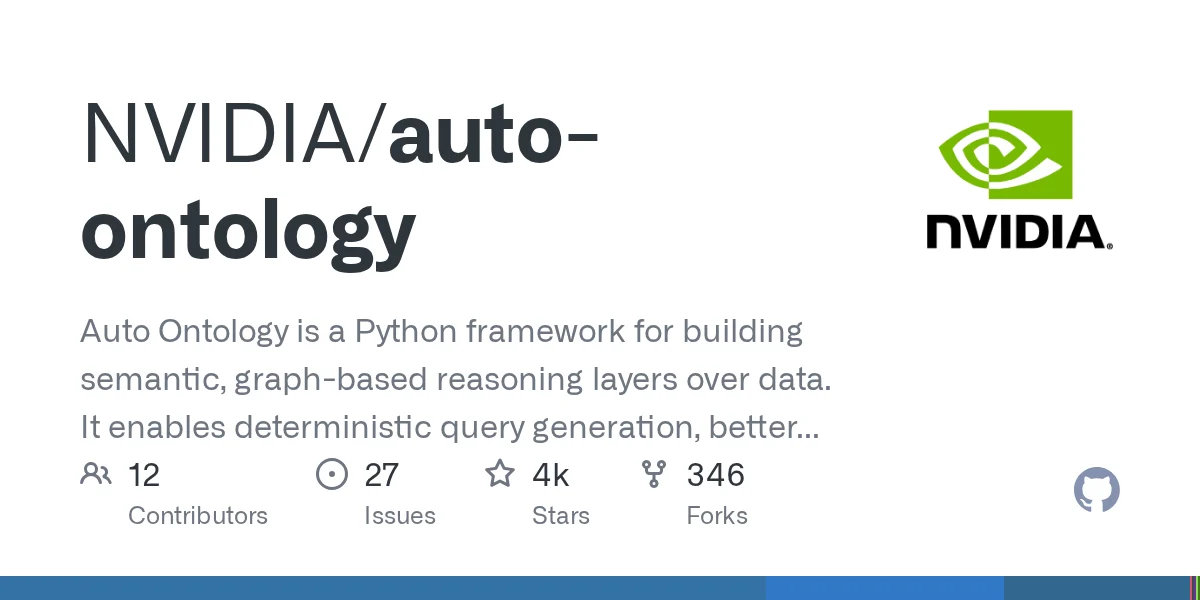
In the GitHub Trending daily ranking collected on November 5, 2026, NVIDIA/auto-ontology, JiaFeiMiao-K-Cat/DiscImageStudio, and thedotmack/claude-mem had the largest increases in stars that day. NVIDIA/auto-ontology builds a graph-based reasoning layer over enterprise data, DiscImageStudio creates images for optical discs, and claude-mem uses AI to compress an agent’s tool usage history and inject the relevant context into the next session. These three GitHub trends cover different areas of development, but all provide a clear workflow and verification steps based on their READMEs.
NVIDIA/auto-ontology: An ontology for enterprise data meanings and relationships
NVIDIA/auto-ontology is a Python framework that builds a semantic graph reasoning layer over databases and documents. It runs as a service beside a database so agents can reference definitions of business terms, availability, sources, and similar relationships as well as the location of data.
- It generates an ontology from database metadata and imports existing semantic models for exploration through a semantic graph.
- It maps a single business concept to tables and database columns to standardize definitions.
- Definitions can be reviewed, edited, and approved through a web UI or API.
- It checks in advance whether a question can be answered and returns the SQL and agent execution steps with the answer.
This repository is suited to data teams and developers whose AI agents need to apply approved metrics and table relationships when querying operational databases. It gained 2,053 stars today and has 4,093 stars in total, with Python as its primary language.
DiscImageStudio: Creating and burning images for optical disc constraints
JiaFeiMiao-K-Cat/DiscImageStudio is a cross-platform tool that converts images into data that meets the physical constraints of CDs, DVDs, and single-layer BD-R media so they can be burned to optical discs. Executables are available directly for Windows, while an experimental CLI distribution package for compatible CPUs is provided for Linux and macOS.
- It creates CD, DVD, and single-layer BD-R projects and edits disc images as layers.
- After previewing the disc projection, it exports ISO, RAW, and WAV+CUE formats or burns them directly to an empty disc.
- It supports WAV audio tracks and CUE files or RAW tracks for CDs, and ISO images for DVDs.
- It supports still images and UDF 2.01 files for 25 GB single-layer BD-R media.
It is designed for developers who create visual designs for CDs, DVDs, and single-layer BD-R media in environments with optical drives, or who burn them directly to test discs. Auxiliary calibration and a triple-track pitch model improve the precision of verifiable physical data, and it appears important to preserve fair comparison conditions when assessing accuracy improvements. It gained 1,792 stars today and has 6,146 stars in total, with C# as its primary language. Because direct burning is an experimental feature, developers must follow the guidance to use only readable test media.
claude-mem: Turning agent history into context for the next session
thedotmack/claude-mem is a persistent memory system that automatically collects observations of tool use during a session, generates AI-based semantic summaries, and injects the relevant context into later sessions. Its purpose is to maintain continuity in project knowledge after a session ends or reconnects.
- It automatically collects observations of an agent’s tool use as records.
- It compresses the collected records into semantic summaries.
- It provides relevant context from past sessions for the next task.
- It supports Claude Code, OpenClaw, Codex, Gemini, Hermes, Copilot, OpenCode, and other environments.
It is relevant to developers using AI coding tools and long-running agent teams that need to carry earlier decisions, bug fixes, security alerts, and sensitive observations into the next task. It gained 1,165 stars today and has 112,534 stars in total, with TypeScript as its primary language. Records covering decisions, bug fixes, security alerts, and sensitive observations are preserved in a format that displays their dates and types.
| Repository | Primary language | Stars gained today | Total stars | One-line purpose |
|---|---|---|---|---|
| NVIDIA/auto-ontology | Python | 2,053 | 4,093 | Manage enterprise data meanings and relationships through an ontology |
| JiaFeiMiao-K-Cat/DiscImageStudio | C# | 1,792 | 6,146 | Create images for CDs, DVDs, and single-layer BD-R media and burn them directly |
| thedotmack/claude-mem | TypeScript | 1,165 | 112,534 | Summarize tool usage records and inject them into later sessions |
NVIDIA/auto-ontology fits database-based agents that need semantic definitions and validation, DiscImageStudio supports optical media production, and claude-mem preserves development context across sessions. As the repository instructions specify, direct burning should be treated as an experimental feature and applied only to disposable test media.
Sources
This article was prepared after checking the following sources: GitHub Trending, GitHub Trending 2026-11-05: auto-ontology, DiscImageStudio, claude-mem
Cross-checked sources:
Leave a Reply