
Key Takeaways
- AMD has announced it will acquire World Labs, an AI research lab launched in 2024, for approximately $8.2 billion in an all-stock transaction.
- World Labs is an AI startup that reached a $1 billion valuation within months of its 2024 founding, and its co-founder is AI luminary Dr. Fei-Fei Li.
- World Labs launched Marble, a world-generation model that creates interactive 3D worlds from prompts alone, as its first commercial product in 2025.
Analysis
Table of Contents
- Key Takeaways
- The World Labs Acquisition Target: Who They Are
- Structure of the AMD–World Labs Deal
- Where Does Fei-Fei Li Sit?
- How Does It Differ from Nvidia and Big Tech?
- AMD’s Place in the Full-Stack Competitive Landscape
- Unresolved Issues
- Follow-Up Indicators to Watch in 2026
- Key Issues Recap
- What to Do Right Now
- Frequently Asked Questions
- Reference Source
The AMD World Labs acquisition has been officially announced at $8.2 billion. AMD has officially revealed that it will absorb World Labs—an AI research company co-founded in 2024 by AI luminary Dr. Fei-Fei Li—through an all-stock transaction. This is more than a simple startup M&A; it is AMD’s all-out bet to seize the initiative in the post-LLM, next-generation model war.
What I find most significant at this point is the nature of the deal. The $8.2 billion price tag is a declaration that AMD intends to fold in software and model capabilities simultaneously, even as it goes head-to-head with Nvidia through the MI300 and MI325 accelerator lineup.
The World Labs Acquisition Target: Who They Are
World Labs is an AI startup that reached a $1 billion valuation within just a few months of its 2024 founding. Co-founder Dr. Fei-Fei Li is the researcher who launched the era of computer vision with ImageNet, making her one of the most influential voices in academic AI.
In 2025, World Labs introduced Marble, a model that generates interactive 3D worlds from text prompts alone, as its first commercial product. If LLMs generate text, Marble generates space. Its applications span gaming, simulation, and robotics training data.
Structure of the AMD–World Labs Deal
This AMD World Labs acquisition is being executed as an all-stock transaction. New AMD shares will be issued to World Labs shareholders with no cash burden. The deal is expected to close by the end of 2026.
The rationale for choosing stock over cash is clear. AMD is already pouring massive amounts of capital into the MI350 and MI400 roadmap and HBM memory procurement. If M&A consideration were also paid in cash, the balance sheet would wobble. Leveraging its own share price is the safer financial route.
Where Does Fei-Fei Li Sit?
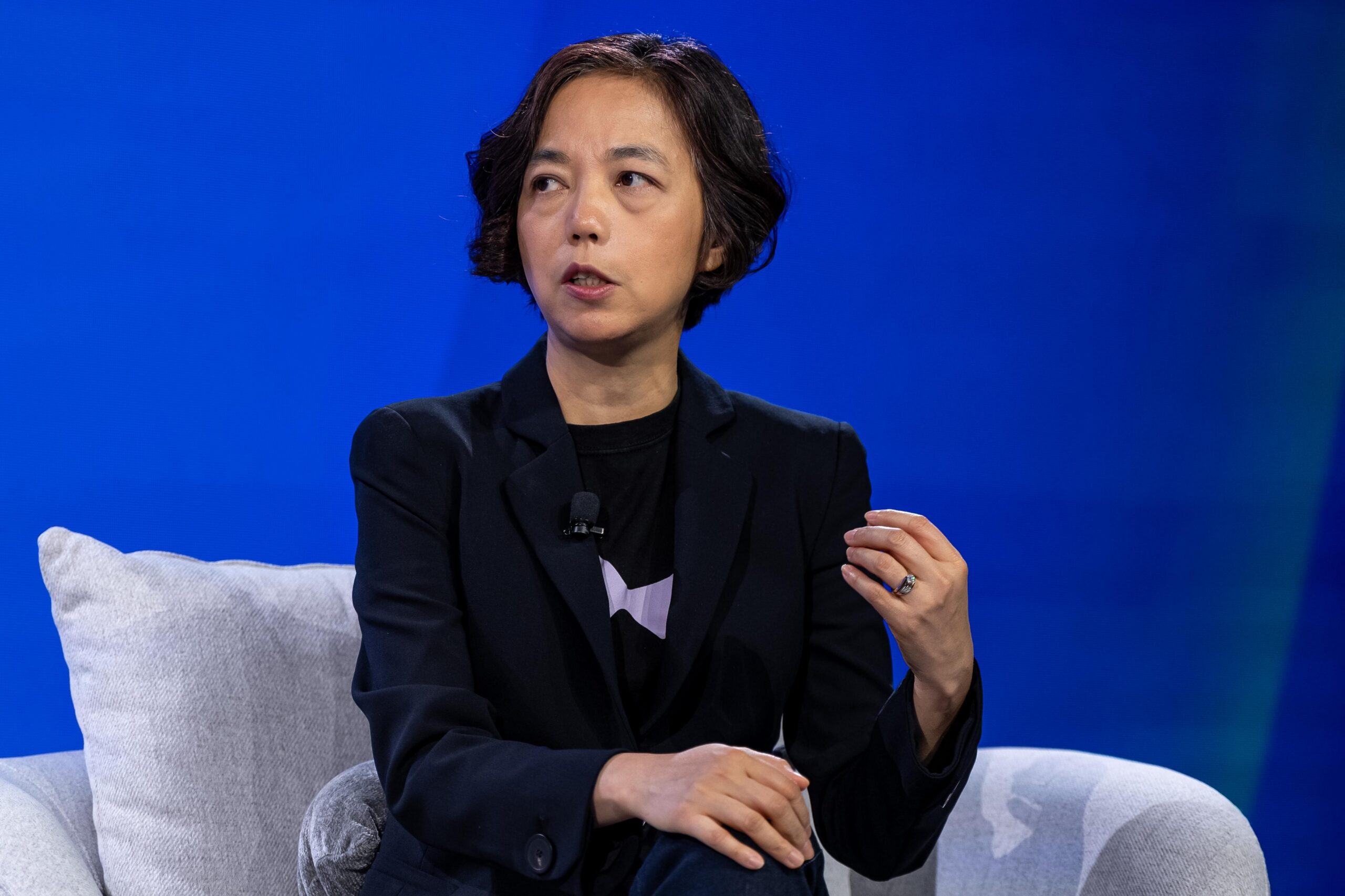
World Labs founder Fei-Fei Li joins AMD as Executive Vice President (EVP) and Chief Scientist. She reports directly to AMD CEO Lisa Su. This is a different pattern from the common one in which founders stay on as CEOs of acquired subsidiaries.
Two things are implied by this arrangement. World Labs is being absorbed into the parent company’s R&D axis rather than remaining an independent subsidiary. And Fei-Fei Li’s academic network is highly likely to be leveraged across AMD’s broader AI strategy. In her own Substack, Li stated, “Just as I decided to start a company to accelerate work on foundation models that go beyond LLMs, continuing World Labs’ mission within AMD is the clear path forward.”
How Does It Differ from Nvidia and Big Tech?
Placing the AMD World Labs acquisition alongside Nvidia’s and Big Tech’s M&A patterns makes the differences stark.
| Category | AMD | Nvidia | Big Tech Average |
|---|---|---|---|
| Recent Major M&A | World Labs, $8.2B | Infrastructure and networking focused | Primarily internal R&D |
| Research Talent Recruitment | Founder appointed as EVP | Industry practitioner retention model | In-house lab absorption |
| Model–Hardware Coupling | In-house world-generation model | Strong software stack | Software-first |
| Form of Consideration | All-stock | Mixed | Mostly cash |
As the table shows, the AMD World Labs acquisition differs from typical acquisitions in that it places an AI research figure at the very center of the company. It is not simply a matter of acquiring technology IP, but of bringing in the person’s entire sphere of influence.
AMD’s Place in the Full-Stack Competitive Landscape
Until now, AMD has been evaluated as strong on MI series accelerator hardware but lacking in the software ecosystem and proprietary foundation models needed to rival CUDA. From the MI300X and MI325X to the upcoming MI350, the lineup is on par with Nvidia’s H100 and B200, but it has lagged a step behind in developer-friendliness.
With the World Labs acquisition, AMD secures model IP in “spatial reasoning,” a category that goes beyond LLMs. World-generation models like Marble demand enormous compute at inference time. This is a so-called “model-to-hardware lock-in” strategy that naturally channels demand toward MI accelerators. From a practitioner’s perspective, what stands out is how rapidly AMD is transforming from a mere chip vendor into a company that owns responsibility for models and software as well.
Unresolved Issues
The risks are clear. The first is how much research autonomy AMD will guarantee to the World Labs team. The company has announced that it will “continue to focus on pushing the frontier of AI model research,” but how reality changes inside a large corporation remains to be seen.
The $8.2 billion valuation is also questionable. World Labs is a startup in its first year, and aside from Marble, it does not yet have a sufficient, validated product pipeline. Shareholder and regulatory approvals are additional variables.
Third is the risk of talent outflow. If research velocity slows inside AMD, key personnel could move to competitors like OpenAI or Anthropic. Competition to secure AI talent is now spreading across the entire globe.
Follow-Up Indicators to Watch in 2026
There are three main indicators to monitor in the market following the AMD World Labs acquisition: MI accelerator shipment volumes and AMD data center revenue trends, the number of Marble’s commercial customers, and the research output Fei-Fei Li directly announces. If all three move up together, the full-stack AI strategy is effectively working.
Conversely, if accelerator revenue stagnates while Marble’s sales also fall short of expectations, the $8.2 billion acquisition will weigh on AMD. While Nvidia maintains dominance in the GPU market, how quickly AMD can productize world-generation models will be the variable in next year’s competition. The real contest for the AMD World Labs acquisition starts now.
Key Issues Recap
- The AMD World Labs acquisition is an $8.2 billion all-stock transaction, with Dr. Fei-Fei Li joining as EVP and Chief Scientist in a direct-report line to CEO Lisa Su.
- The world-generation model Marble targets the post-LLM, next-generation model category, and is designed to drive model-to-hardware lock-in that naturally funnels into MI accelerator demand.
- The all-stock structure preserved AMD’s cash flow while promising research autonomy, but the actual extent of that autonomy remains unknown.
- The $8.2 billion valuation, shareholder and regulatory approvals, and the risk of key talent departures are the main risks carried by the AMD World Labs acquisition.
What to Do Right Now
- Review the original Verge report on the AMD–World Labs deal and compare the deal terms yourself.
- Search AMD IR materials to find out which workloads make Marble prefer MI accelerators.
- Compile a side-by-side list of Nvidia’s recent M&A activity to understand the texture of the AMD World Labs acquisition within full-stack competition.
- Follow Fei-Fei Li’s Substack and X accounts to track changes in her research roadmap after joining AMD.
- Build a checklist to track the share of MI accelerator revenue and R&D cost increases in AMD’s quarterly earnings releases.
Frequently Asked Questions
What are the size and structure of the AMD World Labs acquisition?
It is approximately $8.2 billion and is being executed as an all-stock transaction. New AMD shares are issued with no cash burden, and the deal is expected to close by the end of 2026.
What is Marble, World Labs’ first product?
Marble, released in 2025, is a world-generation model that creates interactive 3D worlds from text prompts alone. Its applications span gaming, robotics simulation, and media production.
What role will Fei-Fei Li take on at AMD?
She joins as EVP and Chief Scientist, reporting directly to AMD CEO Lisa Su. She will lead the World Labs team while also being involved in AMD’s broader AI strategy.
What impact will this acquisition have on Nvidia and the AI infrastructure market?
If AMD formalizes a lock-in strategy that bundles world-generation models with its accelerators, an alternative narrative to Nvidia’s CUDA ecosystem could emerge. However, it will take time before this translates into near-term revenue.
Reference Source
This article was written with reference to the following original: The Verge — AMD is acquiring AI company World Labs in a deal worth more than $8 billion
Expert Commentary (AI)
Semiconductor Industry Strategist
From chip vendor to model company — the direction of vertical expansion is right, but the value case for $8.2B is still thin
AMD’s choice to move beyond hardware specification competition in the MI series and descend into the model and software layers directly targets the structural weakness that the ROCm ecosystem continues to trail CUDA, so the direction itself aligns with industry logic. Because world-generation models produce inference workloads far heavier than LLMs, building proprietary models is a “workload lock-in” structure where model control directly translates into accelerator demand control—essentially the same game Nvidia has played with CUDA-based software, answered with a different ingredient. The problem is price. Paying $8.2 billion for an organization that is only one to two years old and has a single commercial product amounts to a scarcity premium on a frontier research talent pool rather than a technology asset, and because the deal is all-stock, the dilution of existing shareholders and the burden of defending the share price at the time of issuance are passed on directly. The regulatory review timeline and the post-lockup departure of key personnel will determine the realized value, and only if MI350 and MI400 cycle data center revenue and Marble commercialization grow together will this deal remain an “investment”; otherwise, it will end up as a costly research expense.
AI Research & World Model Specialist
Spatial intelligence is genuinely the next competitive axis, but the success of this deal hinges not on technology but on whether the research culture survives
The shift from text and multimodal generation to 3D spatial generation is a leading view shared by both academia and industry, and because it can simultaneously target robotics simulation, game content creation, and the shortage of synthetic training data, the industrial direction of world models is sound. The true asset of such an organization is not a single product but its spatial intelligence fundamental research personnel and experimental culture, and there is a repeated history in which frontier research organizations, when absorbed into a large corporation’s core R&D, see their publication speed and free exploration reduced and their output collapse sharply. Appointing the founder as EVP and Chief Scientist reporting directly to the CEO is a strong contractual signal of talent retention, but integrating into the parent rather than isolating as an independent subsidiary carries the risk that research priorities become subordinate to product launch schedules. Technically, it also takes months to years of joint optimization work for a world-generation model to become co-optimized for a specific accelerator architecture, so near-term revenue carry-through effects should not be expected. Over the next 12 to 18 months, the public release cadence of Marble’s successor models and whether AMD discloses MI architecture optimization checkpoints will be the first indicator of whether research autonomy is actually being preserved.
Critical Analyst
The form of consideration is the real statement of this deal — start by reading backward from the reason stock, not cash, was used
The surface narrative is a “full-stack AI bet,” but if you first map out the cui bono, the primary beneficiaries are World Labs’ shareholders and executives who receive AMD shares worth $8.2 billion, while AMD has effectively purchased an “anti-Nvidia” narrative for the market at the cost of share dilution. The all-stock structure can simultaneously be read as a sample of an officially unspoken financial situation, in which cash is already tied up in HBM prepayments and the MI350 and MI400 production lines. The unusual arrangement of seating the founder not as subsidiary CEO but as parent-level EVP and Chief Scientist reporting directly to the CEO is more likely a trust mechanism aimed at the investor and talent markets than an operational efficiency decision, and such terms typically appear in competitive bidding situations. The timing of the announcement with a long lead time to close can be interpreted as a defensive first move to block the possibility of Nvidia or Big Tech reaching this team first. Ultimately, what we should really be watching is not whether World Labs’ mission survives inside AMD, but how well the AMD share price—now carrying newly issued shares—holds up through the next earnings cycle.
Back-Channel Scenarios
- It is possible that World Labs had already received investment or recruitment overtures from Nvidia or Big Tech, and AMD stepped in first with top-tier terms such as an all-stock transaction and a founder-level EVP appointment — the unusual founder-direct-appointment condition that breaks conventional M&A practice is a hallmark that typically appears in competitive situations.
- A significant portion of the $8.2 billion valuation may be composed not of a technology premium but of staged-lockup talent retention packages, and if the breakdown of employment incentives versus acquisition consideration is disclosed separately in related filings, the actual “team value” could appear smaller than the headline figure.
Leave a Reply