Key Takeaways
- AMD has announced it will acquire World Labs, an AI research lab launched in 2024, for approximately $8.2 billion in an all-stock transaction.
- World Labs is an AI startup that reached a $1 billion valuation within months of its 2024 founding, and its co-founder is AI luminary Dr. Fei-Fei Li.
- World Labs launched Marble, a world-generation model that creates interactive 3D worlds from prompts alone, as its first commercial product in 2025.
Analysis
Table of Contents
The AMD World Labs acquisition has been officially announced at $8.2 billion. AMD has officially revealed that it will absorb World Labs—an AI research company co-founded in 2024 by AI luminary Dr. Fei-Fei Li—through an all-stock transaction. This is more than a simple startup M&A; it is AMD’s all-out bet to seize the initiative in the post-LLM, next-generation model war.
What I find most significant at this point is the nature of the deal. The $8.2 billion price tag is a declaration that AMD intends to fold in software and model capabilities simultaneously, even as it goes head-to-head with Nvidia through the MI300 and MI325 accelerator lineup.
The World Labs Acquisition Target: Who They Are
World Labs is an AI startup that reached a $1 billion valuation within just a few months of its 2024 founding. Co-founder Dr. Fei-Fei Li is the researcher who launched the era of computer vision with ImageNet, making her one of the most influential voices in academic AI.
In 2025, World Labs introduced Marble, a model that generates interactive 3D worlds from text prompts alone, as its first commercial product. If LLMs generate text, Marble generates space. Its applications span gaming, simulation, and robotics training data.
Structure of the AMD–World Labs Deal
This AMD World Labs acquisition is being executed as an all-stock transaction. New AMD shares will be issued to World Labs shareholders with no cash burden. The deal is expected to close by the end of 2026.
The rationale for choosing stock over cash is clear. AMD is already pouring massive amounts of capital into the MI350 and MI400 roadmap and HBM memory procurement. If M&A consideration were also paid in cash, the balance sheet would wobble. Leveraging its own share price is the safer financial route.
Where Does Fei-Fei Li Sit?
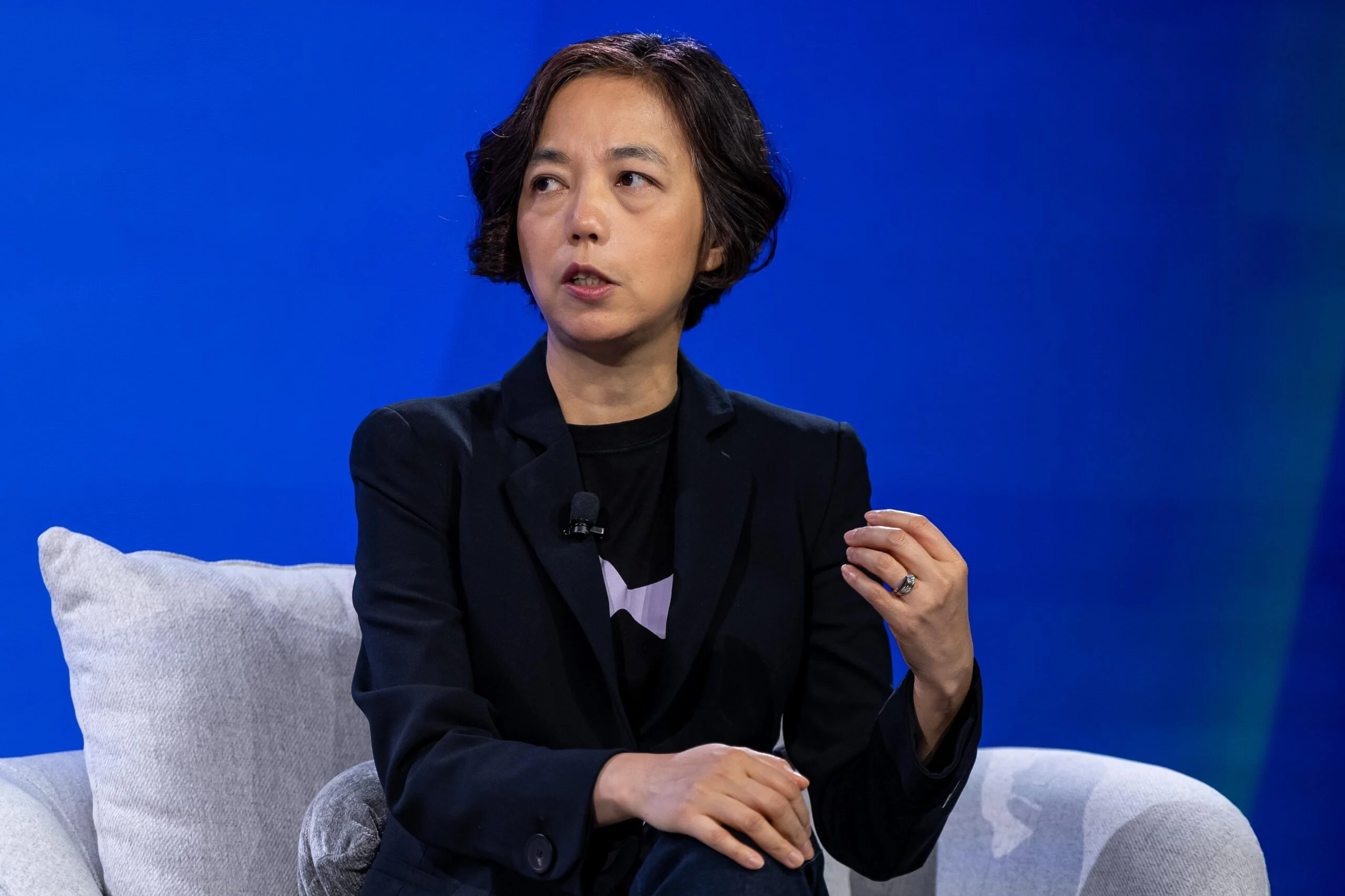
World Labs founder Fei-Fei Li joins AMD as Executive Vice President (EVP) and Chief Scientist. She reports directly to AMD CEO Lisa Su. This is a different pattern from the common one in which founders stay on as CEOs of acquired subsidiaries.
Two things are implied by this arrangement. World Labs is being absorbed into the parent company’s R&D axis rather than remaining an independent subsidiary. And Fei-Fei Li’s academic network is highly likely to be leveraged across AMD’s broader AI strategy. In her own Substack, Li stated, “Just as I decided to start a company to accelerate work on foundation models that go beyond LLMs, continuing World Labs’ mission within AMD is the clear path forward.”
How Does It Differ from Nvidia and Big Tech?
Placing the AMD World Labs acquisition alongside Nvidia’s and Big Tech’s M&A patterns makes the differences stark.
| Category | AMD | Nvidia | Big Tech Average |
|---|---|---|---|
| Recent Major M&A | World Labs, $8.2B | Infrastructure and networking focused | Primarily internal R&D |
| Research Talent Recruitment | Founder appointed as EVP | Industry practitioner retention model | In-house lab absorption |
| Model–Hardware Coupling | In-house world-generation model | Strong software stack | Software-first |
| Form of Consideration | All-stock | Mixed | Mostly cash |
As the table shows, the AMD World Labs acquisition differs from typical acquisitions in that it places an AI research figure at the very center of the company. It is not simply a matter of acquiring technology IP, but of bringing in the person’s entire sphere of influence.
AMD’s Place in the Full-Stack Competitive Landscape
Until now, AMD has been evaluated as strong on MI series accelerator hardware but lacking in the software ecosystem and proprietary foundation models needed to rival CUDA. From the MI300X and MI325X to the upcoming MI350, the lineup is on par with Nvidia’s H100 and B200, but it has lagged a step behind in developer-friendliness.
With the World Labs acquisition, AMD secures model IP in “spatial reasoning,” a category that goes beyond LLMs. World-generation models like Marble demand enormous compute at inference time. This is a so-called “model-to-hardware lock-in” strategy that naturally channels demand toward MI accelerators. From a practitioner’s perspective, what stands out is how rapidly AMD is transforming from a mere chip vendor into a company that owns responsibility for models and software as well.
Unresolved Issues
The risks are clear. The first is how much research autonomy AMD will guarantee to the World Labs team. The company has announced that it will “continue to focus on pushing the frontier of AI model research,” but how reality changes inside a large corporation remains to be seen.
The $8.2 billion valuation is also questionable. World Labs is a startup in its first year, and aside from Marble, it does not yet have a sufficient, validated product pipeline. Shareholder and regulatory approvals are additional variables.
Third is the risk of talent outflow. If research velocity slows inside AMD, key personnel could move to competitors like OpenAI or Anthropic. Competition to secure AI talent is now spreading across the entire globe.
Follow-Up Indicators to Watch in 2026
There are three main indicators to monitor in the market following the AMD World Labs acquisition: MI accelerator shipment volumes and AMD data center revenue trends, the number of Marble’s commercial customers, and the research output Fei-Fei Li directly announces. If all three move up together, the full-stack AI strategy is effectively working.
Conversely, if accelerator revenue stagnates while Marble’s sales also fall short of expectations, the $8.2 billion acquisition will weigh on AMD. While Nvidia maintains dominance in the GPU market, how quickly AMD can productize world-generation models will be the variable in next year’s competition. The real contest for the AMD World Labs acquisition starts now.
Key Issues Recap
- The AMD World Labs acquisition is an $8.2 billion all-stock transaction, with Dr. Fei-Fei Li joining as EVP and Chief Scientist in a direct-report line to CEO Lisa Su.
- The world-generation model Marble targets the post-LLM, next-generation model category, and is designed to drive model-to-hardware lock-in that naturally funnels into MI accelerator demand.
- The all-stock structure preserved AMD’s cash flow while promising research autonomy, but the actual extent of that autonomy remains unknown.
- The $8.2 billion valuation, shareholder and regulatory approvals, and the risk of key talent departures are the main risks carried by the AMD World Labs acquisition.
What to Do Right Now
- Review the original Verge report on the AMD–World Labs deal and compare the deal terms yourself.
- Search AMD IR materials to find out which workloads make Marble prefer MI accelerators.
- Compile a side-by-side list of Nvidia’s recent M&A activity to understand the texture of the AMD World Labs acquisition within full-stack competition.
- Follow Fei-Fei Li’s Substack and X accounts to track changes in her research roadmap after joining AMD.
- Build a checklist to track the share of MI accelerator revenue and R&D cost increases in AMD’s quarterly earnings releases.
Frequently Asked Questions
What are the size and structure of the AMD World Labs acquisition?
It is approximately $8.2 billion and is being executed as an all-stock transaction. New AMD shares are issued with no cash burden, and the deal is expected to close by the end of 2026.
What is Marble, World Labs’ first product?
Marble, released in 2025, is a world-generation model that creates interactive 3D worlds from text prompts alone. Its applications span gaming, robotics simulation, and media production.
What role will Fei-Fei Li take on at AMD?
She joins as EVP and Chief Scientist, reporting directly to AMD CEO Lisa Su. She will lead the World Labs team while also being involved in AMD’s broader AI strategy.
What impact will this acquisition have on Nvidia and the AI infrastructure market?
If AMD formalizes a lock-in strategy that bundles world-generation models with its accelerators, an alternative narrative to Nvidia’s CUDA ecosystem could emerge. However, it will take time before this translates into near-term revenue.
Reference Source
This article was written with reference to the following original: The Verge — AMD is acquiring AI company World Labs in a deal worth more than $8 billion