
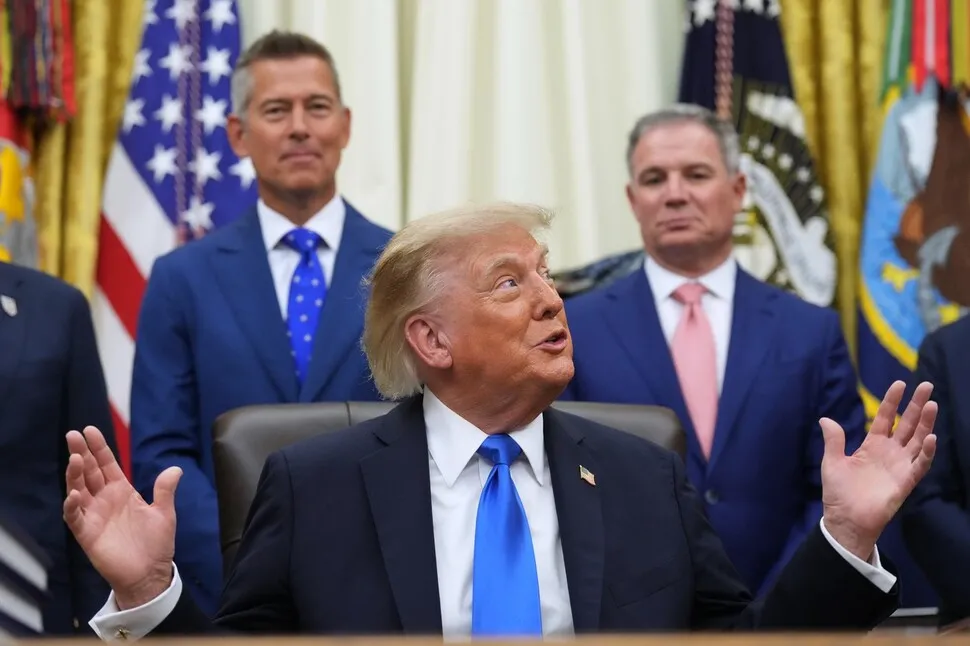
Key Summary
- On the 2nd (local time), President Trump said in the White House Oval Office that a renewed Iranian attack “won’t last very long,” warning that additional strikes are ready, citing claims that Iran is rebuilding its radar, missile, and mine capabilities in the Strait of Hormuz area.
- President Trump posted on Truth Social, “How about renaming the Strait of Hormuz the Trump Strait?” but when a reporter asked whether he was pursuing the renaming, he drew the line, calling it “just something I threw out there.”
- Reuters reported that senior White House aides are pursuing a plan to keep conflict with Iran at a “relatively limited level” before the November 3 midterm elections, and that Vice President JD Vance and Secretary of State Marco Rubio have reportedly agreed.
Analysis — The structure of policy inconsistency revealed by public hawkish rhetoric and the White House’s internally election-driven strategy
Table of Contents
- Key Summary
- The Strait of Hormuz Threat and Trump’s Iran Rhetoric
- Inside the White House, November 3 Comes First
- What “I Am Not Running” Means in Trump’s Iran Policy
- Information Warfare — Calls for Uprising and Hints of CIA Deployment
- Where the Two Speeds Meet, and the Variables Ahead
- Summary of Key Issues
- What to Do Right Now
- Frequently Asked Questions
- Reference Source
Trump’s Iran policy is moving at two different speeds with two months to go before the November 3 midterm elections. The rhetoric coming from the Oval Office says “additional strikes at any time,” while the internal current is “relatively limited level.” This gap is the essence of Trump’s Iran policy right now.
The Strait of Hormuz Threat and Trump’s Iran Rhetoric
On the 2nd (local time), President Trump publicly warned that Iran is rebuilding its radar, missile, and mine capabilities in the Strait of Hormuz area. He added that a renewed Iranian attack “won’t last very long.” On the same day, a post appeared on Truth Social reading, “How about renaming the Strait of Hormuz the Trump Strait?”
However, when a reporter asked whether he was pursuing the renaming, the President drew the line, calling it “just something I threw out there.” This, in my view, is the most meaningful signal. He personally revealed the distance between threat rhetoric and actual policy operation. That distance is exactly the size of the negotiating leverage Trump’s Iran policy currently holds.
Inside the White House, November 3 Comes First
Reuters reported that senior White House aides are pushing to keep conflict with Iran at a “relatively limited level” before the November 3 midterm elections. Vice President JD Vance and Secretary of State Marco Rubio have reportedly agreed. One White House official clearly stated, “We are continuing pressure on Iran,” but added, “November is the priority.”
What stands out from an operational standpoint is that the speakers and the policy decision-makers are different. The President moves public opinion with hawkish rhetoric, while the administrative and military lines are tied to the election calendar. These two currents do not collide because they are bound by the shared agreement to “continue the pressure.”
What “I Am Not Running” Means in Trump’s Iran Policy
President Trump flatly denied the interpretation that the midterm elections influence his Iran policy. His phrasing was, “I am not running; my party is.” He added that the principle of not permitting Iran to possess nuclear weapons is a consensus across the entire Republican Party. In other words, he deliberately asserted policy continuity.
With the Republican Party under pressure to defend its majorities in both chambers, the Iran policy has become a litmus test of the party’s overall identity. Hawkish rhetoric appeals to voters, while limited conflict prevents accidental escalation. The danger begins when this balance within Trump’s Iran policy is disturbed.
Information Warfare — Calls for Uprising and Hints of CIA Deployment
President Trump posted on Truth Social directly calling for an uprising among the Iranian people. On the possibility of CIA deployment, he sidestepped, saying, “I want to tell you, but it’s not appropriate,” while diagnosing, “That regime is getting weaker by the day.” This is the second layer of Iran policy, running psychological and information warfare alongside military pressure.
Where the Two Speeds Meet, and the Variables Ahead
If Iran nuclear negotiations make progress, the public rhetoric could be dialed back. Conversely, if an actual maritime clash occurs in the Strait of Hormuz, the internal agreement on a “limited level” will immediately dissolve. Both variables must be watched simultaneously.
The two speeds of Trump’s Iran policy are no accident. Hawkish rhetoric serves public opinion and negotiating leverage, while limited conflict serves to prevent accidental escalation. The point at which this balance breaks will first signal itself through the actual situation in the Strait of Hormuz and shifts in the Republican Party’s election strategy. For a more detailed sequence of statements, you can check the original Hankyoreh article. For a longer look at where this stretch of policy began, it may be worth reading the prior phase, U.S.-Iran Airstrike Second Wave Record, alongside it.
Summary of Key Issues
- Official hawkish rhetoric vs. internally limited conflict operations — how the two-speed policy structure is maintained
- Freedom of navigation in the Strait of Hormuz — U.S. verification of Iran’s claimed capability rebuild and the gap in public information
- Policy consistency before and after the midterm elections — whether the Republican consensus on the Iran posture will hold after the election
What to Do Right Now
- Check official U.S. Department of Defense and Navy press releases on the Strait of Hormuz daily
- Cross-verify signs of progress in Iran nuclear negotiations through IAEA and regular White House briefings
- Compare key Republican candidates’ Iran policy pledges to directly measure the temperature within the party
- Track movements in Hormuz-related insurance premiums and crude oil futures premiums
- Record the frequency and tone shifts of Trump’s Truth Social posts to read the cycle of hawkish rhetoric
Frequently Asked Questions
Is President Trump seriously pursuing the renaming of the Strait of Hormuz?
In official settings, he drew the line with “just something I threw out there.” However, the Truth Social post itself was clearly used as a symbolic pressure tool, and it is worth watching whether any follow-up administrative procedures emerge.
Does the November midterm election directly affect the Iran policy?
Although President Trump denied a direct effect, combining the White House official’s comments and the Reuters report, the current is moving toward avoiding a full-scale escalation. It is the “speed” of the policy that is being adjusted, not the “intensity.”
If Iran nuclear negotiations resume, will the hawkish rhetoric stop?
At present, the principle of Iran nuclear non-proliferation is classified as a consensus across the entire Republican Party. If negotiations make progress, the tone of public rhetoric may soften, but the pressure posture itself is unlikely to disappear in the short term.
What happens if a Strait of Hormuz blockade becomes reality?
This is a route through which a significant share of global seaborne crude oil transport passes. If a blockade occurs, oil prices will spike and insurance premiums will rise simultaneously, and a U.S. Navy task force deployment is likely to follow.
Reference Source
This article was prepared after checking the following original source: Google News Korea — Trump “Iran’s renewed attack won’t last long…additional strikes at any time” – hani.co.kr
Expert Commentary (AI)
Middle East Geopolitics Specialist
Hormuz pressure and an election-centered limited war are coercive diplomacy with mismatched timelines, and the speed of Iran’s capability rebuild is the first crack
The dual track of public hawkish rhetoric and covert conflict management is close to a textbook design of coercive diplomacy, but its success or failure depends on how much Iran believes that threat. The claim that Iran is rebuilding its radar, missile, and mine capabilities after the 2025 airstrikes aligns with Iran’s past pattern of adaptive recovery, and the verifiable pace of that rebuild is the real metric of deterrence. A full Hormuz blockade would damage Iran’s own oil exports and its relations with China while inviting a multinational naval response, so the probability is low; localized disturbances and gray-zone actions such as mine-laying are the realistic scenarios. The structural weakness is timeline mismatch. Iran’s rebuild is measured in months, while the White House’s restraint is tied to the November 3 election calendar, so immediately after the election a negotiation window and a strike window could reopen at the same time. In addition, calls for uprising and hints of intelligence agency involvement risk producing a rally-around-the-flag effect that strengthens Iran’s domestic cohesion rather than weakening it, producing the opposite result to the regime-weakening diagnosis; this strategy is a balance maintained until an internal consensus breaks with a single maritime incident, and the covert hedging moves of Gulf coastal states will be the earliest barometer of that crack.
U.S. National Security Policy Specialist
The two-speed strategy is signal separation that widens negotiating leverage, and a commitment trap that corrodes deterrence credibility
Separating the President’s public rhetoric from the operational tempo to broaden the negotiating space is a rational signaling technique, but the opposing intelligence agencies quickly read this gap and raise the discount rate on public threats. The internal agreement on a “relatively limited level” managed escalation under the domestic constraint of the midterm election and is a realistic choice consistent with the historical precedent of the United States modulating military intensity around election cycles. However, public commitments such as “the renewed attack won’t last long” create expectations among party hardliners, and failing to carry them out can mutate into a commitment trap with the political cost of looking weak. Low-cost signals such as the Strait renaming remarks or calls for uprising are effective with the domestic audience but leave allied governments questioning the predictability of U.S. policy, stimulating hedging strategies among Gulf states between the U.S. and China. The most vulnerable point is the moment an actual clash occurs in the Strait, where the “limited” agreement has no pre-agreed off-ramp, leaving few means to control accidental escalation. To verify this picture, cross-observing changes in Defense Department press releases, Gulf shipping war-risk insurance premiums, and Republican Party platform language is more useful than official statements.
Critical Analyst
The real audience for hawkish rhetoric is not Tehran but the American voter, and “limited conflict” is not a strategy but a polite alias for election management
The official narrative is “a response to Iran’s rebuilding of its threat,” but the picture flips if you first ask who benefits. Two months before the election, the biggest beneficiary of hawkish rhetoric is not an Iran that is being frightened, but the ruling party seizing the domestic news cycle, and the “Trump Strait” renaming remark being walked back as “just something I threw out there” within a day reads not as a failed policy but as a perfectly executed performance that grabbed headlines at no cost. Reuters reporting the internal strategy of “maintaining limited conflict before the election” at precisely this moment is also unlikely to be a coincidence, functioning as a double insurance that sends a stability signal of “we are restraining ourselves” to markets and allies while also leaving a record of “we tried to restrain” should escalation later occur. The diagnosis that “that regime is getting weaker by the day” is not analysis but a pre-prepared narrative. Repeating the regime-weakening frame from now on completes the linguistic equipment to package any future additional strike as an “intervention for the Iranian people” whenever it comes. The real thing we should pay attention to is the period after November 3. Options deferred for an election do not disappear; they merely mature, and the deadline is set not at the negotiating table but on the water of the Strait. Look at war-risk insurance premiums on Gulf routes and crude oil futures premiums rather than press briefings. No matter how much official statements speak of restraint, markets positioned to lose money may already be pricing in the post-election window.
Underlying Scenarios
- The “Trump Strait” remark and its one-day retraction may not be a policy attempt but a trial balloon to measure public reaction and a headline-management move pushing other domestic issues offstage — the very timing of the immediate “just something I threw out there” walkback is itself the evidence.
- Reuters’ report on “maintaining limited conflict” may be an intentional leak functioning as double insurance that sends a restraint signal to oil markets and allies while also leaving a record of “we tried to restrain” should escalation later occur — the fact that the internal strategy was reported at exactly the most favorable time for a market-stability signal two months before the election is circumstantial evidence.
Leave a Reply