Key Summary
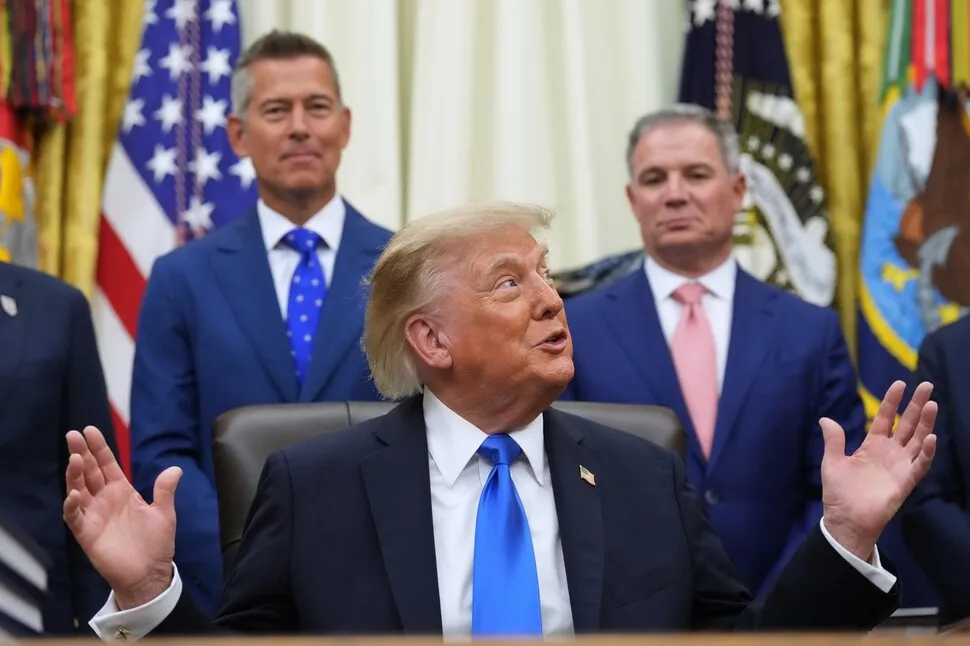
- On the 2nd (local time), President Trump said in the White House Oval Office that a renewed Iranian attack “won’t last very long,” warning that additional strikes are ready, citing claims that Iran is rebuilding its radar, missile, and mine capabilities in the Strait of Hormuz area.
- President Trump posted on Truth Social, “How about renaming the Strait of Hormuz the Trump Strait?” but when a reporter asked whether he was pursuing the renaming, he drew the line, calling it “just something I threw out there.”
- Reuters reported that senior White House aides are pursuing a plan to keep conflict with Iran at a “relatively limited level” before the November 3 midterm elections, and that Vice President JD Vance and Secretary of State Marco Rubio have reportedly agreed.
Analysis — The structure of policy inconsistency revealed by public hawkish rhetoric and the White House’s internally election-driven strategy
Table of Contents
Trump’s Iran policy is moving at two different speeds with two months to go before the November 3 midterm elections. The rhetoric coming from the Oval Office says “additional strikes at any time,” while the internal current is “relatively limited level.” This gap is the essence of Trump’s Iran policy right now.
The Strait of Hormuz Threat and Trump’s Iran Rhetoric
On the 2nd (local time), President Trump publicly warned that Iran is rebuilding its radar, missile, and mine capabilities in the Strait of Hormuz area. He added that a renewed Iranian attack “won’t last very long.” On the same day, a post appeared on Truth Social reading, “How about renaming the Strait of Hormuz the Trump Strait?”
However, when a reporter asked whether he was pursuing the renaming, the President drew the line, calling it “just something I threw out there.” This, in my view, is the most meaningful signal. He personally revealed the distance between threat rhetoric and actual policy operation. That distance is exactly the size of the negotiating leverage Trump’s Iran policy currently holds.
Inside the White House, November 3 Comes First
Reuters reported that senior White House aides are pushing to keep conflict with Iran at a “relatively limited level” before the November 3 midterm elections. Vice President JD Vance and Secretary of State Marco Rubio have reportedly agreed. One White House official clearly stated, “We are continuing pressure on Iran,” but added, “November is the priority.”
What stands out from an operational standpoint is that the speakers and the policy decision-makers are different. The President moves public opinion with hawkish rhetoric, while the administrative and military lines are tied to the election calendar. These two currents do not collide because they are bound by the shared agreement to “continue the pressure.”
What “I Am Not Running” Means in Trump’s Iran Policy
President Trump flatly denied the interpretation that the midterm elections influence his Iran policy. His phrasing was, “I am not running; my party is.” He added that the principle of not permitting Iran to possess nuclear weapons is a consensus across the entire Republican Party. In other words, he deliberately asserted policy continuity.
With the Republican Party under pressure to defend its majorities in both chambers, the Iran policy has become a litmus test of the party’s overall identity. Hawkish rhetoric appeals to voters, while limited conflict prevents accidental escalation. The danger begins when this balance within Trump’s Iran policy is disturbed.
Information Warfare — Calls for Uprising and Hints of CIA Deployment
President Trump posted on Truth Social directly calling for an uprising among the Iranian people. On the possibility of CIA deployment, he sidestepped, saying, “I want to tell you, but it’s not appropriate,” while diagnosing, “That regime is getting weaker by the day.” This is the second layer of Iran policy, running psychological and information warfare alongside military pressure.
Where the Two Speeds Meet, and the Variables Ahead
If Iran nuclear negotiations make progress, the public rhetoric could be dialed back. Conversely, if an actual maritime clash occurs in the Strait of Hormuz, the internal agreement on a “limited level” will immediately dissolve. Both variables must be watched simultaneously.
The two speeds of Trump’s Iran policy are no accident. Hawkish rhetoric serves public opinion and negotiating leverage, while limited conflict serves to prevent accidental escalation. The point at which this balance breaks will first signal itself through the actual situation in the Strait of Hormuz and shifts in the Republican Party’s election strategy. For a more detailed sequence of statements, you can check the original Hankyoreh article. For a longer look at where this stretch of policy began, it may be worth reading the prior phase, U.S.-Iran Airstrike Second Wave Record, alongside it.
Summary of Key Issues
- Official hawkish rhetoric vs. internally limited conflict operations — how the two-speed policy structure is maintained
- Freedom of navigation in the Strait of Hormuz — U.S. verification of Iran’s claimed capability rebuild and the gap in public information
- Policy consistency before and after the midterm elections — whether the Republican consensus on the Iran posture will hold after the election
What to Do Right Now
- Check official U.S. Department of Defense and Navy press releases on the Strait of Hormuz daily
- Cross-verify signs of progress in Iran nuclear negotiations through IAEA and regular White House briefings
- Compare key Republican candidates’ Iran policy pledges to directly measure the temperature within the party
- Track movements in Hormuz-related insurance premiums and crude oil futures premiums
- Record the frequency and tone shifts of Trump’s Truth Social posts to read the cycle of hawkish rhetoric
Frequently Asked Questions
Is President Trump seriously pursuing the renaming of the Strait of Hormuz?
In official settings, he drew the line with “just something I threw out there.” However, the Truth Social post itself was clearly used as a symbolic pressure tool, and it is worth watching whether any follow-up administrative procedures emerge.
Does the November midterm election directly affect the Iran policy?
Although President Trump denied a direct effect, combining the White House official’s comments and the Reuters report, the current is moving toward avoiding a full-scale escalation. It is the “speed” of the policy that is being adjusted, not the “intensity.”
If Iran nuclear negotiations resume, will the hawkish rhetoric stop?
At present, the principle of Iran nuclear non-proliferation is classified as a consensus across the entire Republican Party. If negotiations make progress, the tone of public rhetoric may soften, but the pressure posture itself is unlikely to disappear in the short term.
What happens if a Strait of Hormuz blockade becomes reality?
This is a route through which a significant share of global seaborne crude oil transport passes. If a blockade occurs, oil prices will spike and insurance premiums will rise simultaneously, and a U.S. Navy task force deployment is likely to follow.
Reference Source
This article was prepared after checking the following original source: Google News Korea — Trump “Iran’s renewed attack won’t last long…additional strikes at any time” – hani.co.kr