Key Takeaways
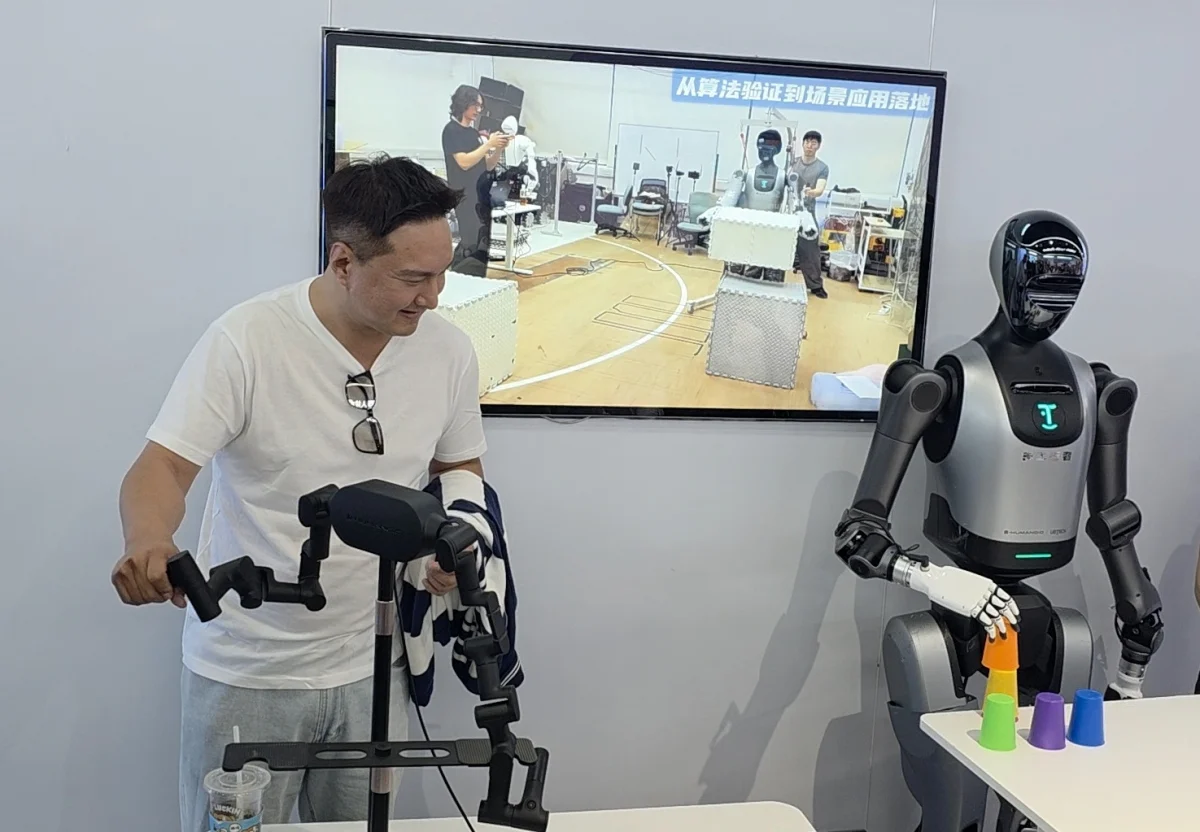
- At UBTECH’s first-floor showroom in the Nanshan District of Shenzhen, multiple humanoid robots the height of an adult woman stand on display. The “Walker S2” lifts stacked cargo with both hands.
- Walker S2 is engineered to swap its own battery in roughly three minutes, enabling uninterrupted work cycles without human intervention.
- While one unit enters battery-swap mode, another takes over the task using shared fleet data—forming a structure in which multiple robots effectively run 24/7 shifts.
For humanoid robots to evolve from demonstration props into continuously operable units of labor, the combination of autonomous battery swap and inter-robot data handoff within a fleet-level operating system is essential. This pushes companies to treat adoption not as a single-unit decision but as a “robot organization” decision—a fundamentally new scale of commitment.
Step into UBTECH’s first-floor showroom in Nanshan District, Shenzhen, and a row of humanoid robots the height of an adult woman greets you. There is Walker S2, carrying floor-stacked cargo with both hands, and behind it, eight identical units dressed in idol costumes standing in formation. The moment a visitor asks, “Should I call them eight units—or eight people?”—the linguistic question of a robot’s social status has already begun.
In the demonstration, Walker S2’s movement was slow, but it had no trouble handling the cargo. The most striking part was that one unit can swap its own battery in roughly three minutes without breaking the workflow. The core is not single-unit continuous operation but fleet-level operation, in which data from a robot entering swap mode is handed off to another. This scene, reported exclusively by The Korea Economic Daily, was introduced alongside expert projections that humanoid robots could replace a significant share of the industrial workforce within 3–5 years.
How a 3-Minute Autonomous Battery Swap Enables Uninterrupted Operation
If previous humanoid demonstrations were often interrupted by long charging times, Walker S2’s approach is fundamentally different. Instead of a human opening a battery slot, its dual-arm grippers travel to the charging dock and perform the detach, align, and insert steps themselves. To keep control power alive through a full shutdown, the body carries an auxiliary capacitor, and the battery dock is standardized so that identical units are interchangeable. While collaborative robot standards (ISO 10218, ISO/TS 15066) are not mandatory humanoid certifications, they serve as crucial reference frameworks for collision avoidance and workspace sharing, while LiDAR-, camera-, and force/torque-sensor-based collision avoidance provides the minimum redundancy those standards require.
The fail-safe pattern that frequently comes up in practice is the ROS 2 lifecycle node. When the battery drops below a threshold, Walker S2 publishes a /battery/low event, and the fleet manager simultaneously calls the /task/handoff service to redistribute work. Below is a configuration skeleton that fleet operators may find useful on the floor.
A trap that engineering teams often miss is the communication handover during a hot swap. If the ROS 2 DDS heartbeat is set to 1 second, task-state publishes can be lost during the swap window. Fleet operators therefore set DDS QoS to RELIABLE + KEEP_LAST(1) and pre-register docks with the Discovery server to reinforce reliability. This is not a simple charging infrastructure—it is an operating system that manages the rotation rate of battery assets itself, and that is the only framing in which the cost equation makes sense.
Multi-Robot Collaboration: When One Rests, Another Picks Up
The three-minute battery swap matters less on its own than the question of who picks up the work during the swap. Just before entering swap mode, Walker S2 pushes its task state, environment map, travel path, and gripper-object geometry to the fleet management system. Another identical unit in the same fleet receives that data and continues the task, while the unit that just finished swapping is reassigned to new work. The structure effectively runs a 24-hour shift rotation, but among machines rather than people.
For this distributed collaboration to operate reliably, three things must be in place. First, a robot operating system that shares battery levels, task queues, and fault events in real time. UBTECH’s proprietary OS plays this role. Second, a synchronization protocol for the handover moment. If the coordinate gap between the moment a worker stops moving a load and the moment the next robot picks it up at the same spot widens even by 1 cm, alignment in the next conveyor process can break.
Third, collision avoidance based on LiDAR, cameras, and force/torque sensors, combined with compliance to collaborative robot safety standards such as ISO 10218 and ISO/TS 15066. Meeting the standards is not enough—an operational procedure that periodically verifies collision-avoidance performance in the field has to follow.
The heart of multi-robot handoff is, ultimately, data consistency. Below is an example of a message schema published by the fleet manager at the task-handoff moment.
The deadline_ms value is set dynamically based on swap cycle and the length of follow-on work, and the figure above is an example upper bound designed to keep work flowing by dividing a three-minute swap into nine sub-segments. A problem that frequently appears on the floor is that the unit in the to_robot field is tied up on another task and accepts the handoff late. In such cases, the fleet manager rebalances task priority and accumulates dispatch failure counts; if the pattern repeats, it quarantines that unit’s health status.
Workforce Replacement Within 3–5 Years: What’s Fact and What’s Forecast
The expert outlook cited by The Korea Economic Daily is “significant replacement of simple, repetitive tasks within 3–5 years.” Both “simple, repetitive” and “significant” leave room for interpretation. Processes with structured positions and movements and few environmental variables—picking, box packing, material transport—are the leading candidates for replacement. By contrast, unstructured environments, real-time human interaction, and tasks that demand frequent exception handling will see widely different timelines even in the same scenarios.
Because the figures themselves remain within the expert views cited in the report, sweeping claims such as “80% replacement” should be treated with caution. The calculation must come with answers to: how many years until a single unit’s acquisition cost is recouped against labor costs; whether utilization above 90% can be sustained; and how operating costs for batteries, maintenance, and consumables aggregate into the TCO. The reported three-minute swap for Walker S2 is a variable that pulls the payback curve sharply downward—charging-standby losses disappear entirely.
The Legal and Ethical Status of the “Robot Worker”: Who Is Liable?
The scene of debating “eight units or eight people” while watching the eight robots is not a mere lexical joke. When an accident occurs on the job, which of the manufacturer, the adopting company, or the fleet operator is the employer? Is the unit of social safety net application—analogous to industrial accident insurance—the unit or the fleet? And who receives pay for the output of a robot that worked from data? Current labor law and the Industrial Safety and Health Act define “worker” on the assumption of a natural person, so this gap must be closed first or adoption itself could stall.
Under the EU AI Act, systems directly interacting with humans are subject to transparency obligations (Article 50), while high-risk classification hinges on whether the humanoid acts as a safety component under Machinery Regulations. In South Korea, safety frameworks are advancing under the Intelligent Robots Act alongside AI basic legislative initiatives.
Safety, Operations, and Cost Items to Review When Deploying a “Robot Organization”
Single-unit adoption and fleet adoption operate at different decision-making scales. Single-unit adoption requires only the spec sheet and price tag of one robot, but a fleet must be evaluated as a bundle: dock layout, battery asset rotation, communications infrastructure, safety-standard certification, and the new roles of operations staff. Adopting companies are well-advised to review the following five items in the same quarter.
- Safety certification: ISO 10218 and ISO/TS 15066 compliance; collision-avoidance sensor redundancy; physical and logical placement of emergency stop buttons.
- Energy operations: Whether a three-minute swap cycle fits the process, power capacity of charging docks and simultaneous swap headcount, battery lifespan and cycle-count tracking system.
- Data governance: Retention period for task video collected by the fleet manager, internal network segmentation, access controls at the OT/IT interface.
- Organizational design: Redefinition of existing line workers’ roles (robot coordination, quality inspection), collaborative safety training, emergency response system for nighttime unmanned operation.
- TCO modeling: Acquisition cost, operating cost, downtime loss, and utilization improvement combined in a single unit (KRW and hours) to produce a three-year payback scenario.
The trap that companies frequently fall into is reviewing acquisition cost only and omitting fleet operating cost. Battery assets, dock infrastructure, communications networks, safety insurance, and operator retraining must all be added in to produce the real payback period for a fleet. The standard way to avoid this trap is a phased approach: start with a single-process pilot, gather utilization data, then expand to fleet operation.
Implications: What Must Be Prepared as the “Robot Worker” Becomes Reality
The eight units in the Shenzhen showroom are not simple demonstration props—they signal that a machine that works around the clock could soon become a “unit of labor.” Now that three-minute autonomous battery swap and fleet-level data handoff are combined, the industrial, employment, and policy axes must move simultaneously. On the industrial side, safety standards and data governance guidelines; on the employment side, worker retraining and role redefinition; on the policy side, responsibility attribution and the unit of social safety net application are the core agenda items.
The pattern of technology moving first and law and policy catching up later was repeated with the cloud and with autonomous driving. However, because these machines share the same workspace as humans, the cost of that gap translates directly into accidents and industrial injuries. Within the 3–5 year window, how prepared Korea is will likely be a variable that determines not just adoption speed but social trust.
This content was analyzed and organized based on an exclusive report by The Korea Economic Daily.
What to Watch
- When UBTECH discloses Walker S2’s actual unit price and fleet-level TCO—operating cost matters more for adoption decisions than headline price.
- Whether Korea’s humanoid collaborative-safety guidelines are established—how ISO 10218 and ISO/TS 15066 will be verified on the industrial floor.
- Korean regulatory trends regarding AI transparency and industrial cobot alignment—where the line between manufacturer and adopter responsibility will be drawn.
- Follow-up reporting on the 3–5 year workforce replacement scenario—which processes come first, and which scale of facility is prioritized.
- When the showroom’s “eight units vs. eight people” question broadens into social discourse—when the debate over robots’ legal and ethical status becomes a policy agenda item.
Frequently Asked Questions
When is humanoid robot acquisition cost recouped relative to labor cost?
The reported three-minute autonomous battery swap on Walker S2 is a variable that significantly raises utilization over previous demonstrations. However, the payback period must be calculated on a TCO basis that includes dock infrastructure, battery assets, and operator retraining costs alongside acquisition. A single-process pilot to validate a three-year payback scenario, followed by fleet expansion, is the safer sequence.
How is collaborative safety ensured in a workspace shared with humans?
Collaborative robot standards (ISO 10218, ISO/TS 15066) provide the adapted reference framework. LiDAR-, camera-, and force/torque-sensor redundancy, physical and logical placement of emergency stop buttons, and speed and force limit monitoring must all be present, and adopting companies must periodically verify collision-avoidance performance in the field rather than relying on certification alone.
Who is liable when a humanoid robot causes an accident?
Under Korea’s current legal framework, “worker” presupposes a natural person, so the humanoid itself is unlikely to be a legal liable party. The distribution of responsibility among manufacturer, adopting company, and fleet operator must first be settled through contracts and insurance, and until domestic guidelines equivalent to the human-oversight obligations introduced by the EU AI Act are in place, adopting companies must proactively build an internal responsibility matrix.