
Key Takeaways
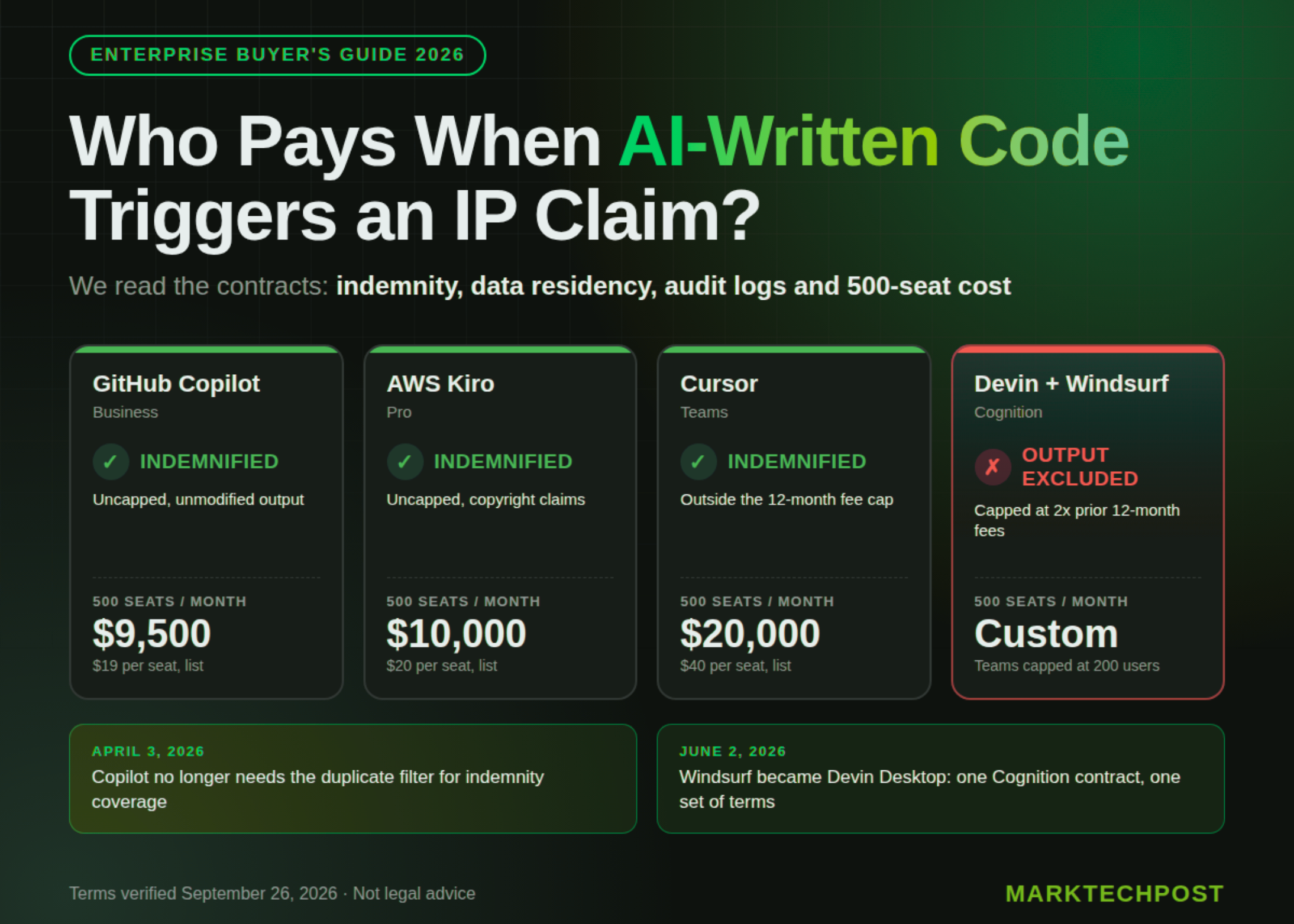
- When Microsoft updated the GitHub Copilot terms on April 3, 2026, it removed the previous structure in which a single administrator setting could void the warranty. The current “Required Mitigations” page lists no additional required actions for the GitHub product family.
- The central interpretive issue surrounding the Copilot warranty is the “unmodified” expression: any code edited even once before release could fall outside the warranty, so legal review is essential.
- AWS Kiro inherits the AWS Generative AI Warranty (Section 50.10) and advertises unlimited coverage for copyright claims. However, the warranty collapses if the input itself is infringing or if filtering features are disabled.
Analysis
Table of Contents
- Key Takeaways
- The 4 Questions Enterprises Ask About Coding Agents
- GitHub Copilot — What the April 3, 2026 Terms Change Means
- AWS Kiro — The Two Sides of the Unlimited Section 50.10 Warranty
- Cursor — The Collision Between a Broad MSA and Narrow Exclusions
- Cognition (Devin · Windsurf) — The Outlier That Disclaims Warranty
- Limits of the Data Collected
- Practical Application Points
- What to Do Right Now
- Frequently Asked Questions
- Source Reference
When an enterprise considers adopting one of 5 coding agents, the first wall a procurement lead runs into is not licensing cost but the IP warranty clause. The enterprise AI coding agent comparison report published by MarkTechPost on September 26, 2026 placed GitHub Copilot, AWS Kiro, Cursor, and Cognition’s Devin/Windsurf on the same scale. This author finds that the questions the report puts to legal reviewers are the most practical ones.
The 4 Questions Enterprises Ask About Coding Agents
The report highlights four core questions. When IP infringement occurs, who is liable? Where are prompts and generated code stored? Can administrators receive audit logs? What is the actual cost when contracting at the 500-seat scale? To answer these, you have to dissect the vendor’s terms clause by clause.
The Four Axes Used in the Comparison
The evaluation was organized around four axes: warranty structure, data residency, administrator audit logs, and 500-seat TCO. Warranty is assessed on “what is covered, under what conditions, and to what extent”; data is assessed on storage region and retention period; logs are assessed on what is visible from the admin console; and cost is assessed on the sum of published pricing and negotiated variables.
GitHub Copilot — What the April 3, 2026 Terms Change Means
Microsoft updated the GitHub Copilot terms on April 3, 2026. The previous structure, in which a single administrator setting could void the warranty, has been removed, and the current “Required Mitigations” page lists no additional required actions for the GitHub product family. In practice, this change is favorable to enterprises because the hidden triggers that could erode the warranty have decreased.
However, the word “unmodified” still gets in the way. It means any code edited even once before release can fall outside the warranty. In reality, all code goes through internal review and is modified. If this clause is applied as written, the warranty could effectively be empty, making legal review essential.
AWS Kiro — The Two Sides of the Unlimited Section 50.10 Warranty
AWS Kiro inherits AWS Generative AI Warranty Section 50.10. Its claim of unlimited coverage for copyright claims is the strongest among the five coding agents. There is, however, an exclusion clause that causes the warranty to collapse if the input is already infringing or if filtering features are disabled. The input-infringement exclusion refers to cases where externally licensed code imported for training is used as-is. The filter-disabling case is practically significant because filters are sometimes turned off for performance reasons during the PoC stage.
Cursor — The Collision Between a Broad MSA and Narrow Exclusions
Cursor’s MSA is nominally the broadest. It explicitly names “Suggestions” and separates the warranty cap from the usage-fee cap. Exclusion clauses activate for claims related to modification or unapproved combination. An interesting point is the gap between the enterprise and consumer terms. The consumer ToS, conversely, places the burden of indemnification on the user toward Anysphere. Even for the same company’s coding agent, responsibility flips depending on the license type. At the adoption stage, you must first confirm which terms apply.
Cognition (Devin · Windsurf) — The Outlier That Disclaims Warranty
Cognition is the only outlier among the five coding agents. Its MSA explicitly excludes generated outputs from warranty scope. After acquiring Windsurf on June 2, 2026, it changed the editor name to Devin Desktop and unified the price list and terms. The warranty disclaimer means the IP risk returns entirely to the user. Given that an agentic coding agent autonomously writes code and pushes to external repositories, this clause may be triggered more frequently than with other products. What stands out from a practitioner’s standpoint is that Cognition does not hide this fact and states it explicitly.
Comparison Table of 5 Coding Agents
| Product | IP Warranty Scope | Key Exclusions | Notes |
|---|---|---|---|
| GitHub Copilot | Generated outputs only | Applies only to unmodified code | April 3, 2026 terms change removed the admin trigger |
| AWS Kiro | Unlimited under Section 50.10 | Input infringement, filter disabled | Limited to copyright claims |
| Cursor (MSA) | Suggestions explicitly named, cap separated | Modification, unapproved combination | Consumer ToS places indemnification on the user |
| Devin | Generated outputs disclaimed | All items | Unified after the June 2, 2026 Windsurf acquisition |
| Windsurf → Devin Desktop | Same as Devin | Same as Devin | Unified price list and terms |
Limits of the Data Collected
The original report focuses on the four questions, but the collected body text was truncated in the middle. Specific figures for the 500-seat cost table and detailed audit log items were not confirmed in the body. This article clarifies that the verification was based on the vendor’s official pages as of September 26, 2026. Since terms may change later, the latest terms at the time of legal review must be re-checked. Teams evaluating coding agent adoption are advised to obtain console and terms PDFs directly during the PoC stage.
Practical Application Points
- Review clauses containing conditional expressions such as “unmodified” with the legal team to determine whether they conflict with the in-house standard development workflow.
- Verify data residency not from the marketing page but from the DPA body, checking the storage region and retention period.
- During the PoC stage, log in to the admin console directly to confirm that the required events appear in the audit logs.
- For agentic coding agents (e.g., Cognition), run a separate simulation of the scenarios in which the warranty disclaimer clause would be triggered.
- Add the 500-seat TCO to a sheet together with volume discounts, multi-year commitments, and training costs, on top of the published price list.
What to Do Right Now
- Search the vendor’s terms for three keywords: “indemnify”, “warranty”, and “limitation of liability”.
- Flag any responsibility-shifting expressions such as “unmodified”, “as-is”, or “your responsibility”.
- Open the DPA and extract three fields: storage region, sub-processor list, and data retention period.
- Request a PoC of the admin console and verify that prompt lookup, generated code download, and admin override items appear in the audit logs.
- Obtain the 500-seat quote under two scenarios (single-year / 3-year commitment) and place them side by side in a sheet.
Frequently Asked Questions
Which clause should be examined first when adopting a coding agent?
The IP warranty (Indemnification) clause. When infringement occurs, who bears the legal fees and damages is decided before cost. Price negotiation comes after that.
Can the IP warranty be voided by administrator settings alone?
In the past, GitHub Copilot had a structure in which certain administrator settings could void the warranty, but the April 3, 2026 terms change removed that trigger. However, conditional clauses such as “unmodified” remain.
What should I do when the consumer and enterprise terms differ?
Even with the same vendor, B2B and B2C terms can differ. Cursor is a representative case: the enterprise MSA has the vendor providing the warranty, while the consumer ToS places indemnification on the user toward the vendor. Confirm the applicable terms at the adoption stage.
How should the actual 500-seat cost be calculated?
The starting point is the official price list multiplied by the number of users. Add volume discounts, multi-year commitment discounts, training/onboarding costs, and the cost of management features such as SSO and audit logs to derive the real TCO.
Source Reference
This article was written after reviewing the following source: MarkTechPost — AI Coding Agents for Enterprise: IP Indemnity, Data Residency and 500-Seat Cost Compared
Expert Commentary (AI)
IT Procurement & Software Contract Law Specialist
The front line of AI coding agent competition has shifted from performance to IP warranty clauses, but the density of carve-out exceptions is hollowing out the substance of warranties in practice.
The fact that IP warranty has been elevated to a procurement gate requirement that precedes price negotiation is itself a reasonable maturation of the enterprise SaaS market. AWS’s structure of conditionally providing unlimited coverage for copyright claims on generative AI services effectively transfers the risk of large mass-claims to itself, while, as with insurance, excluding input defects and the disabling of safety features, follows a conventional design and is also common sense. However, source conditions such as “unmodified” are in direct conflict with the development practice in which human review and modification are mandatory, creating a design flaw that quietly lowers the probability that the warranty will actually be triggered in litigation. The extreme dispersion of responsibility within the same market, such as Cursor’s B2B/B2C terms gap and Cognition’s explicit warranty disclaimer, means there is no standardized vendor liability clause yet, and this vacuum works against mid-sized and small buyers. From a procurement perspective, the warranty should be contract-specialized as a single package along with data residency, DPA, and audit log requirements, and there is a high probability that output provenance clauses and AI-generated-output special terms templates will be standardized within the next 2-3 years.
AI Development Tool Platform Engineer
Vendor warranty transfers only part of the legal risk, and the actual operational risk of autonomous agents must ultimately be reclaimed through internal pipeline governance.
Functionally more important than the warranty clauses is the fact that coverage is structurally linked to whether content filtering is active. The moment you turn off the filter for performance reasons during the PoC stage, the legal safety net disappears with it, creating a new operational issue of synchronizing configuration state with the legal team in real time as policy. The “unmodified” condition is hard to reconcile with a CI/CD culture in which continuous review and refactoring are routine, so on the organization side, provenance records of prompt-generated-output-modification history must be embedded in daily workflows to maintain eligibility for warranty trigger. The warranty disclaimer of agentic products like Devin, which autonomously reflect changes in external repositories, is not a mere contractual disadvantage but a permission design conclusion, and control layers such as push approval stages and sandbox isolation become practically essential. If audit logs do not surface prompt lookup, output download, and admin bypass traces, causal tracing of infringement incidents becomes impossible, so logs and data residency must be elevated from optional requirements to architectural requirements. In short, the comparative axis of this generation is how much risk the vendor takes down, and what remains must be borne by the organization’s own layer such as SBOM-like code origin tracking.
Critical Analyst
Behind the artifact called the unlimited warranty competition, hyperscalers’ procurement lock-in devices and small vendors’ risk-imposition structures sit side by side.
Asking who benefits first, the answer is simple. At a time when the coding quality gap between generative models has narrowed, the legal safety net that remains is the only differentiable procurement axis, and the structure in which hyperscalers (Microsoft, AWS) with abundant litigation response resources can use that language as a weapon to pull enterprise budgets into their own ecosystem is purely a capital decision. The SUS expression “unmodified” is unambiguously written by legal professionals, and the probability that it was inserted without knowing the fact that all real-world released code is modified is low. In other words, it is highly likely a dual structure in which the trigger conditions are designed to effectively point away, turning the warranty into a “nominal vendor product,” while the unlimited expression is loaded onto sales slides. For Cognition’s warranty disclaimer, there is an illusion in which the symbol of transparency paradoxically becomes a marketing asset, and the order in which the post-merger integration unifies only toward the disclaimer can also be read as a trace of legal cleanup that prioritized the resolution of integration liabilities and claim burdens. What we should have checked earlier is not the strength of the warranty language, but the correlation between the public demand for disclosure of cases in which the warranty was actually triggered and where in the corporate accounting cycle the timing of terms revisions falls.
Behind-the-Scenes Scenarios
- Microsoft’s spring 2026 terms relaxation may have been an RFP response asset pre-prepared to match the sales cycle, and there is circumstantial evidence in the timing resembling a recurring pattern in which terms revisions during the cloud transition period were announced right before the start of enterprise budget execution.
- The way the Windsurf post-merger integration unified the price list and terms under the Devin brand at once is likely a legal cleanup intended to eliminate the more favorable clauses held by original Windsurf contractors and to organize the unified claim burden, and the fact that the only direction of integration converged toward the disclaimer supports this interpretation.
Leave a Reply