
Key Takeaways
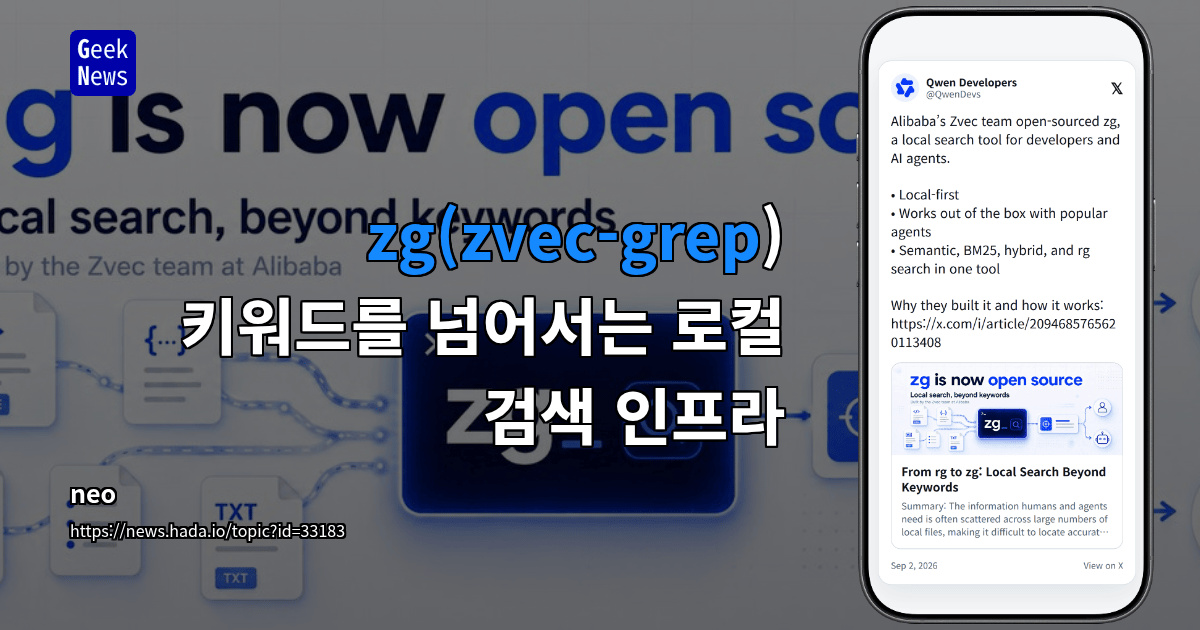
- zg (zvec-grep) is a local-first search tool open-sourced by the Qwen team. It combines ripgrep’s precise text matching with vector search, BM25, and hybrid retrieval, letting natural-language intent navigate code and documents while narrowing down to the exact location.
- The default embedding model is local/potion-code-16m-v2 — 16M parameters, about 32 MiB of local cache, no GPU required. Eleven on-device embedding models are bundled so users can pick the right one for each use case.
- It indexed the entire Django repository of 3,457 files in under 30 seconds on an Apple M4 Pro. Zvec stores vector and BM25 indexes as an embedded library on the device, eliminating the need for a separate database service.
Analysis
Table of Contents
- Key Takeaways
- A New Standard for Local Search: The Context Behind zg
- The Architecture of Hybrid Local Search
- How to Plug zg into Your Agent Workflow
- What Two Benchmarks Reveal About Local Search
- Practical Application Points
- Try It Right Now
- Unverified Aspects and Remaining Challenges
- Frequently Asked Questions
- Reference Source
The standard for local search is shifting. The figure of indexing 3,457 files of the Django repository in 30 seconds on an Apple M4 Pro highlights the limits of workflows that have long relied on ripgrep. zg (zvec-grep), open-sourced by the Qwen team, is a tool that adds semantic exploration to a local-search experience previously confined to keyword matching.
A New Standard for Local Search: The Context Behind zg
ripgrep is fast, but it struggles with natural-language questions like “Where is the OAuth callback handled?” zg addresses exactly that gap in local search. It adopts local/potion-code-16m-v2 as the default embedding model — 16M parameters, about 32 MiB of local cache, running on CPU alone with no GPU required. Eleven on-device embedding models are bundled, letting users choose based on the task at hand.
The vector and BM25 index, called Zvec, is stored on the device as an embedded library. No separate database service is required. This distinction changes how the tool operates in on-premise environments and agent workflows.
The Architecture of Hybrid Local Search
The core idea is fusion, not a single algorithm. BM25 and vector search generate candidates, ripgrep adds exact matching, and RRF (Reciprocal Rank Fusion) produces the final ranking. The default output is a constrained preview plus a compressed ranked list, giving the next reasoning step enough context without re-reading entire result files.
Comparing Three Local Search Approaches
| Item | ripgrep alone | zg hybrid | Remote vector DB |
|---|---|---|---|
| Indexed target | Text only | Vector + BM25 + text | Vector + metadata |
| Natural-language queries | Not supported | Supported | Supported |
| Local self-sufficiency | Full | Full | Not possible (API-dependent) |
| Agent integration | Direct call | MCP supported out of the box | Requires a separate adapter |
| Primary cost | Disk I/O | CPU embedding | API call fees |
How to Plug zg into Your Agent Workflow
The integration path for agents is MCP (Model Context Protocol). Since multiple agents share the same local index, redundant per-agent indexing never happens. The tool description also specifies search termination conditions, reducing repeated calls for the same query. What stands out for practitioners is the shift in cost structure. Given the growing number of teams adopting agent-based development, the local-search layer is becoming the next variable in cost competitiveness.
What Two Benchmarks Reveal About Local Search
SWE-QA-Bench tests multi-step reasoning on 20 questions across real code repositories. With zg introduced, tool calls dropped by more than half and input tokens fell by nearly half. The Judge score rose by 1.50 points.
BrowseComp-Plus is a deep-research evaluation of 80 questions. Accuracy climbed from 98.67% to 99.00%, while input tokens dropped 37.56%, tool calls 43.52%, and agent runtime 38.58%. It is worth remembering, however, that the one-time initial index creation and remote embedding API costs were excluded from these figures.
Practical Application Points
- Start indexing from the repository root with `zg index .`, and add the default `.zvec/` directory to `.gitignore`.
- Use `.zgignore` to explicitly exclude large directories such as `node_modules`, `dist`, and `venv` to reduce indexing time.
- Launch in MCP server mode (`zg serve –mcp`) and include a stop rule in the agent system prompt, such as “after three searches, synthesize the answer candidates.”
- Swap among the 11 embedding models based on the code/documentation/natural-language ratio. For code-heavy work, use `potion-code-16m-v2`; for Korean-language documents, prioritize a multilingual model.
Try It Right Now
- Clone a demo repository (e.g., requests, fastapi) and measure the runtime of `zg index .`.
- Compare ripgrep-only results with zg hybrid results on the same query and track token usage.
- Register the zg server in the MCP configuration file of your agent (Claude Code, Cursor, etc.).
- Write a `.zgignore` to block noisy directories and shrink the index size.
- Pick 5 of the 11 embedding models and record accuracy by query type (symbol search, semantic search, typo correction).
Unverified Aspects and Remaining Challenges
The author views the tool’s significance as lying less in raw search speed and more in the cost structure of a single agent cycle. Cutting tokens and call counts by nearly half means longer reasoning runs on the same budget. That said, the remaining validation challenges are clear: index update policy, monorepo memory footprint, and model swap cost. The original is available at Hacker News Korea’s zg (zvec-grep) — local search infrastructure beyond keywords.
Frequently Asked Questions
Does zg replace ripgrep?
It does not replace it — it sits on top of it. The architecture preserves ripgrep’s exact matching for result precision while placing BM25 and vector search in front to extend candidate generation with semantic understanding.
Can local search work without a GPU?
Yes. The default model, local/potion-code-16m-v2, runs on CPU alone. At 16M parameters and roughly 32 MiB of local cache, indexing and search are feasible on a standard laptop.
How much does it reduce cost when used as an agent tool?
In the BrowseComp-Plus evaluation of 80 questions, input tokens dropped 37.56%, tool calls dropped 43.52%, and agent runtime dropped 38.58%. This is because results are returned as previews and compressed ranked lists.
Is index refresh automatic or manual?
Based on the published workflow, manual indexing (`zg index`) is the default. Automatic refresh based on file-change detection remains an open validation task in monorepo environments.
Reference Source
This article was written after verifying the following source: geeknews — zg (zvec-grep): local search infrastructure beyond keywords
Expert Commentary (AI)
Information Retrieval (IR) Systems Engineer
The combination of hybrid fusion and ultra-small on-device embeddings aligns with IR best practice, but index freshness and monorepo scalability are the final gatekeepers
The design of fusing BM25, vector search, and exact matching through RRF reflects the field’s proven best practice of leveraging the complementarity between sparse and dense retrieval, and is a reasonable approach for bridging the gap between symbol-level precision and natural-language semantic exploration in the code domain. Choosing a CPU-only 16M-parameter model as the default embedding is justified from a privacy and operating-cost standpoint, but how well a model of this size captures the subtle semantics of code identifiers and API naming conventions will set the ceiling on search quality. The 3,457-files-in-30-seconds figure is a small-repository benchmark; in a monorepo with hundreds of thousands of files, indexing time, memory footprint, and incremental updates become problems of a completely different order of difficulty. Because code changes at the commit level, manual indexing policy is the first thing that breaks in practice, so file-watch-based incremental updates and orphan-index cleanup should be the top priorities on the roadmap. The architectural direction itself is sound, but to be evaluated at production grade, two gates remain: empirical measurement of the semantic-search quality ceiling for ultra-small embeddings, and validation of large-scale incremental indexing.
AI Agent Infrastructure Engineer
An MCP-native local search layer targets the real bottleneck in agent cost structure, but security boundaries and operational responsibility remain with the organization
In agent workflows, search failure cascades into repeated tool calls, context bloat, and reasoning stalls, so returning compressed ranked lists and specifying search termination conditions are designs that accurately target the bottleneck from a context-engineering perspective. Storing the index as an embedded library on the device and removing the need for a separate DB service lowers the barrier to on-premise adoption, and letting multiple agents share a single index materially reduces organization-wide redundant cost. On the other hand, MCP server mode opens broad read paths across the repository to the agent, so per-tool access permissions, audit logs, and the confidentiality of the `.zvec/` index files themselves are blanks that each organization must fill outside the tool. The benchmark’s ~40% token reduction translates directly into savings under API billing, but it should be weighed against the initial indexing cost and the risk that code snippets could be sent externally when remote embedding options are used. Going forward, the search layer is likely to become a standard component of the agent stack, and local-first hybrid tools like zg are strong candidates to occupy that slot.
Critical Analyst
Behind the “local-first” slogan, the move reads as ecosystem positioning to seize control of the embedding layer and agent distribution channel
On the surface it looks like an infrastructure contribution for developer productivity, but looking underneath, the real story is that whoever controls the search layer effectively decides what an agent reads as context. The team that builds the model is now releasing its own search tool and bundling the default embedding plus 11 model variants under its own umbrella — a configuration that can be read as a land-grab strategy to make the embedding defaults of the agent ecosystem its own. The benchmarks were measured by the tool’s own developers, and the caveat that initial indexing cost and remote embedding API cost were excluded from the evaluation makes the true size of the savings hard to gauge. The “40% token reduction” narrative is packaged to feel like user-facing savings, but under subscription or fixed-fee billing, the surplus could accrue to the model provider. The timing of an MCP-native release aligned with the peak of the MCP boom, combined with a benchmark size of 3,457 files that sounds impressive but is actually small — together, these read as carefully designed distribution and positioning moves rather than purely technical ones. The point we should really pay attention to is not the tool’s performance, but who builds the candidate list of what your agent reads next.
Underlying Scenarios
- The hidden motivation behind a model provider giving away a search tool for free may be to imprint its 11 embedding models as “defaults” rather than mere “options” and seize embedding dependency in the agent ecosystem — locking the default model and model set under its own umbrella is itself circumstantial evidence of that.
- Combined with the timing of release during the explosive growth of the MCP tool ecosystem and the exclusion of initial-indexing and remote-embedding costs from the benchmark, there is a reasonable chance that the “local-first” narrative has been packaged more favorably than the true total cost of ownership would suggest.
Leave a Reply