
Key Summary
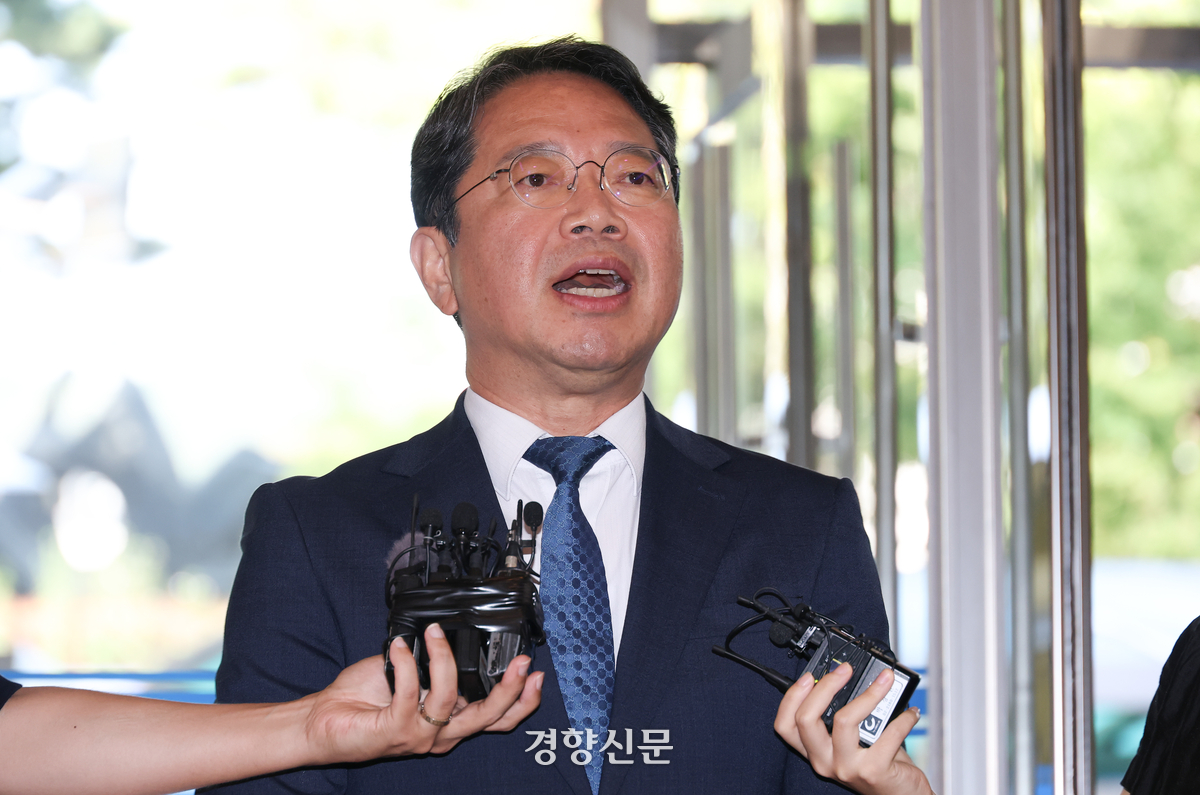
- Justice Minister nominee Kim Seung-won stated on the 3rd, during his first visit to the confirmation hearing preparation office, that he has no intention of directing the dismissal of charges in President Lee Jae-myung’s criminal case.
- The nominee mentioned that the Minister of Justice does not have direct authority to command the Prosecutor General on individual cases; however, under the current Prosecution Service Act and the Public Prosecution Act scheduled to take effect in October, there is a clear legal basis for the Minister of Justice to command the Prosecutor General on specific cases.
- Nominee Kim, who served as co-chair of the “Legislative Caucus for the Dismissal of Charges in the Lee Jae-myung Presidential Case and a National Investigation” (Gongchwi-mo), has publicly advocated for charge dismissal, but explained that his remarks conveyed “the public’s position that the state should correct indictments fabricated through illegal investigation.”
This article bundles, as a political issue, the denial of charge-dismissal authority and the explanation of the new drug lobbying allegations ahead of the nominee’s confirmation hearing in three days. Meanwhile, a new controversy — the warrant-dedicated judge collusion suspicion — has been raised by former leader Han Dong-hoon, presenting a key agenda that requires verification at the hearing, making an issue-organization format appropriate.
Table of Contents
- Key Summary
- Kim Seung-won, Justice Minister Nominee: The Legal Contradiction in Charge-Dismissal Remarks
- New Drug Lobbying Timeline — From 2021 Request to 2024 Constitutional Complaint
- Han Dong-hoon Raises Allegations of Warrant-Dedicated Judge Exclusion Request Related to Justice Minister Nominee
- What to Do Right Now
- Frequently Asked Questions
- Issue Summary
- Reference Source
Justice Minister nominee Kim Seung-won drew a line on the 3rd, stating he has no intention of directing the dismissal of charges in President Lee Jae-myung’s criminal case, as he made his first visit to the confirmation hearing preparation office. At the same time, regarding the COVID-19 treatment clinical trial request allegations, he explained, “I have never done anything improper.” However, on the same day, former People Power Party leader Han Dong-hoon raised suspicions of warrant-dedicated judge collusion, meaning nominee Kim Seung-won has entered hearing D-3 carrying all three controversies at once.
The nominee’s side explains that the Minister of Justice does not have direct authority to command the Prosecutor General on individual cases. However, the current Prosecution Service Act and the Public Prosecution Act scheduled to take effect in October clearly stipulate a legal basis for the Minister of Justice to command the Prosecutor General on specific cases. Since Justice Minister Kim’s command authority operates across the entire investigation and indictment stages, the explanation that “we respect the trial prosecutor who decides whether to proceed to trial” reads as a superficial concession.
From the author’s perspective, the most concerning part is the Gongchwi-mo record. Despite being a former co-chair of the “Legislative Caucus for the Dismissal of Charges in the Lee Jae-myung Presidential Case and a National Investigation,” it appears contradictory that he explained his own remarks as conveying “the public’s position that the state should correct indictments fabricated through illegal investigation.” If he changed his position, we need to hear when and why; if he didn’t, we need to hear why he believes he can perform the duties of minister.
Kim Seung-won, Justice Minister Nominee: The Legal Contradiction in Charge-Dismissal Remarks
The fact that the Justice Minister’s command authority exists under current law has been addressed in legal literature. However, while the nominee emphasizes that “the authority to maintain charges in individual cases belongs to the trial prosecutor,” command at the investigation stage and command at the indictment decision stage are distinguished. How far confirmation hearing members probe this distinction is the first verification point. There is a large interpretive gap between the ruling and opposition parties on this matter.
New Drug Lobbying Timeline — From 2021 Request to 2024 Constitutional Complaint
In 2021, Justice Minister nominee Kim Seung-won was investigated on charges of intermediating bribery promises, etc., for accepting a request from acquaintance Yang Mo and asking then-Ministry of Food and Drug Safety head Kim Gang-rip to expedite approval of Genencell’s COVID-19 treatment clinical trial. In December 2024, he received a suspension of indictment from the prosecution, and filed a constitutional complaint with the Constitutional Court the same year. The nominee’s side argues the injustice, stating, “Not guilty was warranted, but the indictment was merely suspended because I introduced a fundraising method.”
Yang Mo was confirmed to have called nominee Kim “oppa” (older brother) and sent a message reading, “He’s in the Lee Jae-myung line, but since I couldn’t repay the favor, it feels awkward to ask again.” Yang requested the founder of the pharmaceutical company, Mr. Kang, “Please give a 5 million won donation to Kim, who worked hard for us.” However, since Justice Minister Kim Seung-won’s donation limit was already filled, no actual transfer took place. The nominee’s side maintains the position, “We never requested treatment approval, priority review, standard relaxation, or procedure omission, and the approval process proceeded normally.”
The amount of 5 million won is not insignificant even under the Political Funds Act. However, from a practitioner’s standpoint, the more meaningful point is that the matter ended in a suspension of indictment. The prosecution must have had a clear reason for choosing a suspension of indictment rather than a not-guilty disposition, and whether that reason will be disclosed at the hearing is the key. Reports that Yang said, “Attracting 30 billion won was easy,” have also become a new flashpoint in partisan clashes.
Han Dong-hoon Raises Allegations of Warrant-Dedicated Judge Exclusion Request Related to Justice Minister Nominee
Independent lawmaker Han Dong-hoon disclosed on this day through social media the fact that the request to exclude warrant-dedicated judge Jeong Mo from the new drug lobbying case was sent up from the Supreme Prosecutors’ Office to the Supreme Court, but was not accepted. Whether the special relationship between Justice Minister nominee Kim Seung-won and Yang was cited as the reason for exclusion has emerged as a key issue. It was reported that former leader Han fiercely criticized candidate Kim across 13 instances and stated his position of “special prosecutor over hearing.”
It has not yet been officially confirmed whether the warrant-dedicated judge exclusion request was actually filed with the Supreme Court. Why the Supreme Prosecutors’ Office requested exclusion and on what grounds the Supreme Court rejected it are verification points for the hearing. Justice Minister nominee Kim Seung-won’s side has not yet issued an official position on this allegation. People Power Party demanded the withdrawal of the nomination that day.
| Issue | Nominee’s Position | Opposition’s Claim | Hearing Verification Point |
|---|---|---|---|
| Charge Dismissal Authority | “No intention to command” | Command authority exists under current law, Gongchwi-mo record | When and why Gongchwi-mo activities were discontinued |
| New Drug Lobbying | “Never did anything improper” | Request facts acknowledged, constitutional complaint in progress | Whether actual influence was exerted on clinical trial approval |
| Warrant Collusion | No official position issued | Han Dong-hoon: “Exclusion request was made” | Supreme Court filing status and reasons for rejection |
The original report can be found at the related article source.
What to Do Right Now
- Check the confirmation hearing schedule on the National Assembly website and pre-open the live broadcast channel
- Browse the nominee Kim’s speech records and legislative activities on the Open Assembly site in advance
- Follow former leader Han Dong-hoon’s official social media accounts to track subsequent positions on the warrant-dedicated judge
- Check the progress of the constitutional complaint on the Constitutional Court website
- Read the provisions related to command authority in the Prosecution Service Act and the Public Prosecution Act directly at the Prosecution Service’s legal information center
Frequently Asked Questions
When is the confirmation hearing for Justice Minister nominee Kim Seung-won?
It will be held as scheduled at the National Assembly’s Legislation and Judiciary Committee. The exact schedule can be confirmed through the committee’s notice, and at the time of this report, there are three days left until the hearing (D-3).
Does the Justice Minister actually have charge-dismissal command authority?
Both the current Prosecution Service Act and the Public Prosecution Act scheduled to take effect in October provide grounds for the Minister of Justice to command the Prosecutor General on specific cases. However, in practice, the trial prosecutor makes the final decision on whether to maintain or dismiss charges at trial.
Is a suspension of indictment the same as not guilty?
No. A suspension of indictment is a disposition under the Criminal Procedure Act where, although criminal suspicion is acknowledged, the indictment is suspended for reasons of criminal policy. It is distinguished from a not-guilty disposition.
What does a warrant-dedicated judge exclusion request mean?
Under the Criminal Procedure Act, it is a procedure to request a judge to be excluded from a case when there are circumstances that make it difficult to expect fair review. If accepted by the Supreme Court, another judge takes over the warrant review.
Issue Summary
What needs to be confirmed at the hearing is essentially three things. First, when and under what circumstances nominee Kim concluded his co-chair activities at Gongchwi-mo. Second, whether any actual financial benefit was received as consideration for the request in his relationship with Yang Mo. Third, whether the nominee’s circumstances were reflected in the background of the warrant-dedicated judge exclusion request. If all three are not resolved, it will be difficult to receive trust as the head of the Ministry of Justice. Ultimately, how transparently these three are addressed within the three-day hearing period is likely to be the turning point that determines the appointment of Justice Minister Kim Seung-won.
Reference Source
This article was written after confirming the following original source: Kyunghyang Shinmun (Google News Korea) — Justice Minister nominee Kim Seung-won: “No intention to command charge dismissal”… On new drug lobbying allegations, “I have never done anything improper”
Expert Commentary (AI)
Expert in Criminal Procedure & Prosecutorial Authority Structure
The minister’s denial of command authority over specific cases has significantly weakened explanatory power in the face of statutory text and the Gongchwi-mo record
The current Prosecution Service Act specifies that the Minister of Justice directs and supervises the Prosecutor General, and can command the Prosecutor General on specific cases. Therefore, the explanation that the minister has “no direct authority” over individual cases conflicts with the legal structure. Charge dismissal is formally the trial prosecutor’s authority, but in practice it goes through the decision of the superior command line, and there is only a procedural safeguard called court permission, with no device that blocks the minister’s intervention path itself. The nominee’s record of publicly advocating for charge dismissal as co-chair of Gongchwi-mo acts as decisive circumstantial evidence in interpreting this explanation. However, the logic of separation of powers itself — leaving trial maintenance to the trial prosecutor’s expertise and autonomy — has merit, so the issue should shift from whether the authority exists to the reliability of the promise of command restraint. Ultimately, without a specific explanation of when and under what circumstances the Gongchwi-mo activities were concluded, this explanation will be difficult to restore trust in the head of the Ministry of Justice’s principle of non-intervention in investigations.
Expert in Public Personnel & Ethics Verification
An appointment overlapping with a suspension of indictment record, Gongchwi-mo history, and judge exclusion allegations is at the highest level of both difficulty and importance for hearing verification
Since a suspension of indictment is a disposition made on the premise that criminal suspicion has been acknowledged, the explanation of the request allegations needs to be elevated from a not-guilty level explanation to one that explains the reasons for the suspension of indictment. The acquaintance’s mention of “30 billion won attraction” and the message requesting a “5 million won donation” will inevitably be adopted as circumstantial evidence in the personnel suitability review, even if no actual money was transferred. On the other hand, the fact that a constitutional complaint is in progress and the counterargument that the donation limit was already filled and no transfer was made have room to function as defensive logic, so verification-priority approach is more appropriate than complete condemnation. The warrant-dedicated judge exclusion allegations are in a state where even the Supreme Court filing has not been officially confirmed, so the hearing committee’s data request ability and ability to exercise the state audit power will determine the success or failure of verification. However, the structure in which the three issues are raised simultaneously three days before the hearing creates an environment where partisan logic tends to take precedence over fact-checking, posing a high risk that the quality of verification will be eroded by political battles.
Critical Analyst
The timing of charge-dismissal denial, new drug lobbying explanation, and judge exclusion allegations exploding all at once three days before the hearing is itself a map of interests
Before asking “why now,” we must first ask “why this person” — the appointment of a Justice Minister from a Gongchwi-mo co-chair background is a personnel structure that is difficult to see as unrelated to the charge-dismissal roadmap. The nominee’s statement that “there is no command authority” reads more as a sentence optimized to minimize hearing resistance than a statement of legal fact, and after appointment, directional command could be carried out under the umbrella of “respecting trial prosecutor autonomy.” The judge exclusion allegations raised by former leader Han Dong-hoon also suggest the possibility that an organizational internal force opposing charge dismissal intentionally played the card, given that unofficial procedural information between the Supreme Prosecutors’ Office and the Supreme Court leaked to an outside politician. While the ruling side is maintaining the flow by maintaining the schedule rather than withdrawing the nomination, the opposition’s attempt to move the stage to “special prosecutor over hearing” appears to be a strategy to switch the issue to the choice of public opinion battle stage rather than verification. What we should really pay attention to is not the truth of the three issues themselves, but the fact that interested parties in the realization of charge dismissal have taken the same stage in the same week, and we need to suspect ourselves whose explanation is being used as a weapon.
Backchannel Scenarios
- The explanation at the first-day press conference may have been a defense script prepared in advance by the ruling camp — the fact that the ruling party maintained the flow by keeping the hearing schedule rather than withdrawing the nomination immediately after the remarks is read as circumstantial evidence.
- The fact that judge exclusion information, whose Supreme Court filing has not even been officially confirmed, reached an outside politician three days before the hearing may be an intentional information leak by prosecution-judicial insiders opposing charge dismissal — both the timing and nature of the information suggest an organizational internal source.
Leave a Reply