
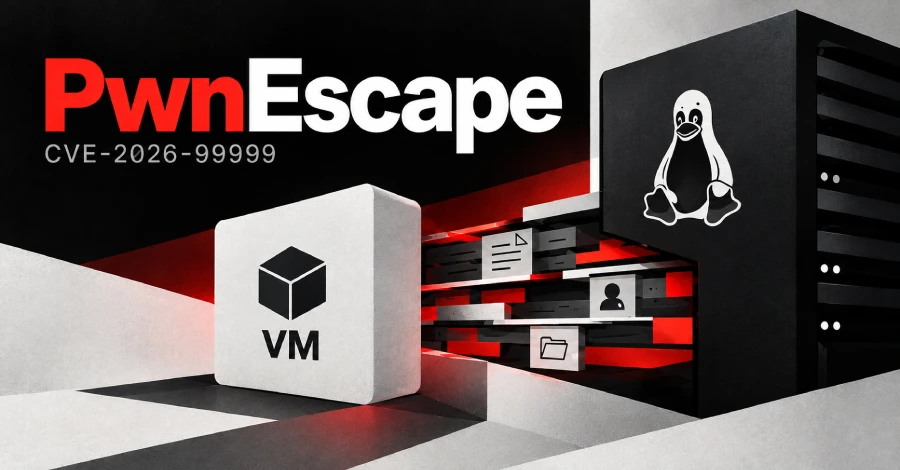
On October 15, 2026, security outlet The Hacker News reported a serious flaw in the Linux kernel that lets a packet sent from inside a virtual machine read the host’s memory. Tracked as CVE-2026-99999 with the alias PwnEscape, the vulnerability can produce three outcomes: guest-to-host memory exposure, host crash, and host code execution. Researcher Paulos Yibelo reproduced a memory leak demonstration in Vercel’s production sandbox, and Vercel confirmed it.
The three demonstration outcomes and their limits
Paulos Yibelo of security firm pwn.ai demonstrated in a technical report that a specially crafted network packet sent from a guest can trigger three behaviors: host memory read, host crash, and host code execution. All three outcomes stem from the same kernel flaw. Each packet sent from the guest leaked roughly 32 bytes of host memory, and the leak continued as long as packet transmission continued.
However, the host crash and code execution were reproduced only in the researcher’s own lab environment simulating Vercel, and the researcher stressed, “This is not a claim of root command execution in any vendor’s production environment”. Two specially crafted packets were enough to crash the host and bring down all sandboxes on the same host, and the same flaw could be leveraged to reach administrative privileges on the host outside the VM. Vercel confirmed in the challenge report that the memory leak demonstration was performed in a production sandbox, but added that no customer files, secrets, or application data were reported to have been read.
Rating and attack conditions
Kernel maintainers assigned CVE-2026-99999 to this flaw and gave it a 9.3/10 Critical rating in the public record. The same record classified the attack vector as Local, specifying that an attacker must already be able to execute code inside the guest. In other words, this is not a flaw an outside party on the internet can exploit simply by sending packets. The flaw is not listed in the U.S. CISA Known Exploited Vulnerabilities catalog, and there are no reports of it being used in real attacks.
Implications for shared infrastructure
Vercel Sandbox runs each customer’s code in a Firecracker microVM with its own Linux kernel copy on a bare-metal Amazon EC2 host, and this microVM serves as the isolation boundary between customers and from the host. pwn.ai assessed that Vercel’s configuration is hardened above industry standard and that no misconfiguration was found. However, the flaw is not in that isolation boundary but in the networking code of the Linux kernel the host runs, so since nearly every major cloud separates customer workloads at the same Linux kernel layer, Vercel noted that the risk extends beyond a single provider to shared infrastructure broadly.
The fix and operational notes
The fix is a single kernel change commit 6785011f8b16 written by Michael S. Tsirkin of Red Hat, and it has been merged into mainline. The patch adds checks at five points in the networking code to ensure that checksum data does not point to a region before the IPv4 header before the kernel acts on the packet. The author described it as a “defence in depth” measure, adding that more complete validation at the point where packets enter the kernel requires additional work. Maintainers backported the fix to supported stable branches. Linux distributions ship their own kernels and often apply this kind of fix without changing the version number, so the version seen in uname is not enough; teams must check distribution security advisories and confirm the kernel the host is actually running includes the fix.
Immediate practical steps
First, the host’s Linux kernel should be updated to a version that includes the fix, or to a vendor build that includes it, and the host rebooted. Updating only the guest kernel does not resolve the host’s flaw. If a patch cannot yet be applied, narrowing the blast radius when a compromise occurs is the typical fallback. Vercel noted that its own mitigations are keeping the host kernel up to date, disabling nested virtualization, and using the Firecracker jailer to grant microVM processes only the privileges they need; this does not fix the flaw itself but is intended to limit what an attacker who succeeds can do. The original report did not present a separate workaround.
AI-assisted research and challenge reward
This flaw was discovered during Vercel’s two-week sandbox breakout challenge in August, which offered a total of USD 1 million in prize money. The per-report cap was USD 50,000, and Vercel paid out a total of USD 242,000 across 1,285 reports; this flaw was the only Critical verdict among them. pwn.ai said it used its AI-assisted research system Omega-Pwn along with GPT-5.6 Sol and SingularityNET’s OmegaClaw components to find the flaw in three days, with an API token cost under USD 700. This case adds to a recent trend showing large language models being used in real Critical-rated flaw discovery.
Reference source
This article was prepared by cross-checking the following source: The Hacker News — Critical PwnEscape Linux Kernel Vulnerability Lets Guest VMs Read Host Memory
Leave a Reply