
Key Takeaways
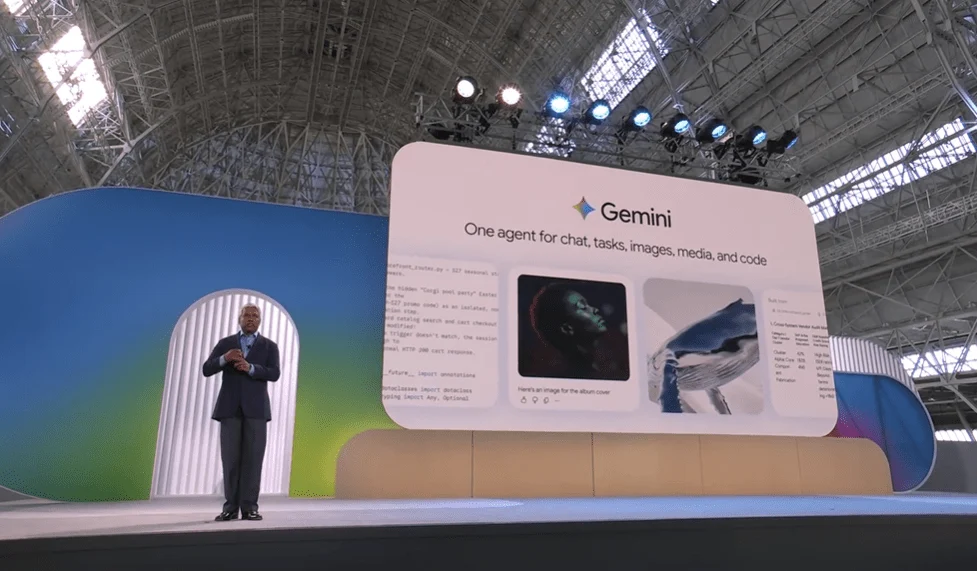
- Google Cloud held the ‘Gemini at Work’ event in San Francisco, USA, unveiling the enterprise ‘Gemini Agent,’ which will be offered in Private Preview to select customers starting on the 8th.
- Google CEO Sundar Pichai noted that Gemini has more than 1 billion monthly active users (MAU) and that nearly 90% of Fortune 100 companies use Gemini Enterprise for work.
- Google Cloud CEO Thomas Kurian explained that agents can ‘be given goals, not just instructions,’ emphasizing automatic model selection for each task, built-in cost controls, and integrated security, management, and governance capabilities.
The enterprise AI race is no longer a contest of single-model performance; it has become a battle for ecosystem dominance over the ‘multi-model agent platform’ — one that freely routes between proprietary and third-party models while integrating enterprise systems, security, and cost controls.
Table of Contents
- Key Takeaways
- Chapter 1. A Permanent Digital Colleague — @agents.company.com and Per-Agent Audit Trails
- Chapter 2. The Four-Type Memory Architecture — Session, Semantic, Procedural, and Episodic
- Chapter 3. Sub-Agent Teams and Always-On Autonomous Operation
- Chapter 4. Multi-Model + Smart Routing Strategy
- Chapter 5. Security, Cost, and Operational Controls — Three-Layer Defense and Spend Caps
In November 2025, Google Cloud held the ‘Gemini at Work’ event in San Francisco, officially unveiling the enterprise Gemini Agent. Beginning on the 8th, it will be available in Private Preview to select customers, and existing Gemini Enterprise and Workspace Business subscribers will receive agent capabilities at no additional cost.
Google CEO Sundar Pichai emphasized that ‘Gemini has more than 1 billion monthly active users, and nearly 90% of Fortune 100 companies use Gemini Enterprise for work.’ Google Cloud CEO Thomas Kurian defined agents as entities to which ‘goals, not just instructions,’ can be assigned. The biggest headline is the multi-model strategy. In addition to its own ‘Gemini 4 Argon’ and ‘Gemini Flash 3.8,’ Google has opened up the platform to freely invoke competitor Anthropic’s ‘Claude Opus 5’ and ‘Claude Sonnet 5.5’ within the same environment. This also marks the first time Argon, which had been released to a limited audience over the past 30 days, is embedded in a commercial product.
1. A Permanent Digital Colleague — @agents.company.com and Per-Agent Audit Trails
The first differentiator of the agent is an operating model that ‘treats agents like employees.’ Each agent is assigned a dedicated email address (@agents.company.com), along with independent access to Gmail, Google Calendar, and Drive storage, in the same format as a standard user account.
The most important change is the audit trail mechanism. For every action an agent performs, the log entry is recorded under the ‘agent name’ rather than the human owner. This clarifies accountability in compliance and audit environments and enables per-agent permission control and usage analytics. In effect, the question of ‘who made this decision’ — a common pain point in enterprise settings — is now extended to the automated actor itself.
2. The Four-Type Memory Architecture — Session, Semantic, Procedural, and Episodic
Traditional LLM-based chatbots share a limitation: the same context must be re-explained at the start of every session. The Gemini Agent separates this into four memory systems.
# Gemini Agent - 4-Type Memory Configuration
memory:
  session:
    ttl: "24h"
    scope: "current_task"
  semantic:
    storage: "vertex_ai_vector_search"
    embedding: "text-embedding-005"
    use: "accumulated domain knowledge"
  procedural:
    format: "workflow_yaml"
    source: "learned from user-approved workflows"
    use: "learned workflow procedures"
  episodic:
    retention: "90d"
    indexed_by: ["agent_id", "timestamp", "task_type"]
    use: "history of past tasks"
Session memory handles short-term context for ongoing tasks, semantic memory stores accumulated domain knowledge via vector search, procedural memory captures workflows learned from the user, and episodic memory retains the history of past tasks. In practice, this design eliminates the engineering friction of having to re-explain project context every time.
3. Sub-Agent Teams and Always-On Autonomous Operation
The agent resides in the cloud and can carry out tasks autonomously over several days, even while a user’s PC is powered off. When given a complex mission, a single agent dynamically creates a temporary ‘sub-agent team’ to divide the work, then releases the resources once the mission is complete.
{
  "smart_routing": {
    "rules": [
      {"condition": "task.complexity >= 0.8", "model": "gemini-4-argon"},
      {"condition": "task.complexity < 0.4", "model": "gemini-flash-3.8"},
      {"condition": "task.requires_chain_of_thought", "model": "claude-opus-5"}
    ],
    "fallback": "claude-sonnet-5.5",
    "cost_optimization": true
  }
}
This represents the core pattern of agent orchestration known as the ‘dynamic multi-agent system.’ It moves beyond the simple ‘AI assistant’ concept and evolves into a ‘digital organizational unit’ capable of forming its own teams and coordinating work.
4. Multi-Model + Smart Routing Strategy
Google’s move to bring a competitor’s model onto its own platform signals that the enterprise AI market has shifted from a contest of ‘model performance’ to one of ‘orchestration and governance.’ Smart Routing automatically matches higher-tier models (Argon, Claude Opus) with lightweight models (Flash 3.8, Claude Sonnet) based on task difficulty, optimizing performance and cost simultaneously.
From an engineering perspective, the trap in this approach is the complexity of tracking model invocations. When four models are mixed within a single project, cost analysis, performance benchmarking, and reproducibility all become difficult. Google aims to address this with a per-project Spend Cap and Agent Gateway policy logs.
5. Security, Cost, and Operational Controls — Three-Layer Defense and Spend Caps
The fact that autonomous agents access enterprise data inherently means a new attack surface. The Gemini Agent applies a three-layer security architecture. The ‘Agent Gateway’ enforces organizational policy in real time at the moment of external system invocation and data access, while the ‘Agent Sandbox’ sets boundaries by running the agent in an isolated execution environment. ‘Cryptographic per-agent identity’ cryptographically proves the identity of each agent, allowing audit trails and permission control to operate at the agent level rather than at the individual user level.
On the cost-control side, a Spend Cap blocks budget overruns caused by unexpected API call surges from autonomous agents. For data integration, the agent supports connections to core systems such as Salesforce, Snowflake, and BigQuery, as well as Model Context Protocol (MCP) servers, while unstructured data can be processed in place through ‘Smart Storage.’
6. Licensing and Channels — Free Provisioning and Cross-Workspace Invocation
Existing Gemini Enterprise and Workspace Business subscribers receive agent capabilities at no additional cost. Agents can be invoked directly from the web, mobile, and desktop, as well as from Google Workspace, Microsoft 365, Slack, and ServiceNow. Embedded invocation from competitor collaboration tools without additional configuration reflects a multi-tenant strategy.
This runs in the opposite direction of Microsoft’s approach of penetrating deep into the workspace with ‘Copilot + Autopilot.’ Google is seeking to maximize the optionality value of its platform by broadening the ‘agent invocation surface’ as widely as possible.
7. Competitive Landscape Analysis
The current enterprise agent platform market is shaped by four big-tech players, each pursuing a distinct strategy.
| Platform | Model Strategy | Key Differentiator | Governance |
|---|---|---|---|
| Google Gemini Agent | Multi-model (Argon + Claude) | Always-on autonomy, 4-type memory, sub-agents | Agent Gateway, Spend Cap |
| MS Copilot + Autopilot | Single model (OpenAI) | Deep M365 integration | Entra ID-based policy |
| OpenAI Dots & ChatGPT Spaces | In-house models | Space-based collaboration | Admin console, usage limits |
| xAI Grok Bot & Team Bot | Grok model | X (Twitter) data integration | Early stage, limited validation |
Anthropic is doubling down on integrating ‘Claude’ with its own workspace editing capabilities, OpenAI is expanding its collaboration footprint through ‘ChatGPT Spaces,’ and xAI is attempting differentiation through ‘Grok Bot’ and ‘Team Bot’ built on social data. The prevailing view is that Google is currently the only player simultaneously delivering all three axes: multi-model, always-on autonomy, and per-agent auditing.
Conclusion — From ‘Model Showdown’ to ‘Platform Orchestration’
The enterprise AI race has shifted from ‘which model is smarter’ to ‘which platform can more flexibly orchestrate models and systems.’ The Gemini Agent is the first case in which a company’s own ‘Argon’ and a competitor’s ‘Claude’ are called upon from the same screen. According to AI Times reporting, this is not merely a model procurement strategy but a signal accelerating the market’s pivot toward orchestration and governance. The two key questions to watch over the coming year boil down to: whether multi-model routing actually outperforms single-model operation on both cost and performance, and whether the per-agent audit framework meets compliance requirements.
What to Watch
- How the cost-allocation system based on model invocation logs will be disclosed after Argon and Claude are deployed together
- Whether per-agent identity verification and Spend Caps will translate into global compliance certifications such as SOX and ISO 27001
- Whether Microsoft will introduce multi-model options within its ‘Copilot + Autopilot’ lineup and reshuffle the market
- How much OpenAI’s ‘ChatGPT Spaces’ will boost its workspace penetration rate
- Whether xAI’s ‘Team Bot’ will expand to data sources beyond X (Twitter) and open up the ‘socially-embedded agent’ market
Frequently Asked Questions
How is the Gemini Agent different from the existing Gemini Enterprise?
Whereas the existing Gemini Enterprise has centered on one-off Q&A interactions, the new agent is a ‘persistent task entity’ equipped with a four-type memory system, always-on autonomous operation, and multi-agent team generation. The biggest difference is that these capabilities are provided within the same subscription at no additional cost.
Is data safe when a competitor’s ‘Claude’ model is invoked within Google’s platform?
The Agent Gateway, Sandbox, and cryptographic identity verification layers enforce policy at the moment of invocation. However, the actual data processing location and log retention policy should be confirmed through the enterprise terms to be published later.
Does multi-model routing truly offer cost advantages?
Multiple industry analyses suggest that only about 10–30% of tasks require a top-tier model. With smart routing, lightweight models cover the remaining tasks, and Google has published internal simulations showing significant cost savings compared to operating a single top-tier model at equivalent performance.
Reference Source
This article was prepared by reviewing the following original report: Google News IT/Science — Google Launches Enterprise ‘Gemini Agent’… Runs ‘Argon’ and ‘Claude’ Simultaneously
Leave a Reply