
DeepSeek Unveils a Router-Worker-Based Coding Agent
The DeepSeek Harness team released an MIT-licensed research prototype called DeepSeek dsh-superagent on November 1, 2026. The system receives requests from GitHub and optionally Feishu, divides them into multiple tasks, and handles each one in an independent agent session.
The released bundle is version 0.1.0, is written in TypeScript, and uses the model from the user-specified DeepSeek Harness profile as-is. Rather than being a separate closed service, it is configured to run on the user’s computer and requires Node.js 22.19 or 24 or later, git 2.32 or later, Python 3.8 or later, tmux, and GitHub CLI 2.48 or later.
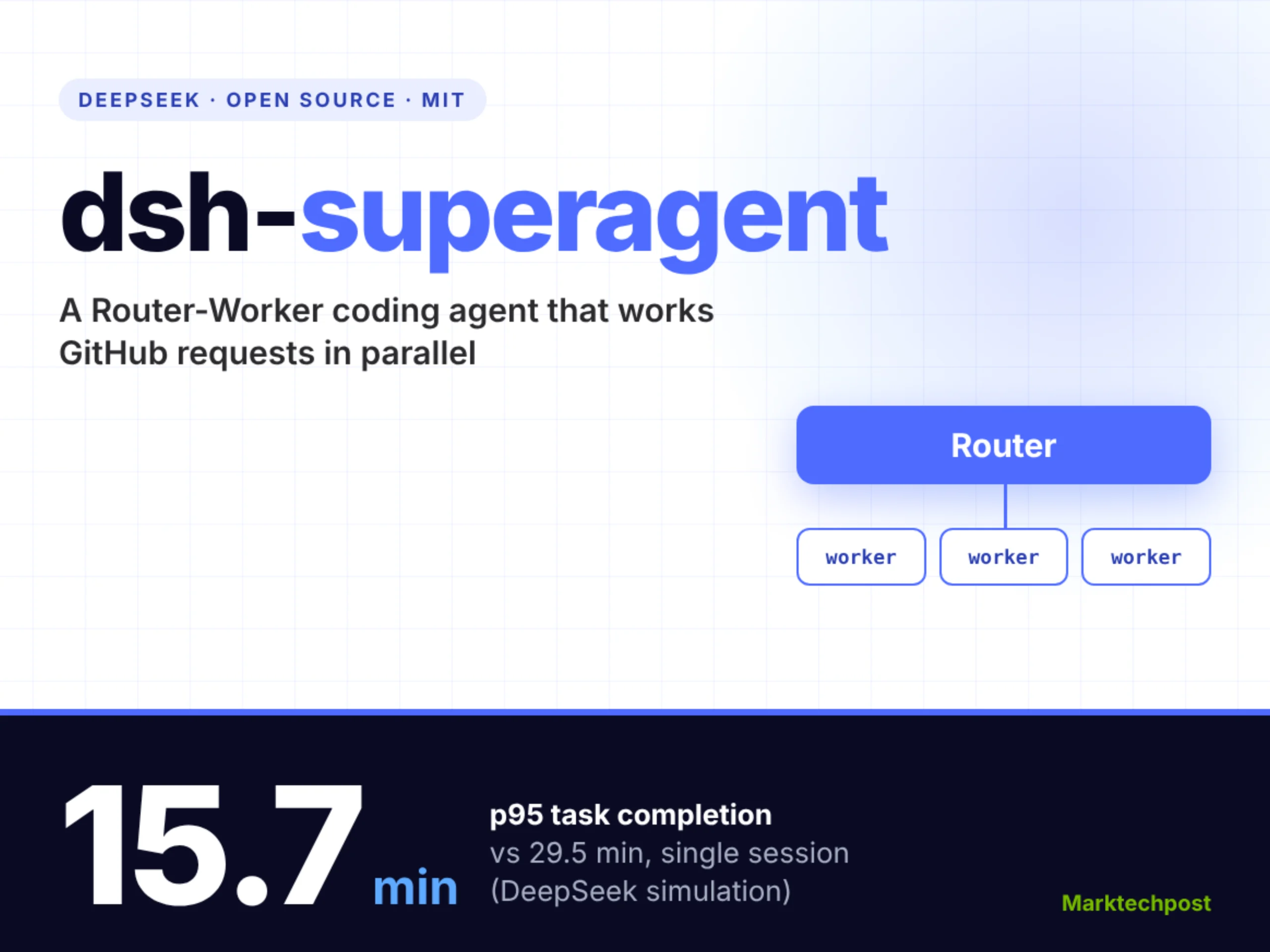
The prototype’s goal was not the model’s individual response performance, but how it would branch, approve, and report multiple requests. It consists of two layers: the Router, which manages interactions and task distribution, and the Worker, which performs the actual coding.
A Workflow That Separates Tickets and Subscriptions
When a GitHub or Feishu event generates a Trigger, the Router evaluates whether it contains a new task. An approved request produces a Ticket containing an immutable Mandate with execution permissions and a reason. Each Ticket is assigned its own working directory and agent session.
Follow-up comments are delivered to the relevant Worker through a Subscription, allowing the task context to continue even without a new mention. Results are either posted back to the original conversation or provided as a pull request, while the local web panel displays only items requiring human confirmation. During execution, shell commands that run for more than five seconds are moved to the background so that Workers can continue receiving messages.
Approval is divided into off, observe, and auto modes, with observe as the default. In observe mode, the system records tasks it would have accepted without executing tasks that have not been approved. The architecture combines a structure designed to accelerate automation with a control mechanism that preserves points for human intervention.
The Meaning and Limits of the 15.7-Minute Completion Figure
In DeepSeek’s simulated experiment, the Super-agent’s task completion time measured a p50 of 12.4 minutes and a p95 of 15.7 minutes. The baseline using a neutral prompt in a single session had a p95 of 29.5 minutes, making the difference approximately 1.9 times. However, the baseline was unable to invoke a subagent even once across five runs.
As requests increased from approximately one to 40 per minute, the average batch size rose from 1.0 to 2.8 and per-request latency increased from 2.5 seconds to 3.9 seconds. In an experiment that did not deliver events directly, the number of Router decisions increased by approximately 30%, while cache-read tokens rose by 37%, from 23.23M to 31.77M.
These figures come from DeepSeek’s own report using synthetic messages and simulated tools, and actual coding quality was not measured. The results therefore suggest the processing-speed potential of a parallel coding agent, but should not be treated as proof of accuracy or security in a real repository.
Validation Challenges Before Moving Beyond Observe to Automation
Because dsh-superagent uses the operating system user’s permissions on the execution host, it requires an isolated environment before being applied to a real repository. Human confirmation through the web panel, the scope of permitted requesters, protection against Mandate changes, and separation of directories and permissions for each Worker must all be reviewed.
Performance validation is also necessary. Before expanding the approval mode, teams need to measure test pass rates against real code, whether incorrect changes cause regressions, the safety of dependency updates, and the possibility of unauthorized command execution or information exposure. External Watchdogs, separation of repositories and computing resources, and an asynchronous ReAct loop remain future challenges that go beyond the current prototype.
Based on the DeepSeek dsh-superagent release, the system’s value lies in branching multiple coding requests into independent tickets rather than merely automating responses. As a parallel coding agent, it can increase throughput and traceability, but those benefits can become risks unless execution permissions and approval policies are appropriately restricted for operational environments.
Original Source
This article was prepared by consulting the following original source: MarkTechPost — DeepSeek Open-Sources dsh-superagent, a Router-Worker Coding Agent
Leave a Reply