
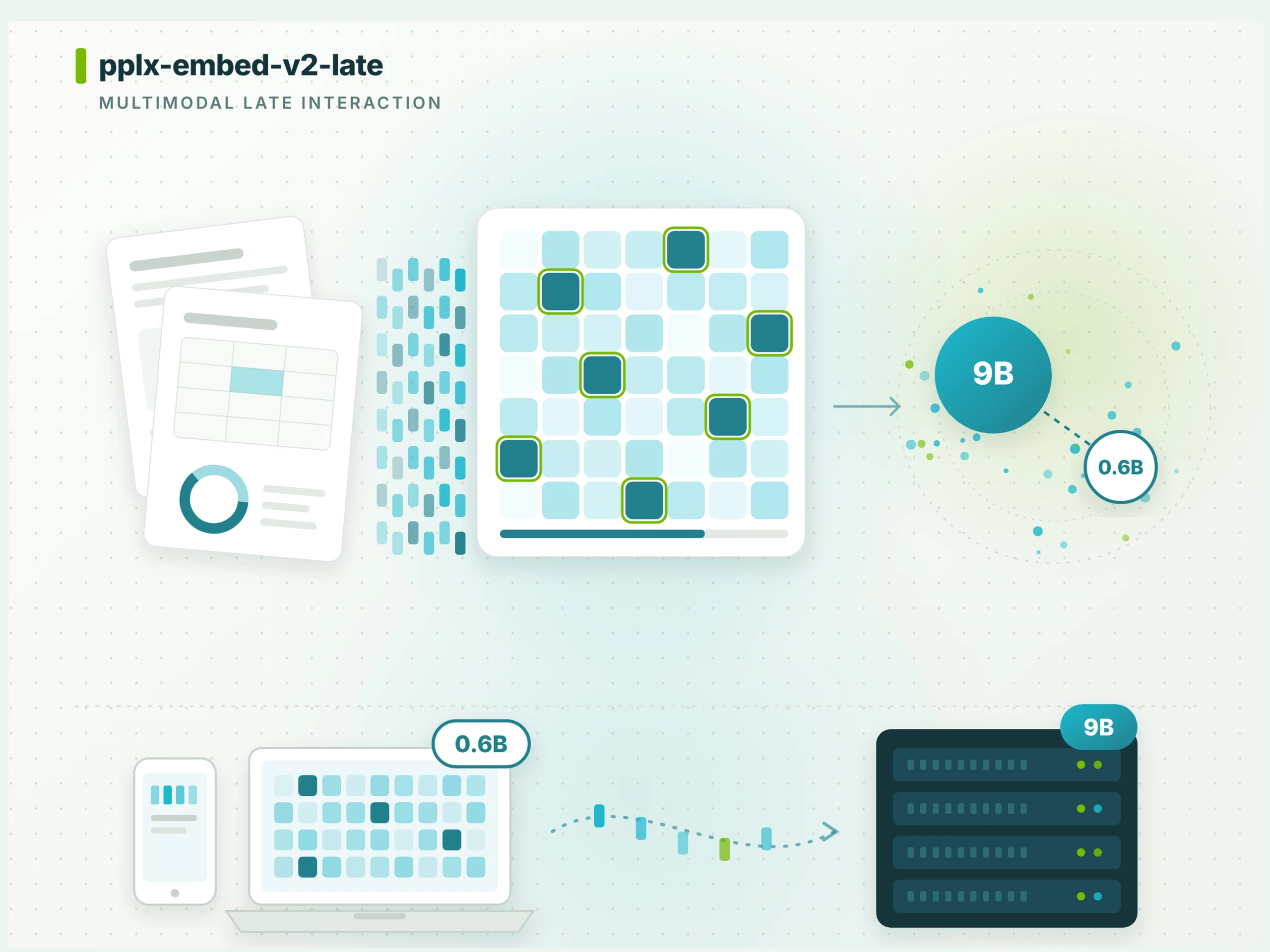
Released by Perplexity in October 2026, pplx-embed-v2-late is a multimodal model that unifies ColBERT-style late interaction across text, images, and rendered PDF pages within a single embedding space. The 9B model scored 92.4% on the agentic PDF QA benchmark MADQA, while the 0.6B model set the floor at 61.2% on ViDoRe v3 Markdown. Because both models share the same embedding space via LEAF distillation from an 18B teacher, mixed deployment is possible—stacking a 0.6B query encoder on top of a 9B index.
Table of Contents
One-Line Summary
pplx-embed-v2-late restores the token-level matching that dense embeddings miss using MaxSim, while keeping per-token vector dimensions at 128 to control storage cost. It can be self-hosted on Hugging Face under an MIT license, but no hosted API is available yet, so the adoption decision hinges directly on the operations team’s capabilities.
Why ColBERT Late Interaction Is Making a Comeback
Dense embedding models compress an entire document into a single 2,048–4,096-dimension vector. This approach is optimized for first-stage retrieval, where a single cosine similarity sweep narrows down candidates, but precision drops sharply for queries that demand fine-grained alignment between two document passages—questions like “How does exemption clause A modify clause B?” The ColBERT family of late-interaction models solves this with MaxSim: every query token is scored independently against every document token, and the per-token maximum values are summed.
pplx-embed-v2-late takes the same philosophy and makes two bold reductions. First, it cuts per-token vector dimensions to 128—16 to 32 times smaller than competitors using 2,048–4,096 dimensions. Second, it routes text, images, and PDF pages through the same encoder, collapsing multimodal retrieval into a single pipeline. Because PDFs are encoded as images without an OCR step, scanned documents and slides are absorbed into the same index.
From my hands-on experience wiring RAG pipelines in production, a two-stage structure—dense model for first-stage candidate filtering, then a ColBERT-style reranker for precision—is becoming the de facto standard. In this trend, 128-dimension late interaction reads as a choice that targets “precision from the first stage.”
Role Division Between the Two Models: 0.6B for Queries, 9B for the Index
Perplexity released the 0.6B and 9B simultaneously, but the recommended deployment pattern is asymmetric. Build document indexes with the 9B to lock in retrieval quality, and handle real-time queries with the 0.6B to reduce latency and cost. Because both models share the same embedding space, this mixed deployment is mathematically valid.
Hardware guidance separates as well. The 0.6B model runs comfortably on a single RTX 3090/4090 at roughly 1.2GB in bf16, while the 9B occupies about 18GB and needs an A100 40GB or H100-class GPU. The 0.6B model activates roughly 340M parameters on image input—meaning it delivers performance comparable to some 8B dense multimodal models on a single GPU.
The most common mistake in the field is treating the two models as “just different-sized options” and applying the same model to the same workload. Index quality matters only at build time, but the query model is invoked on every request, so the cost–quality curve is asymmetric—a fact that must be clearly separated at the design stage.
Benchmark Dissection: Between 92.4% and 61.2%
pplx-embed-v2-late’s published scores show large variance by domain. The most striking is MADQA at 92.4%, where the 9B model set the top score on PDF-based agentic QA. By contrast, the same model falls short of the top tier in domain-specific text retrieval, and the 0.6B model set the floor at 61.2% on ViDoRe v3 Markdown.
| Benchmark | 0.6B | 9B | Notes |
|---|---|---|---|
| MADQA (Agentic PDF QA) | 89.1% | 92.4% | 9B top score |
| ViDoRe v3 Image Retrieval | 62.3% | 63.5% | 9B+0.6B mixed 63.5% |
| ViDoRe v3 Markdown (nDCG@10) | 61.2% | 64.0% | 0.6B floor |
| BrowseComp+ (Text Retrieval) | 73.0% | 76.5% | 9B ahead |
As the table shows, the gap between the two models is narrow on images and PDFs, while the 9B holds a clear advantage in text domains and Markdown-structured documents. Compared with EVIE, Mixedbread, and Gemini Embedding 2, pplx-embed-v2-late sits in the leading group for multimodal tasks, but it does not fully replace dedicated text embedding models in pure text retrieval.
Practical Effects of Mixed-Size Indexing
On ViDoRe v3 Image Retrieval, the 9B index + 0.6B query combination reached 63.5%—1.2 points higher than 0.6B+0.6B (62.3%) and equal to 9B+9B (63.5%). Perplexity claims that in text domains, roughly half of the 9B quality gap can be recovered at 0.6B query cost.
Two production scenarios make this pattern especially effective. First, corpora where PDFs and slides dominate, such as medical or legal domains. Second, SaaS that must process user queries on edge devices or on-premises. The index is built only once, so it makes natural sense to lock in a heavy model there while keeping the user request path lightweight.
However, due to the inherent nature of late interaction—storing one vector per token—index size grows linearly with document length. Without compression via a token indexer like PLAID or ColBERTv2, disk usage on a 100,000-page corpus can balloon to dozens of times that of dense embeddings. When using vector databases like Qdrant or Milvus, you also need a schema design that manages token IDs as separate keys.
Constraints to Know Before Deployment
Several constraints need to be checked before putting pplx-embed-v2-late into real infrastructure.
- Checkpoint format: Distributed in F32, doubling download size compared to bf16. The 9B model is about 36GB and the 0.6B is about 2.4GB, so a cache strategy should be designed upfront when building container images.
- Single-input constraint: Text and images cannot be mixed in a single encoding call. PDF pages are processed only through the image path, and pairing them with per-page text extraction requires a separate post-processing pipeline.
- Library versions: Requires sentence-transformers 6.0.0 or higher and transformers 5.4.0 or higher. It is not compatible with existing 5.x codebases, so the scope of dependency updates should be reviewed first.
- Self-reported benchmarks: All scores are Perplexity’s own measurements, and a technical report has not yet been published. Before adoption, it is safer to run A/B regression tests on your internal corpus to verify real-world performance.
- No hosted API: There is no hosted endpoint, so all operational burden falls on your own team.
We previously covered the trend of revisiting tool integration design across agentic workflows in Three Critiques of MCP — When Agent Tool Integration Must Be Redesigned, and the embedding stage has now reached the same point: tool contracts need to be redrawn.
Try This Right Now
pip install "sentence-transformers>=6.0.0" "transformers>=5.4.0"to bump dependencies, then load the 0.6B model withmodel = SentenceTransformer("perplexity-ai/pplx-embed-v2-late-0.6B")and measure peak GPU memory and first-token latency.- Build a 9B index and a 0.6B index separately from 100 internal PDFs, then compare nDCG@10 on the same query set. Verify whether the benchmarks from the pplx-embed-v2-late release announcement reproduce on your internal corpus.
- Compress the 9B index with a PLAID or ColBERTv2 token indexer and measure both disk occupancy and retrieval latency together. Cap token length with something like
indexer.encode_for_index(docs, max_document_length=512)to prevent index blow-up. - Stack the 0.6B model on the query path and run load tests to confirm whether p95 response latency meets your SLA. Account for the fact that active parameters grow to 340M on image input when sizing concurrent requests.
- Confirm the MIT license notice on the Hugging Face model card and share the commercial use scope with your legal team. Document the absence of a hosted API in your operations wiki so subsequent teams don’t keep asking the same question.
Frequently Asked Questions
Do I need to scrap my existing dense embedding index?
Not necessarily. A two-stage structure—filtering first-stage candidates with a dense model and reranking with pplx-embed-v2-late—is a realistic migration path. Before rebuilding the entire index, measure the cost-vs-accuracy gains at the reranking stage to build a decision basis; this makes internal buy-in much smoother.
Is the 0.6B model enough for multimodal retrieval?
For image and PDF retrieval, the gap with the 9B is narrow, around 1–2 points. But in text domains and Markdown documents, the 9B holds a clear advantage, so model choice depends on corpus composition. For medical-PDF-heavy corpora, the 0.6B works; for mixed legal contracts and technical documents, the 9B index is the safer bet.
How do I estimate the cost of per-token vector storage?
The formula is (average token count × 128 × 4 bytes) × document count. 100,000 documents of 100 tokens each is about 5GB; bumping to 512 tokens brings it to about 25GB. Applying PLAID compression reduces this 5–10×, but compression library compatibility and the search-quality tradeoff need to be validated upfront.
Reference Source
This article was written with reference to the following original: MarkTechPost — Perplexity AI Releases pplx-embed-v2-late: A 0.6B Edge Model and a 9B Model Scoring 92.4% on MADQA
Leave a Reply