
Key Takeaways
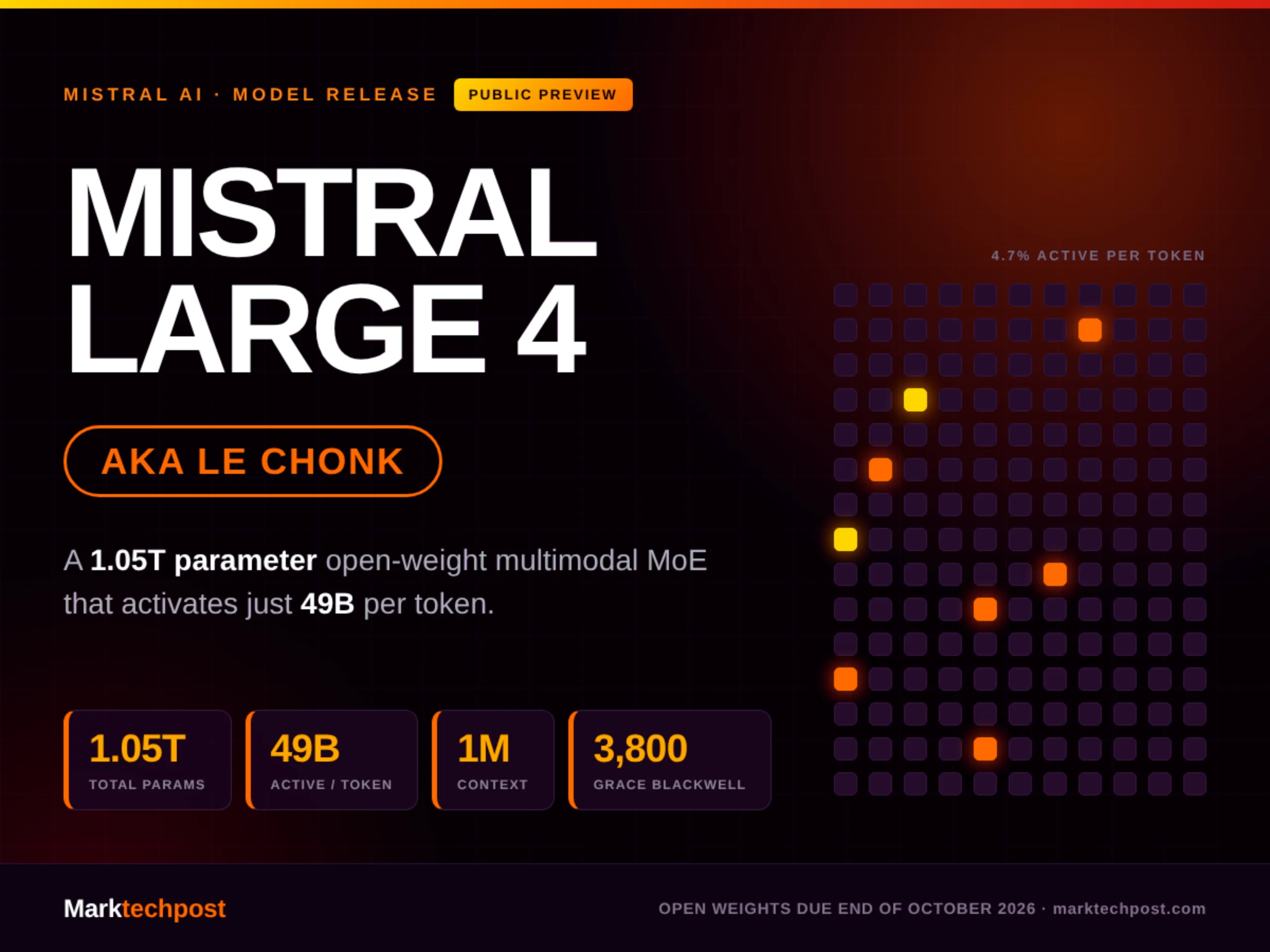
- Mistral AI launched Mistral Large 4 (internal codename Le Chonk) in public preview on October 6, 2026. It is a granular MoE model with 1.05T total parameters, 49B active parameters per token (roughly 4.7% of the total), a 1.6B-parameter vision encoder, and a 1M-token context window.
- Training was carried out from scratch on Mistral’s own European data centers using 3,800 NVIDIA Grace Blackwell GPUs. The training corpus covers 160+ languages and includes every official EU language.
- At launch, only the API is available; weights are scheduled for release at the end of October 2026, so self-hosting is not yet possible. Pricing is set at $1.36 per 1M input tokens, $4.18 per 1M output tokens, and $0.14 per 1M cached input tokens.
Mistral Large 4 shows that a granular MoE design that activates only 4.7% of parameters per token can deliver a trillion-parameter-scale model through a mid-priced API, and the fact that it secures a defensible lead in cybersecurity tasks where closed frontier models effectively score near zero due to task refusal makes it a meaningful option for practitioners.
Table of Contents
Launch Context and One-Line Summary
On October 6, 2026, Mistral AI exposed its new flagship model Mistral Large 4 (internal codename Le Chonk) via API first, in a public preview. It is a granular MoE multimodal model with 1.05T total parameters, 49B active parameters per token (roughly 4.7% of the total), a 1.6B-parameter vision encoder, and a 1M-token context window. Training was carried out from scratch on Mistral’s own European data centers using a cluster of 3,800 NVIDIA Grace Blackwell GPUs, and the training corpus spans 160+ languages, including every official EU language.
When I read a model card on the job, the first things I look at are the training infrastructure and the data provenance, and the 3,800 Grace Blackwell scale signals that Mistral did not build this as a prompt-engineering toy — it trained a trillion-parameter-scale model from scratch. Read alongside our analysis of OLMo Core 3’s sparse training stack, released around the same time, the fact that this model can be trained on European-owned infrastructure is itself a signal of shifting market structure.
Architecture — How Granular MoE Drives the Price
The core idea is that despite a 1.05T memory footprint, only 49B parameters are activated per token, which pulls inference cost into a mid tier. A typical dense 1T model mobilizes all parameters for every token, so pricing per 1M input tokens is essentially infeasible. A granular MoE, by contrast, lets the router pick a small subset of experts per token, which separates compute (49B) from memory residency (1.05T). That separation is precisely what makes Mistral’s public price of $1.36 input / $4.18 output per 1M tokens possible.
That said, the number of experts, the top-k routing configuration, and the layer layout remain undisclosed until the weight release scheduled for late October 2026. The gap looks small from an operations seat, but once weights drop, you will want to independently verify router behavior and expert skew, which means capturing routing logs separately as a safety net. When routing distribution collapses onto a single expert, throughput looks healthy while only that expert’s responses swing wildly in quality — and post-hoc debugging that pattern is brutally expensive.
The vision encoder is decoupled at 1.6B parameters and accepts native image input. Because a single model handles text and images without a separate multimodal adapter, you can build document QnA inside a RAG pipeline without an OCR stage. Whether vision tokens share the 1M context or live in a separate slice, however, needs to be confirmed in the body of the model card (public materials alone are not enough to settle it).
API Pricing and What You Can Use Right Now
At launch, the API is priced at $1.36 per 1M input tokens, $4.18 per 1M output tokens, and $0.14 per 1M cached input tokens. The ability to reuse a cached prefix at $0.14/1M rather than paying the full 1M context on every call is decisive for agent loops: a coding agent that ships an 800K-token codebase plus its conversation history every turn is one where cached pricing drives more than 70% of total cost.
The API surface bundles function calling, structured output (JSON Schema enforcement), document QnA, batch processing, and Agents and Conversations endpoints under a single API key. The integration flow you can run today looks like this:
curl -s https://api.mistral.ai/v1/chat/completions \
  -H "Authorization: Bearer $MISTRAL_API_KEY" \
  -H "Content-Type: application/json" \
  -d '{
    "model": "mistral-large-4",
    "messages": [
      {"role":"system","content":"You are a SOC analyst."},
      {"role":"user","content":"Summarize the last 24h of alerts."}
    ],
    "tools": [{"type":"function","function":{
      "name":"open_ticket",
      "parameters":{"type":"object","properties":{
        "severity":{"type":"string","enum":["low","med","high","crit"]},
        "cve":{"type":"string"}},
        "required":["severity"]}}}],
    "response_format":{"type":"json_schema","json_schema":{"name":"alert","schema":{...}}}
  }'
Enforcing a JSON Schema via response_format in the call above lets downstream code validate straight into a Pydantic model, which then flows into Airflow or Dagster tasks without glue code. Self-hosting is blocked until the late-October weight release, so it is operationally safer to acknowledge API dependency from day one and provision regional failover paths.
Cybersecurity Performance and Task Refusal in Closed Models
Mistral Large 4 recorded 93% on Cybench and 82% on CyberGym-E2E, which puts it in the global top 5 of the Artificial Analysis Cyber Index. Mistral used these numbers to point out that some closed frontier models effectively score near zero on benchmarks because they refuse to generate exploit PoCs or privilege-escalation code. The trap that most security automation teams miss is that when the LLM refuses a legitimate payload-generation request, the cascade also halts every downstream step — exploit verification, log analysis, IOC extraction.
Where this gap shows up in production is automated malware sandbox triage. In a workflow that takes Cuckoo Sandbox output, summarizes the decoded payload, and proposes YARA rule candidates, a model refusal empties out the rule-generation step and pushes a human back into the loop. Being able to deliver legitimate analysis results without refusal has a direct effect on SOC operating cost. That said, until weights ship, there may be an output gap between API mode and self-hosted mode on the same scenario, so organizations whose security policy mandates air-gapped deployment should pin the weight release date to a checkpoint on their roadmap.
Coding and General Quality, Plus Reproducibility Caveats
On agentic coding benchmarks the model posted 61.7% on DeepSWE v1.1, 59.4% on SWE-Atlas-QnA, and 28.3% on Terminal-Bench 4.0, which combine into a 49.8% Artificial Analysis Coding Agent Index. In Surge AI’s blind human evaluation it scored 3.74 out of 5, ranking second out of five models — behind Claude Opus 5 (4.22) and ahead of GLM-5.3 (3.60) and Kimi K3 (3.59). On the coding-agent harness side, compared with our deep dive on four NVIDIA SoL-Pi harnesses, this model appears to lean on the model’s own code-understanding capability rather than on token-saving tricks at the harness layer. Put differently, teams that prioritize coding-agent token efficiency should optimize the harness first, before swapping the model.
| Benchmark | Mistral Large 4 (Le Chonk) | Task Type |
|---|---|---|
| Cybench | 93% | Cybersecurity agent |
| CyberGym-E2E | 82% | Vulnerability analysis, end-to-end |
| DeepSWE v1.1 | 61.7% | Agentic coding |
| SWE-Atlas-QnA | 59.4% | Repository QnA |
| Terminal-Bench 4.0 | 28.3% | Terminal tasks |
| Surge AI blind eval | 3.74 / 5 | 2nd of 5 models |
| Lakera B3 | 93.3% | Prompt injection resistance |
Keep in mind that every one of these numbers was collected in pre-release, undisclosed evaluation rounds, and independent reproduction will not be possible until weights are released. Operations teams that swap tools based purely on benchmark figures and then see different results on their internal reference set is a familiar story. A defensive rollout for the first two weeks — keep A/B routing against your existing model and ramp Mistral Large 4’s share gradually — is the safer move.
Safety Metrics and Comparison Set
On the safety side, Mistral Large 4 posted a 93.3% resistance rate on Lakera B3 and 1.691 / 2.0 on KORABench. Its prompt-injection resistance is on par with closed frontier models, which means it can stand in as a first line of defense in tool-calling agent scenarios where external payloads are mixed into the prompt. Because Lakera B3 is a single benchmark, however, running your own injection regression tests on an internal RAG dataset is the move that meaningfully raises real-world confidence.
What Has Not Been Published Yet and What Comes Next
The number of experts, the top-k routing configuration, and the layer layout will be disclosed at weight release. In the days after the late-October drop, expect the community to quickly surface findings on routing skew, expert dropout, and fine-tuning stability, and the self-hosting TCO will be set by those results. It is also worth deciding at the same time whether you will run 1M context raw, layer it with sliding windows or hierarchical compression, and how you will set cache prefix expiry. Mistral Large 4 widens the option set on three axes — price, performance, and refusal policy — and whether to adopt it comes down to how your organization weights those three.
What to Do Right Now
- Issue an API key from the Mistral dashboard and run a single document QnA call with
response_formatenforced viacurlto measure your token unit cost. - Pull 50 existing SOC payload-generation workloads and count model refusal rates on identical prompts.
- Add an Airflow or Dagster task that validates model output with Pydantic, and compare downstream failure rates between the JSON-Schema-enforced call and legacy free-form output.
- Reflect the 1M context + cache prefix combination in your internal pricing model and back out a per-10K-call unit cost for Mistral Large 4 versus your current model on the same input.
- Reserve an air-gapped PoC slot aligned with the late-October weight release, and pre-stage a routing log capture template plus an expert-skew monitor.
Frequently Asked Questions
Can we adopt Mistral Large 4 for internal evaluation before weights ship?
If your workload can accept API dependency, you can adopt it right away. That said, because the gap between API and self-hosted responses can show up during evaluation, you should re-run internal regression tests in the second sprint after the initial rollout, aligned with the weight release date.
If refusal drops on cybersecurity workloads, where does liability sit?
The boundary becomes clearer between the territory where model refusal prevents an incident and the territory where refusal-free responses keep the analysis pipeline running. When refusal decreases, operations teams should explicitly design a secondary safety net (for example, Trivy for static verification of generated YARA rules, Semgrep rules for static scanning of PoC code).
If a 1M-context call fails, how is it billed?
Under the official price list, calls that use the cached prefix are billed at $0.14/1M, and failed context processing is settled at the standard input rate of $1.36/1M. A fail-open policy can kick in during traffic spikes, so cost alarms should be split between cache hit rate and failure rate to stay operationally safe.
Reference: MarkTechPost’s report on the Mistral Large 4 (Le Chonk) launch
Source Article
This article was prepared by verifying the following original source: MarkTechPost — Mistral AI Releases Mistral Large 4 (Le Chonk): A 1.05T Parameter Multimodal MoE Model
Leave a Reply