
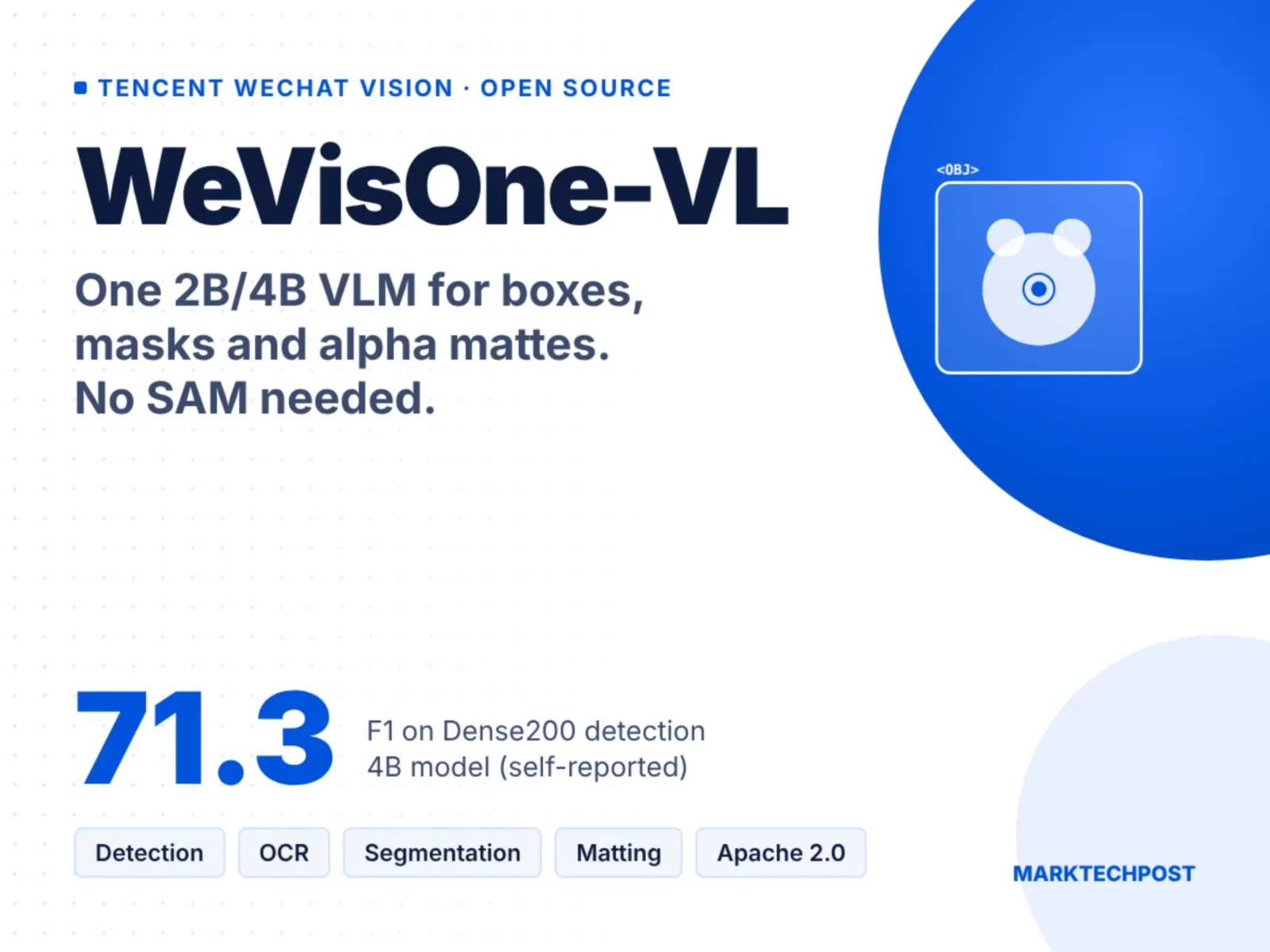
Tencent’s WeChat Vision team has released WeVisOne-VL, a unified vision model that handles object detection and OCR, as well as image segmentation and alpha matting, in a single model. Rather than connecting separate detectors, OCR engines, or segmenters, WeVisOne-VL focuses on performing various perception tasks through one inference path. According to MarkTechPost’s original report, the model is available on Hugging Face in 2B and 4B sizes under the Apache 2.0 license.
One Model From Detection to Pixel-Level Output
WeVisOne-VL supports seven tasks: detection, referring, counting, pointing, OCR, segmentation, and alpha matting. Output formats can be selected according to the required level of precision, including points and boxes, binary masks, and continuous alpha mattes. The model’s goal is closer to fine-grained localization than open-ended conversation. When the requested target does not exist, it outputs “None” instead of a speculative box.
The masks and alpha mattes are generated by a 9.6-million-parameter pixel decoder. This configuration enables pixel-level results without running SAM separately, and it further concentrates responsibility for detection and mask generation in a single model, distinguishing it from conventional perception pipelines.
Architecture Combining Coordinate Tokens and Box-Based Queries
All WeVisOne-VL tasks are processed through structured next-token prediction. Boxes and points use normalized coordinate tokens ranging from 0 to 1,000, while pixel-level tasks emit an <OBJ> token after the predicted box. The hidden state of this token is used as a query for the pixel decoder.
The pixel decoder consists of three stages. The Visual Feature Adapter reuses multi-level ViT features from Qwen3-VL without adding a second image encoder. The Box-Guided Query Decoder uses six deformable cross-attention blocks and processes queries initialized with the <OBJ> state and boxes. The Dense Prediction Head refines results at S/4, S/2, and S/1 resolutions to produce full-resolution masks or mattes.
Large-Scale Annotation and Three-Stage SFT
The training data was constructed by a knowledge-graph-driven data engine that generated approximately 3.6 billion boxes across more than 100 million images. SAM3, Rex-Omni, and Tencent’s own detector proposed regions, which were then verified by Qwen3-VL.
SFT proceeded in three stages. The first stage aligned the output format using 90 million examples. The second expanded the input to 1,960 visual tokens and the output to as many as 500 boxes per response. In the third stage, the model trained the pixel decoder before undertaking matting-focused training with 130 million samples. At the final stage, GRPO was applied to 178,000 examples filtered by an uncertainty criterion.
Benchmark Results Reveal a Trade-Off Through Rejection Rates
Tencent said WeVisOne-VL generally outperformed same-sized VLM baselines across more than 30 benchmarks. The 4B model recorded 55.3 F1 on LVIS detection, 71.3 F1 on Dense200, 81.8 F1 on the RefCOCOg test set, and 89.6% exact-match on the PixMo-Count test set. For OCR, it achieved 52.0 F1 on TotalText, while segmentation reached 71.2 gIoU on the ReasonSeg validation set. These figures are Tencent’s own claims and require independent verification.
| Task | Evaluation Set | WeVisOne-VL 4B | Comparison Model | |
|---|---|---|---|---|
| Dense detection | Dense200 | 71.3 F1 | LocateAnything-3B: 58.7 F1 | |
| OCR | TotalText | 52.0 F1 | PP-OCRv5: 25.7 F1 | |
| Segmentation | ReasonSeg val | 71.2 gIoU | LISA-13B: 65.0 gIoU | |
| Matting | P3M-500-NP box prompts | 7.3 MAD | SAM2-Matting(SAM3): 15.4 MAD |
Its rejection performance on queries involving nonexistent objects was satisfactory. Across 2,880 WeRef-Bench queries, the rejection rate reached 96.4%, higher than the 73.0% of the comparison target. By contrast, PR-Bench recorded a rejection rate of 52.6%, revealing an issue in which the model still output some boxes when asked for nonexistent targets. These results show that the practical safety performance of a unified vision model needs to be evaluated from multiple angles rather than through a simple score comparison.
Apache 2.0 Release and Remaining Deployment Constraints
The 2B and 4B weights are available on Hugging Face, and the wevisone_vl package provides Transformers and vLLM backends. It can run on a single GPU in BF16, while the package also lists NPU and CPU as supported targets. Actual VRAM requirements and the context length for deployment have not been disclosed, although training used up to 8,192 tokens. One reported use of a community GGUF build ran object-level tasks on a 6 GB RTX 2060.
The weights are released under Apache 2.0, but the fine-tuning code remains a TODO. The GGUF build cannot generate masks because it cannot use the pixel decoder, which requires native visual features. Tencent also released Mask2Alpha, which it used in the data engine, alongside the matting annotations.
WeVisOne-VL’s core value lies in bringing multiple perception models together under a single structured output framework. However, its PR-Bench rejection rate, unfinished fine-tuning tools, and GGUF mask limitations are factors that must be considered when applying the unified vision model to real-world product pipelines.
Source
This article was prepared with reference to the following original source: MarkTechPost — Tencent WeVisOne-VL Unifies Detection, OCR, Segmentation and Matting
Leave a Reply