
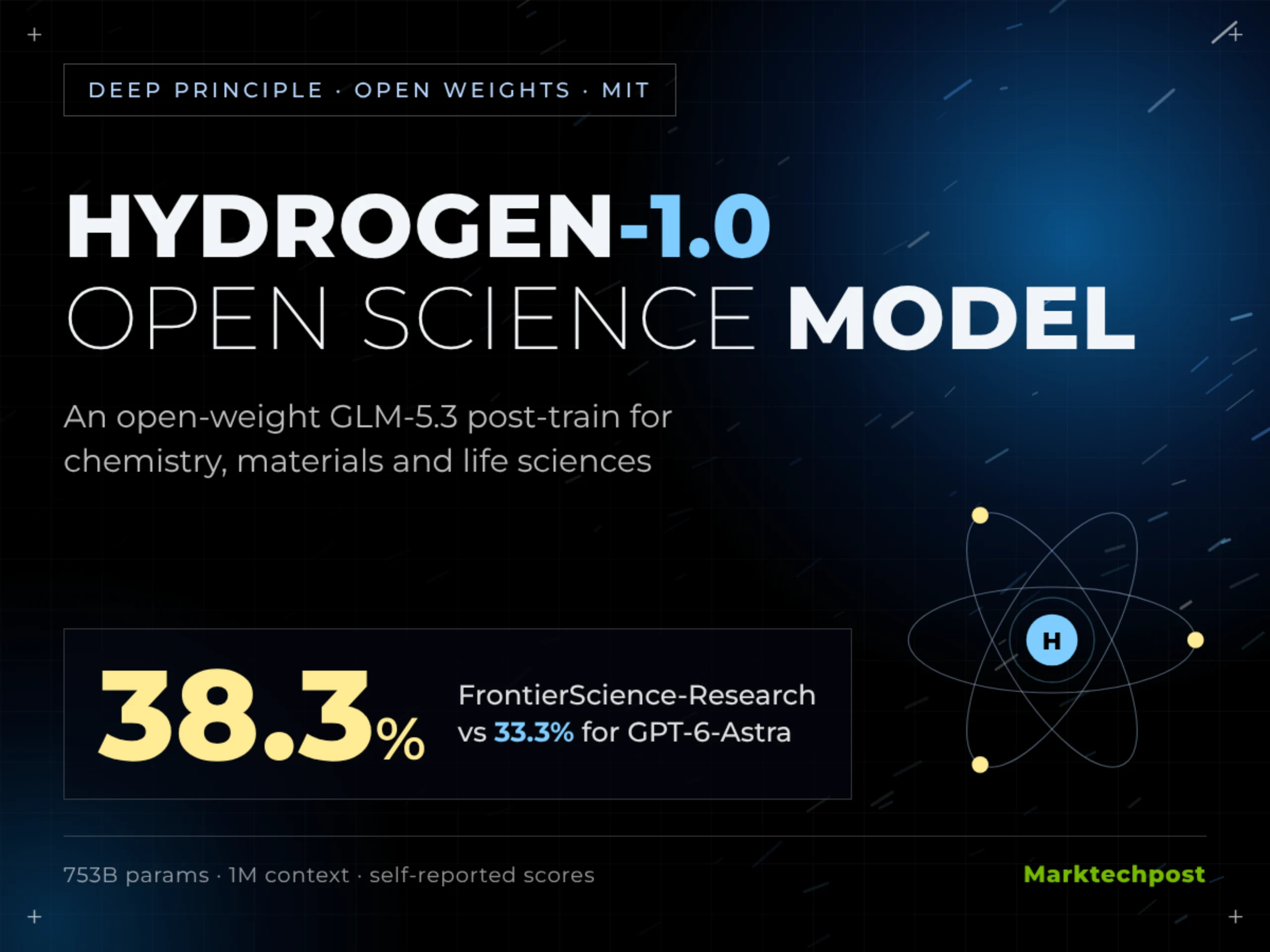
Deep Principle released Hydrogen-1.0, a scientific open model for chemistry, materials science, and life sciences. Built on GLM-5.3, it targets not only general paper queries but also experiment design and result analysis, with its weights distributed under the MIT License. Deep Principle reported that its internal evaluations produced a higher FrontierScience-Research score than GPT-6-Astra, but the full dataset and training recipe have not been released, so the reported figures cannot yet be independently reproduced.
A Scientific Exploration Model Beyond Paper Question Answering
Hydrogen-1.0 is a 753B-parameter MoE model post-trained from Z.ai’s GLM-5.3, with approximately 40B active parameters. Its context window was introduced as 1M tokens, with maximum output of 128K tokens. Its intended uses include question setting, experiment planning, result analysis, and open-ended exploration.
The model used scientist task feedback, electronic experiment notes collected through Mira, and discovery trajectories containing both successes and failures as training data. Training combined supervised fine-tuning with reinforcement learning, and the distributed environment is based on Megatron and SGLang with support for NVIDIA CUDA and AMD ROCm. Muon optimizer state can move between CPU, GPU, and disk depending on the backend, while RL rollouts were designed to be resumable. The layout adapter converts training checkpoints into BF16 inference weights and 128×128 blockwise FP8 inference weights.
Self-Evaluated Results and Task-by-Task Gaps
In an internal research-task evaluation released by Deep Principle, Hydrogen-1.0 outperformed GPT-6-Astra by 5.13 percentage points in scientific computation and by 4.76 percentage points in retrosynthetic prediction. By contrast, GPT-6-Astra scored 3.33 percentage points higher in NMR structure elucidation. In other words, the results should be examined separately by task rather than interpreted as evidence that the performance advantage extends to every area of science.
| Evaluation task | Hydrogen-1.0 | Comparison |
|---|---|---|
| FrontierScience-Research | 38.3% | Higher than GPT-6-Astra’s 33.3% |
| GPQA-Diamond | 93.0% | Generally comparable to Kimi-K3 |
| Scientific computation | Difference benchmark | 5.13 percentage points higher than GPT-6-Astra |
| Retrosynthetic prediction | Difference benchmark | 4.76 percentage points higher than GPT-6-Astra |
| NMR structure elucidation | Difference benchmark | 3.33 percentage points lower than GPT-6-Astra |
In transition-metal complex design, the models tracked larger HOMO-LUMO gaps over five rounds. At round five, Hydrogen-1.0’s average optimal gap was 4.318 eV, compared with 3.689 eV for GPT-6-Astra and 3.353 eV for Kimi-K3. On 117 experiment-planning questions, Hydrogen-1.0 scored higher than Kimi-K3, but GPT-6-Astra and Opus-5.5 refused more than half of the requests and were excluded from the comparison. Because these results were self-reported by Deep Principle, independent validation under the same conditions is also needed.
Lab Automation Demos Reveal Both Possibilities and Risks
The released technical materials show how the model can be integrated into actual research workflows. Hydrogen-1.0 used Python code and GROMACS to assemble a polyethylene melt, identified and corrected topology errors, and analyzed a corrected 40 ns trajectory. For an Ireland-Claisen reaction, it generated a reaction network of 27 structures from 30 reaction candidates, and for the 1H NMR trace of 2-bromonaphthalene, it ranked seven candidates for single formylation products. For a Suzuki coupling study, it wrote a JSON protocol covering 12 vials, with the virtual-laboratory validation stage detecting a case in which a fresh tip was missing during an aspirate operation before execution.
These demos show that the strength of an open scientific model lies not only in answer accuracy but also in executable workflows and intermediate validation. However, protocol generation, reagent safety, and the physical validity of analytical results are separate verification problems. The fact that a model has generated a procedure does not guarantee the reliability of real experiments. Its use of exploration records that include failed attempts should also be evaluated separately from approaches that train only on successful cases and may therefore introduce bias.
The Validation Gap Between Open Release and Real-World Adoption
The weights were released on Hugging Face and ModelScope, and Deep Principle tested BF16 serving with eight GPUs and tensor parallelism of 8 in SGLang. NVFP4 configurations were proposed for NVIDIA B200 and B300 systems, while MXFP4 configurations were proposed for AMD Instinct MI350X and MI355X systems. The server provides an OpenAI-compatible API and exposes a reasoning_effort setting. Reference API pricing for NeuroSpark has not been published. The public scope and release terms can be confirmed through Deep Principle’s Hydrogen-1.0 release materials.
Before practical adoption, organizations must separately verify whether the self-reported evaluations can be reproduced, the model’s accuracy on their actual research data, code-execution and synthesis or analysis error rates, and the stability of long-running exploration processes. The 753B MoE architecture and eight-GPU serving configuration may also place demands on operational resources, while cost information such as NeuroSpark pricing remains a gap in deployment planning. Open weights and the MIT License provide a foundation for directly reviewing the model’s internal behavior and weights, but they do not close the validation gap created by undisclosed training data.
Source
This article was prepared by consulting the following original source: MarkTechPost — Deep Principle Releases Hydrogen-1.0: A 753B Open-Weight Model for Scientific Discovery
Leave a Reply