
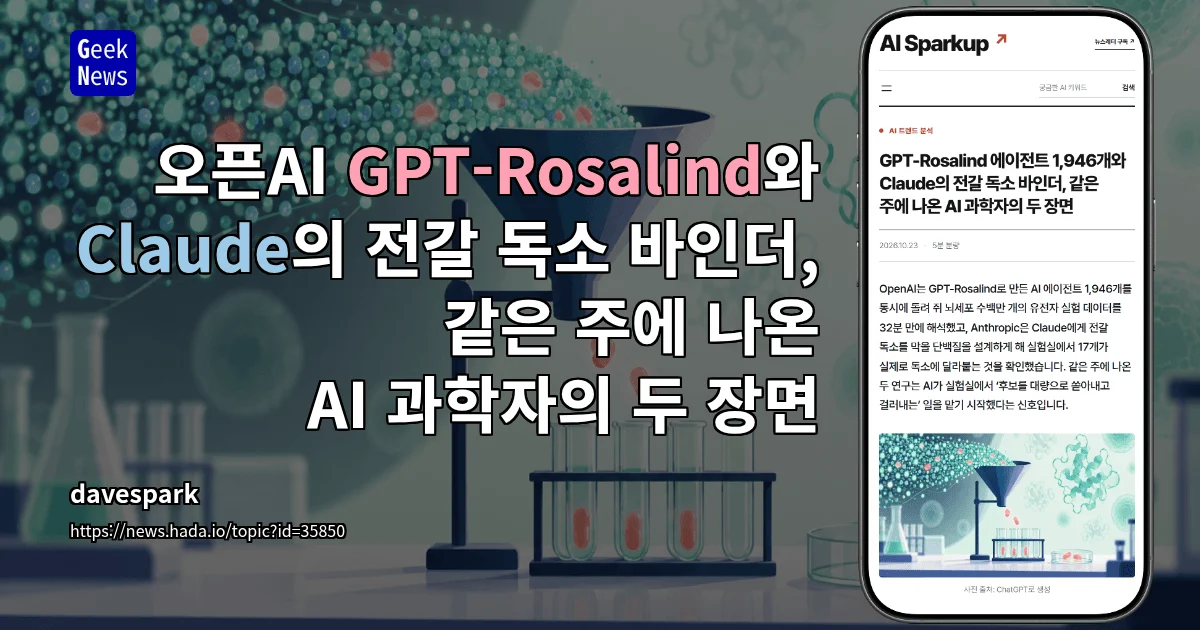
OpenAI and Anthropic unveiled their AI-assisted biology research one day apart. OpenAI’s GPT-Rosalind ran 1,946 AI agents in parallel, analyzing large-scale genetic experiment data from mouse brain cells in 32 minutes, while Anthropic’s Claude demonstrated an approach of designing protein candidates that bind to scorpion neurotoxins and then validating them through experiments. Both cases show that AI science is rapidly gaining ground in the exploratory stages of hypothesis generation and candidate design.
Parallel Analysis and Large-Scale Candidate Design
GPT-Rosalind rediscovered or refined 48 of the 55 findings identified in previous research. Having multiple agents analyze existing experimental data simultaneously broadened the scope of exploration through which researchers can derive new hypotheses from accumulated materials. According to OpenAI, the system generated new biological hypotheses based on existing experimental data.
Claude’s case focused on design and selection beyond the generation stage. Anthropic used AI to design 318,484 candidates for binding scorpion neurotoxins, then tested 211 in actual experiments, 17 of which met strict binding criteria. The crucial element is the setup in which AI-designed proteins are validated in a laboratory.
Experiments Remain the Bottleneck After Hypothesis Generation
The significance is that AI science is beginning to take on the role of generating and screening vast numbers of hypotheses and candidates, rather than entering a stage where it replaces the entire process of scientific discovery. The speed of producing candidates has increased, but the experiments and validation needed to connect them to genuine scientific discoveries or therapeutics remain a bottleneck.
In this structure, the researcher’s role focuses on turning the vast quantity of AI-generated exploration into testable scientific claims. The scale and reproducibility of exploration are strengths of AI science, but the criteria that determine a candidate’s reliability and usability are still established through experiments. The original article summarizing the two research announcements presents two examples of AI science that approached the field in different ways.
Source Article
This article was prepared by consulting the following source: geeknews — Two scenes of AI scientists featuring OpenAI’s GPT-Rosalind and Claude’s scorpion toxin binder, released in the same week
Leave a Reply