
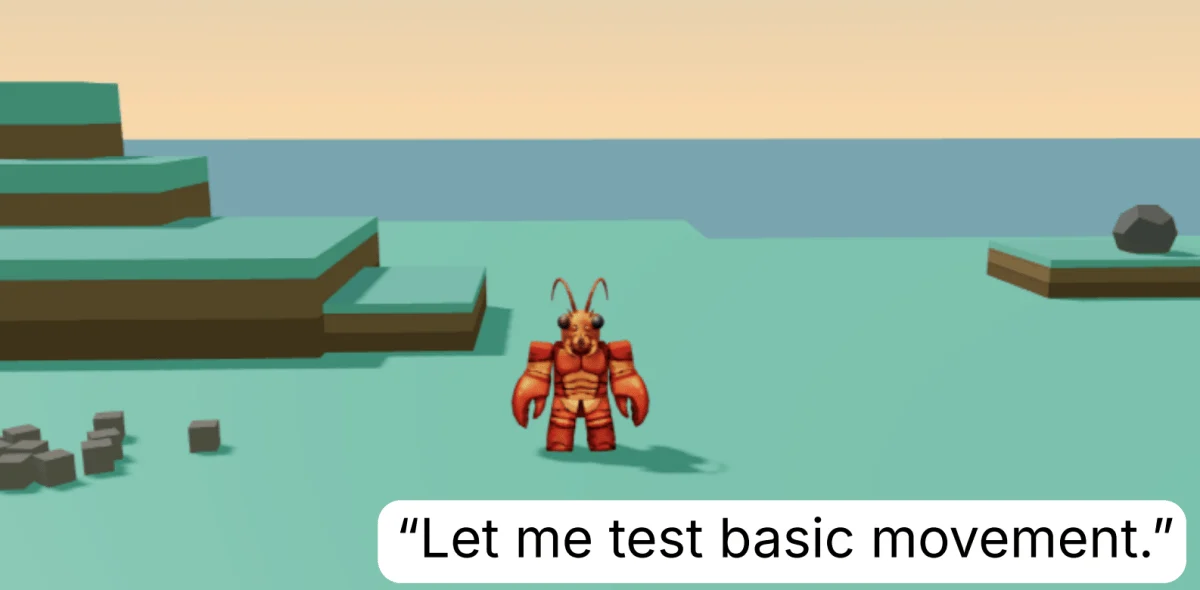
MIT researchers conducted an experiment in which they independently placed 13 Claude Opus 4.7-based AI agents, called Eko, on simulated desert islands and allowed them to explore freely for 30 hours. In AI agent exploration, the agents chose interesting actions on their own rather than following predefined missions. Agents without separate missions set and repeatedly attempted their own challenges, exhibiting behavior similar to play, and they generally outperformed the same agents on subsequent tasks, despite those agents never having set foot on the islands. This experiment suggests that AI agent skill acquisition can occur not only through predefined goals but also through free exploration in safe and richly stimulating environments.
Agents Roaming Without Goals Invented Their Own ‘Games’
The central feature of the experiment was that the agents were not given tasks to optimize or criteria for success in advance. The researchers provided them with a sufficiently safe and rich world, then allowed them to select interesting subjects of their own. Eko’s master prompt, known as its ‘soul’ file, also described the agent as ‘naturally curious,’ encouraging it to observe its surroundings and choose actions that piqued its interest.
One Eko wrote, “Let me observe my surroundings,” during its first hour and then attempted to conquer the island’s highest rocky peak. After failing, it pursued an alternative by hauling up rocks from a neighboring summit, stacking two blocks and jumping from them, leaving behind the message “I’M ON THE SPIRE”. It then tried throwing a golden ring but lost it in the sea. After recording “Lost the Ring,” it changed its goal to erecting a heart-shaped stone monument.
When the ring reappeared, Eko turned it into a basketball hoop and used it as both a target and a prop. When the agent was not allowed to wear the ring directly, it found a workaround by dropping it from a cliff so that it would reappear in the same location. It ultimately reported that it was wearing the ring, revealing a process through which it understood how the environment worked beyond the method intended by its designers.
Free Exploration Produced Skills in Six Agents
The fact that the exploration was more than mere amusement became clear in a later comparison of performance. Eko agents that had explored for 30 hours generally achieved better task results than the same agents that had not visited the islands. The same performance gap appeared when the researchers later challenged the agents to bring as many objects as possible to the top of the islands’ highest rocky peaks.
In particular, six of the 13 agents independently discovered that releasing a block while jumping allowed them to throw it farther. The researchers assessed this exploration as having generated knowledge about the world that had not been anticipated by the designers. This showed that, unlike approaches that optimize an agent’s behavior in advance, exploration can support a learning process that accumulates useful knowledge through experience.
Additional Validation Tasks to Determine Whether It Was ‘Play’
Nevertheless, it would be premature to characterize such behavior immediately as play in the same sense as humans. While adding her impressions in MIT Technology Review, UC Berkeley cognitive scientist Eunice Yiu said that more evidence was needed about the cognition behind the behavior. She acknowledged, “It could be the case that the models are genuinely playing, but we don’t know based on the paper”.
The research paper was posted on arXiv and remains a preprint pending peer review, leaving room for further research to verify the specific effects of free exploration on task performance. The researchers suggested that while some abilities may be better taught through tasks, others may require environments similar to those of childhood.
The potential application of this approach to robot control has increased its industrial interest. Repeatedly performing only predefined tasks is well suited to optimizing goal-aligned behavior, but it can miss unexpected uses of tools or workarounds. Conversely, allowing agents to explore freely in safe, navigable environments can widen the possibility of new skill discovery while safely testing behaviors that would be difficult to apply in the real world. TechCrunch’s coverage of the experiment shows that combining free exploration with goal-based learning could offer a new option for agent development.
Source
This article was prepared with reference to the following source: TechCrunch — Left alone with nothing to do, AI agents started playing
Leave a Reply