
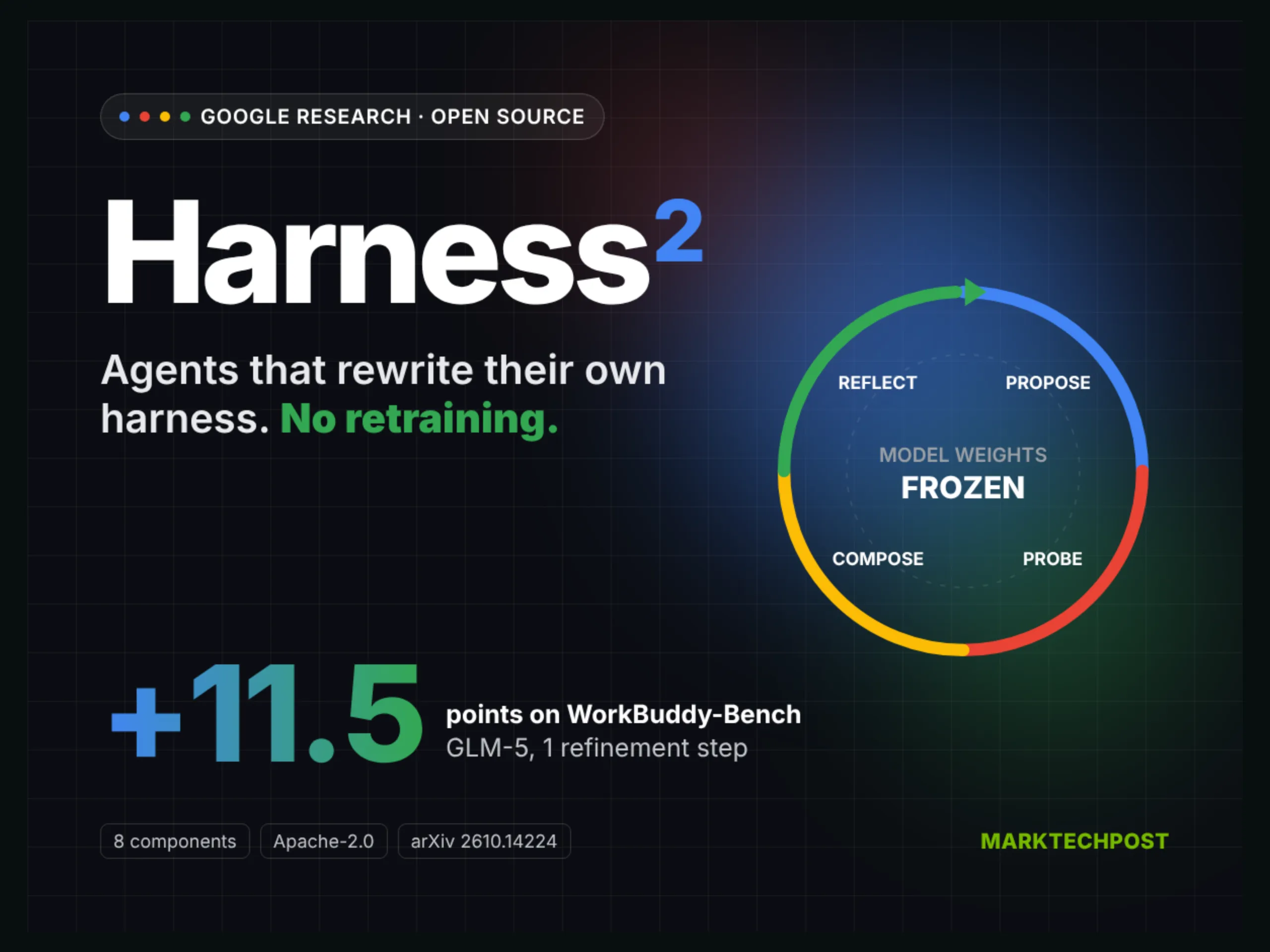
Google Cloud AI Research has introduced Harness², a recursive framework that improves an agent’s execution environment without replacing the agent’s model. The framework refines the code and files surrounding a frozen model, taking an approach aimed at improving agent performance without relying on a better model. The released version is 0.1.0, with no learned parameters and eight editable harness components provided as files.
Changing the Environment Around the Agent, Not the Model
In Harness², the harness is a broader concept than the model itself. Prompts, tools, memory, skills, and orchestration are all included in the system surrounding the model, and optimizing this environment is what is known as harnessing. Model weights remain unchanged, and the framework is designed to improve an agent’s harness during actual deployment.
The harness has eight editable components, each mounted as a file. These components cover context construction, tool interfaces, delegation, and behavior within tool loops. In other words, Harness² is designed for open-ended environments without a validator that provides the correct answer, rather than closed environments where the answer is supplied. Unlike many self-improvement methods that rely on labels or test cases, the framework is designed to operate without such indicators.
Propose·Probe·Compose Verifies Failures Through Behavioral Differences
The core of Harness² consists of two connected stages: task-level recursion and harness-level recursion. Task-level recursion uses a contrastive Propose·Probe·Compose procedure. It first runs a task with a baseline harness, after which the editor proposes candidates, compares them on the same task, and retains only the edits supported by observed behavior.
The candidates proposed by the editor include invariant candidates that target common agent failures and domain candidates that address the knowledge and procedures of the current domain. The composer compares the baseline run with the trajectories of the two candidates, accepting only edits that produce a real behavioral difference rather than merely appearing to solve the task better. This approach focuses on the differences in behavior produced by candidates as direct evidence that replaces answer labels.
After the task is processed, the reflection stage saves the adopted harness and the lesson document, EXPERIENCE.md. This experience library is used in later proposals, but each new task starts again from the default harness. Parallel mode explores k invariant candidates and k domain candidates, then combines them k times, while sequential mode chains k improvement stages. As the exploration breadth increases, the number of additional model executions and the cost per task also increase.
Performance and Execution Costs Across Three Benchmarks
The implementation targets Linux, Python 3.12 or 3.13, and uv, using Vertex AI for model execution. GPU requirements have not been disclosed. Model-based execution requires Node.js 20 or later, Google Cloud CLI, and a Vertex AI project, while LAB requires Pandoc and Poppler, and WorkBuddy-Bench requires Docker. OpenCode is the default runner, with Codex available as a separate option.
Evaluation used three specialized benchmarks: WorkBuddy-Bench, JobBench, and Harvey’s LAB. The execution models were Gemini 3.5 Flash and GLM-5, the execution environments were OpenCode and Codex, and the default editor was Claude Opus 4.8. Results are presented as the average of three runs. One improvement stage raised performance across all four model-and-harness combinations and all three benchmarks, although the size of the improvement varied by environment.
On WorkBuddy-Bench, GLM-5 using OpenCode rose from 64.2 points to 75.7 points, an increase of 11.5 points. The Gemini and OpenCode combination with k set to 5 for parallel recursion recorded 80.8 points on the same benchmark. The number of stages per task also decreased: three of the four WorkBuddy-Bench combinations required fewer stages, while Gemini and OpenCode fell from 25.4 stages to 21.9. By contrast, the smallest improvement for GLM-5 using Codex on JobBench was only 1.2 points, rising from 23.6 to 24.8.
Practical Requirements for Harness Optimization and Validation Challenges
The value of Harness² lies in rewriting the harness at test time without training a model. However, because it requires additional executions, cost forecasting and execution isolation are needed together. Since external commands operate through the tool interface, sandboxing must also be configured directly. The Harness² release report quoting the original source introduced the performance figures, but the exact detailed configuration and reproduction conditions must be checked in the paper and repository together.
The change presented by this framework is not to introduce a larger model immediately, but to correct the planning and tool use of an already deployed agent during execution. Propose·Probe·Compose judges the superiority of candidates through behavioral differences rather than an answer key, while EXPERIENCE.md connects adopted lessons to proposals for subsequent tasks. The key point is that harness optimization is becoming an execution strategy that requires not only performance improvements, but also attention to model-call counts, isolated environments, and reproducible evaluation design.
Source
This article was prepared after consulting the following source: MarkTechPost — Google Open-Sources Harness2, a Recursive Agent Harnessing Framework
Leave a Reply