
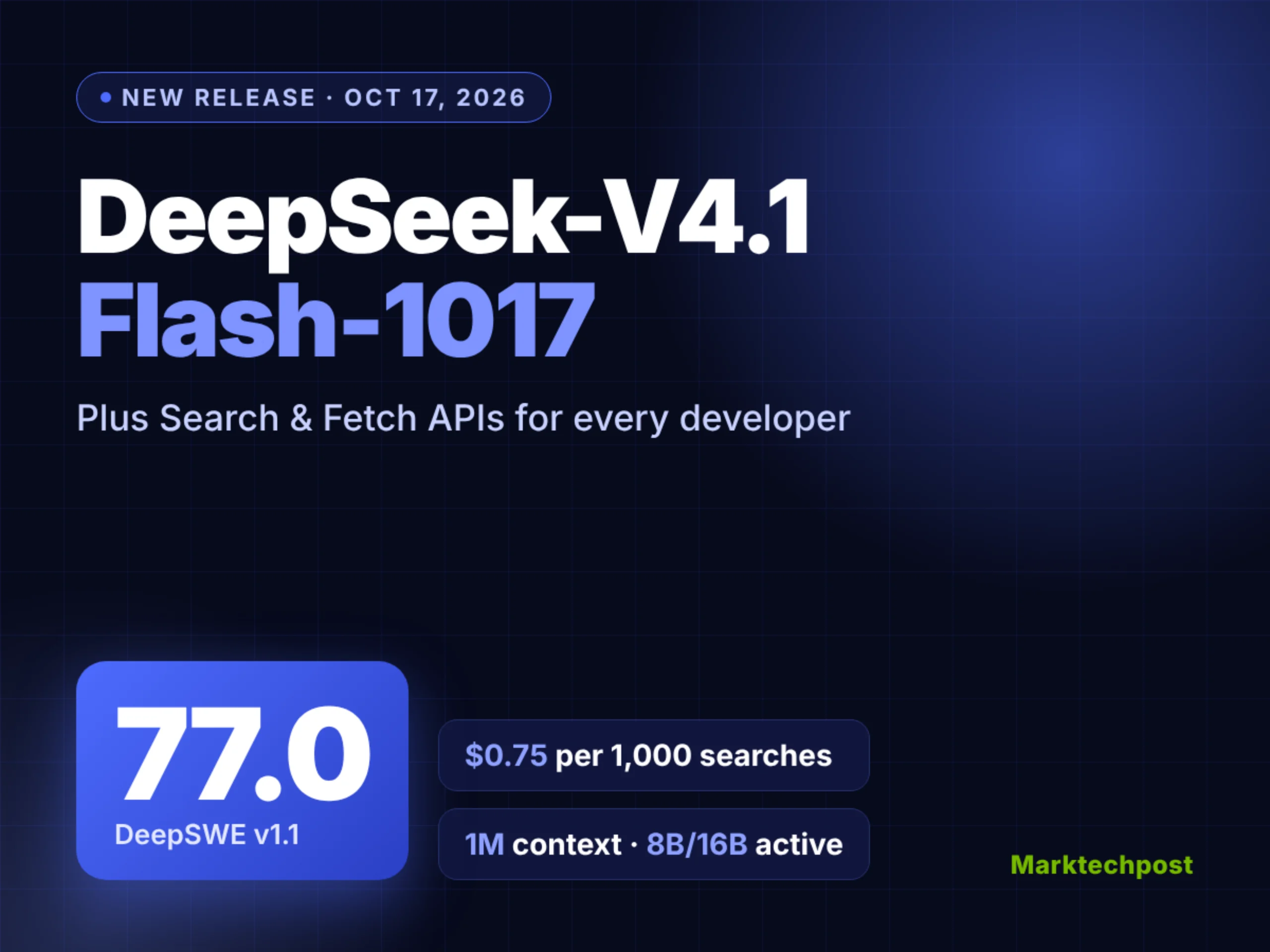
DeepSeek has released the DeepSeek-V4.1-Flash-1017 model and made it available on its website, in its apps, and through the API as the deepseek-flash model. The new model is a follow-up checkpoint to September’s V4.1-Flash and, according to DeepSeek’s own measurements, achieved leading performance across 11 benchmarks. At the same time, the company opened its Search API and Fetch API to all developers, allowing the model and web information access layer to be configured with a single API key.
What the 77.0 DeepSWE Score Means for Coding
DeepSeek said the 1017 checkpoint scored between 2.0 and 11.1 points higher than the previous V4.1-Flash across 11 benchmarks. It recorded a score of 77.0 on DeepSWE v1.1, surpassing the previous V4.1-Flash’s 74.2 and Claude Opus 5’s 74.0. It also posted 60.5 on Automation-Bench and 35.4 on Agents’ Last Exam, leading in those categories as well.
However, the performance advantage does not extend to every area. The 1017 checkpoint scored 42.6 on HLE without tools, below Claude Opus 5’s 56.3, while Claude Opus 5 also led on Terminal-Bench 4.0, ProgramBench, and NL2Repo. These figures were measured by DeepSeek itself and should be treated as performance claims that require independent verification.
| Model | DeepSWE v1.1 | HLE without tools |
|---|---|---|
| DeepSeek-V4.1-Flash-1017 | 77.0 | 42.6 |
| DeepSeek-V4.1-Flash | 74.2 | Not reported |
| Claude Opus 5 | 74.0 | 56.3 |
MoE Architecture and Long-Context Efficiency
DeepSeek-V4.1-Flash-1017 is based on a multimodal Mixture-of-Experts model that divides 40 Transformer layers into 20 causal encoders and 20 decoders. It has a total size of 552B backbone parameters and 196B Engram parameters, with 8B active parameters for prefill and 16B for decoding on a per-token basis. It supports a maximum context of 1M tokens and output of up to 384K tokens.
Efficiency features include Causal Encoder-Decoder, Compressed Sparse Attention 2, an FP4 main KV cache, and SWA Bounded Replay. CED projects the decoder’s global KV from the final encoder hidden state, reducing prefill computation by nearly half. CSA2 operates layers in Full, Reindex, and Reuse modes while sharing main KV and indexer keys across layers. The FP4 main KV cache reduces global KV to 890 bytes per token, about one-quarter the level of V4-Flash, while SWA Bounded Replay reduces the persistent KV cache to roughly one-eighth.
Post-training applied reinforcement learning with self-feedback, and end-to-end project work examples included game development and 3D modeling. The API’s reasoning effort is a scalar from 1 to 100, with low, high, and max corresponding to 50, 75, and 100, respectively.
Simplifying Web Access with the Search and Fetch APIs
The Search API returns ranked web search results for queries, while the Fetch API converts a single page into Markdown. Their endpoints are POST /v1/tools/search and POST /v1/tools/fetch, respectively, and both are available through api.deepseek.com. The Search API supports between 1 and 50 results, optional page content, and the site:, lang:, after:, and before: operators. Each result includes a rerank score from 0 to 3 and an authority tier from 0 to 4.
Pricing and limits are the same for both APIs. The Search API and Fetch API each cost $0.75 per 1,000 successful requests, with no charge for empty results or failed requests. Each account is limited to 5 endpoint requests per second.
Remaining Constraints on Cost and Open Weights
The peak price for deepseek-flash is $0.30 per 1M uncached input tokens and $1.20 per 1M output tokens, while off-peak rates are half those amounts. Server-side calls through DeepSeek Harness, Claude Code, and Codex are free until November 1, 2026. The model can be called through OpenAI-compatible and Anthropic-compatible endpoints.
The 763B-parameter FP8 weights for September’s V4.1-Flash were released on Hugging Face under the MIT license. However, the weights and hardware requirements for the 1017 checkpoint have not been released. Because the company provides the API service alongside web tools, practical selection requires comparing coding quality, long-context throughput, invocation costs, and self-hosting availability. More details are available in MarkTechPost’s public report.
Source
This article was prepared by consulting the following source: MarkTechPost — DeepSeek Just Released V4.1-Flash-1017, Scores 77.0 on DeepSWE, Opens Search API
Leave a Reply