
Key Summary
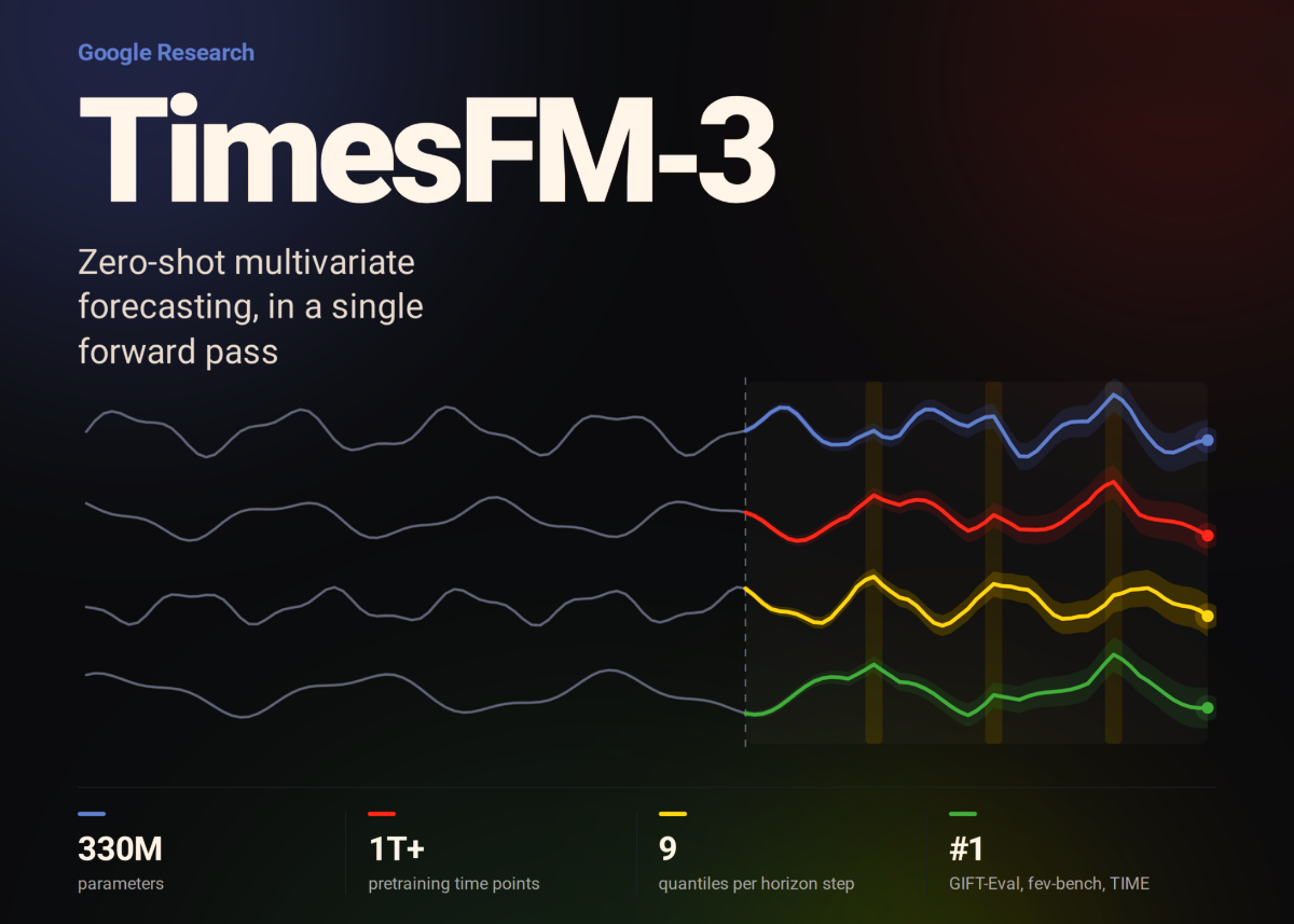
- TimesFM-3 is a 330M-parameter time series foundation model that predicts multiple related time series simultaneously in a single forward pass.
- Every TimesFM checkpoint up to 2.5 was univariate-only, but TimesFM-3 was pretrained from scratch for multivariate forecasting.
- It was pretrained on real and synthetic time series data spanning over 1 trillion time points and accepts multiple targets, past covariates, and past-future covariates in a zero-shot manner without per-task fine-tuning.
Analysis
Table of Contents
The Multivariate Era Declared by TimesFM-3
To define TimesFM-3 in one sentence: it is Google’s new foundation model that takes multivariate time series as zero-shot input with 330M parameters and forecasts multiple related series at once in a single forward pass. The point I find most significant here is that every TimesFM checkpoint up to 2.5 was univariate-only. Earlier versions forecast a single series—temperature or revenue—independently, forcing practitioners to hand-engineer the correlations between variables into the model every time. TimesFM-3 marks a clean break because it is the first version designed as multivariate-native from the ground up.
Core Changes in TimesFM-3: 1T Time-Point Training and Zero-Shot Covariates
Let’s start with the core numbers. 330M parameters, pretraining on real and synthetic data across more than 1 trillion time points, with the decoder-only transformer retained. The model size itself is not a dramatic shift from before, but the training data scale and input design are fundamentally different. The most striking change is how it handles covariates. It accepts multiple targets, past covariates, and past-future covariates in a zero-shot manner, without any separate fine-tuning. In other words, the model performs forecasts while taking known-future signals—such as the weather forecast saying “it will rain tomorrow”—into account.
Three Architectural Highlights
As I dug into the architecture, three elements stood out from a practitioner’s perspective.
- 32-Step Patch Tokenizer: Consecutive time points are grouped into 32-step patches, reducing the transformer input length. Because each series is normalized independently, scale differences (e.g., revenue in the millions and conversion rates between 0 and 1) don’t introduce cross-channel noise.
- 2D Grid Attention: Input tokens pass through a 2D grid (series axis × time axis) and are processed by two alternating attention mechanisms. This separates inter-variable dependencies from temporal patterns during learning.
- Lookahead Covariate Encoding: Past-future covariate tokens are input by combining the current patch with future patches. This is the part of the design that lets the model be aware of scheduled events in advance.
This structure is reminiscent of the data-flow separation thinking discussed in the 6 AI chip architectures piece. How you slice a time series’ “data” and where you reassemble it is what determines performance.
Benchmarks: First Place Across All Three
Evaluation was carried out on three fronts: the GIFT-Eval, fev-bench, and TIME leaderboards. Across all three benchmarks, it achieved the highest average rank among pretrained foundation models on both point metrics and probabilistic metrics. What is especially interesting is the first-place finish on probabilistic metrics as well. Existing foundation models often do well on point predictions but tend to be weak at estimating uncertainty distributions. TimesFM-3 appears to learn covariance structures more naturally because it takes multivariate input from the ground up.
TimesFM Series Comparison
| Item | TimesFM-2.5 | TimesFM-3 |
|---|---|---|
| Parameters | ~200M | 330M |
| Input Design | Univariate | Multivariate native |
| Covariates | Not supported | Past and future covariates, zero-shot |
| Benchmarks | Single leaderboard | First place on GIFT-Eval, fev-bench, and TIME |
| Weight License | Research use | timesfm-non-commercial-v1.0 |
The Asymmetry of the TimesFM-3 License
The repository code is Apache-2.0. In other words, the code can be freely reviewed and modified. The problem lies in the weights. The TimesFM 3.0 weights are distributed under the timesfm-non-commercial-license-v1.0. According to the detailed MarkTechPost report, benchmark evaluation is permitted, but deploying the model into a production forecasting API is not allowed under the license.
This is similar to the strategy Meta has taken with Llama in the LLM space: open up research while keeping commercial advantage for itself. Even if a data science team files a report saying “Let’s adopt TimesFM-3,” the legal team is likely to flag it first, because hosting the weights as-is in a service would constitute a license violation. This asymmetry will be the biggest variable shaping how Korean companies approach adoption going forward.
Questions for Practitioners
For a multivariate time series foundation model to matter in practice, it ultimately has to prove two things. First, it needs a cost-of-operation advantage over traditional statistical models (ARIMA, Prophet) or lightweight ML approaches (LightGBM). Second, forecast quality must be preserved when input variables are added or removed, without retraining. TimesFM-3’s zero-shot design is itself an attempt to answer the second question, while the first will only be settled as cases accumulate showing “accuracy improved once we added covariates.”
That said, because the weights are closed, Korean companies are effectively blocked from fine-tuning them to build internal models. Workarounds such as continued training on synthetic data or distillation are likely to dominate the conversation. This trend connects with the LLM circumvention strategies covered in the Guardbreaker analysis. When a model’s weights are closed, differentiation ultimately happens in input design and data processing.
Practical Application Points
- Before evaluating TimesFM-3, first ask whether “a single variable is enough” in your own forecasting pipeline. Without verifying that multivariate dependencies actually exist, there will be no cost-to-benefit gain.
- Prepare internal data in advance that could serve as covariates. Draft a candidate list of past and future covariates—promotion schedules, price changes, holiday flags—and it will help regardless of which model you end up choosing.
- Note that the weight license is non-commercial. For production deployment, check the Google Cloud TimesFM API route, and if self-hosting is required, keep the door open for a separate license negotiation.
- Prioritize backtest results on your own dataset over benchmark scores. Even a first-place finish on GIFT-Eval can vanish when domain-specific patterns in wholesale, retail, or manufacturing differ.
What to Try Right Now
- Clone the TimesFM code from the GitHub repository and review the architecture and input interface within the Apache-2.0 scope.
- Build a multivariate input shape (multiple targets + covariates) using 5–10 of your own time series.
- Run a backtest over the same period against your existing univariate model and produce a comparison table of MAPE and CRPS.
- Check whether the TimesFM API is exposed on Google Cloud Vertex AI, along with pricing, SLA, and quotas.
- Ask the legal team in advance whether running an internal PoC on non-commercial weights is permissible.
Frequently Asked Questions
How is TimesFM-3 different from the previous TimesFM-2.5?
The biggest difference is input design. Up to 2.5, only univariate input was accepted, but TimesFM-3 takes multivariate input from the start. It handles multiple targets and past-future covariates in a zero-shot manner.
Can I download the weights and use them in a commercial service?
No. The weights are distributed under timesfm-non-commercial-license-v1.0, which restricts commercial and production use. Only the code is Apache-2.0.
Which evaluation gave it the first-place finish?
It ranked first on both point and probabilistic metrics among pretrained foundation models across all three leaderboards: GIFT-Eval, fev-bench, and TIME.
Can Korean companies start using it right away?
Direct self-hosting of the weights is restricted by the license. The code and interface are open, so it can be used for PoCs and research, but commercial production requires going through the Google Cloud API route.
Reference Source
This article was written with reference to the following original: MarkTechPost — Google AI Releases TimesFM-3: A 330M Parameter Zero-Shot Foundation Model For Multivariate Time Series Forecasting