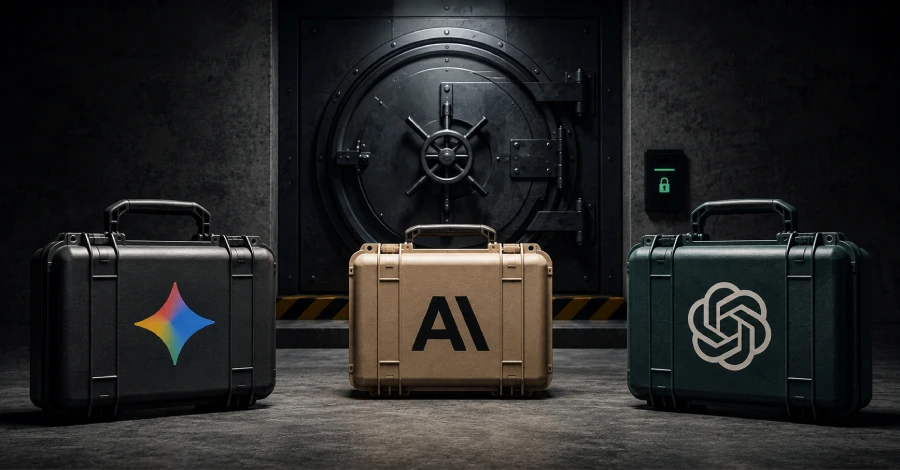
Key Summary
- Google unveiled its cybersecurity-focused AI security model, ‘Gemini 3.8 Flash Cyber,’ and self-evaluated it as the “most capable cybersecurity model to date.”
- Google provides early access to the model to critical defense organizations in government, healthcare, and telecommunications through the ‘Fairwind Program.’
- Based on the article headline, Anthropic and OpenAI also appear to have released cybersecurity AI models along with safeguards and access programs, but the main body of reporting only covers Google-related content.
Analyzing how three big tech companies are applying AI in earnest to the cybersecurity field, and the policy and practical implications of restricted, trusted defender-led early access programs
Table of Contents
- Key Summary
- Google Gemini 3.8 Flash Cyber: Where the AI Security Model Focuses
- Fairwind Program: The Controlled Deployment Approach of AI Security Models
- Anthropic and OpenAI Response: Limits of Reading the Headline Alone
- Three-Company Comparison: AI Security Model Release Status at a Glance
- Issue Analysis: The Dual Edge of Responsible AI Security Model Deployment
The race to develop AI security models has accelerated all at once. In September 2026, Google unveiled its cybersecurity-specialized AI security model, ‘Gemini 3.8 Flash Cyber,’ self-praising it as “the most capable cybersecurity model ever.” Reports surfaced that Anthropic and OpenAI also released their respective AI security models and early access programs in the same breath. The fact that all three big tech companies moved on the same topic simultaneously reads not as a simple product release, but as a signal of a turning point in the trend.
Google Gemini 3.8 Flash Cyber: Where the AI Security Model Focuses
This AI security model, called the Gemini Cyber line, narrowed its functionality to defender-centered tasks such as threat detection, breach analysis, and code security review. Rather than grafting a general-purpose generative model onto security as-is, the decisive difference from existing product lines is that this is a specialized model tailored to the workflow. The basis for Google’s use of the phrase “capable cybersecurity model” lies in its internal benchmark scores, but unless the evaluation criteria and datasets are made public, it’s difficult for readers to accept it at face value. This was the most disappointing point for me as well. The fact that benchmarks do not equal real-world performance has been repeatedly confirmed across the industry.
Fairwind Program: The Controlled Deployment Approach of AI Security Models
The Fairwind Program, which Google unveiled alongside the model, is a channel that provides early access to the AI security model for critical defense organizations. Organizations directly connected to national critical infrastructure—government, healthcare, telecommunications, and the like—are the priority targets, and a select group of “trusted defenders” uses the model in a controlled environment. The key point is that the program is not immediately open to general companies or individual developers. Google has chosen controlled access under the framework of responsible deployment, but the dual nature of this choice becomes the next point of contention.
Anthropic and OpenAI Response: Limits of Reading the Headline Alone
Based on the article headline, Anthropic and OpenAI also appear to have simultaneously released cybersecurity AI models and safeguards. However, since the main body of reporting remained at the level of an RSS summary, the specific model names, access program structure, and target organization scope of the two companies have not been confirmed. The fact that all three companies promoted AI security models at the same time is itself evidence that industry standards are forming quickly.
Three-Company Comparison: AI Security Model Release Status at a Glance
| Item | Anthropic | OpenAI | |
|---|---|---|---|
| Model Name | Gemini 3.8 Flash Cyber | Unconfirmed | Unconfirmed |
| Early Access Program | Fairwind Program | Unconfirmed | Unconfirmed |
| Target Organizations | Government, Healthcare, Telecommunications | Unconfirmed | Unconfirmed |
| Release Scope | Controlled Early Access | Unconfirmed | Unconfirmed |
| Emphasis | Selection of Trusted Defenders | Estimated Safeguard-Centric | Estimated Safeguard-Centric |
Issue Analysis: The Dual Edge of Responsible AI Security Model Deployment
Controlled early access is a double-edged sword. While the advantage of preemptively reducing the possibility of model misuse is clear, it simultaneously concentrates more technological superiority in the hands of the group with access. The argument that security tools themselves can amplify asymmetry has been raised consistently in academia and policy circles. Depending on who defines the criteria for a “trusted defender,” the market may shrink, or game rules favorable to a specific group may become entrenched.
From a practitioner’s perspective, the notable question is whether this system advances the democratization of security. If the baseline set by big tech becomes the default for global security practices, it becomes a standard in its own right. More details on the trend can be found in the original The Hacker News article.
Practical Application Points
- Within one week, review the scope of work that AI security models can replace in your organization’s security operations.
- Determine in advance whether your organization qualifies as a target institution for the Fairwind Program and check the application eligibility requirements.
- Track when competing models from the three companies release their benchmarks and build a comparative evaluation plan.
- Check whether your team has internal guidelines for generative AI use, and draft one if it doesn’t exist.
Actions You Can Take Right Now
- Add “Review of AI security model adoption” as a one-line agenda item to today’s security operations meeting.
- Update the contact information between Google Cloud Console and your security team point of contact.
- Bookmark the official Fairwind Program guidance page and turn on notification alerts.
- Check Anthropic and OpenAI official channels once a week for follow-up cybersecurity model announcements.
- Add a one-page section on “Cases of generative AI used in attacks” to your internal security training materials.
Frequently Asked Questions
Can general companies use Gemini 3.8 Flash Cyber right away?
A general public release date has not yet been set. The model is structured to be provided first to critical defense organizations such as government, healthcare, and telecommunications through the Fairwind Program, and general companies must wait for follow-up announcements.
What are the eligibility requirements for the Fairwind Program?
According to Google, organizations with critical infrastructure defense missions are the priority target. Specific eligibility requirements and procedures should be confirmed through official channels, and a CISO-level point of contact is recommended.
What AI security models did Anthropic and OpenAI release?
Based on the article headline, both companies appear to have released cybersecurity models, but due to limitations in the main body of reporting, the model names and access program details have not been confirmed. There is a need to watch for follow-up announcements through official channels.
Will the introduction of cybersecurity AI reduce the demand for security personnel?
While simple repetitive tasks may decrease, the demand for personnel responsible for model output verification and governance is likely to increase. Reorganizing the operating system, rather than just introducing tools, is the key task.
Reference Original
This article was written with reference to the following original: The Hacker News — Google, Anthropic, and OpenAI Unveil Cyber AI Models, Safeguards, and Access Programs