Key Summary
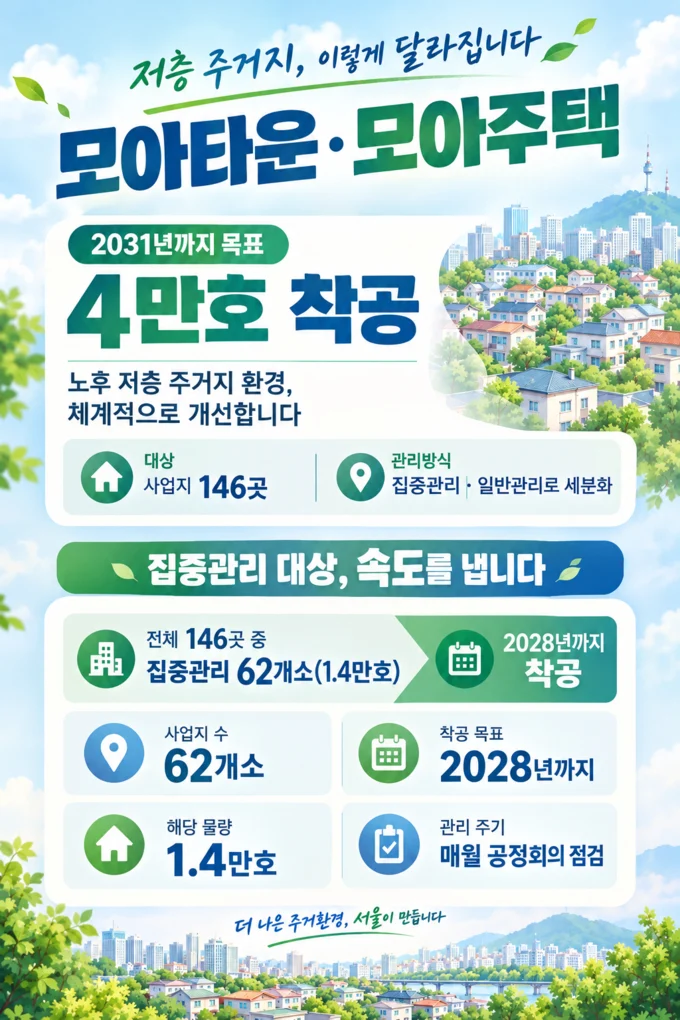
- Hanyang Row Houses in Gwangjin-gu, Seoul, has been designated as ‘Moa Housing Complex No. 1’ and will begin its first move-ins in September. Because Seoul’s Moa Housing system supplies public rental units by bundling them at the complex-group level rather than at the individual complex level, the move-in date of the first case is seen as a turning point for gauging the policy’s real-world effectiveness. Seoul Mayor Oh Se-hoon unveiled a plan to break ground on 40,000 Moa Housing units by 2031, signaling that the Moa Housing line has established itself as a policy axis separate from existing public rental supply volumes. Given that the article was published on September 28, 2026, the simultaneous release of ‘move-in at Complex 1’ and the ‘40,000-unit target’ within the same quarter is interpreted as a combination of an early-stage performance report and a roadmap presentation. Specific figures needed to measure supply effects—such as the number of actual residents at Complex 1, rent levels compared to surrounding market prices, and eligibility requirements—were not confirmed in the original article, so this analysis covers only the fact of the move-in and the policy numbers. For the 40,000-unit target, it appears necessary to distinguish between short-term groundbreaking volumes and long-term cumulative targets, and securing sites within urban areas and the project financing method are seen as variables that will determine future implementation speed.
As the first move-in at Moa Housing Complex 1 and the 40,000-unit groundbreaking target are announced simultaneously, this article organizes the key issues around whether Seoul’s new public rental housing policy axis can take root as actual complexes.
Table of Contents
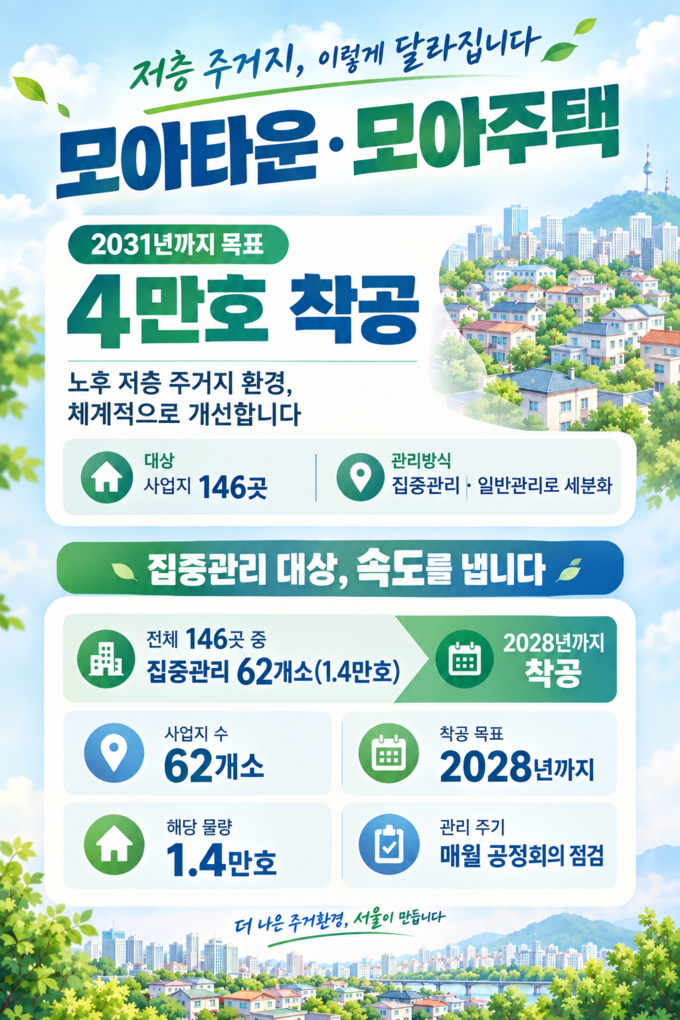
Hanyang Row Houses in Gwangjin-gu, Seoul, began its first move-ins for Seoul Moa Housing Complex 1 on September 28. The same day, Seoul Mayor Oh Se-hoon unveiled a plan to break ground on 40,000 Moa Housing units by 2031. The first move-in and the 40,000-unit target were announced at the very same moment. Rather than viewing this as a symbolic starting line, the author sees it as closer to a turning point for verifying the policy’s real-world effectiveness.
How Seoul Moa Housing Differs from Existing Public Rental Housing
Seoul Moa Housing has a fundamentally different structure from existing SH Corporation public rental, purchase-and-lease rental, and jeonse rental housing. Moa Housing assigns public rental unit quotas not at the level of individual complexes, but at the level of grouped complexes. Because Complex 1 is the first application of this grouped quota assignment, it shapes the design direction for the remaining 40,000 units. How the model of bundling existing row houses such as Hanyang Row Houses in Gwangjin-gu has worked in Complex 1 becomes the reference point for negotiations on subsequent complexes.
However, the number of units, rent levels, and resident composition for Complex 1 were not confirmed in the original article. According to a report by World Environment News, only the fact of the September move-in and the 40,000-unit target are stated. It is a form in which the target figure was disclosed at an early policy stage, with the underlying numbers missing.
Issue 1. Securing Sites in Urban Areas
The 40,000-unit scale is a problem of a different kind from the Complex 1 case. Bundling existing row houses through remodeling, as was done with Hanyang Row Houses in Gwangjin-gu, will not be enough to meet the volume. New candidate sites must be sought within the urban core, where negotiations with redevelopment project unions and landowner acquisition are variables. The difficulty of site selection may have factored into why the Complex 1 move-in date was set for September.
From a practitioner’s perspective, what stands out is how candidate sites are disclosed. Where Seoul Moa Housing’s 2nd and 3rd complex candidate sites are located, and what the land acquisition schedule looks like, will be key variables in the next announcement.
Issue 2. Project Costs and Financing
If we assume 40,000 new public rental units are to be built, the construction cost and subsidy per household alone will amount to several trillion won. Which combination—Seoul Metropolitan Government budget, central government housing stabilization project budget, or LH purchase scheme—will be used to raise funds will determine the speed. If the specific cost-sharing structure does not accompany Mayor Oh’s announcement, the 40,000 units risk remaining merely a target figure.
In particular, if Complex 1 is a remodeling project, the ratio of remodeling units to new-build units within the 40,000 will determine the project cost scale. The fact that this ratio is missing from the policy announcement is a point that needs to be verified in practice.
Issue 3. Absence of Real Occupancy Data from the First Complex
The number of actual residents, eligibility requirement fulfillment rate, and rent level compared to surrounding market prices at Complex 1 have not yet been disclosed. Only when Complex 1’s real occupancy data is released will it be possible to measure the supply effects of the 2nd and 3rd complexes. Whether Seoul Moa Housing shows the same level of data disclosure as existing public rental housing at Complex 1 will set the evaluation baseline going forward.
In existing public rental housing, resident lists, rents, and surrounding market price comparison data are regularly disclosed. Setting the data disclosure cycle at the early policy stage is itself a measure of policy credibility.
Outlook: 2nd and 3rd Complex Timelines as Inflection Points
The move-in at Seoul Moa Housing Complex 1 is a symbolic event, but the policy’s weight lies in the 2nd and 3rd complex timelines. If the gap between Complex 1 and the next complex move-in exceeds one year, the credibility of the 40,000-unit cumulative target will be shaken. Site acquisition speed, financing structure, and real occupancy data disclosure—these three will form the monitoring baseline for the next 1–2 years.
Summary of Key Issues
- Site Acquisition: Complex 1 is a remodel of existing row houses; achieving 40,000 units will inevitably require a mix of new builds and reconstruction
- Financing Structure: 40,000 units are not possible with the Seoul Metropolitan Government budget alone; central government and LH cost-sharing must be specified
- Data Disclosure: Number of units, rent, and resident composition figures for Complex 1 have not been disclosed
What You Can Do Now
- Check Seoul Moa Housing announcements weekly to track the timing of the Complex 2 candidate site announcement
- Monitor LH and SH Corporation move-in recruitment notices with the Seoul Moa Housing keyword to check remaining Complex 1 inventory
- Look up actual transaction prices of nearby complexes via the Korea Real Estate Board to pre-compare the rent calculation baseline
- Review the Seoul housing stabilization project budget trends in National Assembly Budget Office data to gauge the 40,000-unit funding availability
Frequently Asked Questions
Where is Seoul Moa Housing Complex 1 located?
Hanyang Row Houses in Gwangjin-gu, Seoul, was designated as Complex 1 and began its first move-ins on September 28. It is the first case of bundling existing row houses for public rental unit allocation.
By when will 40,000 units be supplied?
Seoul Mayor Oh Se-hoon publicly announced a target of breaking ground on 40,000 units by 2031. Whether this is a cumulative groundbreaking target or a completion-based target requires further announcement.
How is it different from existing SH Corporation public rental housing?
Moa Housing assigns unit quotas not at the level of individual complexes but at the level of grouped complexes. It is a policy axis operated separately from SH Corporation’s single-supplier line.
What are the move-in eligibility requirements?
The number of residents, eligibility requirements, and rent levels were not disclosed in the original article. Comparisons will only be possible after Complex 1’s real occupancy data is released.
Reference Source
This article was prepared based on the following original source: www.e-newsp.com — Seoul ‘Moa Housing 1’ first move-in in September… Mayor Oh Se-hoon, “40,000-unit groundbreaking by 2031”