Key Summary
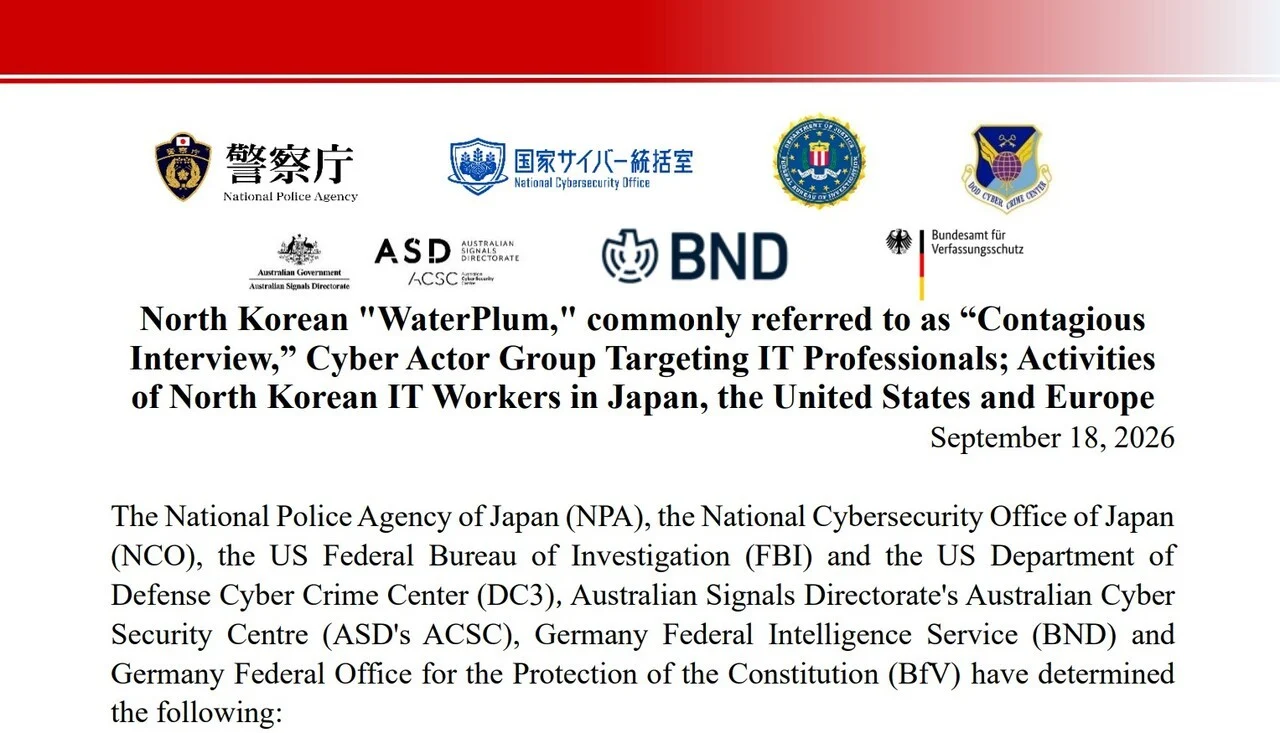
- The North Korean hacking group WaterPlum infected at least 30,000 devices across more than 100 countries during an eight-month period from December 2025 to July 2026, according to a joint advisory issued by investigative authorities from Japan, the U.S., Australia, and Germany.
- The attack is confirmed to have compromised more than 7,000 cryptocurrency wallets, with approximately 1.7 billion yen (about $10.71 million) in crypto assets funneled to North Korea.
- WaterPlum used job-seeking and recruitment activity as bait. The group reportedly impersonated real AI, cryptocurrency, and non-fungible token (NFT) companies, or approached victims through legitimate recruitment and freelance platforms.
News-summary style. Compressed coverage of new cyber threat information focused on key facts, alongside threat characteristics and implications that practitioners can immediately reference.
Table of Contents
“It’s an interview—please run this code.” That single line infected 30,000 devices.
Over an eight-month period from December 2025 to July 2026, the North Korean hacking group WaterPlum infected at least 30,000 devices across more than 100 countries. This was revealed in a joint advisory issued by investigative authorities from Japan, the U.S., Australia, and Germany.
The most shocking element is the method. WaterPlum impersonated real companies in the AI, cryptocurrency, and non-fungible token (NFT) sectors, or approached job seekers through recruitment and freelance platforms. The group then dangled a “fake interview” as bait. During the interview process, victims were instructed to install specific software or run code, allowing malware to infiltrate their systems.
More than 7,000 cryptocurrency wallets are confirmed to have been compromised in the attack. The stolen crypto is valued at approximately 1.7 billion yen, or $10.71 million. This is not a simple case of personal data breach; real assets were systematically transferred to North Korea.
This, in the author’s view, is the most significant point: the “everyday attack surface.” The act of looking for or offering a job—something everyone does—has itself become an attack vector. It’s not phishing emails, nor is it a vulnerability exploit. This is an extreme example of social engineering that preys on the moment when a person does not suspect another person.
Why Four Countries’ Investigative Authorities Issued the WaterPlum Advisory Simultaneously
The fact that not just one country, but four nations simultaneously issued an advisory demonstrates the scale of WaterPlum’s operational reach. The spread of infected devices across 100 countries means that the target was not a specific region but the global pool of job seekers.
The joining of forces by Japan, the U.S., Australia, and Germany appears to reflect the limits of any single nation’s ability to trace funds internationally and disrupt attack infrastructure. Because cryptocurrency is inherently borderless, the money moves quickly regardless of where victims are located.
The WaterPlum Attack Path: 3 Stages of ‘Company Impersonation → Interview → Code Execution’
The WaterPlum attack is broadly divided into three stages.
First, the group impersonated real AI, crypto, and NFT companies, or exploited legitimate hiring platforms to approach job seekers. Second, under the pretext of a video or technical interview, they required the installation of specific programs or the execution of code from GitHub or similar sources. Third, they planted a backdoor on the victim’s device to maintain long-term access, then drained crypto wallets.
What stands out to practitioners is that the “technical interview” setting provided WaterPlum with the perfect excuse. Asking a developer job seeker to execute code is not inherently suspicious in itself. That is likely why this attack was able to accumulate damage over eight months.
| Stage | Action | Result |
|---|---|---|
| 1. Approach | Impersonate real companies; abuse hiring platforms | Gain job seeker’s trust |
| 2. Infiltration | Coerce code/software execution during technical interview | Malware infiltration |
| 3. Theft | Long-term backdoor persistence, then wallet data exfiltration | Crypto asset outflow |
Why the WaterPlum Case Is Dangerous Right Now
North Korea’s cryptocurrency theft has long been established as a core means of foreign currency acquisition. The WaterPlum case stands apart from prior incidents on two axes: scale and international coordination.
- Infected devices: at least 30,000
- Countries affected: 100+
- Wallets stolen: 7,000+
- Amount stolen: approximately 1.7 billion yen ($10.71 million)
- Attack period: 8 months (Dec 2025 – Jul 2026)
Most victims likely lost wallet assets without ever realizing they had been infected. A significant time gap typically exists between the moment malware infiltrates a system and the actual theft of assets.
What to Do Right Now
- Before any interview, cross-verify the company’s domain and business registration through official channels.
- If you are asked to install video interview tools or run external code, report it to your IT security team immediately.
- Separate your crypto wallets into cold and hot wallets, and implement multi-signature (multisig).
- Install EDR products on developer devices, and run sandbox checks on any cloned repositories from GitHub or other external sources.
- Run all files received during a hiring process through static and dynamic analysis on services like VirusTotal before submission.
Practical Application Points
WaterPlum’s method differs in dimension from typical malware response because it targets “what humans do most naturally.” Relying solely on technical controls will not stop this attack. Security verification steps must be embedded directly into the business processes of hiring and interviewing.
- Recruiters: Standardize procedures to reject or require IT team verification for any requests to install video interview tools, execute code, or grant remote access.
- Security practitioners: Establish detection rules to monitor tokens and session information being exfiltrated from job seeker devices.
- Job seekers: Never store wallet seed phrases digitally, and use a laptop dedicated to interviews that is separate from your work device.
Frequently Asked Questions
What kind of organization is WaterPlum?
WaterPlum is a North Korean hacking group, officially named in this four-country joint advisory. Its defining characteristic is the targeting of global job seekers using recruitment activity as bait.
How does the fake interview attack proceed?
The group offers a fake interview by impersonating a real company, then requires the installation of specific software or the execution of code from GitHub during the technical interview. In this process, malware infiltrates the device and steals crypto wallet information.
How can I tell if I have been infected?
If unknown processes are running in the background after an interview, or if wallet funds move without warning, you should suspect an intrusion. The fastest verification is to check EDR logs alongside your wallet transaction history.
How is the cryptocurrency transferred to North Korea?
Stolen wallets are laundered through mixing services, cashed out at exchanges, or converted through P2P transactions. The funds then bypass the international financial network and flow into the North Korean regime—a pattern that has been repeatedly reported.
The WaterPlum case reconfirms that cyberattacks are no longer just a matter of technical vulnerabilities. By infiltrating a normal business process such as hiring and interviewing, this method demonstrates that “the moment you stop suspecting people” is itself the greatest vulnerability.
Both individuals and organizations can preemptively block a significant portion of this attack by adding a single verification step to their hiring process. The full advisory content is available in the initial Boan News report.
Source Material
This article was prepared after reviewing the following source: Boan News — Fake interviews aimed at crypto wallets… North Korea’s WaterPlum infects 30,000 devices across 100 countries